July 17, 2026
The Autonomy Gap: Why Most Mine Sites Still Run on Human Drivers
Despite autonomous haulage technology existing in commercial form for well over a decade, the overwhelming majority of haul trucks operating globally today are still guided by human drivers. This is not a technological failure. It is a structural one. The architecture of how autonomy has been sold to the mining industry has, paradoxically, made it inaccessible to most of the mining industry.
Understanding why this gap exists, and why the Hitachi and Pronto mine automation partnership represents a meaningful attempt to close it, requires looking beyond the headline agreement and examining the deeper mechanics of how autonomous haulage systems are deployed, priced, and integrated into operating mines.
When big ASX news breaks, our subscribers know first
The Vendor Lock-In Problem That Has Quietly Defined Mine Automation
Autonomous haulage systems did not emerge from a philosophy of openness. The first large-scale commercial deployments, pioneered in the Pilbara region of Western Australia, were engineered as tightly integrated, single-OEM solutions. Caterpillar autonomous haulage and Komatsu's FrontRunner both require operators to run dedicated, brand-specific truck fleets, often with bespoke communication infrastructure and proprietary safety validation frameworks built specifically around that manufacturer's hardware.
For Tier 1 operators running hundreds of identical trucks across mega-mine operations, this model is commercially justifiable. The capital commitment to a uniform fleet is already baked into the project economics. But for mid-tier and smaller operations, the arithmetic simply does not work.
Consider what a conventional closed AHS deployment actually demands:
- Full replacement or phase-out of existing mixed-brand haul truck fleets
- Proprietary onboard computing and sensor hardware tied to a specific OEM
- Long-term service and licensing agreements with a single technology vendor
- Significant upfront capital before a single tonne of autonomous production is achieved
These barriers have functionally excluded the majority of global mine sites from any form of haulage autonomy. The technology exists. The willingness to adopt it often exists. The commercial pathway has not.
What Open-Ecosystem Autonomy Changes
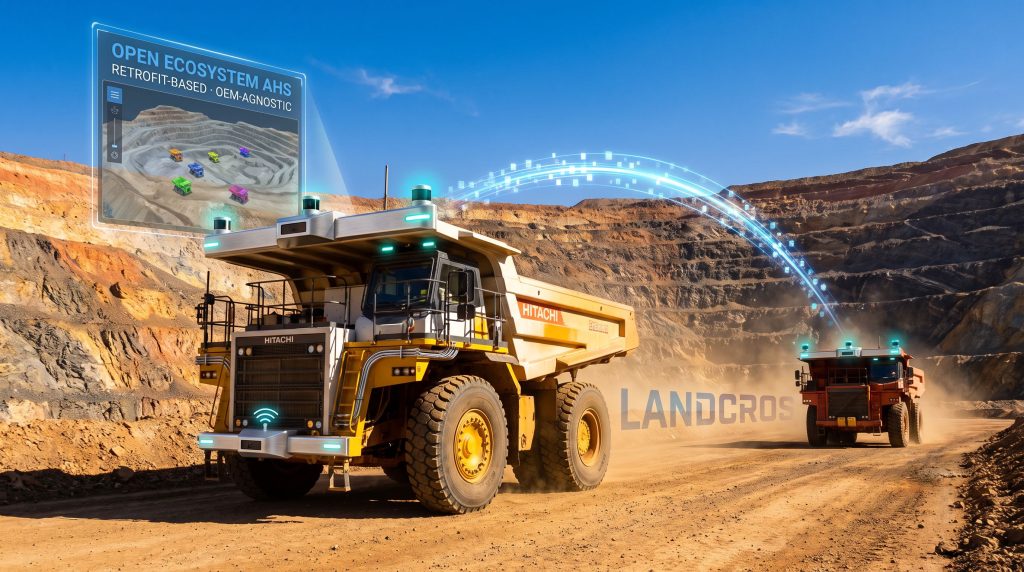
The term OEM-agnostic autonomous haulage refers to systems designed from the ground up to interface with trucks from any manufacturer. Rather than requiring fleet replacement, these platforms are built around retrofit installation, meaning the autonomous hardware and software stack is added to existing vehicles regardless of who built them.
This distinction has profound implications for total cost of automation adoption. An operator running a mixed fleet of Hitachi, Komatsu, and Caterpillar trucks does not need to choose a winner or write off existing equipment. Furthermore, the autonomy layer becomes, in principle, equipment-neutral, much like how a fleet management software platform can theoretically run across multiple hardware brands.
The shift toward open automation ecosystems reflects a broader industry frustration with solutions that require full fleet replacement as a prerequisite for autonomy, a cost that most operations simply cannot justify.
What the Hitachi and Pronto Mine Automation Partnership Actually Establishes
On July 16, 2026, Hitachi Construction Machinery (HCM) and autonomous haulage technology developer Pronto formalised their collaboration through a signed memorandum of understanding. The agreement establishes a cooperative framework oriented around developing open mine automation solutions, explicitly designed to be adaptable to the individual requirements of each mine site.
It is important to be precise about what an MoU is and is not. This agreement is a framework for joint development, not a finished product. No autonomous truck has yet operated under this partnership banner. What the MoU creates is a defined intent to combine four capability domains:
- Mining operations expertise
- Physical equipment engineering and manufacturing
- Digital and data technologies
- Autonomous systems and AI-driven haulage control
What Each Partner Contributes
| Partner | Core Contribution |
|---|---|
| Hitachi Construction Machinery (HCM) | Decades of mining-class haul truck and hydraulic excavator manufacturing; global customer relationships; ownership of Wenco International Mining Systems |
| Pronto | Proven OEM-agnostic autonomous haulage system; commercial-scale deployment track record; millions of tonnes hauled at quarry operations using articulated truck fleets |
The pairing is strategically coherent. HCM brings the physical asset credibility and the installed base. Pronto brings the software and autonomous control layer that, by design, does not require those assets to be Hitachi-branded. Together, they are attempting to construct something neither could offer independently: a commercially credible, open-architecture path to haulage autonomy.
The LANDCROS Vision and What It Signals
HCM has publicly announced its intention to rebrand as LANDCROS effective April 1, 2027. The naming architecture is deliberate. The letter O within LANDCROS is explicitly intended to represent open co-creation with customers and industry partners, a philosophical commitment embedded directly into the company's future brand identity.
This is not coincidental timing relative to the Pronto partnership. The MoU functions as an early, concrete expression of the open-platform strategy that LANDCROS will represent commercially. For operators evaluating HCM as a long-term partner, the Pronto collaboration offers the first tangible evidence of how that philosophy translates into product development.
Pronto's Technology: How the Autonomous Haulage Stack Works
Pronto's autonomous haulage system is engineered around the retrofit principle. The platform integrates with a truck's existing hardware through onboard sensors, processing units, and communication systems, without requiring the truck to be replaced or substantially rebuilt. This architecture covers the full sensor fusion pipeline: lidar, cameras, radar, and GPS positioning systems working in combination to enable safe autonomous navigation across active haul road environments.
The distinction between levels of autonomy matters here. Full autonomy means the vehicle operates without any human intervention across the entire haul cycle. Partial autonomy, sometimes called driver assistance or teleoperation-assisted modes, involves human oversight at certain decision points. Pronto's commercial deployments sit at the full autonomy end of this spectrum for the haul cycle itself, meaning autonomous trucks in mining navigate routes, manage intersections, and complete loading and dumping cycles without a human in the cab.
Commercial Validation at Scale
Pronto achieved a milestone that is often underappreciated in industry coverage: it was the first company to achieve regular daily ore production using autonomous vehicles in the United States. This occurred at Heidelberg Materials' Lake Bridgeport quarry in Texas, where Pronto deployed autonomous articulated haul trucks across a functioning commercial quarry operation.
The significance of this is not simply that the technology worked in a controlled trial. It is that it worked continuously, at production scale, in the context of an active quarrying operation with real revenue implications attached to uptime and throughput. That distinction, production-proven versus trial-proven, is critical when evaluating autonomous haulage credibility.
Across its deployments, Pronto's system has been used to haul millions of tonnes of material, establishing a data and operational track record that underpins the commercial conversation with HCM.
Comparison With Competing Platforms
| Dimension | Pronto (OEM-Agnostic) | Traditional Closed AHS |
|---|---|---|
| Equipment compatibility | Any manufacturer's trucks | Single OEM only |
| Fleet replacement required | No, retrofit-based | Typically yes |
| Deployment flexibility | High, adaptable per site | Low, standardised |
| Entry cost for operators | Lower barrier | High capital commitment |
| Commercial scale validation | Yes, quarry-scale, United States | Yes, large-scale mining, Pilbara-style |
Wenco: The Hidden Strategic Layer in This Partnership
A dimension of the HCM-Pronto collaboration that receives less attention than it deserves is the role of Wenco International Mining Systems, HCM's wholly owned fleet management subsidiary.
Fleet management systems sit at the operational intelligence layer of any mine haulage network. Wenco's platform manages real-time truck positioning, dispatch logic, load tracking, and productivity analytics across large mixed fleets. It is, functionally, the nervous system that coordinates how trucks move across a mine site.
For an autonomous haulage system to operate at full commercial effectiveness, it must communicate bidirectionally with the fleet management layer. Dispatch decisions, route optimisation, and loading queue management all depend on tight integration between the autonomous vehicle control system and the site-level operational intelligence platform.
HCM's ownership of Wenco positions the partnership to eventually offer this integrated stack, autonomous vehicle control through Pronto's AHS combined with site-level fleet intelligence through Wenco, as a unified but open solution. This is a meaningful competitive differentiator. Most autonomous haulage providers must either build their own fleet management integration or negotiate interoperability agreements with third parties. HCM already owns that layer. Consequently, data-driven mining operations of this kind could represent a significant step forward for the broader industry.
The Komatsu-Pronto Comparison: Two Models, Two Markets
Pronto is not operating exclusively within the HCM ecosystem. In August 2025, Pronto and Komatsu launched the Komatsu Smart Quarry Autonomous system, targeting quarry-scale truck operations within the North American market.
The structural difference between these two collaborations reveals something important about Pronto's strategic positioning:
- The Komatsu arrangement embeds Pronto's technology within Komatsu's existing Smart Quarry platform, making it a Komatsu-branded, Komatsu-integrated product. It is OEM-specific by design.
- The HCM arrangement is explicitly oriented around OEM-agnosticism, aiming to create solutions that work across manufacturer boundaries rather than within a single equipment ecosystem.
Pronto appears to be pursuing a dual-track strategy: participating in OEM-specific integrations where market demand justifies it, while simultaneously developing the open-ecosystem model that addresses the broader mid-tier mining opportunity.
Where the Major Players Currently Stand
| Partnership or Platform | OEM Agnostic? | Primary Equipment Focus | Scale of Deployment |
|---|---|---|---|
| Hitachi (HCM) and Pronto | Yes | Haul trucks, mixed fleet | Development stage, MoU signed July 2026 |
| Komatsu and Pronto | No, Komatsu-integrated | Quarry-scale trucks, North America | Commercial, launched August 2025 |
| Caterpillar Command for Hauling | No | Cat haul trucks | Large-scale mining operations |
| Epiroc Open Autonomy | Partial | Drilling and underground equipment | Expanding commercially |
The next major ASX story will hit our subscribers first
HCM's Multi-Track Automation Strategy
One of the less commonly discussed aspects of HCM's current automation trajectory is that haulage is not its only autonomy frontier. The company is separately engaged in remote operation and partial autonomy development for ultra-large hydraulic excavators in collaboration with Rio Tinto, a distinct initiative focused on the excavation function rather than haulage.
This matters because it signals that HCM is approaching automation as a fleet-wide, cross-function challenge rather than a problem confined to haul trucks. An autonomous mine ultimately requires coordinated autonomy across the excavation, loading, and haulage cycle. A manufacturer with development programmes spanning both functions is better positioned to eventually offer integrated autonomous mining solutions than one focused solely on a single machine type.
Strategic observation: An OEM simultaneously developing autonomous haulage partnerships and excavator autonomy programmes is effectively building toward full autonomous mining cycle capability, even if the pieces are currently separate initiatives.
The Addressable Market Beyond Tier 1
The commercial logic underpinning the Hitachi and Pronto mine automation partnership becomes clearest when you examine the composition of the global mining industry by site count rather than by revenue concentration.
Tier 1 mega-mines, the iron ore operations of the Pilbara, the copper porphyry systems of Chile and Peru, the oil sands operations of Alberta, represent a small fraction of operating mine sites globally. The majority of active mines are mid-tier or smaller operations, running mixed equipment fleets, managing tighter capital budgets, and operating without the procurement leverage that allows a Rio Tinto or BHP to negotiate bespoke autonomous systems from a single OEM.
Key barriers cited by mid-tier operators when evaluating autonomous haulage adoption include:
- The capital cost of full fleet replacement
- Incompatibility of existing trucks with closed AHS platforms
- Long implementation timelines relative to mine life
- Uncertainty about ongoing software licensing and support costs
- Limited access to the engineering resources needed to manage complex integrations
An open, retrofit-capable autonomous haulage system directly addresses the first two barriers and meaningfully reduces the third. The addressable market for a genuinely OEM-agnostic AHS is therefore substantially larger than the market that conventional closed platforms have been able to access.
Operational Benefits Already Documented in AHS Deployments
Evidence from existing large-scale autonomous haulage deployments, primarily at Tier 1 iron ore and copper operations, consistently points to several measurable improvements:
- Increased truck utilisation rates resulting from elimination of shift changes, fatigue breaks, and human-variability in cycle time management
- Reduced cycle time variability, with autonomous trucks maintaining more consistent speeds and routing decisions than human operators across extended shifts
- Lower fuel consumption per tonne moved, attributed to smoother acceleration and braking profiles under autonomous control
- Significantly reduced exposure of personnel to active haulage road environments, a primary safety benefit
The challenge for the industry is extending these benefits beyond the operations that could afford closed-system AHS in the first place. Indeed, automation transformed mining at the Tier 1 level has set high expectations that open-platform solutions must now meet at scale.
Technical and Regulatory Challenges the Partnership Must Navigate
The open-ecosystem model introduces a distinct category of engineering complexity that single-OEM deployments do not face. When the autonomous system must interface with trucks from multiple manufacturers, each with different braking response characteristics, sensor mounting points, steering geometries, and onboard computing architectures, standardisation becomes genuinely difficult.
Specific technical challenges that the HCM-Pronto collaboration will need to address include:
- Sensor standardisation across different truck body configurations and cab designs
- Communication protocol compatibility between the AHS and mine-site infrastructure, including blast clearance systems, traffic management, and proximity detection
- Safety system validation for each truck model the platform is deployed on, a regulatory requirement that effectively means separate certification work per vehicle type
- Fleet management interoperability, specifically how Wenco's dispatch and analytics systems communicate with Pronto's autonomous control layer across heterogeneous fleets
Regulatory requirements add another layer of complexity. Mine safety certification requirements vary significantly by jurisdiction, meaning a platform validated for deployment in the United States will need to meet different technical standards in Australia, Canada, or Chile. However, any globally scalable open-autonomy platform must either navigate this complexity per market or develop a modular compliance architecture that accommodates jurisdictional variation.
Key Questions the Industry Is Watching
Will the MoU Become a Commercial Product?
An MoU is a statement of intent, not a delivery milestone. The mining industry has seen numerous technology partnerships announced at the MoU stage that did not progress to commercially deployed products. The markers of genuine progress to watch for include:
- Announcement of a pilot site with a named mine operator
- Integration of Pronto's AHS with Wenco's fleet management platform in a live operational context
- Joint product announcements carrying the LANDCROS brand identity post-April 2027
- Customer adoption announcements from operators outside HCM's existing installed base
Can Open Autonomy Match Closed Systems on Reliability?
This is the most technically substantive question facing the partnership. Single-OEM autonomous haulage systems benefit from deep hardware-software co-design. The autonomous control system is tuned for a specific truck's braking, steering, and powertrain characteristics. Safety validation is performed once for a known, consistent vehicle configuration.
An OEM-agnostic system must achieve equivalent reliability and safety performance across a range of vehicle configurations it did not co-design. Whether Pronto's architecture can meet the extremely high safety certification thresholds required for continuous production autonomy, across multiple truck types, remains the central technical unknown in this partnership's commercial trajectory. In addition, AI mining efficiency advances across the sector will likely shape how quickly these validation benchmarks can be reached.
How Does Data Ownership Work in an Open Ecosystem?
One underappreciated dimension of open-platform autonomy is the question of who owns the operational data generated by autonomous trucks. In a closed single-OEM system, the data ownership structure is typically defined by the OEM's service agreement. In an open ecosystem involving multiple hardware manufacturers, a third-party autonomous software provider, and a fleet management platform, data ownership and access rights become genuinely complex.
This has competitive implications. Operational data from autonomous haulage, cycle times, fuel consumption, mechanical performance, route efficiency, is enormously valuable for continuous system improvement. How HCM and Pronto structure data rights within their partnership framework, and how they share or retain data from multi-OEM deployments, will influence both the platform's technical development trajectory and its commercial attractiveness to operators.
FAQ: Hitachi and Pronto Mine Automation Partnership
What is the Hitachi and Pronto mine automation partnership?
Hitachi Construction Machinery and Pronto signed a memorandum of understanding in July 2026 to jointly develop open mine automation solutions, combining HCM's manufacturing expertise and fleet management capabilities through Wenco with Pronto's OEM-agnostic autonomous haulage system.
What makes this collaboration different from other mine automation deals?
Most existing autonomous haulage systems are tied to a single equipment manufacturer and require operators to run brand-specific fleets. The HCM-Pronto collaboration is built around an open-ecosystem model designed to work across trucks from multiple OEMs, targeting a far broader range of mine operators.
What has Pronto actually deployed commercially?
Pronto has commercially deployed its autonomous haulage system at quarry operations in the United States, including Heidelberg Materials' Lake Bridgeport quarry in Texas, where it achieved the first regular daily ore production using autonomous vehicles in the country. The system has cumulatively hauled millions of tonnes of material, establishing a strong production-proven track record.
What is LANDCROS?
LANDCROS is the new corporate brand that Hitachi Construction Machinery plans to adopt on April 1, 2027. The O in the name specifically represents a commitment to open co-creation with customers and partners, a philosophy the Pronto partnership is designed to demonstrate in practice.
Does HCM have other autonomy initiatives?
Yes. Separately from the Pronto partnership, HCM is engaged in remote operation and partial autonomy development for ultra-large hydraulic excavators in collaboration with Rio Tinto. This initiative focuses on excavator autonomy rather than haulage and is a distinct programme from the Pronto collaboration.
What role does Wenco play in this partnership?
Wenco International Mining Systems, owned by HCM, develops fleet management platforms used across mine haulage operations. Its integration with Pronto's autonomous haulage system would allow the partnership to offer a more complete operational platform combining vehicle-level autonomy with site-level fleet intelligence.
A Structural Shift or a Long Road Ahead?
The Hitachi and Pronto mine automation partnership matters not because it has delivered a finished product, but because of the commercial hypothesis it is testing. That hypothesis holds that the autonomous haulage market does not have to remain the exclusive domain of Tier 1 operators and single-OEM systems, that a technically credible, open-architecture approach can serve the vastly larger population of mine operators who have been structurally locked out of automation adoption.
If the partnership progresses to commercial deployment, the implications extend well beyond Hitachi's customer base. An open-platform AHS that achieves safety validation and production-scale reliability across multiple truck types would effectively rewrite the commercial model for mine autonomy. Equipment OEMs that have built competitive moats around closed, proprietary autonomy systems would face a fundamentally different competitive environment.
For mine operators, the next 12 to 24 months of development milestones will determine whether this partnership delivers on its premise. The indicators worth tracking are specific: a pilot site announcement, a Wenco integration milestone, a joint commercial product under the LANDCROS brand, and the first customer outside HCM's existing installed base to adopt the combined platform.
The MoU is a beginning, not a conclusion. However, it is a beginning that reflects where the pressure points in mine automation have been building for years.
This article is intended for informational purposes only and does not constitute financial or investment advice. Readers should conduct their own due diligence before making investment or operational decisions based on information contained herein. Forward-looking statements and partnership outcomes described are subject to material uncertainty and may not reflect actual commercial results.
Readers interested in further coverage of autonomous haulage and mine automation technology can explore ongoing industry reporting at Engineering & Mining Journal, available at e-mj.com.
Want to Stay Ahead of the Next Major ASX Mining Discovery?
Discovery Alert's proprietary Discovery IQ model scans ASX announcements in real time, delivering instant alerts on significant mineral discoveries — turning complex data into actionable insights for investors at every level. Explore how major discoveries have historically generated substantial returns on the Discovery Alert discoveries page, and begin your 14-day free trial today to position yourself ahead of the broader market.