
July 16, 2026
The Engineering Problem That AI Cannot Solve Alone
Every few years, a transformative technology arrives in the mining sector accompanied by promises that consistently outrun operational reality. Electrification, automation, and remote sensing all followed this trajectory. Artificial intelligence is no different. The gap between what AI can theoretically deliver in mineral processing and what it actually achieves across most operating circuits is not primarily a software problem — it is a structural one, rooted in decisions made long before the first algorithm was ever written.
Understanding why most flotation circuits are fundamentally incompatible with meaningful AI optimisation requires stepping back from the software discussion entirely and examining the physical and informational architecture of the circuits themselves. This is precisely the perspective that Glencore Technology's principal metallurgist, Chris Anderson, brought to the SME 2026 conference, reframing what has largely been a technology conversation as an engineering and design conversation.
The implications for the global processing industry are significant. Circuit design decisions made during greenfield construction or major brownfield refurbishment create data infrastructure that either supports or constrains AI deployment for decades. Getting this wrong is not a recoverable short-term error — it is a compounding strategic liability.
When big ASX news breaks, our subscribers know first
Why Flotation Circuits Produce the Wrong Kind of Data
The Structural Mismatch Between Circuit Design and Machine Learning Requirements
Conventional flotation circuits were engineered over more than a century of metallurgical refinement. Their design priorities were recovery performance, reagent efficiency, and throughput stability. Data generation was never a design criterion, and this historical blind spot has become a serious liability in the context of AI in mining operations deployment.
The core problem is temporal. Conventional multi-cell flotation configurations have long hydraulic residence times, meaning the lag between an input change and a measurable output can span minutes or longer. For machine learning systems, particularly supervised learning models that require clear cause-and-effect signal relationships, this creates a fundamental training challenge.
When the same reagent dosage adjustment produces different observable outcomes depending on upstream feed variability, models cannot reliably learn the relationships they need to optimise process performance. Furthermore, reinforcement learning approaches face an even steeper challenge. These systems refine decision-making through repeated feedback cycles, and their effectiveness scales directly with feedback speed. In slow-residence flotation environments, the feedback loop is too attenuated to support the iterative learning cycles that make reinforcement learning powerful in other industrial contexts.
The Inference Problem in Process Measurement
A less-discussed but equally critical barrier is the reliance on inferred rather than directly measured process variables across most conventional circuits. In many operating plants, concentrate grade and recovery are not measured continuously — they are estimated from proxy variables such as pulp density, froth depth, and periodic assay results. Algorithms built on inferred inputs inherit the compounding error rates of the estimation methodology itself.
Technical Note: When AI systems act on inferred data rather than directly measured variables, every layer of estimation introduces additional uncertainty. Under variable feed conditions, this compounding error can render optimisation recommendations not just unreliable but actively counterproductive.
This dependency on inference is not simply a matter of instrumentation gaps. It reflects a deeper architectural reality: circuits that were not designed with measurement in mind cannot be easily retrofitted with the sensor density required to eliminate inference dependencies without substantial capital expenditure.
What Glencore Flotation AI Readiness Actually Looks Like in Practice
The Jameson Cell as a Data Architecture Case Study
Glencore Technology's position in the AI-readiness debate is grounded in the specific operational characteristics of the Jameson Cell, a flotation technology the company has commercialised across numerous global operations. The Glencore flotation AI readiness discussion derives from design features that were originally developed for metallurgical reasons but which happen to create precisely the data environment that AI systems require.
The cell's short hydraulic residence time compresses the cause-and-effect relationship between process inputs and measurable outputs. This temporal compression is directly valuable for model training and closed-loop optimisation: algorithms receive feedback faster, decision cycles become more frequent, and the relationship between input adjustments and performance outcomes becomes cleaner and more attributable.
The simplified circuit layout associated with Jameson Cell configurations also reduces the number of interacting variables that AI models must interpret. Fewer confounding interactions produce cleaner training data, more interpretable model outputs, and more reliable optimisation recommendations. As Anderson noted at SME 2026, the advantage of this approach lies specifically in its simplicity, and that simplicity is not a metallurgical compromise — it is a prerequisite for realising the full potential of AI-driven process control. Indeed, AI-powered mining efficiency at this level demands exactly this kind of foundational design thinking.
The Full Instrumentation Stack for AI-Ready Flotation
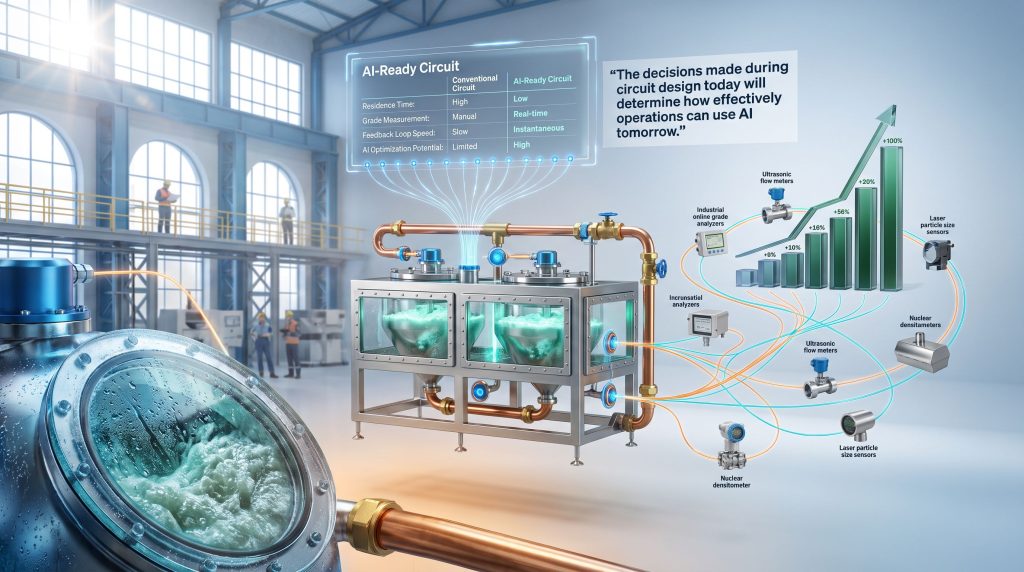
Glencore Technology has identified a specific suite of instrumentation as essential to enabling direct, continuous measurement across key process variables. When combined with the Jameson Cell's short residence characteristics, this sensor stack eliminates the inference dependencies that undermine AI performance in conventional circuits.
| Instrument Type | Variable Measured | AI Relevance |
|---|---|---|
| Online grade analysers | Concentrate and tailing grade | Enables direct, continuous grade measurement without inference |
| Flow meters | Volumetric flow across all streams | Provides real-time mass balance inputs for model training |
| Densitometers | Pulp density variations | Tracks kinetic changes that affect flotation rate constants |
| Particle size sensors | Feed and product liberation characteristics | Monitors the primary driver of recovery variability |
| Automated samplers | Periodic stream composition | Validates continuous sensor readings and supports model calibration |
Together, these instruments convert a flotation circuit from a system that generates inferred, batch-sampled process estimates into one that produces continuous, directly measured data streams. This is the foundational requirement for effective AI deployment. As Anderson articulated, the industry's ambition to realise AI's full potential in mineral processing requires moving beyond conventional flotation thinking first, with circuit design decisions made today directly determining how effectively operations can deploy automation in the future. Glencore itself has outlined this AI-ready flotation vision in detail, making a compelling case for redesigning circuit architecture around data quality.
The Four Pillars of AI-Ready Flotation Circuit Design
A Framework for Evaluating Processing Infrastructure Against AI Requirements
Processing engineers evaluating their circuit's readiness for AI integration benefit from a structured assessment framework that goes beyond software and connectivity considerations. True Glencore flotation AI readiness is an engineering state defined by four interconnected dimensions.
1. Direct Measurement Capability
The circuit must be capable of quantifying grade and recovery directly and continuously, without reliance on estimation from proxy variables. Online grade analysers are the cornerstone of this capability.
2. High-Frequency Feedback
Short hydraulic residence times are not merely a metallurgical advantage. They are an AI infrastructure advantage, enabling the rapid cause-and-effect attribution that machine learning models require to develop reliable predictive accuracy.
3. Comprehensive Sensor Density
All key process variables must be instrumented. Gaps in sensor coverage force inference, and inference introduces the compounding error rates that undermine model reliability under variable feed conditions.
4. Architectural Simplicity
Circuit complexity is the enemy of model interpretability. Every additional interacting variable increases the computational difficulty of modelling and the likelihood that AI recommendations will be unreliable under edge conditions.
Key Insight: AI readiness is an engineering problem before it is a software problem. Circuit design decisions made today will constrain or enable automation capabilities for the next decade.
Glencore's Broader AI Infrastructure Strategy
Building the Operational Data Backbone Across the Portfolio
Glencore's engagement with AI readiness in flotation sits within a broader enterprise technology strategy that spans multiple operational domains. The company has deployed AI-adjacent systems across several areas of its global portfolio, creating organisational experience and data infrastructure that supports more sophisticated future applications. This approach reflects broader mining innovation trends that are reshaping how major operators think about technology investment.
Current and recent AI-related deployments across Glencore operations include:
- Predictive maintenance programmes using telemetry data from the Newtrax platform to anticipate equipment failures before they result in unplanned downtime
- Fleet dispatch optimisation at copper mining operations, applying algorithmic scheduling to improve cycle times and equipment utilisation
- Safety risk identification systems in underground environments, particularly at high-risk operations, where historical incident data is used to flag emerging hazard conditions
- Incident pattern recognition frameworks that analyse operational data streams to identify precursors to safety events before they escalate
These deployments reflect a deliberate progression from AI at the operational periphery toward AI at the core of primary processing circuits. The flotation AI-readiness framework represents the next phase of that progression, requiring not just additional software capability but fundamental rethinking of the physical circuit architecture that generates the underlying data.
The Workforce Dimension: Human Readiness as a Parallel Requirement
Technical infrastructure investment is necessary but not sufficient. Processing operations that invest in AI-ready circuit design but lack personnel capable of interpreting model outputs, validating recommendations, and managing the transition from manual to algorithmic control will fail to capture the benefits of the underlying infrastructure. Glencore's emphasis on workforce development in machine learning and IoT competencies reflects recognition that the human system must evolve in parallel with the physical one.
The Industry-Wide Readiness Gap: Where AI Adoption Actually Stands
The Current State of AI in Mineral Processing
Honest assessment of AI adoption in mineral processing reveals a sector that remains predominantly experimental rather than transformational. The most common active deployments are concentrated at the monitoring and anomaly detection layer, where AI adds value without requiring the circuit-level data infrastructure that closed-loop optimisation demands.
Full closed-loop AI optimisation of primary flotation circuits — where algorithms autonomously adjust reagent dosage, aeration rates, and other key process parameters in real time — remains rare. It is typically confined to advanced pilot programmes at operations that have already invested significantly in instrumentation density and circuit simplification. Consequently, the gap between aspiration and operational reality remains wide across most of the sector.
The reasons most sites remain at the experimental margin are structural:
- Legacy circuit architectures were built without AI readiness as a design criterion
- Retrofitting existing circuits with the required sensor density demands significant unbudgeted capital
- Operational teams trained on manual control paradigms are understandably cautious about ceding process authority to algorithmic systems
- Without sufficient high-quality historical data from well-instrumented circuits, AI models cannot be validated to the reliability standards that autonomous operation requires
However, the emergence of data-driven mining frameworks is beginning to shift how operators approach these structural barriers, offering clearer pathways from experimental deployment toward full process optimisation.
The Compounding Cost of Deferred Action
Perhaps the least-appreciated dimension of this challenge is the non-linear cost of delay. Organisations that defer circuit redesign decisions are not simply pushing AI adoption further into the future. They are actively generating suboptimal training data during every year of operation with an AI-incompatible circuit, weakening the performance potential of future models and widening the competitive gap relative to early movers.
Industry Warning: The window for lowest-cost AI readiness integration is narrowest during greenfield development and major brownfield refurbishment cycles. Operators who miss these windows face substantially higher retrofit costs and longer timelines to effective AI deployment.
The next major ASX story will hit our subscribers first
Evaluating Circuit AI Readiness: A Practical Decision Framework
Step-by-Step Assessment for Processing Engineers
For engineers and technical decision-makers evaluating their circuit's position on the AI-readiness spectrum, a systematic assessment process provides the clearest foundation for capital planning and technology roadmap development.
- Map existing instrumentation against the four-pillar framework, identifying gaps in direct measurement, feedback speed, sensor density, and architectural simplicity
- Quantify hydraulic residence times across all flotation stages, establishing where temporal lag is most likely to impair AI model training quality
- Assess data continuity by determining what percentage of key process variables are measured in real time versus estimated from batch samples or proxy variables
- Catalogue inference dependencies, identifying all process decisions currently made on estimated rather than directly measured values
- Evaluate circuit complexity, mapping interacting variable relationships and identifying where simplification could materially reduce model training noise
- Define the target AI use case, since predictive monitoring, closed-loop optimisation, and autonomous control require different data infrastructure thresholds
- Develop a staged instrumentation roadmap, prioritising sensor additions by their impact on training data quality relative to installation cost
In addition, engineering teams should consider how predictive maintenance strategies can be woven into their AI readiness roadmap from the outset, rather than treated as a separate workstream.
Comparing Conventional and AI-Ready Flotation Circuit Characteristics
| Characteristic | Conventional Circuit | AI-Ready Circuit |
|---|---|---|
| Residence Time | Long, minutes to hours | Short, seconds to low minutes |
| Grade Measurement | Batch sampling or inferred | Continuous online analysers |
| Sensor Density | Low, key variables unmeasured | High, comprehensive instrumentation |
| Circuit Complexity | High, multiple interacting stages | Simplified, reduced variable interactions |
| Feedback Loop Speed | Slow, delayed cause-effect relationship | Fast, near real-time response |
| Model Training Quality | Poor, noisy and temporally lagged | High, clean and high-frequency signals |
| AI Optimisation Potential | Low without major retrofit investment | High, architecture supports closed-loop control |
Reframing Capital Allocation: Processing Infrastructure as AI Investment
A New Evaluation Criterion for Flotation Circuit Capital Decisions
The traditional capital evaluation framework for flotation circuits weighs metallurgical performance, throughput capacity, and operating cost against total capital expenditure. This framework is incomplete in a world where AI optimisation potential has quantifiable long-term value.
A forward-looking capital allocation approach incorporates AI readiness as an explicit evaluation criterion. Instrumentation density and architectural simplicity carry compounding future value as AI optimisation capabilities mature. Operations that embed these considerations into their capital planning process today will access that value earlier and at lower incremental cost than those who treat AI readiness as a future retrofit problem.
The three-to-five year outlook for mineral processing AI is one of accelerating capability development. The performance gap between AI-ready and AI-incompatible flotation operations is expected to widen materially over this period. Early movers who have invested in the right physical infrastructure will be positioned to deploy increasingly sophisticated optimisation capabilities as model performance advances, capturing measurable operational benefits in recovery rates, reagent consumption, energy intensity, and concentrate quality consistency. Intellisense.io's key takeaways from IMPC 2024 reinforce this outlook, highlighting how the industry's leading voices are converging on circuit-level data quality as the defining constraint on AI performance.
Forward Outlook: The mineral processing operations that treat circuit design as a data architecture decision — not just a metallurgical one — will define the performance frontier of the next decade.
Want to Know Which ASX Mining Companies Are Leading the Next Wave of Mineral Discovery?
Discovery Alert's proprietary Discovery IQ model scans ASX announcements in real time, instantly identifying significant mineral discoveries and translating complex data into actionable investment insights — so subscribers are positioned ahead of the broader market. Explore historic examples of major discovery returns and begin your 14-day free trial to secure a genuine market-leading edge.