August 23, 2026
When the Smelter Goes Cold: Australia's Industrial Processing Crisis
The global resources industry has spent decades debating the difference between being a commodity exporter and being an industrial nation. At the heart of this debate sits a deceptively simple question: does it matter where raw materials are turned into useful products? For most of Australia's post-war economic history, the answer was treated as largely academic. Ore left the country. Steel, alloys, and refined metals came back. The trade balance looked fine on paper, even as the value-added work happened elsewhere.
The permanent closure of Australia's only manganese smelter has forced that question off the academic shelf and into the realm of urgent national policy. This closure also lays bare deep contradictions within Australia's critical minerals strategy, raising questions about whether ambition has been matched by action.
When big ASX news breaks, our subscribers know first
Manganese Alloy: More Than a Steel Additive
Why the Distinction Between Ore and Alloy Matters
Manganese is one of the most indispensable yet least publicly discussed metals in industrial civilisation. It is primarily used as a hardening and deoxidising agent in steelmaking, with roughly 90% of global manganese consumption directed toward steel production. However, the form in which manganese enters that process matters enormously.
Raw manganese ore, as mined from the ground, contains the mineral in a chemically bonded, impure state that cannot be added directly to a blast furnace or electric arc furnace at scale. It must first be processed into manganese alloy forms, primarily silicomanganese and ferromanganese, through high-temperature smelting. These alloys are the actual industrial inputs that steelmakers, defence manufacturers, and advanced materials producers purchase and use.
The economic gap between selling ore and selling alloy is substantial:
- Manganese ore typically trades at a fraction of the value of processed silicomanganese or ferromanganese
- Alloy production captures energy value, labour value, and technical knowledge that ore export does not
- Domestic alloy production creates supply chain security for downstream steel manufacturers
- Processing capacity represents a form of sovereign industrial capability that cannot be quickly replicated once lost
Australia has long occupied a paradoxical position in this supply chain. The nation is one of the world's most significant producers of raw manganese ore, anchored by the Groote Eylandt Mining Company (GEMCO) operation in the Northern Territory. GEMCO is managed by South32 and represents one of the highest-grade manganese ore deposits on the planet. Yet despite this ore abundance, Australia processed virtually none of its manganese into finished alloy domestically, with the sole exception being the Liberty Bell Bay smelter in Tasmania.
How Peer Nations Have Built Integrated Processing Industries
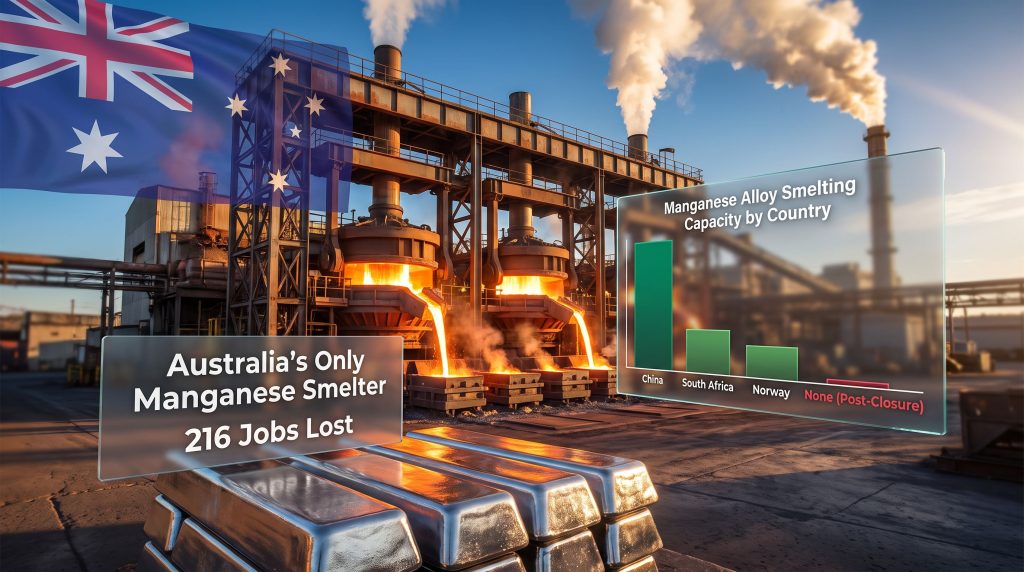
The contrast with competing resource nations is instructive. China has constructed a dominant global position in manganese alloy production through decades of state-directed industrial policy, combining domestic ore with imported ore to feed a vast smelting sector. South Africa, which also produces significant ore volumes, has developed meaningful domestic smelting capacity. Norway, which imports all of its ore, has nonetheless built a significant European manganese alloy industry by leveraging its competitive advantage in low-cost hydroelectric power.
Furthermore, the lesson from these comparisons is uncomfortable for Australian policymakers. As seen with critical minerals supply chains globally, processing competitiveness is not simply a function of ore access. It requires deliberate long-term investment in energy infrastructure, workforce capability, and industrial policy that Australia has historically been reluctant to commit to at the necessary scale.
The Rise and Fall of Liberty Bell Bay
A Facility With No Domestic Equivalent
Located within Tasmania's Bell Bay industrial precinct in the state's north, the Liberty Bell Bay smelter was, for a meaningful period, Australia's only domestic manganese alloy producer. The facility operated as a genuine piece of sovereign industrial infrastructure, converting raw manganese ore into the alloy forms required by steel manufacturers. At its operational peak, the facility employed approximately 216 workers directly, with further indirect employment flowing through the Bell Bay precinct and the broader northern Tasmanian economy.
The smelter came under the ownership of GFG Alliance, the industrial conglomerate controlled by British billionaire Sanjeev Gupta, as part of GFG's broader strategy of acquiring steel and metals assets across Australia and globally. GFG's Australian portfolio at various points included steelmaking operations, processing facilities, and renewable energy assets, reflecting an ambitious but ultimately overstretched industrial vision.
A Collapse Years in the Making
The closure of the Bell Bay smelter was not a sudden event. It was the terminal outcome of a multi-year deterioration driven by compounding failures across supply chains, corporate governance, and market conditions. The timeline reveals a pattern of escalating stress:
| Period | Key Development |
|---|---|
| 2021–2024 | GFG Alliance fails to lodge mandatory annual financial reports for five consecutive years |
| Mid-2025 | Smelter suspends production; enters care-and-maintenance status |
| May 2025 | Formal care-and-maintenance confirmed, citing ore supply disruptions |
| March 2026 | Voluntary administration commenced; EY Parthenon appointed administrators |
| March 2026 | ASIC initiates wind-up proceedings over chronic reporting failures |
| May 2026 | Adroit Capital identified as preferred bidder |
| June 12, 2026 | Adroit Capital's primary financial backer withdraws; acquisition collapses |
| July 2026 | Administrators confirm immediate closure and orderly wind-down |
The five consecutive years of missing financial reporting obligations to ASIC represents a governance failure of remarkable persistence. This chronic non-compliance did not merely attract regulatory attention; it fundamentally undermined the smelter's ability to attract commercial lenders, negotiate supply agreements from a position of credibility, or engage strategic partners with confidence in the asset's financial standing.
Understanding the Multi-Layer Failure
The GEMCO Supply Chain Rupture
One of the proximate triggers for the smelter's production suspension was the disruption to ore supply from South32's Groote Eylandt Mining Company. GEMCO is the dominant supplier of high-grade manganese ore in the Australian market, and its ore was a primary input for the Bell Bay operation. Cyclone-related damage to GEMCO's infrastructure created a cascade of supply interruptions that the smelter's already-stressed operational position could not absorb.
This episode exposes a structural vulnerability that is poorly understood outside specialist circles: single-source ore dependency in smelting operations creates catastrophic concentration risk. Unlike a steel mill that can source feedstock from multiple suppliers across different geographies, a manganese smelter configured around a specific ore chemistry from a single regional source has limited flexibility when that source is disrupted. The GEMCO cyclone damage did not merely reduce ore supply; it exposed the fragility of the entire supply arrangement.
Market Dynamics: The Price-Cost Squeeze
The global manganese alloy market experienced significant price pressure during the 2024–2025 period, driven in part by oversupply from lower-cost producers, particularly in China and South Africa, where production cost structures differ substantially from Australian operations. These industrial power challenges are well-documented across heavy industry, and Australian smelting economics are no exception, characterised by:
- Higher energy costs relative to Norwegian hydropower-advantaged competitors
- Higher labour costs relative to Chinese and some African producers
- Geographic isolation adding logistics cost to both ore inputs and alloy outputs
- Smaller scale limiting the economies of scale available to large Asian and South African producers
When commodity price cycles compress margins across the entire alloy-producing sector, Australian operations face a structural disadvantage that is difficult to overcome without either significant energy cost reform or substantial productivity improvements.
Governance as an Accelerant of Failure
It would be a mistake to view GFG Alliance's governance failures as merely a compliance technicality. The chronic failure to lodge financial reports created a vacuum of financial transparency that had practical consequences for the smelter's survival prospects. Potential lenders had no audited basis on which to extend credit. Prospective buyers faced heightened due diligence risk. Strategic partners had no reliable financial baseline from which to model a joint venture.
When EY Parthenon was appointed as administrators in March 2026, the firm inherited an asset with genuinely uncertain financial history and limited commercial momentum. The subsequent failure of the Adroit Capital acquisition after its financial backer withdrew in June 2026 illustrated precisely this dynamic: even a willing buyer could not secure the private capital necessary to backstop the transaction.
The Government Intervention and Its Limits
What Federal and State Governments Committed
Both federal and Tasmanian state governments recognised the strategic significance of the Bell Bay facility and committed substantial support packages to attract a buyer and maintain operational viability:
| Support Measure | Value |
|---|---|
| Emergency wages support | A$10 million (~USD $6.99 million) |
| Operational start-up package | A$20 million |
| Concessional power agreement | 10-year term |
| Total direct financial commitment | A$30 million+ |
Industry Minister Tim Ayres confirmed publicly that despite this government commitment and active engagement with potential acquirers, no commercially viable buyer was ultimately identified. The concessional power agreement in particular represented a recognition that energy costs were a structural impediment to the facility's competitiveness and that government had a role in addressing that constraint.
Why A$30 Million Was Not Enough
The gap between public financial support and the commercial risk threshold required by private capital proved unbridgeable. A prospective buyer of the Bell Bay smelter would have needed to:
- Fund significant capital expenditure to recommission a mothballed facility
- Secure long-term ore supply agreements in a market where GEMCO supply remained uncertain
- Navigate the governance and legal complications arising from GFG's prolonged non-compliance
- Model a return on investment against a price environment that remained challenging for high-cost producers
- Absorb the reputational and financial risk of a failed predecessor ownership structure
The A$30 million in government support, while substantial, addressed only part of this risk stack. It could not substitute for the long-term market certainty, competitive energy costs at sufficient scale, or the governance clean slate that a credible acquirer would require.
The policy debate this raises extends beyond Bell Bay. Should Australian governments deploy equity co-investment alongside grants? Should long-term offtake guarantees from government-affiliated steel buyers be structured as part of rescue packages? These are questions that the Bell Bay experience has placed squarely on the policy agenda.
What Australia Loses With Australia's Only Manganese Smelter to Close
The Sovereign Capability Gap
The permanent closure of Australia's only manganese smelter creates a capability gap that is not simply about lost jobs or lost revenue. It represents the elimination of an entire category of domestic industrial knowledge. The workforce expertise in manganese smelting, the engineering systems optimised for this specific process, the operational relationships with ore suppliers and alloy buyers — these do not remain idle waiting for a new owner. They disperse.
Rebuilding a functional manganese smelting operation from a cold start would require not just capital investment but the re-accumulation of specialised technical knowledge that typically takes years to develop. International experience with industrial reconstitution suggests that the time-to-production gap for a greenfield or brownfield smelting restart in a regulated market like Australia is commonly a decade or more.
Workforce and Regional Economic Impact
The immediate human cost is 216 direct jobs at the Bell Bay facility, with a smaller number of workers retained temporarily for site demobilisation and environmental remediation. As union representatives have emphasised, Bell Bay has historically served as a cornerstone of northern Tasmania's industrial economy, and the smelter's closure accelerates a trend of industrial contraction in the region that has been building for some years.
The flow-on effects through the regional supply chain, including contractors, logistics providers, and local service businesses, are likely to amplify the direct employment impact significantly. For communities with limited alternative industrial employers, this kind of concentrated job loss creates economic stress that persists well beyond the closure event itself.
The Contradiction at the Heart of Australia's Critical Minerals Strategy
Manganese is formally classified as a critical mineral under Australian government frameworks, reflecting its importance to steel, battery, and defence supply chains. Yet the closure of Australia's only manganese smelter exposes a profound contradiction: critical mineral designation has not translated into the sustained industrial policy required to maintain a domestic processing sector.
This contradiction is not unique to manganese. Australia has experienced analogous processing capability losses in nickel refining and faces ongoing challenges in lithium hydroxide processing and rare earth refining. The pattern raises a systemic question about whether Australia's resource export model is genuinely oriented toward building a domestic processing industry or whether it remains primarily focused on accelerating ore extraction for export.
The next major ASX story will hit our subscribers first
Global Benchmarking: Where Australia Stands
Comparative Manganese Alloy Production Capacity
| Country | Domestic Smelting Capacity | Integrated with Ore Production? | Processing Policy Orientation |
|---|---|---|---|
| China | Dominant global producer | Partially | High — long-term state industrial policy |
| South Africa | Major producer | Yes | Moderate — established private sector |
| Norway | Significant European capacity | No (imports ore) | High — energy cost advantage leveraged |
| India | Growing capacity | Partially | Increasing — domestic demand driven |
| Australia (post-closure) | None | N/A — ore exported raw | Reactive, insufficient at scale |
The Norwegian case deserves particular attention. Norway produces no manganese ore domestically yet operates a globally competitive manganese alloy sector. The competitive advantage is almost entirely energy-based: Norway's abundant, low-cost hydroelectric power makes the electricity-intensive smelting process economically viable even with the added cost of importing ore. This illustrates that processing competitiveness is a policy-buildable attribute, not simply a geological endowment.
Rebuilding Processing Competitiveness: What Would It Take?
The Prerequisites for a Viable Australian Manganese Processing Sector
Any future attempt to restore Australian manganese smelting capability would need to address several structural prerequisites simultaneously. The decarbonisation economics of industrial processing also add further complexity to each of the following requirements:
- Energy cost reform — either through dedicated industrial power agreements at competitive rates, or co-location with renewable energy generation assets
- Ore supply security — diversified input sourcing arrangements that reduce single-source dependency on any one supplier
- Long-term demand anchors — offtake agreements with domestic steel producers and defence supply chains sufficient to justify capital commitment
- Structured co-investment — blended public-private capital models that reduce the risk threshold for private investors without requiring open-ended government subsidy
- Workforce development — deliberate pipeline programmes to rebuild metallurgical processing skills that will otherwise leave the sector permanently
The Bell Bay closure does not make this reconstruction impossible, but it makes it significantly harder and more expensive. Every year without a domestic smelting capability increases the workforce dispersion, the knowledge loss, and the infrastructural deterioration that any future investor would need to reverse.
Frequently Asked Questions
What was the Liberty Bell Bay smelter?
A manganese alloy smelting and processing facility located in the Bell Bay industrial precinct in northern Tasmania, and until its closure the only domestic producer of manganese alloy in Australia.
Why did the closure occur?
The closure resulted from the convergence of several compounding factors: ore supply disruptions linked to cyclone damage at the GEMCO operation in the Northern Territory; adverse global manganese alloy pricing that compressed margins; prolonged corporate governance failures under GFG Alliance including five consecutive years of missed financial reporting; and the collapse of a prospective sale after the buyer's financial backer withdrew in June 2026.
How many jobs were lost?
Approximately 216 direct employees lost their positions, with a smaller number retained temporarily for site demobilisation and environmental remediation activities.
How much government support was committed?
Federal and state governments committed more than A$30 million in direct support, including A$10 million in wages assistance, an A$20 million operational start-up package, and a 10-year concessional power arrangement.
What happens to Australia's manganese alloy supply now?
Australia will need to source manganese alloy entirely from international producers, primarily in China, South Africa, and Norway, deepening reliance on foreign processing capacity for a mineral that Australia produces in substantial ore volumes domestically.
Could a new smelter be built?
Theoretically yes, but practical timelines for greenfield or brownfield smelting investment in a regulated market environment suggest a minimum of a decade from commitment to production, and only if energy costs, ore supply security, and demand anchors can be structured attractively enough for private capital.
The Broader Warning: Australia's Downstream Processing Deficit
The closure of Australia's only manganese smelter is not an isolated industrial misfortune. It is, however, the most visible recent example of a structural pattern in which Australia consistently fails to capture value from the resources it extracts in abundance. The nickel refinery closures of recent years, the difficulties in scaling lithium hydroxide processing, and the limited progress in rare earth refining all point to the same underlying dynamic: Australian industrial policy has been more effective at encouraging ore extraction than at building the processing industries that convert that ore into economic and strategic value.
The risk of cementing this pattern is that Australia increasingly resembles what resource economists term a quarry economy: a nation that supplies the raw material inputs for other countries' industrial sectors while importing the finished goods those raw materials ultimately produce. This model is not inherently disastrous in the short term, but it carries meaningful long-term risks, including vulnerability to commodity price cycles, dependency on foreign processing decisions, and the progressive loss of the technical workforce and industrial knowledge base required to compete in higher-value segments of the supply chain.
The countries that have successfully broken this pattern — Norway in manganese, Finland in nickel, South Korea in steel — did so through deliberate, sustained, and patient industrial policy over multiple decades. The question the Bell Bay closure poses for Australia is whether the loss of its only manganese smelter will serve as a catalyst for that kind of policy ambition, or simply as another chapter in a long story of processing capability foregone.
This article contains forward-looking analysis and commentary regarding industrial policy, market dynamics, and investment conditions. Such analysis involves inherent uncertainty and should not be construed as financial advice. Readers should conduct independent research and seek qualified professional guidance before making any investment or policy-related decisions.
Want to Identify the Next Major ASX Mineral Discovery Before the Market Moves?
Discovery Alert's proprietary Discovery IQ model scans ASX announcements in real time, instantly identifying significant mineral discoveries across more than 30 commodities — including the critical minerals at the centre of Australia's processing debate — and delivering actionable insights directly to subscribers. Explore how historic discoveries have generated exceptional market returns and begin your 14-day free trial at Discovery Alert to position yourself ahead of the broader market.