July 16, 2026
The Hardware Gap That AI Cannot Bridge in Modern Flotation
The mining industry has spent considerable energy debating which artificial intelligence platform, which machine learning algorithm, or which advanced process control vendor will transform mineral processing. Yet this conversation consistently skips past a more fundamental question: is the physical circuit actually capable of generating the data that any AI system needs to function effectively for Jameson Cell AI-ready flotation circuit design?
This is not a software problem. It is a circuit architecture problem, and it is one that gets locked in at the feasibility and basic engineering stage, long before an AI vendor ever enters the conversation.
When big ASX news breaks, our subscribers know first
Why Software-First AI Thinking Fails in Flotation
There is a persistent assumption in the industry that AI can be layered onto an existing operation to extract optimisation value that conventional control systems have left on the table. In some contexts, this is partially true. In flotation, however, it runs into a hard structural constraint.
A conventional flotation circuit typically comprises dozens of mechanical cells operating across rougher, cleaner, and scavenger stages. The combined residence time through such a circuit can span several hours, meaning that when an operator or control system makes a process adjustment, the metallurgical response does not manifest at the measurement point for a significant period afterward.
For an AI system that learns by acting, observing outcomes, and refining its behaviour, this lag interval is not a minor inconvenience. It is a fundamental ceiling on learning speed and control responsiveness. Furthermore, AI in mining is increasingly demonstrating that hardware readiness must precede software deployment for meaningful results.
Circuit complexity compounds this further. The more interdependent variables an AI system must simultaneously manage, the harder it becomes to isolate cause and effect, and the more noise accumulates in any predictive model attempting to learn from that environment.
What AI-Readiness Actually Requires From a Circuit
AI-readiness is not a software certification or a digital maturity score. It is a set of physical and instrumentation characteristics that determine whether a circuit can supply the data quality and response speed that machine learning and advanced process control systems require.
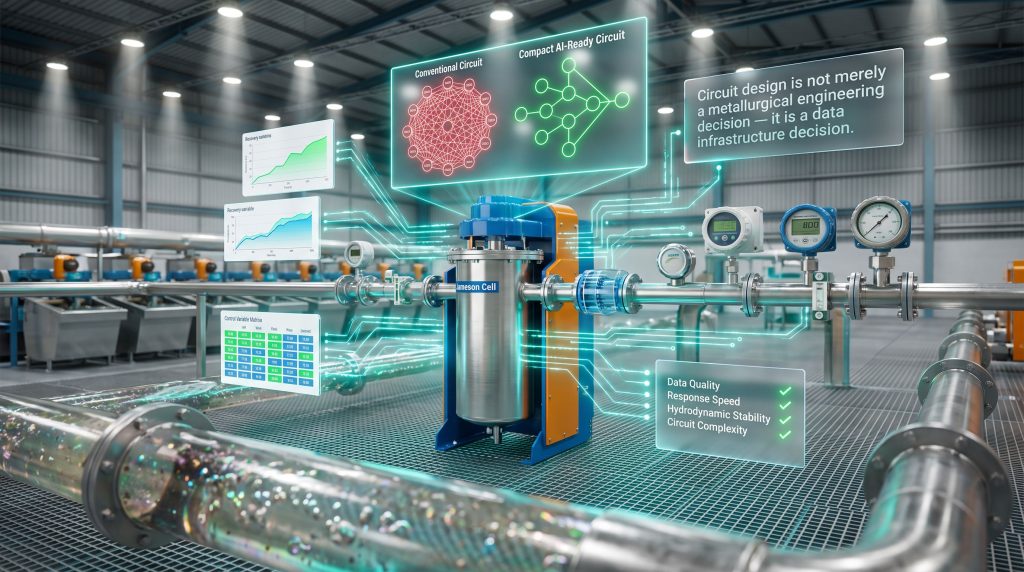
The four structural pillars of a genuinely AI-compatible flotation circuit are:
- Data quality: High-frequency, directly measured, and reconciled instrumentation data rather than inferred proxy measurements
- Response speed: Short flotation kinetics that compress the feedback loop between a control action and a measurable outcome
- Hydrodynamic consistency: A stable contacting environment that reduces variance in the digital process model
- Circuit simplicity: A compact architecture that minimises the number of simultaneous optimisation targets
| Design Criterion | AI Compatibility Requirement | Why It Matters |
|---|---|---|
| Data Quality | Direct measurement via online analysers | Eliminates noise from soft sensor proxies |
| Response Speed | Residence time of 5 to 10 minutes | Enables near real-time APC learning cycles |
| Hydrodynamic Stability | Consistent gas dispersion and contacting | Reduces model variance and prediction error |
| Circuit Simplicity | Fewer stages and fewer interdependent cells | Simplifies the AI optimisation matrix |
When these criteria are met at the design stage, AI and advanced process control systems operate with maximum effectiveness. When they are absent, software sophistication cannot compensate. Consequently, data-driven mining operations that neglect circuit architecture will consistently underperform their potential.
How the Jameson Cell Addresses These Requirements by Design
The Jameson Cell operates on fundamentally different hydrodynamic principles than conventional mechanical flotation cells. Rather than relying on mechanical agitation to disperse air into a slurry, it uses a high-velocity slurry jet passing through a downcomer to generate fine, high-energy bubble-particle contact in a dedicated contacting zone, entirely separated from the quiescent disengagement zone above.
This design produces several characteristics that are directly relevant to Jameson Cell AI-ready flotation circuit design.
Short Residence Times and Faster Feedback Loops
Residence times within a Jameson Cell circuit typically fall in the range of five to ten minutes, compared to the multi-hour equivalent in conventional mechanical cell circuits. This compression of the feedback window is not merely operationally convenient. It structurally accelerates the learning cycle available to any AI or APC system managing the circuit.
When a setpoint adjustment takes five minutes to produce a measurable metallurgical response rather than several hours, the AI system can evaluate, learn from, and refine its control strategy in what amounts to real time. The number of learning iterations available within a given operational window increases dramatically. In addition, AI-powered mining efficiency gains are most pronounced precisely where feedback loops are shortest.
Compact Architecture and the Control Matrix
Fewer cells, fewer stages, and a smaller physical footprint directly reduce the number of variables that an AI system must track and manage simultaneously. In conventional circuits, the interdependencies between dozens of cells across multiple stages create a high-dimensional optimisation problem that introduces noise, delays, and computational complexity.
A compact Jameson Cell circuit architecture reduces this problem dimensionality, allowing AI control systems to converge on optimal setpoints faster and with greater confidence. Furthermore, mining automation technology performs most effectively when the underlying circuit complexity is minimised at the design stage.
Direct Measurement Over Inferred Proxies
One of the most underappreciated barriers to AI effectiveness in conventional flotation is the industry's reliance on inferred measurements such as froth camera analysis and soft sensors to estimate grade and recovery in real time. These proxies introduce systematic uncertainty into any AI model trained on the resulting data.
An AI-ready Jameson Cell circuit is designed to support direct measurement through:
- Online elemental analysers providing continuous grade data
- Flowmeters and densitometers enabling real-time mass flow calculation
- Particle size analysers tracking liberation and size distribution
- Automated sampling systems providing ground truth for model validation
Together, these instruments enable a live circuit mass balance, meaning the AI system is learning from directly observed metallurgical reality rather than inferred approximations of it. Research published on the Jameson Cell flotation circuit design further supports the case for compact, directly instrumented configurations.
Circuit Configurations Optimised for AI Integration
Not all Jameson Cell installations are configured identically, and the choice of circuit architecture carries distinct implications for how effectively AI can be deployed.
Hybrid Cleaner Circuits
In this configuration, the Jameson Cell handles cleaner and scalper duties while mechanical cells manage cleaner-scavenger functions, with a re-cleaner Jameson Cell producing the final concentrate. The AI control leverage is concentrated at the re-cleaner stage, where the optimisation target — final concentrate grade — is both clearly defined and directly measurable.
All-Jameson Compact Circuits
Replacing conventional mechanical cell banks entirely with Jameson Cell technology produces a circuit whose compounding advantages for AI are significant. High flotation rate constants allow smaller physical circuits to replicate the throughput of much larger conventional installations, while the uniform hydrodynamic environment across the circuit reduces inter-cell variability in the data stream.
Flash Rougher Applications
Positioning a Jameson Cell as a flash rougher upstream of a conventional circuit allows high-value, fast-floating particles to be recovered at near-final concentrate grade early in the process. This not only protects these particles from over-grinding but also simplifies the feed composition entering the downstream conventional circuit, which in turn reduces the complexity of the AI optimisation problem in that section.
Brownfield Retrofit: What Needs to Happen Before AI Software Arrives
For existing operations looking to deploy AI or advanced process control on their flotation circuits, the instrumentation baseline of the existing installation is the first and most critical assessment point.
Most legacy concentrators were not built with high-frequency, reconciled measurement systems in mind. Standard installations are typically under-equipped relative to the data density that AI platforms require to function at their design capability. Moreover, 3D geological modelling has demonstrated a similar lesson — digital systems are only as valuable as the quality of underlying data inputs.
The practical sequencing for a brownfield AI integration should follow this order:
- Conduct an instrumentation audit to identify measurement frequency and coverage gaps
- Upgrade to online analysers and high-frequency flowmeters where missing
- Implement a data reconciliation framework to ensure measurement integrity before model training begins
- Address any circuit architecture simplifications available within capital constraints
- Deploy APC or machine learning software only after the data infrastructure is validated
Deploying advanced process control software onto circuits with inadequate instrumentation or unresolved data reconciliation issues will consistently produce performance that falls short of vendor expectations, regardless of how sophisticated the underlying algorithm may be.
Glencore Technology's AI-ready flotation research reinforces this sequencing, emphasising that hardware and instrumentation readiness are non-negotiable prerequisites for effective AI deployment in mineral processing.
The next major ASX story will hit our subscribers first
The Automation Variables That AI Manages in a Jameson Cell Circuit
Understanding what an AI system actually controls in a Jameson Cell circuit helps clarify why circuit simplicity matters so much. The primary controllable variables are:
- Air flow rate through the downcomer, which governs bubble generation and gas holdup
- Froth depth, which determines the grade-recovery balance at the cell level
- Wash water flow rate, which controls froth stability and concentrate dilution
- Feed flow and density to maintain consistent downcomer operating conditions
This is a significantly smaller and more tractable optimisation space than the equivalent variable set in a large conventional mechanical cell circuit. The Jameson Cell's self-stabilising operating characteristics, particularly the self-aspirating downcomer mechanism, further reduce the corrective control burden placed on AI systems, allowing them to focus on optimisation rather than disturbance rejection.
Embedding AI-Readiness at the Right Stage of Project Development
The strategic window for making AI-compatible circuit design decisions is narrow. It opens during pre-feasibility and basic engineering, when circuit architecture choices are still fluid, and it closes when detailed engineering is finalised and equipment is procured.
Treating flotation circuit architecture as a data infrastructure decision rather than purely a metallurgical engineering choice reframes the entire technology investment conversation. The capital allocated to circuit simplification, direct instrumentation, and compact layout at the design stage determines the AI optimisation ceiling that the asset will operate within for its entire producing life.
Deferred circuit redesign carries a compounding cost. Every operating year during which a poorly structured circuit prevents AI systems from reaching their optimisation potential represents a permanent loss of value that no future software upgrade can recover.
Glencore Technology's technical positioning of the Jameson Cell for advanced process control applications, as reported by Global Mining Review, reflects this broader shift in how the industry's most technically sophisticated operators are beginning to think about Jameson Cell AI-ready flotation circuit design. The hardware decisions made today are not merely engineering choices. They are technology strategy decisions with consequences measured in decades.
Frequently Asked Questions: Jameson Cell AI-Ready Flotation Circuit Design
What makes a flotation circuit AI-ready?
An AI-ready flotation circuit is one designed to produce high-frequency, directly measured process data through dense instrumentation, while maintaining sufficient circuit simplicity to allow AI and APC systems to evaluate and act on control adjustments rapidly. Short residence times, stable hydrodynamics, and compact architecture are the three structural foundations.
Why does residence time matter so much for AI-enabled flotation control?
Residence time governs how quickly a process adjustment produces a measurable metallurgical response. Shorter residence times compress the feedback loop, enabling AI systems to operate in near real time rather than waiting hours for a control signal to propagate through a large conventional circuit.
Can conventional flotation circuits support effective AI deployment?
They can support some level of APC, but structural characteristics — including large cell counts, long residence times, and dependence on inferred measurements — impose a hard ceiling on optimisation effectiveness. The largest AI performance gains are available in circuits designed from the outset for control responsiveness and data quality.
What instrumentation does an AI-ready Jameson Cell circuit require?
A fully equipped circuit incorporates online elemental analysers, flowmeters, densitometers, particle size analysers, and automated sampling systems. These tools together enable a real-time circuit mass balance and direct grade and recovery measurement.
Is the Jameson Cell suitable for brownfield AI integration?
Yes, but only after instrumentation upgrades and data reconciliation frameworks are in place. The circuit's inherent simplicity and fast kinetics make it well-suited to AI integration once the data infrastructure meets the minimum frequency and quality requirements.
Want to Know Which ASX Companies Are Building Tomorrow's Mining Technology Edge?
Discovery Alert's proprietary Discovery IQ model scans ASX announcements in real time, instantly identifying significant mineral discoveries across more than 30 commodities — transforming complex data into actionable investment insights for both short-term traders and long-term investors. Explore historic discoveries and their market returns or start your 14-day free trial today to position yourself ahead of the market before the broader investment community takes notice.