July 16, 2026
When Industrial Peace Breaks Down: Understanding the Forces Behind the BHP Port Hedland Strike
Large-scale resource extraction has always operated on a delicate social contract. Miners accept remote postings, hazardous conditions, and demanding rosters in exchange for wages that reflect both the difficulty of the work and the enormous value they help generate. When that contract frays, the consequences extend far beyond the picket line. The BHP workers strike at Port Hedland on July 16, 2026 is a case study in exactly this dynamic, revealing structural tensions that have been building quietly beneath one of the world's most productive bulk commodity corridors.
When big ASX news breaks, our subscribers know first
The Strike in Numbers: A Snapshot of What Happened
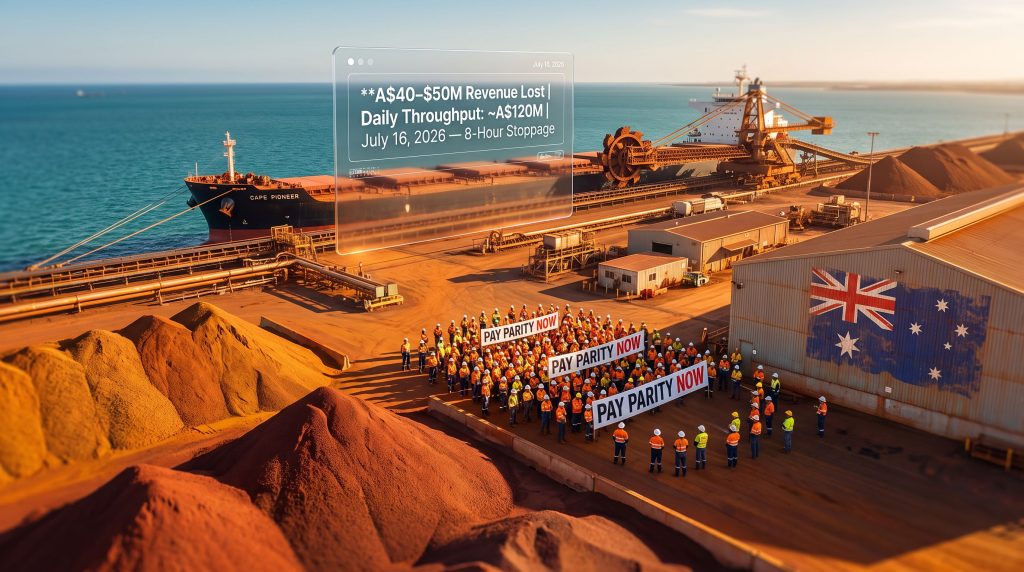
Before examining the deeper forces at play, it is worth establishing the precise parameters of the stoppage. On the afternoon of July 16, 2026, workers at BHP's Port Hedland terminal walked off the job for an eight-hour period spanning 2:00 PM to 10:00 PM. Between 150 and 200 workers ultimately participated, drawn from port operations and maintenance roles, though initial union planning had anticipated up to 400 participants taking protected action.
| Factor | Detail |
|---|---|
| Date and Duration | July 16, 2026, 8 hours (2:00 PM to 10:00 PM) |
| Workers Involved | 150 to 200 (up to 400 planned) |
| Unions Represented | ETU, AMWU, Western Mine Workers' Alliance |
| Daily Iron Ore Revenue at Risk | Approximately A$120 million |
| Estimated Revenue Disrupted | A$40 million to A$50 million |
| WA Government Royalties Forfeited | Approximately A$7 million |
| Next Bargaining Session | July 21, 2026 (Fair Work Commission) |
The three unions coordinating the action — the Electrical Trades Union, the Australian Manufacturing Workers' Union, and the Western Mine Workers' Alliance — operate together under the banner of the Combined Ports Unions. Their collective decision to authorise protected industrial action marks the most significant labour disruption in the Western Australian mining sector in roughly 25 years, ending what had been an extended period of relative industrial calm across the Pilbara.
Six to Seven Months of Collapsed Negotiations
Industrial stoppages of this scale rarely emerge overnight. The events of July 16 were the culmination of between six and seven months of enterprise agreement negotiations that repeatedly failed to reach resolution. Understanding why those talks broke down requires looking at the specific grievances workers brought to the table.
The Pay Parity Problem
At the core of the dispute is a wage equity argument that is both simple and structurally significant. Workers at BHP's South Flank iron ore mine and Mining Area C operations had already secured a 16% wage increase through their enterprise agreement. Workers performing equivalent roles at the Port Hedland terminal had not received comparable adjustments, creating pay gaps of up to A$40,000 for individuals doing functionally similar work under different contract structures.
The Electrical Trades Union specifically sought an additional A$25,000 payment for electrical trades workers. This figure is not arbitrary. Electrical tradespeople at bulk commodity ports are responsible for maintaining the conveyor systems, ship-loading equipment, dust suppression infrastructure, and power distribution networks that keep throughput moving. Their skills are in high demand across multiple industries, and the gap between what they could earn elsewhere versus what BHP's terminal agreement offered had widened to a point that workers considered untenable.
Beyond base wages, the negotiations also exposed inequities in classification structures and career progression pathways. Workers argued that role gradings did not accurately reflect the complexity of their responsibilities, limiting both their current earnings and their capacity to advance. These classification disputes are often harder to resolve than straight wage disagreements because they require changes to agreement architecture rather than simple numerical adjustments.
Understanding Enterprise Bargaining Under the Fair Work Act
For those unfamiliar with Australian industrial law, enterprise agreements are legally binding documents negotiated between employers and their workforce — usually represented by unions — that set out wages and conditions for a defined period. Under the Fair Work Act 2009, workers covered by an agreement can take protected industrial action once specific procedural requirements are met, including a valid majority vote and appropriate notice periods.
A four-year enterprise agreement, which is what unions and BHP are negotiating toward, provides both parties with a long runway of certainty. For workers, it locks in known wage trajectories. For the company, it reduces the frequency of disruptive bargaining cycles. The stakes of getting the terms right are therefore elevated on both sides, which partially explains why six months of talks produced no resolution. Neither party has an easy concession to make.
Port Hedland's Role in Global Iron Ore Supply Chains
To appreciate why this stoppage carries weight beyond the Pilbara, it is necessary to understand what Port Hedland actually represents in the architecture of global commodity trade. The port is the single largest bulk export terminal on the planet by annual tonnage, with iron ore shipments flowing primarily to steel mills in China, Japan, and South Korea. BHP's Pilbara operations, channelled through this terminal, contribute a substantial portion of total seaborne iron ore supply to Asian markets.
Iron ore price trends in the seaborne market are closely tied to supply continuity. Asian steelmakers typically maintain relatively lean port inventories compared to historical norms, meaning any disruption to loading schedules at Port Hedland creates downstream scheduling pressure within days, not weeks. Vessel demurrage costs accumulate rapidly when ships wait at anchor, and rescheduling shipments in a spot-driven market can result in cargo being repriced against unfavourable benchmarks.
Furthermore, the global iron ore market impact of supply chain disruptions is precisely what gives unions meaningful leverage even during a single-day action. The threat of disruption to ongoing shipments can be as commercially impactful as the disruption itself, encouraging faster movement at the bargaining table.
Breaking Down the Financial Consequences
Revenue and Royalty Losses
The A$120 million daily revenue figure used to estimate losses from the stoppage is derived from the terminal's typical throughput volume multiplied by prevailing iron ore prices. Across an eight-hour window representing one-third of a 24-hour operating day, the estimated A$40 million to A$50 million in disrupted revenue reflects the fact that BHP's contingency operations can partially sustain throughput using supervisory staff and automated systems, even if full commercial loading rates cannot be maintained.
The Western Australian government's royalty exposure of approximately A$7 million from this single stoppage illustrates a structural fiscal vulnerability that is rarely discussed in mainstream budget analysis. WA resources contribution represents a disproportionately large share of WA's state revenue base. When commodity prices are elevated and volumes are high, the state budget benefits enormously. However, that same concentration creates sensitivity to operational disruptions at the mine and port level. A multi-day escalation of this dispute would translate into tens of millions of dollars in foregone royalty income.
Who Else Absorbs the Impact?
The immediate financial effects extend across multiple stakeholder groups:
- Asian steel producers: Loading delays create scheduling gaps that ripple into production planning at integrated steel mills, where ore stockpile management is already tight in many facilities.
- Shipping operators: Vessels waiting at anchor accrue demurrage charges, typically calculated on a daily rate basis per charter agreement. These costs are initially borne by cargo buyers or charterers, but can ultimately influence freight rate negotiations.
- WA State Treasury: As noted, royalty income is the most direct governmental exposure, but secondary effects on state corporate tax receipts and employment taxes are also present.
- BHP shareholders: While a single eight-hour stoppage is unlikely to move full-year production guidance materially, a prolonged or escalating dispute introduces guidance risk that equity markets would reprice relatively quickly.
If negotiations at the July 21 Fair Work Commission session fail to produce a resolution and further protected action is authorised, the cumulative financial exposure scales rapidly. A week-long partial disruption could represent several hundred million dollars in foregone export revenue and well over A$40 million in state royalty losses.
What the Breakdown of Two Decades of Industrial Peace Signals
The Pilbara has operated with remarkable labour stability since the early 2000s. This stability was not accidental. It was built on a combination of factors including high wages relative to most Australian industries, regular agreement renewals that kept pace with commodity cycles, and union-employer relationships that, while never frictionless, maintained functional dialogue.
Several forces have disrupted this equilibrium. The post-pandemic resources boom pushed iron ore prices to historically elevated levels, generating record profits for major producers. Workers who contributed to those production records reasonably expected their wage outcomes to reflect that performance. When they observed colleagues at adjacent operations receiving 16% increases while their own negotiations stalled, the disconnect became politically untenable within the workforce.
There is also a broader structural shift occurring across Australian resources sector bargaining. Tighter labour markets, skills shortages in trades roles, and greater union coordination across sites have collectively strengthened worker bargaining power in ways not seen for a generation. In addition, Australia's iron ore dominance means these labour dynamics carry outsized consequences for global supply chains. The BHP workers strike at Port Hedland is consequently likely an early signal of a more assertive enterprise bargaining era across the Pilbara, not an isolated anomaly.
The next major ASX story will hit our subscribers first
The July 21 Bargaining Session: Three Scenarios
The Fair Work Commission session scheduled for July 21, 2026 represents the next critical decision point. The range of plausible outcomes spans a significant spectrum:
- Full resolution: BHP agrees to pay parity measures, workers accept the four-year term, and industrial peace is restored. This outcome is commercially optimal for both parties and would remove near-term production risk.
- Partial compromise: A phased wage adjustment is agreed upon, with classification disputes referred to a separate review process. This buys time but leaves underlying structural tensions unresolved.
- Escalation: Talks break down and further protected action is authorised. This scenario could involve longer stoppages, broader worker categories joining the action, or coordinated action across multiple BHP Pilbara sites. The Fair Work Commission retains the power to terminate protected action if it determines that the action threatens significant damage to the national economy, though this power is used sparingly and only in exceptional circumstances.
Other major Pilbara operators including Rio Tinto and Fortescue are watching these proceedings with considerable interest. The outcome will function as a de facto benchmark for enterprise bargaining expectations across the sector. Moreover, given the significance of China steel demand to Pilbara revenues, a generous settlement that reduces disruption risk would be welcomed across the supply chain. A generous settlement for BHP's port workers will almost certainly inform union claims at competing operations when their own agreements come up for renewal.
Key Takeaways for Industry Observers
The BHP workers strike at Port Hedland is more than a labour relations story. It is a window into several converging pressures reshaping the Australian resources sector:
- Pay parity as a structural demand: The gap between wages at different sites within the same company has emerged as a defining grievance, one that is harder for employers to dismiss than simple above-inflation claims.
- Asymmetric financial leverage: Even brief, targeted stoppages generate disproportionate financial pressure relative to their duration, giving unions significant negotiating power without requiring prolonged action.
- State fiscal concentration risk: Western Australia's royalty dependency on iron ore means that industrial disruptions carry direct budget consequences that extend well beyond the corporate level.
- Sector-wide bargaining implications: The resolution framework established here will influence enterprise agreement negotiations across the Pilbara for years to come.
- The end of passive industrial peace: The era in which long-term Pilbara stability could be assumed appears to be giving way to a more contested bargaining environment.
This article contains forward-looking scenarios and financial estimates based on available public information. Revenue and royalty loss estimates involve assumptions about throughput rates and pricing that may differ from actual outcomes. Readers should not treat any projected figures as confirmed financial data. For further on-the-ground reporting from the Pilbara region, ABC News' 7.30 program coverage provides additional context.
Frequently Asked Questions: BHP Port Hedland Strike
What triggered the BHP Port Hedland strike in 2026?
Between six and seven months of unresolved enterprise agreement negotiations drove workers to take protected industrial action. The central issue was pay parity with colleagues at other BHP Pilbara sites where a 16% wage increase had already been secured, alongside wage disparities of up to A$40,000 for equivalent roles.
How many workers participated in the Port Hedland strike?
Between 150 and 200 workers took part in the eight-hour stoppage on July 16, 2026. Up to 400 had been expected to participate at the outset of planning.
Which unions were involved in the BHP Port Hedland industrial action?
The Combined Ports Unions, comprising the Electrical Trades Union, the Australian Manufacturing Workers' Union, and the Western Mine Workers' Alliance, coordinated the protected action.
How much revenue was disrupted during the BHP strike?
Estimates place the disrupted iron ore revenue at between A$40 million and A$50 million across the eight-hour window, against a daily throughput value of approximately A$120 million. The Western Australian government is estimated to have forfeited around A$7 million in royalty income.
Is this the most significant mining strike in Western Australia's recent history?
It is widely characterised as the most substantial industrial action in the Western Australian mining sector in approximately 25 years, ending an extended period of relative Pilbara labour stability.
What happens if an agreement cannot be reached on July 21?
If the Fair Work Commission session fails to produce a resolution, unions may be authorised to pursue further protected industrial action, potentially involving longer stoppages or a broader range of worker categories. The BHP workers strike at Port Hedland has therefore created a pivotal moment for the entire Pilbara bargaining landscape.
Want to Stay Ahead of the Next Major ASX Minerals Discovery?
Whilst labour disruptions at Port Hedland highlight the immense value locked within Australia's resources sector, Discovery Alert's proprietary Discovery IQ model scans ASX announcements in real time, instantly identifying significant mineral discoveries and delivering actionable alerts to subscribers before the broader market reacts — explore historic discoveries and their returns to understand the opportunity, then begin your 14-day free trial to position yourself at the forefront of the next major find.