August 9, 2026
Underground Ventilation Has Always Been the Hard Problem
For as long as miners have worked below the surface, the management of underground air has sat at the intersection of physics, engineering, and calculated risk. Heat accumulates with depth. Diesel particulates drift through interconnected tunnels. Methane migrates along geological fractures with no regard for shift schedules. Traditional approaches to controlling these conditions have relied on periodic manual surveys, static network models, and the professional judgment of ventilation engineers operating with incomplete, time-delayed information.
The arrival of real-time digital twin technology in mine ventilation represents a genuine structural break from this paradigm. Not an incremental improvement to existing monitoring, but a fundamentally different relationship between the physical mine and the people responsible for managing it safely.
When big ASX news breaks, our subscribers know first
What Real-Time Digital Twin Technology in Mine Ventilation Actually Does
A ventilation digital twin is not a dashboard, and it is not a simulation tool in the conventional sense. It is a continuously synchronised virtual replica of an operating underground ventilation network, one that ingests live sensor data, runs calibrated fluid dynamic calculations in real time, and maintains a persistent, current-state model of how air is moving through every tunnel, shaft, and working area.
The distinction from conventional ventilation simulation software such as VUMA or VUMA-3D is important. Those tools, developed in South Africa and capable of modelling transient ventilation behaviour across hundreds of kilometres of tunnel, are powerful planning instruments. They allow engineers to test design changes, evaluate fan configurations, and model heat and airflow under different production scenarios. What they do not do is update automatically as underground conditions evolve minute by minute.
A real-time digital twin bridges that gap. It uses the calibrated network model as its foundation but layers continuous live measurement on top, producing an always-current picture rather than a point-in-time snapshot. Furthermore, the system does not simply observe conditions; it compares observed performance against model-predicted performance, surfacing deviations the moment they appear. This capability connects closely with broader data-driven mining operations trends that are reshaping how mines are managed at every level.
The Five-Layer Architecture Beneath the Surface
Understanding how this technology functions requires looking at the architectural layers that make bidirectional synchronisation possible.
Layer 1: Physical Data Acquisition
The foundation is an instrumentation network of IoT sensors, actuators, and remote-controlled starters distributed throughout the underground environment. These devices measure airflow velocity, temperature, humidity, gas concentrations, and equipment positioning. Without this layer functioning reliably, nothing above it can be trusted.
Layer 2: Virtual Modeling Engine
Above the sensor layer sits a computational fluid dynamics engine running a three-dimensional network flow model of the mine. This model encodes the resistance characteristics of every airway, the performance curves of every fan, and the thermal properties of the rock mass. In practice, this is closely related to 3D geological modelling approaches that underpin modern underground mine design and stakeholder communication.
Layer 3: Data Fusion and Calibration
Raw sensor data is rarely clean. Dust accumulates on sensors, calibration drifts, and communication dropouts create gaps. The data fusion layer applies filtering, calibration correction, and multi-source reconciliation algorithms to ensure that only validated measurements feed the virtual model.
Layer 4: Predictive Intelligence via LSTM-Attention Neural Networks
This is where the system moves from observation to anticipation. Long Short-Term Memory networks with attention mechanisms analyse temporal patterns in ventilation data to forecast future states. These networks excel at identifying slow-developing trends that fall beneath the detection threshold of threshold-based alarm systems.
Layer 5: Adaptive Control and Decision Support
The final layer closes the loop between model and mine. Based on predicted and current states, automated control recommendations are generated for fan speeds, regulator positions, and auxiliary ventilation configurations. Three-dimensional visualisation displays give operators a comprehensible, human-readable interface to this complexity.
| Architecture Layer | Core Function | Enabling Technology |
|---|---|---|
| Physical Entity Interface | Live data acquisition from underground | IoT sensors, SCADA systems |
| Virtual Modeling Engine | 3D ventilation network construction | CFD simulation, network flow analysis |
| Data Fusion | Multi-source data integration | Filtering, calibration, cleaning algorithms |
| Prediction and Analysis | Future-state ventilation forecasting | LSTM-Attention neural networks |
| Adaptive Control | Dynamic fan and regulator optimisation | Model predictive control |
| Visualisation and Decision Support | Human-readable operational intelligence | 3D dashboards, real-time displays |
The bidirectional synchronisation between the physical mine environment and its virtual counterpart is what separates a true digital twin from a monitoring dashboard. The system does not simply observe; it anticipates, models consequences, and informs control decisions in real time.
What the Field Evidence Actually Shows
Performance claims in mining technology are frequently aspirational. However, the evidence base for ventilation digital twins is more substantive. An eight-month field validation conducted at an operational coal mine produced a set of performance metrics that deserve careful examination.
| Performance Metric | Digital Twin System | Conventional Control | Improvement |
|---|---|---|---|
| Control Accuracy | 97.3% | Baseline | Significant gain |
| Energy Consumption | 27% reduction | Baseline | Major cost saving |
| System Response Speed | 66.4% faster | Baseline | Critical for emergencies |
| Prediction Error (MAPE) | 2.87% | Higher variance | Near-real-time accuracy |
| Neural Network R² | 0.9612 | N/A | High model fidelity |
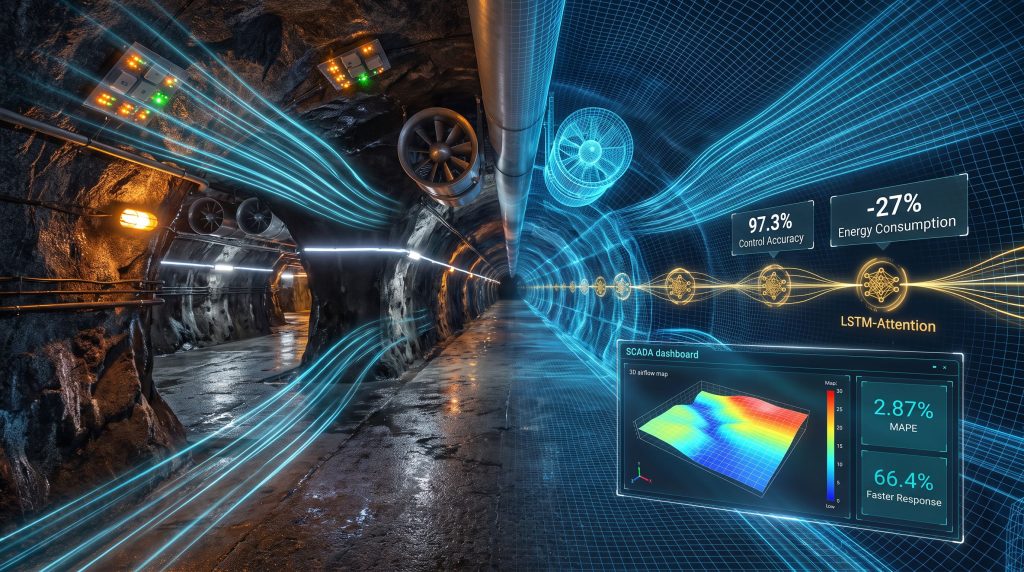
The 97.3% control accuracy figure reflects how consistently the system delivered target airflow conditions across monitored zones. The 27% reduction in energy consumption is perhaps the most commercially significant result. Ventilation and cooling systems typically account for 40 to 50% of total underground mine energy consumption, according to published research in mine energy management. A 27% reduction in that component translates directly to material operating cost improvement, particularly at depth where refrigeration loads compound the challenge.
The 66.4% improvement in system response speed carries safety implications that extend beyond efficiency. In emergency scenarios, the interval between a ventilation disturbance and a corrective response can determine whether a developing hazard remains manageable. A system that responds in seconds rather than minutes fundamentally changes the risk profile of underground operations.
The 2.87% Mean Absolute Percentage Error achieved by the LSTM-Attention neural network in ventilation parameter prediction indicates that the forecasting layer is operating with accuracy sufficient for operational decision-making, not merely trend indication. The R² value of 0.9612 confirms that the model explains more than 96% of the variance in observed ventilation behaviour, a level of fidelity that supports genuine predictive confidence.
Ventilation-on-Demand: Where Digital Twin Technology Creates the Largest Operational Gap
Ventilation-on-Demand systems have been present in underground mining for well over a decade. The core principle — delivering air to where workers and equipment are located rather than ventilating the entire mine continuously — is sound and delivers measurable energy savings even in basic form.
The limitation of conventional VoD implementations is their dependence on scheduled setpoints. A fan configuration established at shift start reflects conditions at shift start. What it cannot account for is the continuous flow of disturbances that characterise real underground operations.
A fan trip elsewhere in the network. A ventilation door left open during equipment movement. An auxiliary fan starting up in a heading not accounted for in the shift configuration. Each of these events shifts the ventilation balance of the entire network, because underground airflow behaves as a connected hydraulic system, not a collection of independent zones.
Unlike periodic manual assessments or static ventilation models, a real-time digital twin surfaces slow-developing risks such as gradual air quality deterioration or incremental heat load increases at the earliest detectable stage, enabling intervention before compliance thresholds are breached.
Manual VoD, set once per shift, will not detect these disturbances with any speed. A real-time digital twin flags the deviation from expected performance the moment it appears. More importantly, it can model the downstream consequences of proposed corrective actions before they are implemented, preventing the common error of well-intentioned interventions that resolve one problem while creating another elsewhere in the network. This connects directly with how mining automation technologies are increasingly being used to close the gap between what operators know and what the mine is actually doing.
The Non-Negotiable Prerequisites: Why Foundations Determine Outcomes
The most critical insight for operations considering digital twin implementation is also the least technically exciting: the technology performs exactly as well as the data it receives. Three prerequisites are genuinely non-negotiable.
1. A surveyed mine with accurate geometric data for every airway, including dimensions, lengths, and branching configurations. Without this, no network model can be correctly calibrated.
2. A calibrated network model validated against measured conditions under known operating states. VUMA and VUMA-3D, the South African-developed simulation platforms capable of handling transient conditions across extensive tunnel networks, represent established tools for achieving this baseline. The Process Toolbox (PTB) adds the capability to integrate cooling plant and ventilation network behaviour in complex deep-level environments.
3. Trusted, continuous sensor data. A digital twin amplifies the quality of its inputs. A sophisticated modelling layer built on unreliable instrumentation will produce confident-looking outputs that are systematically wrong.
Deploying a digital twin without first establishing a calibrated baseline model and reliable sensor coverage will produce unreliable outputs. The technology amplifies the quality of its inputs; poor instrumentation yields poor intelligence, regardless of the sophistication of the modelling layer above it.
Operations already using VUMA have a significant structural advantage in this regard. The groundwork of a surveyed mine and a calibrated model is already in place, which reduces the implementation journey to layering real-time connectivity and instrumentation onto an existing foundation. This is consistent with how AI-powered mining efficiency tools are designed to build on — rather than replace — existing operational infrastructure.
The next major ASX story will hit our subscribers first
A Phased Rollout Approach That Matches Capability to Complexity
The practical implementation pathway for most operations follows a staged progression. Attempting to deploy full adaptive control before instrumentation and connectivity are reliable is a known failure mode.
- Baseline Establishment — Complete mine survey, build calibrated network model, validate against known conditions
- Instrumentation Deployment — Install IoT sensor arrays, actuators, and remote control infrastructure at priority zones
- Connectivity Architecture — Establish robust underground communications to eliminate data gaps
- Digital Twin Commissioning — Integrate live sensor feeds with the virtual model; begin expected-versus-actual performance monitoring
- Predictive Layer Activation — Deploy LSTM-Attention neural networks for hazard forecasting and trend analysis
- Adaptive Control Integration — Enable model predictive control for automated fan and regulator optimisation
- Continuous Calibration — Maintain model accuracy through ongoing data validation and periodic recalibration
The value of starting small is not just pragmatic. Operations that begin with limited instrumentation at high-priority zones develop the institutional capability to interpret digital twin outputs correctly before expanding to full-mine coverage. Deploying the full system without this learning period produces technology that outpaces the organisation's ability to use it effectively.
Emergency Response: The Clearest Demonstration of Operational Value
The performance advantage of real-time digital twin technology in mine ventilation is most visible when examining emergency scenarios. In a conventional ventilation management environment, an emergency such as a fire, an unexpected gas outburst, or a major fan failure forces decision-makers to reconstruct the current state of the ventilation network from whatever information is immediately available — which is frequently incomplete, contradictory, and time-delayed.
A digital twin fundamentally changes this situation by providing shared situational awareness. According to IDENTEC Solutions, every team operating in or monitoring the underground environment sees the same, current picture of airflow distribution, air quality conditions, and system state. This shared visibility eliminates the coordination failures that can occur when different teams are operating from different information.
More critically, operators can model the consequences of proposed emergency interventions before implementing them. Changing a main fan setting, isolating an area, or reversing airflow direction in an emergency all carry second-order effects that may not be intuitively obvious. The ability to verify consequences before acting prevents scenarios where corrective action inadvertently creates stagnant air conditions in a different zone or worsens gas ingress into an area being evacuated. The role of AI in mining operations more broadly reflects this same shift toward model-based decision support in high-stakes underground environments.
SCADA Integration and the Cyber-Physical Layer
Connecting a digital twin to existing mine infrastructure requires integration with SCADA systems that may have been installed over different generations of technology and multiple vendor platforms. Modern implementations increasingly use time-series database architectures, including the InfluxData TICK stack, to manage the high-frequency data streams generated by underground sensor networks.
Interoperability between sensor brands, communication protocols, and control systems is a genuine engineering challenge. Underground environments impose additional constraints on communication reliability: signal propagation through rock, the physical movement of equipment, and the need for fail-safe behaviour when connectivity is temporarily lost.
Cybersecurity considerations are also non-trivial. A ventilation digital twin that connects to automated fan and regulator control creates a cyber-physical attack surface with direct safety implications. Security architecture for these systems requires deliberate design, not afterthought hardening.
Comparing Systems: What Separates High-Performance Digital Twins From Basic Monitoring
| Capability | Basic Sensor Monitoring | Static Ventilation Model | Real-Time Digital Twin |
|---|---|---|---|
| Live Data Integration | Yes | No | Yes |
| Predictive Hazard Detection | No | No | Yes |
| Scenario Simulation | No | Limited | Yes |
| Adaptive Fan Control | No | No | Yes |
| Emergency Response Support | Partial | No | Yes |
| Energy Optimisation | No | No | Yes |
| Expected vs. Actual Tracking | No | No | Yes |
The table above illustrates why partial implementations deliver partial results. Basic sensor monitoring provides situational awareness without prediction or control. Static ventilation models support planning without real-time fidelity. Only a fully integrated real-time digital twin delivers the complete capability set, and the performance data from field validation reflects this.
The Trajectory: From Reactive Management to Proactive Underground Governance
The deeper significance of real-time digital twin technology in mine ventilation extends beyond the specific performance metrics achieved in field trials. It represents a shift in the fundamental operating model for underground air management — from a discipline characterised by reactive adjustment and periodic assessment to one governed by continuous model-based intelligence.
The next generation of this technology will move progressively toward autonomous control, where the system not only recommends but implements ventilation adjustments within pre-authorised parameters. Integration with broader mine digitalisation programmes, including production planning systems and asset management platforms, will allow ventilation management to respond dynamically to production schedules rather than operating on fixed configurations that approximate expected activity.
Workforce capability development is an underappreciated dimension of this transition. The value of a sophisticated digital twin depends on engineers who can interpret model outputs, understand model limitations, and recognise when the system is operating outside its calibrated envelope. Technology that outpaces the skills of the people operating it tends to produce confident-looking errors rather than confident-looking successes.
Key Takeaways for Mine Operators and Ventilation Engineers
- Real-time digital twins combine continuously calibrated simulation models with live sensor feeds to create a persistent, current-state picture of underground ventilation behaviour
- Field validation has demonstrated 97.3% control accuracy, 27% energy savings, and 66.4% faster system response compared to conventional ventilation management approaches
- LSTM-Attention hybrid neural networks achieve a prediction error of just 2.87% MAPE, providing reliable short-horizon forecasting of temperature, airflow, and air quality parameters
- Ventilation and cooling typically represent 40 to 50% of total underground mine energy consumption, making the 27% energy reduction result a material operational cost improvement
- Three prerequisites are non-negotiable before deployment: a surveyed mine, a calibrated network model, and trusted continuous sensor data
- Phased implementation starting with instrumentation and connectivity before advancing to predictive analytics is the most reliable pathway to full capability
- In emergencies, the primary value is shared situational awareness, enabling faster and better-grounded decisions about evacuation routing, isolation, and re-entry authorisation
- Operations already using VUMA or VUMA-3D have a structural head start, because the foundational survey and model calibration work that underpins digital twin deployment is already substantially complete
The performance figures referenced in this article, including control accuracy, energy reduction, and neural network prediction error metrics, are drawn from published field validation research. Readers should note that actual performance outcomes in any specific mine will vary based on geological conditions, existing infrastructure, instrumentation quality, and operational practices. This article does not constitute investment or procurement advice.
Ready to Invest in the Companies Pioneering the Next Wave of Mining Technology?
Discovery Alert's proprietary Discovery IQ model delivers real-time alerts the moment significant ASX mineral discoveries are announced, instantly transforming complex data into actionable investment opportunities for both short-term traders and long-term investors. Explore Discovery Alert's dedicated discoveries page to see how historic finds have generated substantial returns, and begin your 14-day free trial today to position yourself ahead of the broader market.