August 9, 2026
The Fragile Economics of Being the Last One Standing
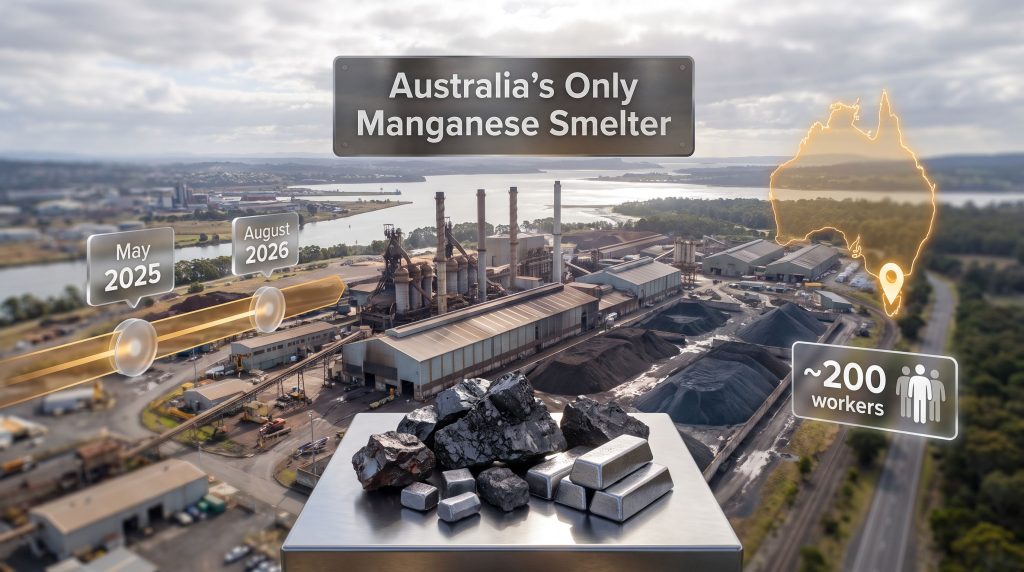
When a country loses its final facility of a particular industrial type, the consequences extend far beyond the immediate workforce. There is no redundancy to fall back on, no sister plant to absorb capacity, and no domestic competitor to step in. The closure becomes categorical rather than incremental. This is precisely the situation Australia now faces with the Liberty Bell Bay smelter revival question sitting unresolved in northern Tasmania, where the nation's only manganese alloy processing facility has been idle since May 2025 and, as of August 2026, formally under liquidation management.
Understanding why this matters requires stepping back from the immediate drama of insolvency proceedings and examining what manganese actually does in an industrial economy, and what it means when a resource-rich nation loses its capacity to add value to one of its own abundant raw materials.
When big ASX news breaks, our subscribers know first
Manganese's Hidden Role in Modern Industry
Most people associate critical minerals demand with lithium, cobalt, or rare earths. Manganese tends to occupy a quieter position in public discourse, yet it is arguably more fundamental to industrial civilisation than many of its higher-profile counterparts.
Manganese serves as an essential deoxidising and desulphurising agent in steelmaking. Without it, steel becomes brittle, prone to cracking under stress, and far less durable. Virtually every tonne of steel produced globally requires manganese as an alloying input, typically at concentrations of around 6 to 9 kilograms per tonne of finished steel. This is not an optional additive. It is a structural requirement of the metallurgical process itself.
Beyond steel, manganese is emerging as a significant material in next-generation battery chemistry. High-manganese lithium-ion formulations, sometimes referred to as LMFP (lithium manganese iron phosphate) and LNMO (lithium nickel manganese oxide) cathode chemistries, are attracting considerable research interest as alternatives to cobalt-heavy battery designs. The energy storage sector's appetite for manganese is expected to grow materially over the coming decade, adding a second demand pillar to what was historically a single-sector commodity.
Australia sits among the world's largest producers of manganese ore by volume, with major mining operations in the Northern Territory contributing significantly to global supply. The strategic irony is stark: Australia digs manganese out of the ground, ships it offshore for processing, then imports the ferroalloy products it could theoretically produce domestically. Bell Bay was the single point in Australia's industrial chain where that conversion happened on home soil. Furthermore, domestic value-adding of this kind is precisely what industrial policy advocates argue Australia must prioritise going forward.
A Timeline of Collapse: How Liberty Bell Bay Reached Liquidation
The trajectory from operational smelter to liquidation was neither sudden nor simple. It unfolded across more than 14 months of compounding failures, disputed finances, and unsuccessful rescue attempts.
| Milestone | Date | Significance |
|---|---|---|
| Operations suspended | May 2025 | Ore supply disruptions and global market volatility cited |
| Tasmanian government loan issued | 2025 | $20 million extended to support restart attempt |
| Ore purchased with loan funds | 2025 | $14.5 million of loan used to acquire ore stockpile |
| Government repossesses ore | January 2026 | Triggered by company's failure to resume operations |
| Insolvency trading period identified | July 2026 | Administrators conclude company traded insolvent for over 12 months |
| Preferred consortium collapses | June 2026 | Adroit Capital withdraws from the acquisition bid |
| Creditors vote for liquidation | August 2026 | Approximately 200 workers lose employment |
| New consortium interest emerges | August 2026 | White Oak and OM Holdings signal conditional intent |
The liquidator, EY Parthenon, has identified approximately $200 million allegedly transferred out of Liberty Bell Bay through intercompany loans to GFG Alliance entities. This figure is particularly significant because it overlaps with the period during which the Tasmanian government was extending financial assistance to the company, raising substantive questions about the adequacy of due diligence conducted before public funds were committed.
The $14.5 million portion of the government loan used to purchase ore was subsequently repossessed by the state after the company failed to resume production. This sequence of events illustrates how quickly a rescue attempt can transform into a creditor dispute when the underlying entity is already insolvent. In addition, mining asset sales of this complexity rarely proceed without significant legal and financial contestation.
Intercompany Loans and the Limits of Oversight
The GFG Alliance dimension of this story carries lessons that extend well beyond Tasmania. Complex multinational industrial conglomerates present inherent monitoring challenges for both creditors and governments. Cash movements through intercompany loan structures can be technically legitimate while simultaneously creating liquidity vacuums at the operational subsidiary level.
This dynamic is not unique to GFG Alliance. It reflects a broader structural tension in the way global industrial ownership interacts with locally significant assets. When a smelter in northern Tasmania is owned by a UK-headquartered conglomerate with operations across multiple continents, the financial health of that smelter becomes entangled with the financial decisions of entities several degrees removed from the physical site.
Structural Risk Note: Single-site industrial assets owned by financially stressed multinational entities carry compounded vulnerability. The local operation has no control over group-level capital allocation decisions, yet bears the full consequences when those decisions go wrong.
For policymakers evaluating future industrial investment proposals, the Bell Bay case presents a practical argument for stronger ring-fencing requirements and more rigorous financial reporting conditions attached to any government financial support extended to foreign-owned industrial operators.
Who Is Behind the TEMCO Bell Bay Proposal?
Against this backdrop of liquidation and financial complexity, a new consortium has emerged with conditional interest in acquiring the site. The vehicle through which they intend to bid is a newly registered entity called TEMCO Bell Bay, incorporated in late June 2026.
The name is deliberate. Before GFG Alliance acquired the facility, the smelter operated under the identity of the Tasmanian Electro Metallurgical Company, known as TEMCO. By reviving that name in the corporate registration, the consortium is doing something strategically calculated: anchoring the proposal to the site's pre-GFG industrial identity and signalling a form of continuity that may resonate with workers, community members, and government stakeholders who remember the facility's more stable operating period.
The two principal entities behind the proposal are:
- White Oak: A United States-based private credit and investment advisory firm, listed as a shareholder in TEMCO Bell Bay. White Oak's Kenneth Pereira is registered as director of the new entity.
- OM Holdings: An integrated manganese ore and ferroalloy company with operational presence spanning Australia, Malaysia, Singapore, and China. OM Holdings brings direct sector expertise that the previous Adroit Capital-led consortium arguably lacked at the operational level.
The involvement of OM Holdings is particularly noteworthy from an industry perspective. Unlike a purely financial acquirer, OM Holdings understands the manganese supply chain end-to-end, from ore sourcing through to ferroalloy marketing. This vertical integration experience could prove critical to the commercial viability of any restart, since securing consistent ore supply at competitive pricing is one of the operational challenges that contributed to Liberty Bell Bay's original suspension. Indeed, this is comparable to the kind of expertise seen in the strategic manganese project developments emerging elsewhere globally.
The Australian Workers' Union has characterised the revised proposal as a genuine phoenix opportunity, noting that the consortium has engaged with private investors and expressed confidence in its capacity to recapitalise the plant. However, no binding financial commitments have been publicly confirmed, and EY Parthenon must formally evaluate any proposals received, including from other interested parties who are also reportedly circling the site.
The Two Conditions That Will Determine the Outcome
The Liberty Bell Bay smelter revival proposal is not unconditional. The consortium has attached two substantive requirements that the Tasmanian government must respond to before any acquisition can proceed.
Condition One: Environmental Liability Waiver
The consortium has indicated it will only proceed if pre-existing environmental liabilities at the site are not transferred to the incoming operator. Under the proposed arrangement, the new entity would accept full responsibility for environmental impacts generated under its ownership, but would be shielded from historical contamination obligations.
This condition places the Tasmanian government in a difficult negotiating position. If it accepts the waiver, it absorbs legacy environmental costs on behalf of taxpayers. If it rejects the waiver, the most credible revival proposal currently on the table may collapse, and those same taxpayers could end up funding site remediation anyway through the liquidation process.
Industry observers have noted that environmental liability waivers of this type, while uncomfortable from a regulatory integrity standpoint, are not without precedent in brownfield industrial acquisition scenarios. The alternative of an indefinitely idle contaminated site with no operator generates its own environmental risks and taxpayer costs. The Tasmanian Premier's office has outlined the government's position on protecting the future of the Bell Bay site, signalling that some degree of flexibility may be available in negotiations.
Condition Two: Transfer of the Existing Hydro Tasmania Power Agreement
The consortium has also stipulated that the existing electricity pricing agreement negotiated by Liberty Bell Bay with Hydro Tasmania must transfer to the new operator. Tasmania's Resources Minister Felix Ellis has publicly acknowledged that a 10-year power agreement was offered to White Oak during the administration process, a detail that signals the government has already signalled flexibility on this point.
Energy costs are not incidental to smelting economics. They are the dominant variable input cost. Manganese smelting is an electrointensive process: electric arc furnaces consume enormous quantities of power to achieve the temperatures required for ore reduction. Without access to competitively priced electricity, the cost structure of a Tasmanian smelter cannot compete against operations in jurisdictions with lower energy costs or subsidised industrial power.
Tasmania's hydroelectric endowment is one of the key natural advantages the Bell Bay site possesses. The ability to access renewable power in mining operations at contracted industrial rates is a structural competitive advantage that cannot be replicated easily elsewhere in Australia.
Energy Cost Context: Electric arc furnace operations typically represent 30 to 40 percent of total production costs in ferroalloy smelting. Access to favourable power pricing is therefore not merely a financial preference but an operational necessity for any economically viable restart.
The next major ASX story will hit our subscribers first
Scenario Analysis: Three Pathways Forward
The outcome of the Liberty Bell Bay smelter revival process will be determined by the interaction between government decisions, consortium financing, and EY Parthenon's evaluation of competing proposals. Three distinct scenarios are plausible:
Scenario 1: Successful Phoenix Revival
The Tasmanian government accepts both conditions. EY Parthenon approves the TEMCO Bell Bay acquisition. Private capital is secured through White Oak's investor network. A phased recommissioning program begins, with production resuming within 12 to 18 months. Australia's sovereign manganese processing capability is restored, approximately 200 jobs return to the Bell Bay precinct, and OM Holdings secures a reliable demand outlet for its ore supply chain.
Scenario 2: Prolonged Negotiation Limbo
Disagreement over environmental liability terms stalls the process. The consortium's private financing remains unconfirmed. Other interested parties fail to present superior proposals. The site remains idle under liquidation management while equipment deteriorates and the skilled workforce disperses permanently. Each passing month raises the cost and complexity of any future restart.
Scenario 3: Permanent Closure
No viable buyer emerges on acceptable terms. EY Parthenon proceeds with asset realisation, and the site transitions to remediation. Taxpayers bear environmental rehabilitation costs regardless. Australia permanently loses its only domestic manganese alloy processing capability, and the Bell Bay industrial precinct faces long-term structural adjustment.
The Workforce Clock Is Already Ticking
One dimension of this situation that deserves more analytical attention is the human capital risk embedded in extended operational downtime. The approximately 200 workers who lost employment when creditors voted to liquidate Liberty Bell Bay represent a specialised skills base that took years to develop.
Manganese smelting is not a generic industrial process. Operators of electric arc furnaces for ferroalloy production require training in high-temperature metallurgy, electrochemical process control, and the specific safety protocols associated with handling molten metal and high-voltage equipment. These are not skills that can be rapidly recruited from a general labour pool.
The AWU has indicated that many displaced workers wish to remain in the region and would return if operations resumed. However, this willingness has a time limit. Workers with families and financial obligations cannot remain in a state of indefinite availability. Each additional month of inactivity increases the probability that trained smelter operators accept positions in other industries or relocate to other regions.
This creates a compounding challenge: the longer negotiations extend, the higher the restart cost, and the harder it becomes to reconstruct the human infrastructure required for safe and productive operations.
What Australia Risks Losing Permanently
The Liberty Bell Bay smelter revival situation crystallises a broader question about Australia's approach to industrial value-adding. The country possesses world-class endowments of manganese ore, yet its industrial policy has historically tolerated a structural arrangement in which raw materials are exported and processed commodities are imported.
This pattern is not economically neutral. Processing adds value, creates employment, generates tax revenue, and builds technical capability. A tonne of manganese ore is worth a fraction of a tonne of high-grade ferromanganese. The difference in value is captured by whichever country performs the conversion.
Several resource-rich nations have adopted explicit industrial policies to ensure domestic processing occurs before export. Australia's implicit policy posture has been more permissive, relying on market forces and foreign industrial ownership to organise value chains. Consequently, the AFR's reporting on the GFG liquidation details how the Bell Bay collapse illustrates the vulnerability embedded in that approach when foreign owners encounter financial distress.
Strategic Framing: Australia's manganese paradox — exporting ore while importing alloy — represents a textbook example of the resource curse dynamic in a developed economy context. The country bears the environmental and logistical costs of extraction without capturing the higher-margin processing and manufacturing value.
Frequently Asked Questions: Liberty Bell Bay Smelter Revival
What is Liberty Bell Bay and why does it matter?
Liberty Bell Bay was Australia's only manganese alloy smelting facility, located at Bell Bay in northern Tasmania. Its closure means Australia has no remaining domestic capacity to convert manganese ore into the ferroalloy products required for steelmaking.
Who is the TEMCO Bell Bay consortium?
TEMCO Bell Bay is a newly incorporated entity through which White Oak, a US-based private credit firm, and OM Holdings, an integrated manganese company with Asia-Pacific operations, have signalled conditional interest in acquiring the site.
What does the consortium require from the Tasmanian government?
The consortium has indicated its proposal depends on the government waiving pre-existing environmental liabilities at the site and agreeing to transfer the existing Hydro Tasmania electricity pricing agreement to the new operator.
Why did the previous bid collapse?
An earlier three-party consortium that included Adroit Capital alongside White Oak and OM Holdings fell apart in June 2026 when Adroit Capital withdrew from the process.
How realistic is a successful restart?
The site has been idle for more than 14 months, equipment will require significant recommissioning expenditure, the workforce has dispersed, and no binding financing has been confirmed. The probability of a successful restart is materially lower than it was earlier in 2026, though not zero if government conditions are met promptly.
What happens to workers if the revival fails?
Approximately 200 workers have already lost their jobs. If no revival proceeds, those positions are unlikely to return, and the specialised skills base associated with manganese smelting in Australia would be effectively lost.
This article contains forward-looking scenarios and analytical assessments based on publicly available information as of August 2026. Outcomes may differ materially from those described. Nothing in this article constitutes financial or investment advice.
Want to Track the Next Major Mineral Discovery Before the Market Does?
Discovery Alert's proprietary Discovery IQ model delivers real-time alerts on significant ASX mineral discoveries — instantly transforming complex mineral data into actionable investment insights for traders and long-term investors alike. Explore historic discoveries and their returns to understand the scale of opportunity, and begin your 14-day free trial at Discovery Alert to position yourself ahead of the broader market.