August 8, 2026
India's Bauxite Scramble Reaches a Tipping Point
The economics of aluminium production have always rested on one foundational truth: without reliable access to bauxite, everything downstream becomes vulnerable. Refineries, smelters, rolling mills, and fabrication operations all trace their cost structures back to the quality and security of raw material supply. For decades, India's integrated aluminium producers managed this reality through a combination of existing captive leases, long-term supply agreements, and toleration of import dependency. That era is ending.
The competitive auction for the Karlapat bauxite block in Odisha, which concluded with BALCO wins Karlapat bauxite block at a record 175% premium, crystallises a structural turning point. This was not a routine procurement exercise. It was a high-stakes resource acquisition battle that drew some of India's most powerful industrial conglomerates into a single bidding room, drove premiums to historically unprecedented levels, and signalled that the era of accessible, inexpensive captive bauxite allocation in India is firmly behind us.
Understanding why this auction unfolded as it did requires looking beyond the headline figure and examining the geological, economic, and strategic forces that have been building pressure across India's aluminium supply chain for years. Furthermore, the result carries implications that extend well beyond India's borders, touching on global bauxite supply dynamics and the intensifying global competition for high-quality ore.
When big ASX news breaks, our subscribers know first
The Geology Behind the Competition
Why Karlapat's Physical Characteristics Set It Apart
Not all bauxite deposits are equal, and within India's mineral landscape, the Karlapat block occupies a genuinely exceptional position. Located in Kalahandi district in Odisha, the block covers approximately 3,100 hectares and contains more than 200 million tonnes of bauxite, with some independent assessments placing the resource base as high as 248 million tonnes.
Critically, the deposit is classified as metallurgical-grade bauxite, the category most directly suited to alumina refining via the Bayer process. Metallurgical-grade bauxite is characterised by higher available alumina content and lower concentrations of reactive silica, which is the primary contaminant that drives up caustic soda consumption and processing costs. Higher silica levels in bauxite translate directly into higher refining costs per tonne of alumina produced, making silica content one of the most commercially significant quality parameters in bauxite evaluation.
Bauxite quality is typically assessed through two key ratios: the alumina-to-silica ratio (A/S ratio) and the available alumina content. Metallurgical-grade deposits with A/S ratios exceeding 8:1 are considered premium quality, offering refinery operators meaningful efficiency advantages over lower-grade alternatives.
What further distinguishes Karlapat is its virgin status. Unlike deposits that have been partially developed, selectively mined in earlier decades, or subjected to resource depletion through artisanal extraction, Karlapat remains entirely undisturbed. This means the winning bidder inherits the complete resource with no legacy infrastructure complications, no prior depletion of high-grade zones, and full optionality in mine design and development sequencing. For a producer planning a 30 to 40-year production horizon, this distinction is not trivial. It is transformative.
A Bidding War That Rewrote the Record Books
How the Auction Unfolded Round by Round
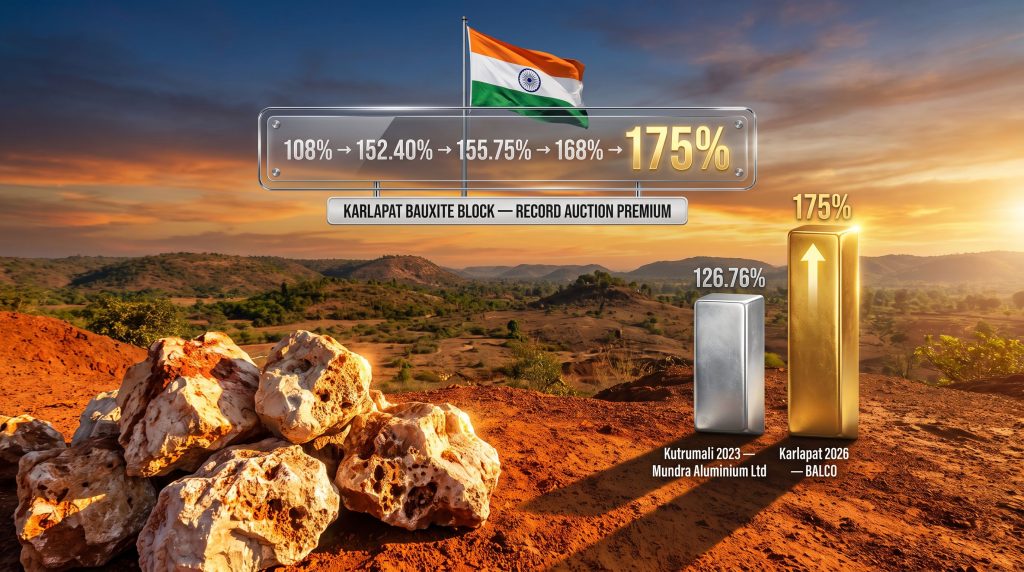
The Odisha Directorate of Mines and Geology conducted the competitive e-auction on 29 May 2026, offering Karlapat as part of a broader package of 11 virgin mineral blocks. Of all the assets on offer, Karlapat attracted the deepest and most sustained competitive intensity. In addition, the progression of bids tells its own story:
- Opening premium: 108%
- First escalation: 152.40%
- Second escalation: 155.75%
- Near-final round: 168%
- Winning bid (BALCO): 175%
The 67 percentage point climb from opening to close is not merely a statistical footnote. It reflects the depth of conviction among multiple well-capitalised bidders that the Karlapat resource justifies a structurally elevated long-term cost commitment. BALCO was declared the preferred bidder on 7 August 2026.
The Competitive Field: Who Was in the Room
The participant list for the Karlapat auction reads as a who's who of Indian industrial capital:
- Adani Enterprises
- Reliance Industries
- Hindalco Industries
- Vedanta Aluminium
- Powermec
- Coal India
- BALCO (Bharat Aluminium Company Ltd, Vedanta Group subsidiary)
The presence of Reliance Industries and Coal India alongside traditional aluminium producers is one of the more analytically significant aspects of this auction. Neither entity operates primary aluminium smelters at scale. Their participation signals that bauxite is increasingly being evaluated as a long-duration strategic commodity with upstream value independent of current production operations. Consequently, this reflects either diversification intent or anticipation of future downstream ambitions.
Market sources indicated that Adani Enterprises and Vedanta Aluminium were among the most aggressive participants in the final bidding rounds before BALCO ultimately secured the block. This pattern closely mirrors competitive dynamics observed at other leading bauxite mines globally, where institutional appetite for large-scale virgin deposits has consistently driven premiums beyond initial expectations.
How Karlapat Compares to India's Previous Auction Records
| Auction | Block | Winner | Premium | Year |
|---|---|---|---|---|
| New Record | Karlapat, Odisha | BALCO | 175% | 2026 |
| Previous Record | Kutrumali, Odisha | Mundra Aluminium Ltd | 126.76% | February 2023 |
The nearly 50 percentage point gap between consecutive records is not the kind of incremental progression that results from gradual market tightening. It represents a qualitative repricing of what captive, large-scale, virgin bauxite is worth to a producer with long-term capacity ambitions in India.
What a 175% Premium Actually Means Financially
Decoding the Cost Commitment Behind the Bid
In India's mineral auction framework, the premium percentage determines the royalty rate that the winning bidder will pay to the state government on every tonne of mineral extracted over the life of the mine. At a 175% premium, BALCO commits to paying royalties at a rate 175% above the government-set floor price per tonne of bauxite mined, for the duration of the mining lease.
This creates a substantial ongoing cost obligation that will compound across the mine's operational life. To justify this commitment, BALCO must hold genuine confidence in several concurrent assumptions:
- Aluminium demand growth in India will remain robust enough to support expanded smelting capacity over the coming decades
- Downstream integration margins from alumina refining and aluminium smelting are sufficient to absorb elevated raw material royalty costs
- The alternative cost of not having captive bauxite — import dependency, spot market exposure, third-party supply risk — exceeds the ongoing premium commitment
- Karlapat's resource base of 200+ million tonnes provides a long enough production horizon to amortise development capital and premium costs at scale
Investor Note: High auction premiums are not inherently bearish for an acquiring company's economics. When captive resources eliminate import dependency and provide multi-decade supply certainty, the operational and financial benefits can significantly exceed the royalty cost differential. The net present value of supply security, properly modelled, often dwarfs the headline premium figure.
Vedanta's Strategic Logic: Building a Bauxite Fortress in Odisha
How Karlapat Fits Into a Wider Integration Play
BALCO's acquisition of the Karlapat block does not exist in isolation. It is a deliberate extension of Vedanta Group's broader strategy of building vertically integrated aluminium operations anchored in Odisha's mineral corridor. Furthermore, shifts in alumina refining strategy among global producers demonstrate that captive feedstock security is now considered a prerequisite rather than a luxury for long-term competitiveness.
Vedanta's Odisha Bauxite Portfolio Post-Karlapat:
| Block | Status |
|---|---|
| Sijimali | Previously acquired |
| Karlapat | Preferred bidder declared 7 August 2026 |
Operating two large bauxite assets in Odisha creates compounding strategic advantages. Geographically diversified supply reduces single-asset operational risk. Combined resource volumes support alumina refinery throughput planning at greater scale. The combined bauxite supply runway, moreover, extends the period over which Vedanta can plan and execute downstream capacity expansions without raw material uncertainty as a constraining variable.
The Aluminium Value Chain Logic
Understanding why integrated producers pursue captive bauxite so aggressively requires a clear picture of how the value chain operates:
- Bauxite mining extracts the raw ore, typically grading 40–60% aluminium oxide (Al₂O₃)
- Alumina refining (Bayer process) converts bauxite to alumina, consuming approximately 2.5–3 tonnes of bauxite per tonne of alumina
- Aluminium smelting (Hall-Héroult process) reduces alumina to primary aluminium metal, consuming approximately 2 tonnes of alumina per tonne of aluminium
- Downstream fabrication converts primary aluminium into rolled products, extrusions, castings, and finished components
At each stage, input cost certainty flows upstream. For fully integrated producers, captive bauxite is the foundation on which margin predictability for the entire value chain is built.
Odisha's Dominance and the Narrowing Window for Large Deposits
Why India's Most Competitive Bauxite Auctions Keep Happening in Odisha
Odisha's geological endowment is not accidental. The Eastern Ghats mineral belt, which runs through Odisha and into neighbouring states, hosts one of the world's most significant bauxite-bearing geological formations. The plateaus and lateritic terrain of districts like Kalahandi, Koraput, and Rayagada contain bauxite deposits formed through prolonged tropical weathering of aluminium-rich parent rocks over geological timescales.
The state has consistently produced India's highest-premium bauxite auction outcomes, a pattern reinforced sequentially by the Kutrumali result in 2023 and the Karlapat result in 2026. This is not coincidence. It reflects both the quality of Odisha's bauxite resources and the diminishing inventory of undeveloped large-scale deposits available for future allocation. Shifts in bauxite and alumina markets globally have further intensified the focus on securing domestic supply wherever possible.
The Finite Resource Problem Driving Escalating Premiums
Unlike renewable energy projects or manufacturing capacity that can be replicated at will, bauxite deposits are geologically fixed and finite. Once the best deposits are allocated, they are gone from the available pool permanently. This asymmetry between the growing demand for captive resources and the declining supply of high-quality undeveloped deposits creates a structural upward bias in auction premiums that is independent of near-term aluminium price cycles.
The pattern emerging across India's mineral auction history suggests that premium escalation is not primarily a function of spot aluminium prices, but rather a function of long-term resource scarcity expectations. Producers are not bidding on today's aluminium price. They are bidding on the cost of being without captive bauxite in 2035 or 2045.
The next major ASX story will hit our subscribers first
India's Aluminium Demand Trajectory: The Demand Pull Behind the Resource Push
Sectors Reshaping India's Per Capita Aluminium Consumption
India's per capita aluminium consumption remains substantially below global averages for a country at its stage of economic development, which means the demand growth trajectory has meaningful room to run. Among the major aluminium producers globally, those with secure captive feedstock are consistently better positioned to capitalise on this structural demand growth. The sectors most directly responsible for accelerating consumption include:
- Renewable energy infrastructure: Solar panel frames, transmission towers, and wind turbine components all require significant aluminium volumes
- Electric vehicle manufacturing: EV platforms are structurally more aluminium-intensive than conventional internal combustion vehicles, driven by lightweighting requirements
- Defence modernisation: Aerospace and defence applications demand high-grade aluminium alloys with stringent specification requirements
- Construction and infrastructure: India's ongoing urbanisation and infrastructure build-out sustains baseline aluminium demand across structural, architectural, and electrical applications
- Packaging: Growth in food and pharmaceutical packaging continues to drive foil and rolled products demand
Each of these demand vectors reinforces the strategic logic of securing captive bauxite at scale. Producers who control their raw material supply chain will consequently be better positioned to serve growing downstream demand at competitive cost structures than those reliant on external procurement. India's Ministry of Mines auction framework has, however, made securing those resources increasingly costly as competition intensifies.
Key Takeaways
- BALCO wins Karlapat bauxite block with a record 175% premium, surpassing the previous Indian bauxite auction record of 126.76% by nearly 50 percentage points
- The Karlapat deposit contains more than 200 million tonnes of metallurgical-grade bauxite across 3,100 hectares, making it the largest virgin bauxite resource recently offered by the Odisha government
- Bidding escalated from an opening of 108% through five rounds before BALCO secured the block, reflecting deep competitive conviction from multiple major industrial groups
- Participants included Adani Enterprises, Reliance Industries, Hindalco, Vedanta Aluminium, Coal India, and Powermec
- The acquisition gives Vedanta two major bauxite assets in Odisha, strengthening backward integration across its aluminium value chain
- Non-traditional bidders entering bauxite auctions signal that large-scale virgin deposits are increasingly valued as long-duration strategic assets beyond the aluminium sector alone
- Odisha's diminishing inventory of undeveloped high-quality bauxite deposits is likely to sustain structural upward pressure on auction premiums in future allocation cycles
Disclaimer: This article contains forward-looking analysis and market observations based on publicly available information. It does not constitute financial or investment advice. Readers should conduct independent due diligence before making investment decisions. Resource estimates and auction data referenced are based on publicly reported figures and may be subject to revision.
Want to Capitalise on the Next Major Resource Discovery Before the Market Catches On?
Discovery Alert's proprietary Discovery IQ model delivers real-time alerts on significant ASX mineral discoveries, transforming complex resource data into actionable investment insights the moment they hit the exchange — explore historic discoveries and their returns to see what's possible, then begin your 14-day free trial at Discovery Alert to position yourself ahead of the broader market.