August 8, 2026
The Engineering Signal That Tells You More Than the Headlines
In the long-cycle world of LNG megaproject development, the decisions that carry the most predictive weight rarely make front-page news. Full investment sanctions, financing closings, and first-cargo announcements attract the spotlight. But the quiet, procedural steps taken in the years beforehand — FEED completions, joint venture formations, letters of intent — are where serious analysts find the clearest signals about project conviction.
The recent ExxonMobil Rovuma LNG McDermott engineering award fits precisely into this category. On the surface, it appears to be an administrative milestone: a Letter of Intent for limited engineering and procurement services issued to a contractor consortium. Look deeper, and it reveals a great deal about ExxonMobil's confidence in one of the most consequential energy developments ever attempted on the African continent.
When big ASX news breaks, our subscribers know first
Mozambique and the Geometry of Global LNG Supply
To understand why the Rovuma LNG project commands serious attention, it helps to first understand the structural forces reshaping global LNG trade. European energy buyers accelerated their pivot away from pipeline gas dependency after 2022, creating sustained appetite for long-term LNG offtake commitments. Simultaneously, Asian demand growth across India, China, and Southeast Asia continues to compound.
The uncomfortable arithmetic of this demand expansion is that the project sanctions required to fill mid-2030s supply gaps need to occur in the mid-2020s — precisely the window in which Rovuma LNG is targeting its Final Investment Decision. The global LNG supply outlook for 2025 and beyond reinforces just how consequential the timing of this project is.
Mozambique's geography is an underappreciated advantage in this dynamic. Situated on Africa's eastern coastline, the country offers shipping lanes that provide competitive voyage economics to both Asian and European destinations, giving potential offtake buyers flexibility that landlocked or Pacific-facing export projects cannot match.
Project Specifications at a Glance
| Parameter | Detail |
|---|---|
| Project Name | Rovuma LNG Phase 1 |
| Operator | ExxonMobil Moçambique |
| Liquefaction Configuration | 12-train modular system |
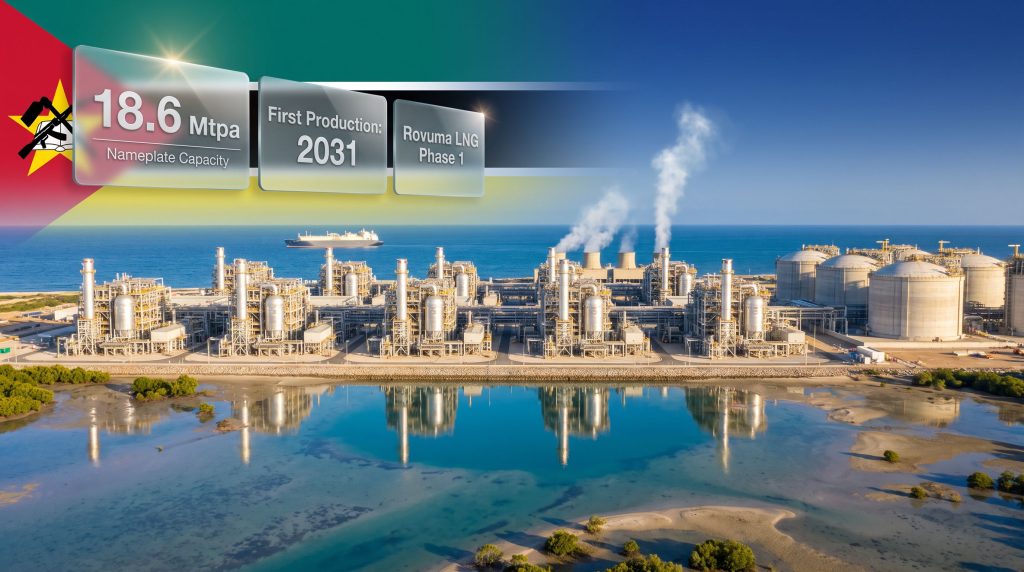
| Nameplate Capacity | 18.6 million tonnes per year (Mtpa) |
| Targeted First Production | 2031 |
| Strategic Classification | ExxonMobil's largest single capital investment |
| Current Development Stage | Pre-FID (FID expected 2026) |
At 18.6 Mtpa, Rovuma LNG Phase 1 would rank among the largest single-site LNG facilities ever sanctioned. For context, this capacity exceeds many individual LNG complexes across Australia and is broadly comparable in scale to some of the largest trains operating in Qatar. It would fundamentally reposition Mozambique from an energy-poor developing economy into a top-tier global LNG exporter.
What a Letter of Intent Actually Signals in LNG Project Development
There is a persistent misunderstanding among general observers about what an LOI represents in large-scale project contracting. It is not a full Engineering, Procurement, and Construction contract. It authorises a defined, limited scope of work — in this case, engineering and procurement services supporting continued project definition — ahead of formal contract execution. The critical function it serves is maintaining project schedule integrity during the pre-FID period.
In LNG development terms, allowing an engineering team to demobilise between FEED completion and FID can be catastrophic for project economics. Key personnel scatter to competing projects, accumulated institutional knowledge dissipates, and a cold-restart of engineering activity can add years and substantial cost to an already complex execution programme. The LOI prevents exactly this scenario.
Furthermore, understanding global energy market trends helps contextualise why maintaining engineering momentum is commercially vital at this particular stage of the project cycle.
The FEED-to-FID Pipeline: Where the SMDC Consortium Sits Today
- Conceptual Engineering — Feasibility assessment and site selection
- Front-End Engineering and Design (FEED) — Completed by McDermott prior to this award
- Letter of Intent (LOI) Phase — Current stage: McDermott / SMDC JV
- Final Investment Decision (FID) — Anticipated in 2026
- Full EPC Contract Award — Expected post-FID
- Construction and Commissioning — Targeting 2031 first production
The issuance of an LOI for continued engineering — rather than a pause, rebid process, or scope reduction — is one of the clearest signals available that project sponsors are committed to maintaining active development velocity.
Inside the SMDC Consortium: A Multi-Party Structure Built for Scale
The entity receiving the ExxonMobil Rovuma LNG McDermott engineering award is not a single contractor but a carefully assembled four-party joint venture designated as SMDC. Its composition reflects the geographic, financial, and technical requirements of executing one of the world's largest LNG developments.
- McDermott Energy Solutions — Lead engineering contractor and FEED incumbent, providing the critical thread of continuity from previous project definition phases
- Saipem — Italian energy infrastructure specialist with demonstrated experience across African hydrocarbon projects and complex offshore-to-onshore development interfaces
- Daewoo Engineering & Construction — South Korean industrial construction organisation with a strong track record across large-scale LNG and petrochemical facilities in Asia and internationally
- China Petroleum Engineering & Construction Corp. (CPECC) — Chinese state-backed EPC capability providing procurement network depth and construction workforce mobilisation capacity
Why Multi-Party JV Structures Are Necessary at This Scale
Projects of this magnitude cannot be efficiently absorbed by a single contractor. The combination of engineering complexity, geographic procurement requirements, and the need to mobilise construction workforces numbering in the tens of thousands makes a consortium approach the only operationally viable structure.
The geographic distribution of engineering execution reinforces this logic:
| Function | Location |
|---|---|
| Liquefaction Module Engineering (ISBL) | London, UK |
| Detailed Engineering Support | Gurgaon, India |
| Project Management Hub | Milan, Italy (SMDC JV) |
This arrangement leverages McDermott's established LNG engineering centres in London and Gurgaon — facilities with deep institutional expertise in liquefaction process engineering — while centralising cross-consortium coordination in Milan.
ISBL Engineering: The Most Technically Demanding Scope
The engineering mandate under this LOI is specifically directed at Inside Battery Limits (ISBL) facilities. This terminology is worth unpacking because it defines precisely where the most technically sensitive work occurs in LNG project execution.
ISBL refers to the core processing infrastructure within the operational boundary of the facility itself. In LNG terms, this encompasses the liquefaction trains, cryogenic heat exchangers, compression systems, refrigerant circuits, and the associated process equipment that actually converts natural gas into liquid form at approximately minus 162 degrees Celsius. ISBL engineering sets the parameters that govern plant throughput, thermal efficiency, and ultimately the commercial performance of the facility across its operational life.
The Case for a 12-Train Modular Configuration
The decision to pursue a 12-train modular architecture rather than a smaller number of larger trains carries significant technical and financial logic:
- Modular configurations allow phased capital deployment, reducing the peak funding burden on project sponsors and lenders at any single point
- Individual train commissioning enables earlier first revenues before the full facility reaches nameplate capacity, improving project internal rate of return metrics
- Operational and maintenance risk is distributed across multiple discrete units, preventing a single equipment failure from disabling the entirety of production
- The modular template creates a natural expansion pathway, as additional trains can theoretically be added beyond Phase 1 if reservoir performance and market conditions support it
McDermott's FEED Incumbency: A Structural Competitive Advantage
One dimension of this award that receives insufficient analytical attention is the strategic value of FEED incumbency in large-scale LNG contracting. Contractors who complete FEED on major energy projects enter subsequent EPC competitions with an information asymmetry that is genuinely difficult for competing bidders to overcome.
FEED work generates an extraordinary depth of project-specific knowledge: subsurface data interpretations, equipment vendor assessments, site-specific engineering constraints, detailed cost modelling, and a granular understanding of regulatory and permitting pathways. A competing bidder must estimate all of this. The FEED incumbent already knows it.
McDermott's prior completion of FEED for Rovuma LNG therefore positions it not merely as a preferred contractor but as the most informed engineering organisation on the planet with respect to this specific project's technical requirements. The LOI award cements this position and extends the accumulated knowledge base through the pre-FID period. For a deeper look at early procurement activity as Rovuma approaches FID, the wider project pipeline dynamics are equally instructive.
The next major ASX story will hit our subscribers first
Sovereign Context: Reading the Security and Political Risk Environment
Any credible analysis of Rovuma LNG must address the sovereign risk dimension directly. The project sits within Mozambique's northern Cabo Delgado province, the same region where an insurgency led TotalEnergies to declare force majeure on its adjacent Mozambique LNG project in 2021. That declaration effectively suspended construction activity and created significant uncertainty about the viability of Mozambican LNG development as a class.
The broader geopolitical risk landscape facing resource megaprojects in 2025 underscores just how carefully sponsors must weigh sovereign stability against commercial opportunity. ExxonMobil's continued advancement of Rovuma LNG through active engineering engagement suggests that the company's security and geopolitical risk assessment has reached a threshold of sufficient confidence to maintain project velocity.
What the engineering award does signal is that ExxonMobil, as the world's largest publicly traded oil and gas company and an organisation with sophisticated political risk assessment capabilities, has made a calculated determination that the trajectory of conditions in Cabo Delgado justifies continued investment in project development infrastructure.
Three Development Scenarios: How the Path to 2031 Could Unfold
Scenario 1 — Base Case (FID achieved in 2026):
Engineering momentum is sustained through the LOI phase, project financing is structured and committed, and construction commences on a timeline consistent with a 2031 first LNG cargo.
Scenario 2 — Delayed FID (2027 or beyond):
Complexity in project financing arrangements, commodity price volatility affecting project economics, or a reassessment of security conditions in Cabo Delgado delays the investment decision, compressing the construction window and potentially pushing first production beyond the current 2031 target.
Scenario 3 — Phased Acceleration:
Strong LNG demand signals from Asian buyers and competitive project financing terms allow earlier train commissioning, with individual trains entering service in a staggered sequence that begins generating cash flow ahead of the full facility reaching nameplate capacity.
What Global LNG Market Conditions Mean for Rovuma's Timing
| LNG Market Factor | Relevance to Rovuma LNG |
|---|---|
| European demand for non-pipeline gas | Sustained appetite for long-term LNG offtake contracts |
| Asian demand growth (India, China, Southeast Asia) | Rovuma's eastern position offers competitive shipping economics |
| Projected mid-2030s supply gap | New FIDs required by mid-2020s to fill future demand |
| African LNG competitiveness | Mozambique competes with US Gulf Coast and peer East African projects |
However, it is worth noting that resource export challenges facing other major LNG producers offer a useful comparative backdrop for understanding the competitive pressures Mozambique will face once production begins.
Frequently Asked Questions
What has McDermott been awarded for Rovuma LNG?
McDermott, operating through the four-party SMDC joint venture, has received a Letter of Intent from ExxonMobil Moçambique authorising limited engineering and procurement services in support of continued project definition. This is not the full EPC contract; that award is expected after the Final Investment Decision.
When is the Rovuma LNG FID expected?
The Final Investment Decision is targeted for 2026, with first LNG production aimed at 2031.
What is the production capacity of Rovuma LNG Phase 1?
The project is designed as a 12-train modular liquefaction facility with a nameplate capacity of 18.6 million tonnes per year (Mtpa), making it one of the largest single-site LNG developments ever proposed.
Why does FEED incumbency matter in EPC contracting?
Contractors who complete FEED accumulate project-specific knowledge, including cost modelling, equipment specifications, and site constraints, that competing bidders cannot replicate. This creates a structural information advantage that typically converts into more competitive and credible EPC proposals, making the FEED incumbent the natural frontrunner for subsequent contract awards.
What are the economic implications for Mozambique?
An operational 18.6 Mtpa export facility would position Mozambique among the world's leading LNG exporters, generating long-term fiscal receipts through royalties, production-sharing arrangements, and corporate taxation. The ExxonMobil Rovuma LNG McDermott engineering award is, in this respect, far more than a contractor announcement — it is a signal of sustained project conviction with generational economic implications for the country.
Disclaimer: This article contains forward-looking statements and scenario projections based on publicly available information. LNG project development timelines and outcomes are subject to numerous variables including commodity markets, financing conditions, regulatory environments, and geopolitical factors. Nothing in this article constitutes financial or investment advice.
Want to Capitalise on the Next Major Resource Discovery Before the Market Catches On?
While megaprojects like Rovuma LNG dominate the long-cycle energy conversation, significant mineral discoveries on the ASX can deliver transformative returns in a far shorter timeframe — and Discovery Alert's proprietary Discovery IQ model ensures subscribers receive real-time alerts the moment those discoveries are announced. Explore historic examples of exceptional discovery-driven returns or start your 14-day free trial today to position yourself ahead of the broader market.