August 8, 2026
A Technology Inflection Point in Global Nickel Supply
The global nickel industry is approaching a structural crossroads. For decades, processing economics dictated that laterite nickel ores were best handled through either pyrometallurgical smelting or high-pressure acid leach (HPAL) technology. Both approaches carry significant capital and operational burdens. Now, an alternative route is being validated at commercial scale for the first time anywhere in the world, and it is happening not in Indonesia, the Philippines, or Australia, but in the semi-arid interior of northeastern Brazil.
The Brazilian Nickel Piauí Níquel project is not simply another mining development story. It represents a genuine technology and supply chain inflection point, one that carries implications for how battery-grade nickel is produced, where it comes from, and which nations ultimately secure a durable seat in the global critical minerals demand economy.
When big ASX news breaks, our subscribers know first
What the Piauí Níquel Project Actually Is
Laterite Ore, Heap Leaching, and a Battery-Grade Outcome
Located near Capitão Gervásio Oliveira in southern Piauí state, the Brazilian Nickel Piauí Níquel project sits within one of Brazil's significant laterite nickel belts. Laterite nickel deposits form through prolonged tropical weathering of ultramafic rocks, a process that concentrates nickel and cobalt near the surface in a profile that is geologically distinct from sulfide nickel deposits common in Canada, Russia, and parts of Australia.
The ore type matters enormously because it determines which processing routes are technically and economically viable. Sulfide ores can be concentrated through relatively efficient flotation methods. Laterites cannot. They require hydrometallurgical or pyrometallurgical treatment, and the choice between approaches defines the entire project economics.
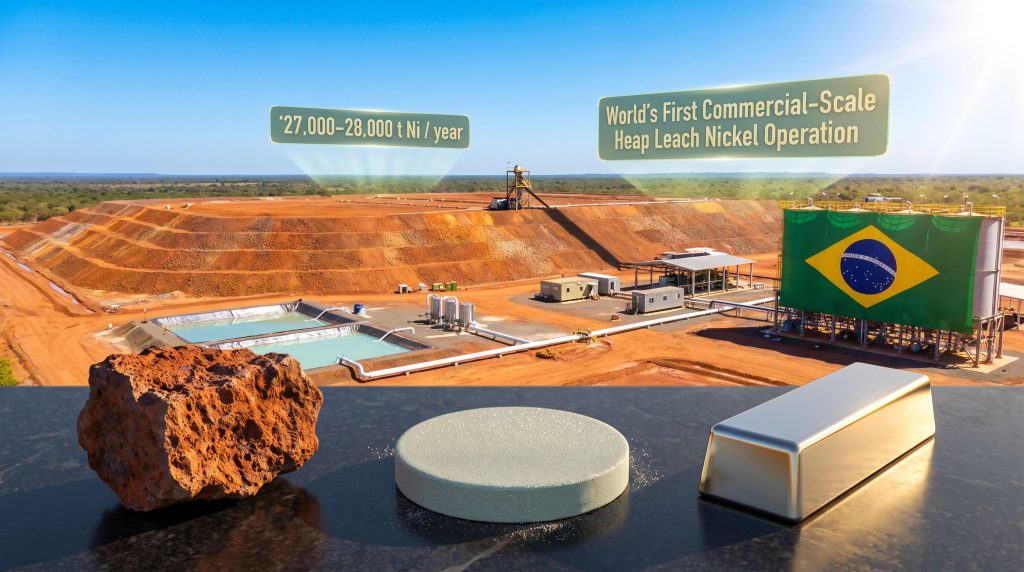
The Piauí Níquel project applies heap leaching to its laterite ore, producing Mixed Hydroxide Precipitate (MHP) as its primary output. MHP is an intermediate nickel-cobalt product that sits one processing step away from battery-grade precursor cathode active materials (pCAM) used in lithium-ion battery manufacturing. It is not a finished battery material, but it feeds directly into the supply chains that produce them.
Project Development Timeline
| Milestone | Year |
|---|---|
| Early-stage exploration and pilot testing | Pre-2022 |
| Small-scale production commences | 2022 |
| BNDES financing commitment | July 2026 |
| Full-scale commercial production target | 2028-2029 |
Why Heap Leaching Changes the Economics of Laterite Nickel
The Problem With Conventional Processing Routes
High-pressure acid leach (HPAL) technology has been the dominant hydrometallurgical route for processing laterite nickel into battery-grade intermediates. Projects such as those operated in the Pacific and Southeast Asia demonstrate both the capability and the limitations of HPAL at scale. Capital costs for HPAL facilities routinely run into billions of dollars. Operating environments require high-temperature, high-pressure vessels that are corrosion-prone, energy-intensive, and technically demanding to maintain. Cost overruns and commissioning delays have been a persistent feature of the HPAL project landscape globally.
Heap leaching works differently. Crushed ore is stacked on engineered lined pads, and an acid solution is applied to percolate through the material, dissolving target metals into a solution that is then processed downstream. The technology has been used commercially for copper and gold for several decades. Applying it to nickel laterite at commercial scale, however, has not been achieved before the Piauí Níquel project. Furthermore, heap leach technology is now being closely watched by industry analysts as a potential game-changer for laterite supply outside Indonesia.
A Direct Environmental and Cost Comparison
| Parameter | Heap Leaching (Piauí Níquel) | HPAL Processing (Conventional) |
|---|---|---|
| Water consumption | Lower | Significantly higher |
| Energy intensity | Lower | High (requires steam and pressure) |
| Capital expenditure | More competitive | Capital-intensive |
| Acid consumption | Moderate | Very high |
| Tailings risk profile | Different and manageable | High-volume tailings risk |
| Technology readiness at this scale | First commercial application | Established but expensive |
Technical Insight: The pilot plant validation phase is the critical de-risking step that separates speculative heap leach nickel claims from credible commercial projects. Piauí Níquel has completed pilot-scale testing, providing the empirical recovery data that underpins the commercial production forecasts. Without this validation, production estimates would remain theoretical.
MHP: Understanding the Battery Supply Chain Position
Not all nickel products are equal in the context of battery manufacturing. Class 1 nickel, refined to above 99.8% purity, is the traditional benchmark product. MHP occupies a different and increasingly important position as a direct precursor to battery cathode materials, particularly for nickel-manganese-cobalt (NMC) and nickel-cobalt-aluminum (NCA) cathode chemistries. In addition, the broader battery metals investment landscape has increasingly recognised MHP as a strategically significant intermediate product.
- MHP is produced at a lower cost than finished Class 1 nickel refinery products
- Battery manufacturers can process MHP directly into cathode precursors without full metallic refining
- Cobalt content in MHP from laterite sources provides an additional revenue stream in a market where cobalt supply remains geographically concentrated in the Democratic Republic of Congo
- Premium pricing applies when MHP meets battery-grade specifications, reflecting the supply constraints for reliable intermediate nickel-cobalt products
Projected Production Output and What It Means
Annual Capacity at Full Commercial Scale
| Metric | Conservative Estimate | Upper Estimate |
|---|---|---|
| Annual nickel production | 27,000 tonnes | 28,000 tonnes |
| Annual cobalt production | 900 tonnes | 1,000 tonnes |
| Product form | Battery-grade MHP | Battery-grade MHP |
| Target start year | 2028 | 2029 |
To contextualise these figures, global nickel demand for battery applications alone was estimated at approximately 500,000 tonnes in recent years and is projected to grow substantially through the decade. A single project producing 27,000 to 28,000 tonnes annually therefore represents a meaningful but not dominant contribution, placing Piauí Níquel in the category of a significant supply addition rather than a market-transforming volume event.
The one-year variance in the production timeline reflects genuine uncertainty in infrastructure completion, financing finalisation, and construction sequencing. For project observers and investors, the 2028 versus 2029 distinction carries financial implications because it affects when the project begins generating operating cash flow against development capital deployed.
Investor Note: All forward-looking production estimates involve material assumptions about financing completion, construction progress, regulatory approvals, and commodity price conditions. These forecasts should not be treated as guaranteed outcomes. Prospective investors should conduct independent due diligence and consult qualified financial advisors before making investment decisions.
Brazil's Strategic Position in the Global Nickel Supply Chain
The Concentration Problem Driving Diversification Demand
Indonesia's dominance in global nickel production has created a structural vulnerability in battery supply chains that manufacturers, automakers, and governments in Europe, North America, and Asia are actively trying to address. Indonesian nickel supply challenges, including export restrictions and domestic processing mandates, have added layers of uncertainty for international buyers. Consequently, this concentration dynamic creates a genuine market opening for alternative producing jurisdictions with:
- Stable political and regulatory environments
- Technically validated processing capabilities
- ESG-compatible operations that meet international financier and buyer requirements
- Geographic diversity relative to existing supply concentration
Brazil satisfies several of these criteria simultaneously, a combination that is less common than the demand-driven narrative might suggest.
The Value-Add Imperative: Why MHP Production Matters for Brazil
Brazilian Nickel's Corporate Affairs Director, Luciana Gutmann, articulated a clear strategic position when addressing an industry panel focused on operational and environmental monitoring challenges in critical mineral exploration. Her remarks made plain that the project's decision to produce MHP rather than export raw ore is a deliberate industrial policy choice as much as a commercial one.
The distinction is significant. Raw laterite ore exports generate minimal domestic economic value and leave the entire processing margin offshore. By contrast, producing battery-grade MHP captures a substantially larger share of the value chain within Brazil, positions the country as a processing-capable supplier rather than a raw material exporter, and strengthens the commercial relationships available to Brazilian entities in global battery supply chains.
Gutmann further highlighted that Brazil has the opportunity to position itself not merely as a large nickel producer but as one of the most reliable. In a global supply environment increasingly defined by concentration risk, reliability and ESG-compatible processing credentials carry commercial weight beyond simple volume metrics.
Financing Structure and the Role of Development Capital
BNDES Commits R$19.2 Million to Piauí Níquel Metais
In July 2026, Brazil's national development bank, BNDES, committed R$19.2 million in financing to Piauí Níquel Metais, the Brazilian subsidiary through which the project operates. This represents development-stage capital rather than full project financing, and its significance lies as much in the validation signal it sends to private capital markets as in the quantum of funding itself. Details of this commitment are outlined in the project financing announcement that accompanied the letter of intent for broader capital raising.
Development finance institutions like BNDES serve a structurally important function in the critical minerals project development cycle:
- They can price long-duration project risk more patiently than commercial banks
- Their participation signals regulatory and institutional confidence to co-investors
- They often require robust community engagement and environmental management frameworks as conditions of financing, which strengthens project social licence
- Their involvement can unlock access to international development finance from multilateral institutions
The project is structured through a subsidiary arrangement, with Brazilian Nickel as the parent entity and Piauí Níquel Metais as the Brazilian operating company. This structure is typical for foreign-originated mining projects operating in Brazil, providing local legal standing and facilitating access to domestic financing instruments.
Framework Note: BNDES financing at the development stage does not constitute a guarantee of project completion or commercial success. The gap between early-stage development capital and the full project financing required for construction remains a material risk for projects at this stage of the development cycle.
The next major ASX story will hit our subscribers first
Community Engagement as an Operational Prerequisite
Building Social Licence in a Region Without Mining Tradition
The social dimensions of the Brazilian Nickel Piauí Níquel project are as strategically important as the technical ones. Piauí state does not have an established mining industry tradition. Communities in the project area have no prior experience of large-scale resource extraction, which means that assumptions, institutional knowledge, and trust frameworks that exist in established mining regions cannot be borrowed or assumed.
This context requires a different community engagement model, and the approach taken by Brazilian Nickel reflects an awareness of that distinction. Engagement was initiated substantially earlier than is typical for greenfield projects, with Gutmann noting that the project established its community committee structure well before construction had commenced.
The current community engagement framework includes:
- A formal Project Committee composed of representatives from ten distinct community groups
- Dedicated forums for women as a specific and separate stakeholder cohort
- Active dialogue with local government representatives at both municipal and state levels
- Social investment programs developed in response to community-identified priorities rather than corporate-defined templates
Operational Insight: In regions without prior mining exposure, the absence of cultural familiarity with extraction industries means that even well-intentioned projects can generate significant community resistance if engagement begins too close to construction. The value of early, sustained dialogue is that it converts abstract risk into understood opportunity, replacing fear of the unknown with informed participation.
Environmental Considerations and ESG Positioning
Why Processing Route Choice Has ESG Consequences
The selection of heap leaching over HPAL carries meaningful environmental implications beyond the cost structure. HPAL operations generate large volumes of acidic tailings that require extensive containment and long-term management. The energy footprint of high-pressure steam systems is substantial, typically powered by fossil fuels in jurisdictions where renewable energy infrastructure is limited.
Heap leaching produces a different environmental profile. Water consumption is lower, energy requirements are less intensive, and the acid volumes involved, while still significant, are more manageable at the scale of a single project.
For international capital markets, particularly European institutional investors and development finance institutions with explicit ESG mandates, the processing route choice affects both financing eligibility and the terms on which capital is available. ESG-compatible projects in the critical minerals sector increasingly access preferential financing conditions, reflecting the growing alignment between sustainability credentials and capital cost.
Challenges on the Path to First Production
The Risks That Remain Material
Acknowledging the project's technical and strategic strengths requires equal attention to the challenges that remain unresolved:
-
Full project financing: The gap between BNDES development capital and the total capital required for commercial-scale construction is substantial. Securing project finance at acceptable terms in the current interest rate environment is a genuine execution risk.
-
Infrastructure in Piauí: Northeastern Brazil's infrastructure profile, including power grid capacity, water access, and logistics connectivity, requires careful management. Project timelines are sensitive to infrastructure development alongside the mining operation itself.
-
Nickel price cyclicality: The nickel market has experienced significant price volatility in recent years, including the extraordinary events of the London Metal Exchange nickel short squeeze in 2022 and subsequent price corrections. Project viability at various price scenarios must be stress-tested against realistic market conditions.
-
Regulatory and environmental licensing: Brazil's environmental licensing process, administered through federal and state agencies, can introduce timeline uncertainty even for well-prepared projects. Proactive engagement with regulators is essential but does not eliminate approval risk.
Brazil's Emerging Role in the Critical Minerals Economy
Institutional Architecture as the Missing Variable
Brazil possesses the geological endowment, the processing technology validation, and the geopolitical attributes that make it a credible alternative anchor supplier for global battery supply chains. What determines whether this potential is realised is not geology but institutional coordination. Furthermore, nickel's industrial importance in the energy transition continues to grow, reinforcing the strategic case for diversified supply sources.
The convergence of technically validated processing, development finance commitment, proactive community engagement, and ESG-aligned operations at the Brazilian Nickel Piauí Níquel project represents a rare alignment of conditions in the critical minerals development landscape. Converting that alignment into a producing asset requires sustained coordination between the private sector, financial institutions, and regulatory bodies across a multi-year execution window.
For the broader nickel market, the Piauí Níquel project carries an importance that extends beyond its individual production volumes. If heap leaching for nickel laterite is successfully validated at commercial scale, it opens a new technological pathway for laterite deposits globally. This could potentially reshape project economics across a resource base that is distributed far more widely than the sulfide deposits that dominated 20th-century nickel production. The implications for battery storage expansion are likewise considerable, as reliable intermediate nickel supply underpins the entire downstream battery manufacturing ecosystem.
Frequently Asked Questions: Brazilian Nickel Piauí Níquel Project
What type of ore does the Piauí Níquel project process?
The project processes laterite nickel ore, a surface-level ore type formed through prolonged tropical weathering of ultramafic rocks. This ore type is widespread across tropical regions including Brazil, and its processing has historically required either pyrometallurgical or HPAL hydrometallurgical approaches.
What product will the project produce?
The primary output is battery-grade Mixed Hydroxide Precipitate (MHP), an intermediate nickel-cobalt product used in lithium-ion battery cathode manufacturing and broader industrial chemical applications.
When is commercial production expected?
Current estimates place full-scale commercial production between 2028 and 2029, subject to financing completion, construction progress, and regulatory approvals.
How much nickel will the project produce annually?
Planned annual output ranges from approximately 27,000 to 28,000 tonnes of nickel and 900 to 1,000 tonnes of cobalt per year at full capacity.
What financing has the project secured?
In July 2026, Brazilian development bank BNDES committed R$19.2 million in financing to Piauí Níquel Metais to support project development.
Why is this project considered a global first?
It is set to become the first commercial-scale application of heap leaching technology specifically for nickel and cobalt production anywhere in the world, a milestone with significant implications for global laterite nickel processing economics.
Where is the project located?
The project is situated near Capitão Gervásio Oliveira in southern Piauí state, northeastern Brazil.
Readers seeking further coverage of Brazil's critical minerals sector and nickel industry developments can access ongoing reporting through Brasil Mineral at brasilmineral.com.br.
Want to Stay Ahead of the Next Major Mineral Discovery on the ASX?
Discovery Alert's proprietary Discovery IQ model delivers real-time alerts the moment significant ASX mineral discoveries are announced, transforming complex data across more than 30 commodities into clear, actionable insights for both short-term traders and long-term investors. Explore historic examples of exceptional discovery returns and begin your 14-day free trial today to position yourself ahead of the broader market.