
August 7, 2026
The Regulatory Mechanism That Shapes a Nation's Resource Future
Every major mining jurisdiction on earth wrestles with the same fundamental tension: how to extract strategic minerals efficiently while maintaining credible environmental oversight. Canada's answer to that question has been tested, contested, and now, with the Crawford nickel project federal approval issued on July 31, 2026, partially validated. For investors, policymakers, and resource professionals tracking critical mineral supply chains, understanding what this approval does and does not represent is essential context.
The Crawford decision is not simply a corporate milestone for Canada Nickel Company. It is a stress test result for a regulatory framework that has been under sustained scrutiny since its introduction.
When big ASX news breaks, our subscribers know first
Crawford's Federal Approval: What the Decision Statement Actually Means
A federal Decision Statement issued under Canada's Impact Assessment Act is a precisely defined legal instrument. It represents a formal determination by the Minister of Environment that a designated project may proceed, subject to a set of legally binding conditions. What it does not represent is construction authorisation. The distinction carries significant weight for anyone assessing project timelines or capital deployment risk.
For the Crawford nickel project near Timmins, Ontario, the positive Decision Statement issued on July 31, 2026, marks the culmination of an assessment process that was still under active federal review as recently as June 11, 2026. The speed of the final determination phase was noted across the sector.
Critically, before any earth is moved at Crawford, Canada Nickel must complete:
- Detailed engineering and feasibility finalisation
- A formal investment decision, currently targeted for 2027
- All remaining Ontario provincial permit approvals
- Outstanding federal permit requirements that sit downstream of the Decision Statement itself
- Fulfilment of Indigenous partnership and community engagement commitments
A federal Decision Statement is environmental clearance, not a construction licence. The regulatory journey from positive Decision Statement to ground-breaking typically spans multiple years and requires parallel workstreams across engineering, financing, and permitting.
The conditions attached to the approval are legally enforceable throughout the project's operational life, covering areas including environmental monitoring protocols, biodiversity protection measures, and ongoing Indigenous consultation obligations. Compliance tracking mechanisms are embedded in the IAA framework itself.
Why This Is the First Approval of Its Kind Since 2019
Canada's Impact Assessment Act, which replaced the Canadian Environmental Assessment Act in 2019, has faced sustained criticism from mining industry participants who argued it created unpredictable timelines, duplicated provincial processes, and generated commercial uncertainty for project proponents. The legislation also faced constitutional challenges, with the Supreme Court of Canada issuing a reference opinion in 2023 that found certain provisions exceeded federal jurisdiction, prompting subsequent amendments.
Crawford is the first mining project to receive a positive Decision Statement under the amended IAA framework, making it a de facto regulatory precedent. The mining sector has been watching closely to see whether the post-amendment legislation could process a project of this scale through to approval in a commercially credible timeframe.
The implications extend well beyond Crawford. Projects currently in the federal assessment queue will now have a concrete reference point for timelines, condition structures, and process sequencing. Furthermore, whether that precedent proves encouraging or cautionary for future proponents will depend heavily on the specific conditions attached and the efficiency of post-Decision Statement permitting.
Industry stakeholders have consistently called for:
- Clearer and more predictable assessment timelines
- Reduced duplication between federal and provincial review processes
- Greater front-end engagement with Indigenous communities to prevent late-stage project delays
- Transparent condition-setting criteria to allow meaningful pre-application planning
The broader mining claims framework across Canadian jurisdictions continues to evolve in response to these pressures, adding further complexity for project proponents navigating approvals at both provincial and federal levels.
Understanding Crawford's Scale and Strategic Position
The Crawford deposit sits within one of the most prolific mining belts in North America. The Timmins region of northeastern Ontario has produced more than 70 million ounces of gold historically and hosts world-class base metal infrastructure, experienced workforce pools, and established supply chain networks. For a project requiring multi-decade operational continuity, location quality is as important as deposit quality.
Crawford Nickel Project: Key Economic Metrics
| Metric | Projected Figure |
|---|---|
| Total investment potential | ~$5 billion |
| Construction employment | ~5,000 jobs |
| Operational employment | ~1,300 jobs |
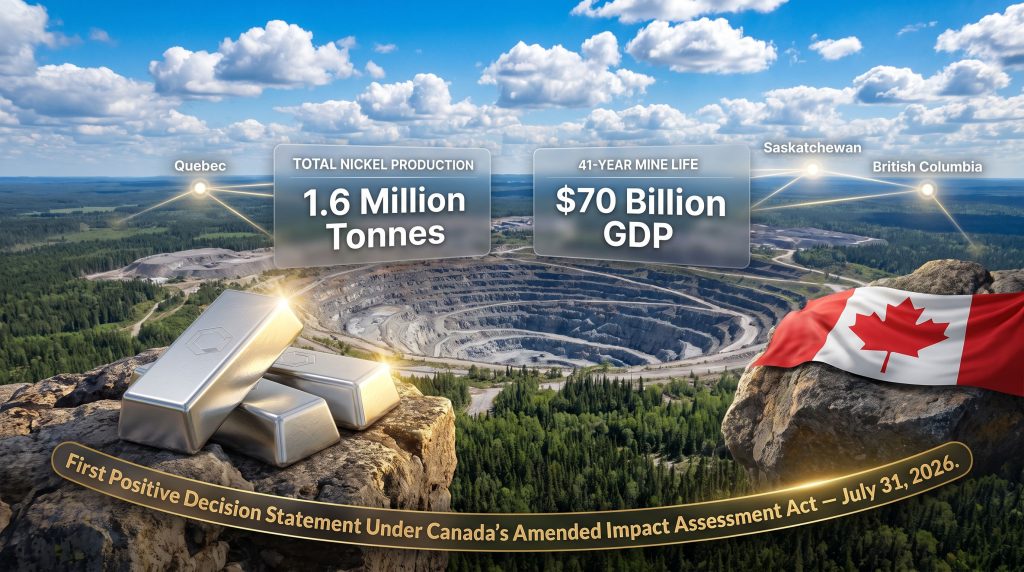
| Estimated GDP contribution | ~$70 billion (life of mine) |
| Mine life | 41 years |
| Total nickel production | 1.6 million tonnes |
The deposit's geology warrants specific attention. Crawford is a large-tonnage, low-to-moderate-grade nickel sulphide deposit hosted in ultramafic rock, a geological setting that also yields significant cobalt and chromium credits. Unlike laterite nickel deposits, which require energy-intensive high-pressure acid leach processing, nickel sulphide ores are amenable to conventional flotation concentration followed by smelting.
This processing pathway carries well-understood economics, lower processing costs per tonne, and a more established offtake market. This metallurgical distinction matters for the battery supply chain specifically. Class 1 nickel, the refined form required for lithium-ion battery cathodes used in electric vehicles, is more readily produced from sulphide concentrates than from laterite sources. With the global EV industry placing increasing pressure on Class 1 nickel supply, sulphide deposits of Crawford's scale carry a structural premium in long-term offtake negotiations.
What Makes Crawford Strategically Irreplaceable
- Sulphide ore type enables lower-cost processing routes compared to laterite nickel, the dominant global nickel ore type
- 41-year mine life provides long-duration supply visibility for battery manufacturers seeking decade-scale offtake security
- Timmins location offers existing infrastructure, power access, and proximity to established smelting capacity in the Sudbury Basin
- Canadian jurisdiction satisfies increasingly stringent ESG and supply chain provenance requirements from North American and European battery manufacturers
- Scale positions Crawford as one of the largest undeveloped nickel sulphide deposits in the Western Hemisphere
Canada's Critical Minerals Pipeline: A Multi-Commodity, Multi-Province Build-Out
The Crawford nickel project federal approval does not exist in isolation. It is one data point in a broader national effort to convert Canada's geological endowment into operating production capacity across a range of battery-relevant and industrial minerals. The emphasis on critical minerals energy security has intensified considerably at both federal and provincial levels over recent years.
Major Canadian Critical Mineral Projects Advancing in 2026
Bégin-Lamarche Phosphate Project, Quebec
Natural Resources Canada committed nearly $5 million toward power transmission and transportation infrastructure studies for First Phosphate's Quebec project, with First Phosphate matching the contribution. The work examines connections to regional rail networks and the Port of Saguenay. Production is targeted for 2029, positioning the project within the accelerating North American phosphate supply chain for fertiliser and battery-grade applications.
Project Aurora Lithium-Brine Demonstration Plant, Saskatchewan
EMP Metals completed construction of its Viewfield demonstration facility and, at the time of reporting, was approximately halfway through commissioning. The facility is designed to validate direct lithium extraction process performance, optimise operating parameters, and generate the engineering and economic data necessary for a commercial-scale plant targeting production of more than 3,000 tonnes of lithium products annually.
Blackwater Gold Mine Phase 1A Expansion, British Columbia
Artemis Gold reported 57% completion of its $120-million Phase 1A expansion at the end of Q2 2026, with commissioning on track for Q4 2026. The expansion increases nameplate processing capacity from 6 million to 8 million tonnes per year. Simultaneously, major works construction has commenced on the $1.44 billion EP2 expansion, with combined throughput capacity across both expansions expected to reach 21 million tonnes per year by Q4 2028.
Canada's Emerging Critical Minerals Geography
| Province | Key Commodity | Notable Project |
|---|---|---|
| Ontario | Nickel, Cobalt | Crawford (Canada Nickel) |
| Quebec | Phosphate | Bégin-Lamarche (First Phosphate) |
| Saskatchewan | Lithium | Project Aurora (EMP Metals) |
| British Columbia | Gold | Blackwater (Artemis Gold) |
The geographic diversification of Canada's critical minerals pipeline reduces single-jurisdiction concentration risk and reflects the geological reality that Canada's resource endowment spans virtually every commodity relevant to the energy transition. In addition, developments such as the major copper system discoveries in South America serve as a reminder that international competition for strategic mineral supply remains intense.
The Financing Architecture Behind Critical Mineral Development
One of the least-discussed but most consequential challenges facing Canadian critical mineral projects is financing complexity. The capital required to move a project from federal approval to first production is measured in billions, and the sources of that capital are increasingly diverse and conditionally complex.
Government incentive structures, international capital flows, strategic investors with offtake motivations, and sovereign wealth participation are all reshaping how Canadian critical mineral projects are structured financially. This diversity creates both opportunity and legal complexity.
Carlos da Costa, writing for CIM Magazine, argued that conditions attached to public funding, discretionary national security reviews, trade obligations, and expectations around Indigenous participation are generating layered legal and commercial uncertainties for project proponents. The core argument is that a more coherent statutory framework governing the state's role in critical mineral project financing would reduce uncertainty for private capital and strengthen Canada's competitive position against peer jurisdictions.
For Crawford specifically, reaching a 2027 investment decision will require Canada Nickel to navigate exactly this kind of multi-stakeholder financing environment while simultaneously advancing detailed engineering and maintaining regulatory compliance momentum.
The next major ASX story will hit our subscribers first
Canada's Critical Minerals Strategy Refresh: What's Being Revised
The federal government is actively updating its Critical Minerals Strategy, with stakeholder input sought through a Request for Information process with a submission deadline of August 14, 2026. The refreshed strategy is expected to place greater emphasis on:
- Domestic production and downstream processing capacity
- Stronger partnerships with Indigenous communities, provinces, and territories
- Deeper alignment with international allies on supply chain security
- Clearer frameworks for state participation in project financing
The Crawford nickel project federal approval arrives at a moment when the policy architecture governing critical minerals development is itself in active revision. The project's approval simultaneously validates the existing regulatory framework and informs the updated strategy's thinking on how large-scale mine approvals should be structured going forward.
Policy frameworks can create enabling conditions for mineral development, but project-specific outcomes depend entirely on the proponent's capacity to complete engineering, secure financing, and satisfy all remaining permit requirements. Regulatory approval and project execution are separate disciplines.
Mine Closure as a Regulatory Benchmark: Lessons from Diavik
Any discussion of new project approvals in Canada's mining sector now operates in the context of how existing operators manage end-of-life obligations. The Diavik diamond mine in the Northwest Territories, operated by Rio Tinto, provides an instructive case study. Furthermore, mine reclamation importance has increasingly become a central consideration in how regulators assess new project applications.
After 23 years of continuous production, Diavik ceased mining operations in March 2026. The reclamation programme is now in active execution. Rio Tinto activated nine siphons to transfer water from Lac de Gras into three mined-out open pits: A21, A418, and A154. The pit-filling process is expected to take between 6 and 12 months, after which water quality confirmation testing must be completed before the pits are reconnected to Lac de Gras. Full active closure activities are targeted for completion by 2030.
What makes Diavik relevant to Crawford's regulatory context is the signal it sends to assessment processes for new approvals. Regulators and affected communities increasingly evaluate proposed projects through the lens of demonstrated closure performance by major operators. A structured, phased closure programme like Diavik's establishes a credibility benchmark that new project proponents, including Canada Nickel, will be expected to match or exceed in their own closure planning obligations.
Crawford's eventual closure framework, though decades away, is already embedded in the conditions attached to its federal Decision Statement. The architecture of responsible closure is now built into the approval architecture itself, a structural shift from earlier regulatory generations where closure planning was an afterthought addressed near the end of mine life.
FAQ: Crawford Nickel Project Federal Approval
Has Crawford Been Approved for Construction?
No. The July 31, 2026 Decision Statement provides federal environmental clearance subject to binding conditions. Physical construction requires completion of detailed engineering, secured financing, and all remaining provincial and federal permits.
When Is a Final Investment Decision Expected?
Canada Nickel is targeting a formal investment decision in 2027, following completion of engineering and financing arrangements.
What Is Crawford's Projected Nickel Output?
The project is expected to produce approximately 1.6 million tonnes of nickel across a 41-year mine life.
Why Is the July 31 Approval Historically Significant?
Crawford is the first mining project to receive a positive Decision Statement under Canada's amended Impact Assessment Act since the legislation's 2019 introduction, establishing a meaningful regulatory precedent for the sector.
What Conditions Apply to the Approval?
Legally binding conditions cover environmental monitoring, biodiversity protection, and Indigenous consultation obligations. These apply throughout the project's construction and operational phases.
What Is the Projected Economic Contribution?
Federal projections estimate approximately $5 billion in total investment, 5,000 construction jobs, 1,300 operational roles, and a ~$70 billion GDP contribution over the life of the mine.
Disclaimer: Projections, timelines, employment forecasts, and economic estimates referenced in this article are based on publicly available project assessments and federal review documentation. Forward-looking figures are subject to change based on engineering outcomes, financing conditions, commodity markets, and regulatory developments. This article does not constitute financial or investment advice.
Want to Track the Next Major Mineral Discovery Before the Market Moves?
Discovery Alert's proprietary Discovery IQ model delivers real-time alerts on significant ASX mineral discoveries, transforming complex geological data into actionable investment insights for both new and experienced investors — explore historic discoveries and their exceptional returns to understand the opportunity, then begin your 14-day free trial at Discovery Alert to position yourself ahead of the market.