July 16, 2026
The Automation Architecture Dilemma Reshaping Surface Mining
The history of industrial automation is littered with cautionary tales about proprietary lock-in. From early programmable logic controllers to enterprise resource planning systems, industries that embraced closed ecosystems often found themselves trapped by vendor dependency, constrained upgrade cycles, and inflated long-term costs. Surface mining is now confronting this same inflection point, and automation in mining decisions made today about autonomous haulage architecture will shape operational economics for decades.
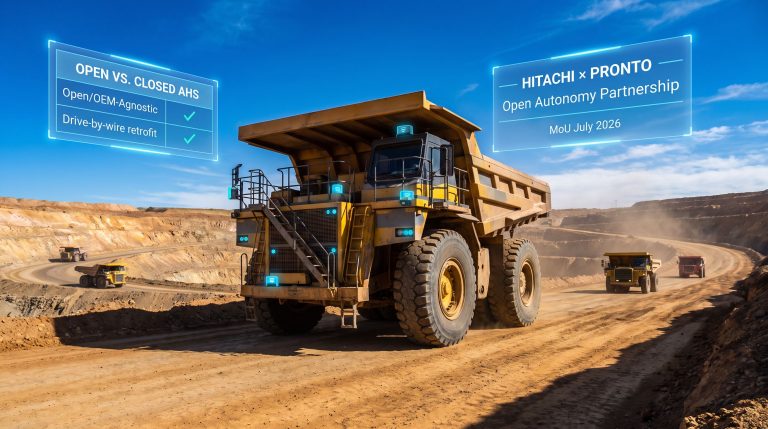
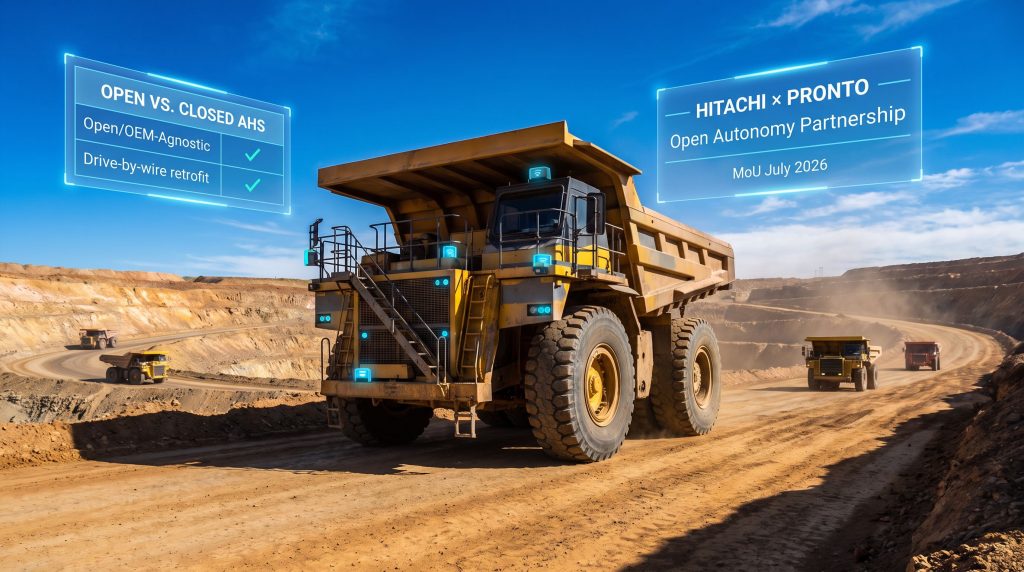
Against this backdrop, Hitachi Construction Machinery and autonomous haulage technology company Pronto formalised a memorandum of understanding in July 2026 to jointly develop open mine automation solutions designed to function across mixed-fleet environments. The partnership reflects a broader structural shift in how the mining sector is beginning to think about automation procurement, and it arrives at a moment when the limitations of closed, single-vendor systems are becoming increasingly difficult to ignore.
When big ASX news breaks, our subscribers know first
Why Closed Automation Ecosystems Are Losing Ground
The Mixed-Fleet Reality Most Mine Operators Face
The vast majority of active surface mining operations globally do not run uniform fleets sourced from a single original equipment manufacturer. Capital procurement decisions are made over decades, equipment is inherited through acquisitions, and different truck classes serve different operational needs across a single mine site. This is the mixed-fleet reality that proprietary autonomous haulage systems have historically failed to accommodate.
Closed-ecosystem AHS providers have typically required operators to standardise their entire haul truck fleet on one manufacturer's equipment before deployment becomes viable. For most mid-tier and regional operators, this represents an economically prohibitive barrier. The capital required to replace an existing mixed fleet solely to qualify for autonomous operation is rarely justifiable on productivity grounds alone.
The compounding pressures operators now face make this problem more acute:
- Persistent skilled labour shortages across major mining jurisdictions including Australia, North America, and parts of sub-Saharan Africa are forcing operations to reconsider workforce dependency models
- Rising input costs are compressing margins and increasing scrutiny on every capital allocation decision
- Safety imperatives are accelerating the case for removing human operators from high-risk haulage environments, where fatigue and visibility limitations contribute disproportionately to serious incidents
- Productivity pressure from commodity market volatility is driving demand for systems that can sustain higher truck utilisation across extended operating windows
Haul truck operations consistently rank among the highest-risk activity categories in surface mining. Autonomous configurations that remove operators from the cab directly address several of the most persistent causal factors in haulage-related incidents, including fatigue, proximity errors, and poor visibility conditions.
The Total Cost of Ownership Problem With Proprietary Systems
Beyond the upfront capital barrier, closed automation architectures generate ongoing costs that are less visible but equally significant. When an operator's entire autonomous haulage capability is tied to a single vendor's technology stack, that vendor effectively controls the upgrade roadmap, pricing trajectory, and integration flexibility of the system indefinitely.
Open automation platforms are designed to break this dependency. Furthermore, by enabling integration with equipment and software from multiple manufacturers, they restore procurement leverage to operators and allow technology decisions to be made on technical and commercial merit rather than ecosystem compatibility. Data-driven mining operations are increasingly central to this shift, enabling smarter decisions across procurement and fleet management alike.
What the Hitachi-Pronto MoU Actually Establishes
A Development Framework, Not a Finished Product
It is important to understand what the July 2026 MoU represents and what it does not. According to Hitachi Construction Machinery, this agreement establishes a collaborative development framework through which Hitachi Construction Machinery and Pronto will work to define the architecture, integration protocols, and commercial pathways for joint open automation solutions. No pre-existing commercial product carries the combined Hitachi-Pronto branding at this stage.
The distinction matters for operators evaluating the market. The partnership is in the process of building the technical and commercial foundation from which deployable solutions will eventually emerge, and both companies intend to leverage their respective customer relationships to identify priority environments for early adoption work.
What Each Partner Contributes
The strategic logic of the partnership becomes clear when the complementary capabilities of each party are examined side by side.
| Partner | Core Contribution to the Partnership |
|---|---|
| Hitachi Construction Machinery | Global mining equipment manufacturing presence, large established customer base, digital fleet management infrastructure (Wenco FMS, ConSite Mine), and an active proprietary AHS programme in testing and deployment |
| Pronto | OEM-agnostic autonomous haulage system, drive-by-wire retrofit technology, computer vision and GNSS-based navigation, commercial deployments across three continents at varying operational scales |
The combination is strategically coherent. Pronto's mining industry solutions bring validated retrofit technology that has already demonstrated cross-OEM compatibility in live production environments. Hitachi Construction Machinery, in addition, brings the equipment credibility, global distribution infrastructure, and digital data layer that a specialist autonomy company typically lacks.
The Open Connectivity Philosophy Behind the LANDCROS Rebrand
Hitachi Construction Machinery's planned rebrand to LANDCROS, scheduled for April 2027, provides important strategic context for understanding why this partnership was pursued. The company has publicly framed the transition as a commitment to open connectivity, describing an approach centred on linking products, technologies, and third-party partners within a flexible ecosystem rather than a closed proprietary model.
The Pronto MoU is consistent with this repositioning. Rather than defending a closed AHS ecosystem as a competitive moat, Hitachi Construction Machinery appears to be betting that open interoperability will generate greater long-term commercial value by expanding the addressable market for its equipment and digital solutions.
How Pronto's Autonomous Haulage System Works
The Technical Architecture Enabling OEM-Agnostic Operation
Pronto's system achieves OEM-agnostic operation through a drive-by-wire retrofit kit that can be installed on existing haul trucks from any manufacturer. Rather than requiring purpose-built autonomous vehicles, the technology converts conventional haul trucks into autonomously capable units without replacing the underlying asset.
Navigation is achieved through a combination of computer vision and GNSS positioning. This sensor-light architecture is a deliberate design choice that carries significant practical implications. Systems that depend heavily on LiDAR arrays or dense fixed infrastructure require substantial upfront capital investment and create complex ongoing maintenance obligations. Pronto's approach minimises these requirements, consequently reducing the deployment threshold for operations that might otherwise find high-infrastructure AHS systems commercially unviable.
Key technical characteristics of the system include:
- Drive-by-wire retrofit capability applicable to haul trucks regardless of original manufacturer
- Computer vision paired with GNSS navigation, reducing reliance on expensive sensor arrays
- Minimal site infrastructure modification requirements prior to deployment
- Scalable architecture validated from regional quarry environments through to ultra-class, deep-pit open-cut operations
- Commercial deployment history spanning mixed-fleet operations across three continents
Why Sensor-Light Architecture Matters for Mid-Tier Operators
The autonomous haulage market has historically skewed toward the largest global mining operations, partly because the capital requirements of high-infrastructure systems favoured operators with the largest balance sheets. A sensor-light, retrofit-first architecture changes this dynamic materially.
By reducing both the capital threshold and the site modification burden, Pronto's approach opens autonomous haulage to a segment of the market that has been structurally excluded from prior generations of AHS technology. This is the segment the Hitachi-Pronto partnership is most directly positioned to serve, and it represents a compelling opportunity for AI-powered mining efficiency gains at scale.
Comparing Open and Closed Autonomous Haulage Architectures
The performance and commercial characteristics of open versus closed AHS architectures differ across multiple dimensions that matter to operators at the point of technology selection.
| Evaluation Dimension | Closed Proprietary AHS | Open OEM-Agnostic AHS |
|---|---|---|
| Fleet compatibility | Single OEM equipment only | Multi-manufacturer, mixed fleet |
| Retrofit capability | Limited or unavailable | Drive-by-wire retrofit on existing trucks |
| Site infrastructure requirement | High, often dedicated infrastructure | Low, minimal modification needed |
| Vendor dependency | High, single provider controls roadmap | Reduced through open architecture design |
| Capital threshold | High, fleet replacement frequently required | Lower, applied to existing capital assets |
| Scalability | Constrained by OEM fleet size | Validated across quarry to ultra-class scale |
The economic case for autonomous haulage is fundamentally stronger when the technology can be applied to existing capital equipment rather than requiring wholesale fleet replacement. OEM-agnostic retrofit capability is not merely a technical feature; it is the mechanism through which autonomy becomes commercially accessible to the broader market.
What This Means for Mining Operators Evaluating Automation
A Practical Framework for Technology Assessment
Operators considering autonomous haulage deployment under an open architecture model should evaluate candidate solutions against a structured set of criteria. The following sequence reflects the hierarchy of considerations most relevant to mixed-fleet surface mining environments:
- Retrofit compatibility across existing truck manufacturers represented in the current fleet
- Infrastructure requirements and the capital and time cost of necessary site modifications
- Operational scale validation confirming the system has been demonstrated at a comparable production environment
- Fleet management system integration and how the AHS communicates with existing dispatch and FMS platforms
- Vendor roadmap stability including the long-term commercial viability and development trajectory of the technology provider
The Incremental Deployment Advantage
One underappreciated benefit of open automation architectures is that they support phased deployment strategies. Rather than requiring a whole-of-fleet commitment upfront, operators can begin automating a subset of trucks, build operational confidence, and scale progressively. This reduces both financial exposure and organisational disruption during the transition.
The convergence of electrification and automation visible in Hitachi Construction Machinery's portfolio adds another dimension to long-term planning. Aligned with broader mining electrification trends, the April 2026 delivery of the EX2600-7E ultra-large electric excavator to Rudnik uglja Pljevlja in Montenegro signals that the company is pursuing zero-emission powertrains alongside autonomous operation as parallel strategic priorities. For operators designing multi-decade capital plans, the integration of both capabilities within a single equipment relationship has meaningful operational planning value.
The next major ASX story will hit our subscribers first
The Broader Market Shift Underway
Successful commercialisation of open, OEM-agnostic Hitachi Pronto mine automation solutions has the potential to alter the competitive dynamics of the entire autonomous haulage sector. The structural advantage that large OEMs with proprietary closed systems currently hold depends significantly on operators accepting the premise that fleet standardisation is a necessary precondition for automation.
If open architecture platforms demonstrate sustained reliability at commercial scale, that premise loses its force. Mid-tier and regional operators who have been excluded from autonomous haulage by capital and compatibility barriers become addressable. The total market for autonomous haulage expands, and furthermore, the competitive position of vendors who built their offering around closed ecosystems is incrementally weakened.
This is not a near-term certainty. The Hitachi-Pronto collaboration is still in the framework development phase, and the path from MoU to commercial deployment at scale involves substantial technical, operational, and commercial work. However, the broader application of AI in drilling and blasting and adjacent operational areas demonstrates that open, intelligent systems are gaining meaningful traction across the sector. Investors and operators should interpret the Hitachi Pronto mine automation solutions partnership as a directional signal about where automation procurement is heading rather than a validated commercial outcome.
What the agreement does establish unambiguously is that two credible participants in the mining equipment and technology space have concluded that the future of mine automation is built on open connectivity rather than proprietary exclusivity. For the broader industry, that conclusion is itself a meaningful data point.
This article contains forward-looking analysis regarding technology development timelines, market adoption trajectories, and commercial outcomes. These represent analytical perspectives based on publicly available information and should not be construed as investment advice. Actual outcomes may differ materially from those discussed.
Want to Stay Ahead of the Next Major Mining Technology Shift?
Discovery Alert's proprietary Discovery IQ model scans ASX announcements in real time, delivering instant alerts on significant mineral discoveries and actionable opportunities across the sectors being reshaped by innovations like open mine automation — explore historic discoveries and their returns to see what early positioning can mean, then begin your 14-day free trial at Discovery Alert to ensure you're never behind the market.