August 3, 2026
When Economic Lifelines Collide with Climate Obligations: The HVO Dilemma
Australia's coal-dependent regional communities have long existed in a paradox that policymakers struggle to resolve cleanly. The infrastructure, workforce skills, and local economies built around thermal coal extraction do not simply pivot toward renewables when a mine closes. Roads, schools, hospitals, and thousands of household budgets in towns like Singleton depend on the rhythms of production schedules and shift rosters. It is within this economic and social reality that the Hunter Valley Operations extension debate is unfolding, and why the Independent Planning Commission's upcoming ruling carries consequences that extend well beyond the mine gate.
When big ASX news breaks, our subscribers know first
Understanding the Hunter Valley Operations Continuation Project
The Hunter Valley Operations site, located near Singleton in the Upper Hunter region of New South Wales, is one of Australia's largest open-cut thermal coal operations. Operated as a joint venture between Yancoal and Glencore, it currently holds approvals that expire in December 2026 for the North Mine. The proposed Continuation Project would extend North Mine operations through to 2045 and South Mine activities through to 2042, representing a 19-year extension of the joint venture's operational footprint at the site.
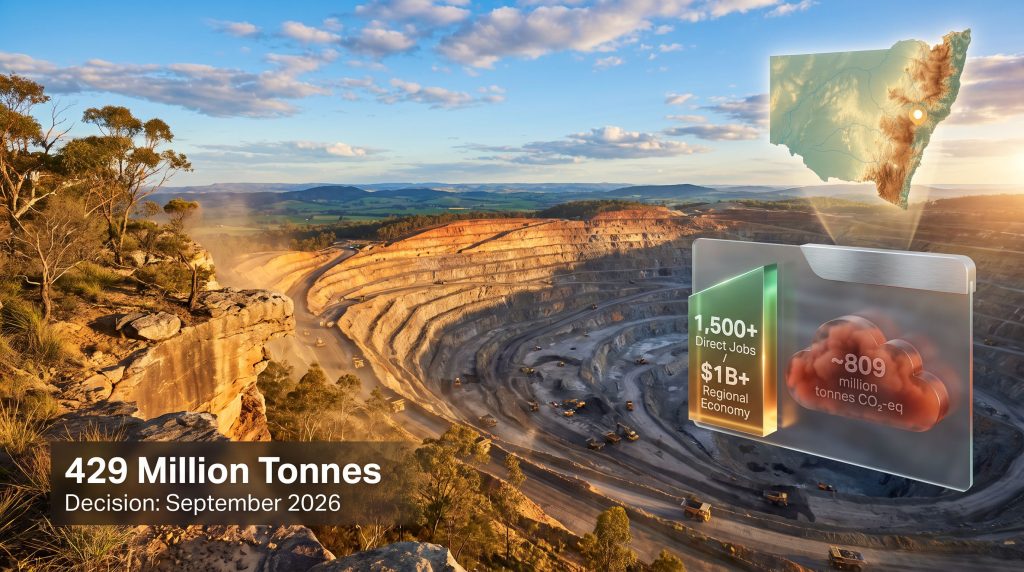
Crucially, the proposal does not seek to increase annual production volumes above currently approved rates. The extension is purely about duration, not intensification of extraction. Over that extended period, the project proposes to extract approximately 429 million tonnes of coal in total.
The Two-Stage Approval Structure Explained
A detail frequently overlooked in broader coverage is that the HVO extension actually involves two distinct regulatory layers, not a single approval decision. Understanding this structure is important for accurately interpreting what is already settled versus what remains under active assessment.
| Dimension | Short-Term Extension (Granted) | Long-Term Continuation Project (Under Assessment) |
|---|---|---|
| Approval Status | Granted via NSW Modification 8 | Under IPC assessment; decision expected September 2026 |
| North Mine Lifespan | Extended to December 2026 | Proposed extension to 2045 |
| South Mine Lifespan | Approved until 2030 (unchanged) | Proposed extension to 2042 |
| Production Volume | Within existing approved limits | No increase above current annual rates |
| Primary Rationale | Protect 1,500 jobs during assessment period | Long-term regional economic continuity |
| Total Coal Extraction | Within existing approvals | 429 million tonnes proposed |
The short-term bridge approval was granted to safeguard approximately 1,500 direct jobs during the IPC's assessment period for the long-term project. The substantive decision — the one that will determine whether HVO operates through the mid-2040s — is expected from the IPC in September 2026.
From 2050 to 2045: A Decade of Revisions
One aspect of this project that provides important regulatory context is how substantially it has been scaled back since it was first conceived. The original 2017 proposal targeted a North Mine operational endpoint of 2050. The amended proposal submitted in August 2025 represents a material reduction in scope.
| Metric | Original 2017 Proposal | Amended 2025 Proposal |
|---|---|---|
| North Mine End Date | 2050 | 2045 |
| Coal Production Reduction | Baseline | Over 220 million tonnes less |
| Scope 1 Emissions Reduction | Baseline | Approximately 43% lower |
| Total Proposed Extraction | Higher | 429 million tonnes |
These amendments were introduced to better align the project with evolving state and federal climate frameworks. Whether that recalibration is sufficient to satisfy the IPC's assessment criteria is precisely what the current hearings are designed to determine.
The Economic Weight Behind the Hunter Valley Operations Extension
Any honest analysis of the HVO Continuation Project must begin with the scale of what is at stake economically for the Upper Hunter region. The figures presented at the IPC hearings make the dependency explicit.
- More than 1,500 direct employees hold jobs tied to HVO's continued operation
- Over 800 suppliers across the broader regional supply chain have commercial relationships with the mine
- The annual economic contribution to the regional economy exceeds $1 billion
- More than 90% of approximately 2,000 public submissions received by the NSW Department of Planning expressed support for the extension
The NSW Department of Planning assessed the project as approvable, concluding it meets both NSW and federal legislative requirements, including those relating to greenhouse gas emissions. That departmental finding provides the joint venture with a measure of regulatory confidence heading into the IPC's determination phase.
What Closure Would Mean for Local Supply Chain Businesses
The ripple effects of a rejection extend far beyond the 1,500 workers directly employed at the mine. Equipment maintenance firms, specialist contractors, transport operators, and professional services providers operating across Singleton and surrounding communities have significant revenue exposure to HVO's continued operation.
Equipment maintenance operators in the region have flagged publicly that no comparable renewable energy projects currently exist that could absorb their specialised workforces or repurpose their facilities. This is not a hypothetical concern. It reflects the structural gap between the pace of renewable energy deployment and the scale of economic activity being wound back at coal operations across Australia's resource regions.
The core challenge facing the Upper Hunter is not simply about one mine closing. It is about the absence of an economic replacement of comparable scale during the current phase of Australia's energy transition. For communities where a single large employer anchors the entire local economy, that gap is not a policy abstraction but a daily financial reality.
How the IPC Weighs Competing Interests
The Independent Planning Commission functions as NSW's independent decision-making authority for state significant development proposals that attract substantial public interest or objection. Its assessment is not a simple cost-benefit calculation but a structured legislative balancing exercise across multiple statutory criteria.
The IPC must weigh:
- Economic benefits including employment, regional investment, and supply chain value generated by the project
- Environmental impacts covering greenhouse gas emissions, land disturbance, water use, and biodiversity effects
- Community sentiment as evidenced by the volume and nature of public and stakeholder submissions
- Legislative compliance particularly alignment with the NSW Climate Change Act and federal environmental law
- Departmental recommendations from the NSW Department of Planning's independent technical assessment
IPC Assessment Timeline at a Glance
- Public hearings commenced: July 2026
- IPC site inspection of HVO: Completed
- Online submissions: Open during hearing period
- Expected determination: September 2026
The Climate Case Against the Extension
The environmental arguments presented at the IPC hearings are grounded in figures that demand serious consideration. The scale of projected emissions from the HVO Continuation Project is significant by any metric.
| Emissions Category | Estimated Volume |
|---|---|
| Total CO₂-equivalent (including combustion/Scope 3) | ~809 million tonnes |
| Scope 1 and 2 offset cost versus net-zero targets | ~$2.1 billion |
| EPA-flagged annual CO₂-equivalent concern | ~30 million tonnes per annum |
| Scope 1 emissions reduction vs. original 2017 proposal | ~43% |
The NSW Environmental Protection Authority has characterised the broader HVO proposal as the largest coal mining proposal in the state's history. Furthermore, the EPA's own assessment recommended restricting mining activity beyond 2040 — a five-year tighter endpoint than the joint venture's amended proposal seeks.
Financial modelling presented to the IPC by the Australasian Centre for Corporate Responsibility estimated that the cost of offsetting HVO's Scope 1 and 2 emissions in line with NSW net-zero targets amounts to approximately $2.1 billion. This figure, if integrated into the project's economic analysis, would substantially reduce the net benefit that the project delivers to NSW as a whole. The Climate Council's analysis of this proposal similarly highlights the long-term systemic risks associated with approving such a scale of extraction.
The Legislative Tension at the Heart of the Decision
Environmental advocates, including Lock the Gate Alliance, argue that approving 429 million tonnes of coal extraction through to 2045 sits in direct conflict with the objectives of the NSW Climate Change Act, which is designed to protect communities from escalating climate-related harm. Their position is that each additional tonne of coal extracted from HVO contributes to the very warming events — intensified bushfires, heatwaves, and flooding — that communities across NSW are increasingly experiencing.
This is not merely a philosophical objection. It raises a structural question about whether NSW's existing planning framework is architecturally capable of pricing the full social cost of carbon into major project approvals. The $2.1 billion emissions cost figure is particularly instructive here because it suggests the current cost-benefit methodology applied to resource project approvals may systematically undervalue climate-related externalities.
If the cost of emissions is not treated as a real financial liability against the project's economic benefits, the planning framework effectively subsidises carbon-intensive development by leaving its largest cost off the ledger.
Key Stakeholders and Their Positions
The IPC hearings have drawn a clear map of competing interests. Understanding where each party stands and why illuminates the structural complexity of the decision.
Proponents:
- Yancoal and Glencore (Joint Venture Operators) maintain the project satisfies all NSW and federal legislative requirements and delivers economic benefits to the region that cannot be replicated by alternative industries in the foreseeable future
- HVO Workforce and Union Representatives staged a highly visible show of support at the hearings, with hundreds of workers gathering outside the IPC proceedings to reinforce the employment stakes of the decision
- Regional Supply Chain Businesses including equipment operators and contractors submitted evidence that a denial of the extension would trigger significant workforce reductions with no clear transition pathway available
Opponents:
- Lock the Gate Alliance staged a public rally at the IPC hearings, arguing that proceeding with extraction of 429 million tonnes of coal deepens the climate harm already being paid for by communities across NSW
- Climate Council contends the extension would release approximately 800 million tonnes of climate pollution, creating long-term systemic risks that outweigh the project's regional economic value
- Australasian Centre for Corporate Responsibility (ACCR) presented financial modelling to the IPC estimating that Scope 1 and 2 emissions costs of approximately $2.1 billion materially erode the project's net benefit to NSW
The next major ASX story will hit our subscribers first
Three Possible Outcomes of the September 2026 IPC Decision
The IPC's ruling is expected in September 2026 and carries significant implications under any of the three plausible scenarios.
Scenario 1: Full Approval
Mining continues through to 2045 (North Mine) and 2042 (South Mine). More than 1,500 jobs are secured for the medium term, and the regional supply chain retains its primary anchor. NSW faces heightened scrutiny from environmental groups and climate advocates over the consistency between its resource approvals and its legislated climate commitments. Glencore and Yancoal secure long-term operational certainty for a significant tier-one asset.
Scenario 2: Conditional Approval with Modified End Date
The IPC approves the extension but applies a 2040 cut-off consistent with the EPA's recommendation. This represents a compromise outcome that partially protects employment and investment while acknowledging the emissions trajectory that NSW's climate legislation implies. It is the outcome most likely to generate partial dissatisfaction across all parties, satisfying neither the workforce seeking maximum tenure certainty nor the environmental groups seeking project rejection.
Scenario 3: Rejection
Immediate risk falls on more than 1,500 direct employees and 800-plus supplier relationships. The economic contraction across the Upper Hunter would extend into hospitality, housing, professional services, and the broader Singleton community economy. The joint venture may pursue legal challenge. Critically, this outcome would establish a significant precedent for how NSW evaluates large-scale thermal coal proposals against the requirements of its own climate legislation, potentially reshaping the regulatory environment for similar proposals elsewhere in the state.
Frequently Asked Questions: Hunter Valley Operations Extension
What is the Hunter Valley Operations Continuation Project?
It is a proposal by the Yancoal-Glencore joint venture to extend coal mining at the HVO site near Singleton, NSW, from its current approval expiry in December 2026 through to 2045 for the North Mine and 2042 for the South Mine.
How many jobs depend on the HVO extension being approved?
More than 1,500 direct employees work at HVO, with a further 800-plus suppliers engaged across the regional supply chain. The indirect employment effect across Singleton and surrounding communities is considerably larger.
How much coal would be extracted under the Continuation Project?
The amended proposal involves the extraction of approximately 429 million tonnes of coal over the life of the extension, with no increase above currently approved annual production rates.
What is the IPC and when will it make a decision?
The Independent Planning Commission is NSW's independent planning authority for major development decisions attracting significant public interest. It is expected to hand down its determination on the Hunter Valley Operations extension in September 2026.
What are the projected emissions from the HVO extension?
Total CO₂-equivalent emissions, including combustion, are estimated at approximately 809 million tonnes. Scope 1 and 2 emissions alone carry an estimated offset cost of $2.1 billion against NSW net-zero targets.
Has the project been modified since it was first proposed?
Yes. The original 2017 proposal targeted a North Mine end date of 2050. The amended 2025 proposal reduces this to 2045, cuts total coal production by more than 220 million tonnes, and reduces Scope 1 emissions by approximately 43% compared to the original scope.
Did the NSW Department of Planning support the project?
The Department of Planning assessed the project as approvable, concluding it meets NSW and federal legislative requirements including those governing greenhouse gas emissions. However, the final decision rests with the IPC, which conducts its own independent assessment.
What the HVO Decision Reveals About Australia's Transition Challenge
The Hunter Valley Operations extension hearing is, at its core, a stress test of Australia's ability to manage the human dimensions of its energy transition. The national policy direction toward net zero is clear at the legislative level. What is far less clear is how communities whose economic foundations were built over decades around fossil fuel extraction are expected to absorb the withdrawal of that foundation, particularly when the renewable energy projects intended to replace that economic activity operate on different scales, in different locations, and require different skills.
Several dynamics make this case particularly instructive for analysts and observers of Australia's resource sector:
- The scale of community support, with over 90% of 2,000 public submissions backing the extension, demonstrates how decisively economic dependency shapes public opinion in resource-reliant communities, even when climate risks are widely acknowledged
- The $2.1 billion emissions cost figure introduces a method of integrating carbon pricing into project cost-benefit analysis that, if adopted systematically, would fundamentally alter the economics of future coal approvals across NSW
- The EPA's 2040 recommendation creates a documented regulatory position that splits the difference between full approval and rejection, potentially offering the IPC a defensible middle path
- The absence of transition pathways flagged by local businesses is not unique to HVO. It reflects a structural shortfall in Australia's broader just transition policy architecture, where the political commitment to emissions reduction has outpaced the investment in replacement economic activity for affected communities
The September 2026 IPC ruling will not resolve these structural tensions. But it will reveal how seriously NSW's independent planning framework treats carbon costs as real economic liabilities, and whether Australia's regulatory institutions are equipped to make the kinds of decisions that its own climate legislation logically demands.
This article is analytical and informational in nature. It does not constitute financial, legal, or investment advice. Emissions projections, economic estimates, and regulatory outcomes discussed are based on figures presented during public IPC hearings and should be understood as subject to ongoing assessment. Readers interested in the IPC's official determination process and timeline can find further updates through ABC News Australia's Upper Hunter coverage.
Want to Stay Ahead of Significant ASX Mineral Discoveries in Australia's Resource Sector?
Discovery Alert's proprietary Discovery IQ model delivers real-time alerts on major ASX mineral discoveries, transforming complex resource data into actionable investment insights for both short-term traders and long-term investors — explore the historic returns major discoveries have generated and begin your 14-day free trial at Discovery Alert to position yourself ahead of the broader market.