August 3, 2026
The Processing Bottleneck That Determines Who Controls the Clean Energy Future
Cobalt sits at a peculiar intersection of industries. It is simultaneously a defence-critical metal, an aerospace superalloy ingredient, and a fundamental input for the lithium-ion battery chemistries that power everything from electric vehicles to grid-scale energy storage. Yet despite consuming significant quantities of refined cobalt every year, the United States currently lacks a single commercial-scale domestic facility capable of processing cobalt from raw intermediate material into market-ready refined products.
That structural absence is not simply an inconvenience. It represents a supply chain vulnerability that concentrates refining leverage in the hands of Chinese state-affiliated enterprises, which control an estimated 70 to 80 percent of global cobalt refining capacity. For a material embedded across aerospace, defence, and clean energy applications, this dependency carries strategic dimensions that extend well beyond commodity pricing cycles.
The EVelution Energy Arizona cobalt processing facility, currently advancing through its pre-construction engineering and permitting phase in Yuma County, is designed to directly address this gap. Understanding the project requires moving beyond its commercial statistics and examining the interlocking technical systems that make it possible, starting with the foundational engineering question that every arid-region processing facility must resolve before anything else: where does the water come from?
When big ASX news breaks, our subscribers know first
Why Processing Is the Real Bottleneck, Not Mining
Cobalt Hydroxide, Cobalt Sulfate, and Cobalt Metal: Understanding the Value Chain
Most public discussion of cobalt supply chains focuses on mining, particularly the Democratic Republic of Congo, which produces approximately 70 percent of the world's mined cobalt. However, mining is only the beginning of the value chain. The critical and far less visible stage is processing, specifically the conversion of cobalt hydroxide intermediate product into the refined forms that manufacturers actually use. Furthermore, understanding global cobalt production patterns helps contextualise why this processing gap matters so acutely.
The two primary outputs that industrial buyers require are:
- Battery-grade cobalt sulfate (CoSO₄): Used in cathode precursor manufacturing for nickel-manganese-cobalt (NMC) and nickel-cobalt-aluminium (NCA) lithium-ion batteries, which power EVs and energy storage systems
- Alloy-grade cobalt metal: Used in superalloys for jet engines, gas turbines, and cutting tools, as well as in hard-facing and wear-resistant applications across defence and aerospace
Cobalt hydroxide, the intermediate feedstock, is produced at mine sites and then shipped to refineries, which is where the critical processing step occurs. Because the US has historically lacked domestic refinery-scale capacity for either output, cobalt hydroxide produced globally has predominantly been routed through Chinese refining infrastructure before re-entering Western supply chains as finished product.
This creates a dependency at the processing node, not at the mine — a distinction rarely articulated in mainstream coverage. In addition, this reality underscores broader concerns around critical minerals energy security that policymakers and investors alike are now urgently confronting.
| Cobalt Product Stage | Process Description | Primary End Use |
|---|---|---|
| Cobalt ore/concentrate | Mined material | Feedstock to hydroxide plants |
| Cobalt hydroxide | Intermediate precipitate | Feedstock to refineries |
| Cobalt sulfate (battery-grade) | Hydrometallurgical refinery output | EV and energy storage cathodes |
| Cobalt metal (alloy-grade) | Electrowinning or reduction output | Aerospace, defence, advanced manufacturing |
Site Selection in an Arid Environment: Why Yuma County Creates Engineering Complexity
The Hydrogeological Prerequisite
Locating a hydrometallurgical processing facility in the American Southwest carries inherent tension: the region offers significant advantages in terms of solar resource availability, proximity to California's EV and technology manufacturing ecosystem, and access to key logistics corridors. However, it simultaneously presents one of the most challenging water management environments in North America.
For any processing facility in an arid zone, groundwater confirmation is not merely a regulatory formality. It is a prerequisite for every subsequent stage of project development. Without a confirmed aquifer capable of sustaining operations across the facility's full planned life, a Bankable Feasibility Study (BFS) cannot be completed, financing cannot be structured, and insurance underwriting cannot proceed on commercially viable terms.
"Aquifer confirmation at this stage is not simply about finding water. It validates the long-term operational viability of the facility and directly influences the bankable feasibility study, financing terms, and insurance underwriting frameworks that lenders and equity partners require before committing capital."
The hydrogeological programme completed by EVelution Energy at the Wellton/Tacna site in Yuma County, carried out under the supervision of BasinWells Associates, followed a three-stage methodology:
- Groundwater sampling to characterise water chemistry, quality parameters, and baseline salinity levels
- Aquifer testing to determine hydraulic conductivity, transmissivity, and sustainable yield capacity
- Hydrogeological modelling and analysis to project aquifer behaviour under production-scale extraction rates across the facility's operational life
The programme confirmed aquifer capacity sufficient to support both the planned initial operations and potential future expansion. Critically, testing also identified elevated salinity levels in the groundwater, a finding that carries important implications for both process engineering design and community relations.
What the Salinity Finding Actually Means
Saline groundwater is not inherently a liability. In a processing context, it becomes a design input. EVelution Energy's planned water treatment systems are engineered to handle brackish or saline source water, meaning the facility can draw from an aquifer that agricultural users and municipal water authorities largely cannot use for their own purposes.
This is a politically and regulatorily significant distinction in Yuma County, one of Arizona's most productive agricultural regions. By designing around saline aquifer water, the facility avoids competing with the freshwater allocations that underpin existing farming operations. In a basin-managed water environment like the Lower Colorado River system, demonstrating that a facility's water draw does not diminish agricultural or municipal freshwater availability substantially reduces regulatory friction and community opposition risk.
Engineering Water Efficiency Into a Desert Processing Plant
The Closed-Loop Water Management Architecture
Hydrometallurgical processing is inherently water-intensive. The leaching, solvent extraction, and electrowinning stages that convert cobalt hydroxide into refined cobalt products all require substantial aqueous process streams. In a conventional open-circuit design, significant volumes of process water would be discharged as effluent or lost through evaporation, creating both environmental liability and operational cost.
The EVelution Energy Arizona cobalt processing facility has been engineered around a closed-loop water management architecture that targets several key outcomes:
- Recycling and reusing approximately 70 percent of all process water within closed circuit loops
- Eliminating on-site process-water discharge entirely
- Eliminating on-site tailings storage, which removes one of the most significant environmental liability categories for processing facilities
- Routing all process residues to licensed off-site disposal facilities, transferring residue management responsibility to specialist operators
The combination of these design choices has significant implications for the facility's environmental permitting timeline and community relations profile. Facilities with no on-site tailings storage and no process-water discharge carry a fundamentally lower environmental risk profile than conventional designs, which typically encounter sustained opposition from environmental regulators and local communities.
The 408 Acre-Feet Benchmark in Context
The projected net freshwater consumption of approximately 408 acre-feet per year is the figure that anchors the facility's water rights application and its community-facing environmental narrative.
| Water Consumption Benchmark | Annual Volume |
|---|---|
| EVelution Arizona facility (projected net draw) | ~408 acre-feet/year |
| Equivalent Yuma County farmland irrigation | ~70 acres |
| Typical mid-scale US industrial processing facility | 1,000-3,000+ acre-feet/year (varies by process) |
For context, Yuma County agriculture collectively irrigates hundreds of thousands of acres annually, drawing on Colorado River allocations and groundwater. A processing facility consuming the equivalent of 70 acres of farmland irrigation while generating approximately US$1.2 billion in projected annual economic activity represents an extraordinarily efficient use of the region's water resource base — a ratio that is difficult for water authorities or community stakeholders to argue against.
Output Specifications and US Market Coverage
What the Facility Will Produce
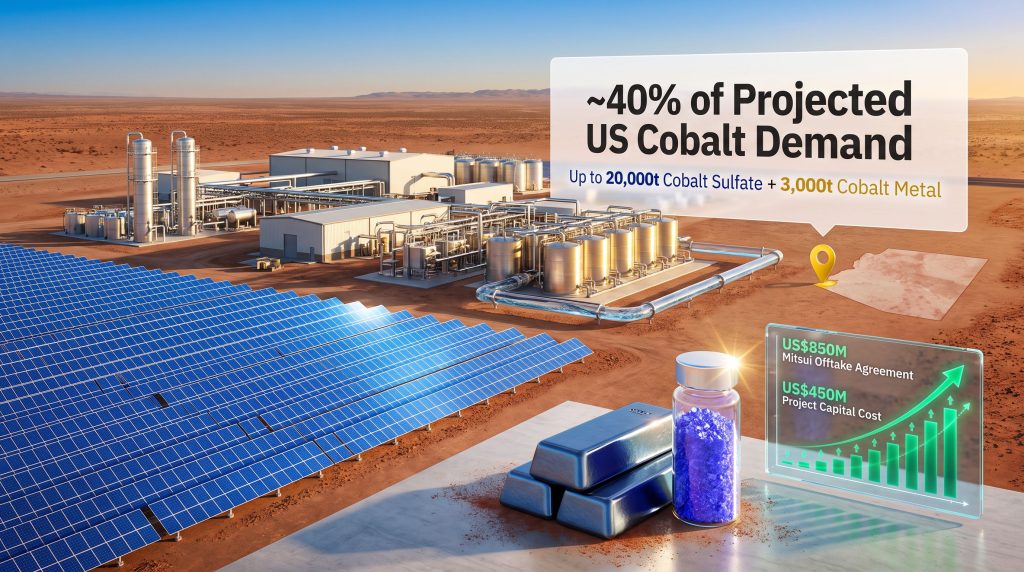
The EVelution Energy Arizona cobalt processing facility is designed to handle approximately 24,000 metric tons of cobalt hydroxide feedstock per year, producing two distinct refined output streams. Consequently, this positions it as a pivotal contributor to the evolving cobalt supply analysis landscape across North America.
| Output Type | Annual Volume | Primary Market | Key Buyer Categories |
|---|---|---|---|
| Battery-grade cobalt sulfate | Up to 20,000 metric tons | EV batteries, energy storage | Battery cell manufacturers, cathode producers |
| Alloy-grade cobalt metal | Up to 3,000 metric tons | Aerospace, defence | Superalloy producers, defence primes |
The claim that facility output could supply approximately 40 percent of projected US cobalt demand reflects the scale of current US import dependency rather than any suggestion of a small domestic market. US cobalt demand is substantial across EV adoption growth trajectories and defence procurement, making a 40 percent domestic supply contribution genuinely material to supply chain resilience planning.
The Feedstock-Agnostic Processing Model
A structurally underappreciated feature of the EVelution model is its deliberate decision not to operate captive cobalt mines. Rather than vertically integrating from mine to refinery, the facility is designed as a processing-only operation that sources cobalt hydroxide feedstock from multiple international suppliers.
This approach carries distinct advantages:
- Capital efficiency: Processing-only facilities require substantially less capital than vertically integrated mine-to-refinery projects, accelerating the path from investment decision to production
- Feedstock diversification: Multi-supplier sourcing reduces single-point-of-failure risk compared to captive mine supply, where geological, operational, or geopolitical disruptions at one site affect the entire supply chain
- Speed to market: Bypassing mine development timelines means the refinery can reach commercial production years earlier than an equivalent integrated project
- Flexibility: Feedstock sourcing can shift between geographies and suppliers in response to pricing, quality, and availability changes without restructuring the core business
The Mitsui Offtake Agreement and Commercial Architecture
A US$850 Million Binding Commitment
The binding long-term offtake agreement with Mitsui, valued at approximately US$850 million over five years, represents one of the most commercially significant milestones in the project's development history. The agreement covers a substantial majority of the facility's cobalt metal output, providing revenue visibility that is essential for project finance structuring.
Mitsui's strategic rationale for this commitment reflects the broader positioning of Japanese trading houses in global critical minerals supply chains. As a major participant in battery materials markets across Asia and increasingly in North America, Mitsui's offtake commitment signals confidence in both the project's technical viability and its commercial positioning relative to competing cobalt supply sources.
For project financing purposes, a binding offtake agreement of this scale with a counterparty of Mitsui's credit standing substantially de-risks the revenue side of the financing model, enabling more favourable debt terms and reducing the equity contribution required to achieve financial close. Those tracking the broader battery metals investment landscape will recognise this structure as increasingly standard for strategic processing assets.
The next major ASX story will hit our subscribers first
Solar Power Integration and the Carbon Provenance Advantage
The 28 MW On-Site Solar Facility
Construction commenced in June 2026 on a 28 MW on-site solar energy facility that will supply power to the cobalt processing operations. This integration creates a carbon-neutral processing claim that carries commercial weight beyond its environmental symbolism. For further context on this development, Mining Outlook's coverage of the solar facility construction provides additional technical detail.
Battery manufacturers and EV original equipment manufacturers (OEMs) are increasingly embedding verified low-carbon provenance requirements into their procurement frameworks, driven by Scope 3 emissions reporting obligations under corporate sustainability commitments and, in some markets, emerging regulatory requirements.
"A solar-powered, US-domiciled cobalt processor addresses both the supply security and the Scope 3 emissions profile that major automotive and technology buyers require from their critical mineral supply chains simultaneously, creating a dual commercial advantage that conventional refinery models cannot replicate."
The carbon intensity differential between solar-powered US cobalt processing and grid or fossil-fuel-powered refining in the DRC-China corridor is substantial. This positions EVelution's output not merely as a domestically produced alternative but as a verifiably lower-carbon product that commands consideration in procurement processes where ESG criteria are material to supplier selection.
Project Timeline and Critical Path
Construction and Commissioning Milestones
| Milestone | Target Date |
|---|---|
| Solar facility construction commences | June 2026 |
| Bankable Feasibility Study completion | 2026 (ongoing) |
| Cobalt processing facility construction commences | Early 2027 |
| Commercial production operations | 2029 |
The remaining workstreams on the critical path before construction formally begins include BFS completion incorporating the groundwater programme findings into production well design and water treatment infrastructure chapters, finalisation of water rights applications, environmental impact assessment and air quality permitting in Arizona, and financing close integrating private capital with export credit agency participation.
The approximately US$450 million total project cost is being financed through a structure that combines private investment with export credit initiatives, a financing architecture that reflects the strategic nature of the asset rather than a purely commercial return profile.
Economic Footprint: Yuma County and Beyond
What an Industrial Facility of This Scale Means for a Rural Region
Independent economic impact assessments project the following outcomes from the EVelution Energy Arizona cobalt processing facility:
| Economic Impact Category | Projected Figure |
|---|---|
| Total jobs supported (direct, indirect, induced) | More than 6,200 |
| Annual economic activity generated | ~US$1.2 billion |
| Annual household earnings | ~US$326 million |
The significance of these figures scales considerably when viewed against the context of rural Yuma County. A facility generating over a billion dollars in annual economic activity in an agricultural-economy region creates multiplier effects that extend well beyond direct employment. Furthermore, supporting local supply chains, retail, housing, healthcare, and education services in communities that rarely attract capital-intensive industrial investment of this magnitude makes this project particularly transformative.
Frequently Asked Questions: EVelution Energy Arizona Cobalt Processing Facility
What is EVelution Energy building in Arizona?
A solar-powered, commercial-scale cobalt processing facility in Yuma County designed to produce battery-grade cobalt sulfate for EV and energy storage applications and alloy-grade cobalt metal for aerospace and defence end markets.
Where exactly is the EVelution Energy facility located?
Yuma County, Arizona, in the Wellton/Tacna area near the California state border, within reach of key Southwest demand centres and logistics corridors.
When will the Arizona facility begin commercial production?
Commercial operations are targeted for 2029, with processing facility construction expected to begin in early 2027 following completion of the Bankable Feasibility Study and financing close.
How much cobalt will the facility produce annually?
Up to 20,000 metric tons of battery-grade cobalt sulfate and up to 3,000 metric tons of alloy-grade cobalt metal, processed from approximately 24,000 metric tons of cobalt hydroxide feedstock.
Why is the groundwater confirmation so important?
Aquifer confirmation validates a critical operational input for the facility, enabling completion of the BFS and supporting financing, permitting, and construction planning in a water-stressed region where undocumented water availability would constitute an unbankable project risk.
How does the facility manage water use in the desert?
Through a closed-loop water management system targeting approximately 70 percent process water recycling, with no on-site process-water discharge, no on-site tailings storage, and a projected net freshwater draw of approximately 408 acre-feet per year.
What is the Mitsui offtake agreement worth?
Approximately US$850 million over five years, covering a substantial majority of the facility's cobalt metal output under a binding long-term agreement.
What will the facility cost to build?
The project carries an estimated capital cost of approximately US$450 million, financed through a combination of private investment and export credit agency involvement.
What economic benefits will the facility bring to Arizona?
Independent assessments project more than 6,200 jobs supported, approximately US$1.2 billion in annual economic activity, and around US$326 million in annual household earnings, with the majority of benefits concentrated in Yuma County.
A Technical Blueprint for Domestic Cobalt Independence
What This Project Actually Represents
The EVelution Energy Arizona cobalt processing facility is best understood not as a single project announcement but as a multi-system engineering undertaking where each validated layer reduces risk across the entire development. Hydrogeological confirmation feeds into BFS water infrastructure design. BFS completion enables financing close. Financing close enables construction. Construction enables the 2029 commercial operations target.
The groundwater milestone is therefore not a peripheral administrative accomplishment. It is a load-bearing element in the engineering and financial architecture of the project, without which no downstream stage could proceed with the certainty that institutional lenders and equity investors require.
What makes the EVelution model structurally distinctive — and potentially replicable across other critical minerals where the same processing bottleneck exists — is its processing-only orientation. By targeting the refining node rather than the mining node, the project addresses the actual vulnerability in the US cobalt supply chain at lower capital cost, faster timeline, and with a feedstock flexibility that mine-to-refinery vertically integrated models cannot match. In addition, the project's approach aligns closely with the accelerating critical minerals demand trajectory that is reshaping global energy transition investment strategies.
This article is intended for informational purposes only and does not constitute financial or investment advice. Project timelines, production estimates, and financial projections are forward-looking statements subject to change. Readers should conduct independent due diligence before making any investment decisions. Further coverage of critical minerals processing developments is available at Mining Outlook (mining-outlook.com).
Want to Spot the Next Major Critical Minerals Discovery Before the Market Does?
Discovery Alert's proprietary Discovery IQ model delivers real-time alerts on significant ASX mineral discoveries — instantly converting complex data across more than 30 commodities into clear, actionable insights for both traders and long-term investors. Explore historic discovery returns on Discovery Alert's discoveries page and begin your 14-day free trial today to position yourself ahead of the market.