August 2, 2026
Why Nickel Sulphide Deposits Are Not All Created Equal
Not every nickel deposit is worth the same to a battery manufacturer. The metallurgical pathway from ore in the ground to a battery-grade nickel sulphate solution ready for cathode production is where project economics, carbon footprint, and geopolitical risk all converge. For Western automakers and battery cell producers racing to secure domestic supply chains, the distinction between sulphide and laterite nickel has moved from a technical footnote to a boardroom-level strategic variable.
It is against this backdrop that the Canada Nickel Crawford nickel project federal approval, issued on July 31, 2026, carries weight well beyond a single regulatory milestone. The decision represents a convergence of geological advantage, regulatory precedent, and critical minerals strategy that is worth unpacking in full.
When big ASX news breaks, our subscribers know first
What the Federal Decision Statement Actually Means
The approval issued by Canada's Minister of Environment, Climate Change and Nature is formally known as a Decision Statement under the Impact Assessment Act. For those unfamiliar with Canadian mining regulation, this document is the federal government's final determination on whether a designated project's significant adverse effects are justified in the public interest.
Critically, it is not a green light for construction. It is the culmination of a multi-year federal environmental review process, and it comes with legally binding conditions covering environmental performance, Indigenous engagement, and socioeconomic commitments that Canada Nickel must satisfy across the project's full lifecycle.
What makes this particular Decision Statement historically significant is its regulatory context. Crawford is the first mining project to receive this determination under Canada's Impact Assessment Act as amended since 2019. That makes this approval a genuine test case for whether the post-2019 legislative framework can process complex, large-scale mining proposals through to a final outcome. The fact that it has done so sets a meaningful procedural precedent for other critical mineral projects currently navigating the Canadian assessment pipeline.
### Does This Approval Guarantee Construction?
Not immediately. Furthermore, the Decision Statement represents federal sign-off, but several provincial authorisations and additional federal permits must still be secured before Canada Nickel can commit to a construction decision. The 2027 construction target depends on resolving all remaining requirements within a compressed timeframe.
The Geological Case for Crawford: Sulphide vs. Laterite
To understand why Crawford's resource type matters so much, it helps to understand how nickel occurs in nature and what that means for downstream processing. Magmatic nickel deposits like Crawford form in ancient igneous rock and offer distinct processing advantages over their laterite counterparts.
Nickel deposits broadly fall into two categories:
- Sulphide deposits, where nickel is chemically bound with sulphur minerals, typically found in ancient igneous rock formations. These can be processed using conventional smelting and refining techniques that have been refined over more than a century.
- Laterite deposits, formed through long-term weathering of nickel-bearing rock in tropical climates. These require high-pressure acid leach (HPAL) processing, which is energy-intensive, capital-heavy, and generates significant processing waste.
The Indonesian nickel industry currently dominates global nickel production, but predominantly through laterite-based HPAL operations. The resulting product is suitable for battery-grade applications, however the processing route carries a substantially higher carbon intensity and involves complex waste management challenges.
For Western battery manufacturers with net-zero commitments embedded in their supplier qualification criteria, sourcing from sulphide operations like Crawford offers a measurable sustainability advantage. In addition, nickel's industrial uses extend well beyond batteries, making the processing pathway a strategic consideration across multiple end-use sectors.
Sulphide nickel's lower-carbon processing pathway is increasingly treated as a formal criterion in battery supply chain qualification processes, not merely a reputational preference. This creates a structural demand premium for projects like Crawford that is separate from commodity price dynamics.
Crawford's Regulatory Journey: A Compressed Development Arc
The timeline from Crawford's early exploration phase to federal mining approval is notable by any measure. Canada Nickel advanced the project from its fifth drill hole through to a completed feasibility study and federal approval in under seven years. For large-scale greenfield mining developments, this pace is substantially faster than industry norms, where timelines of 15 to 20 years from discovery to construction approval are common.
Key regulatory milestones in Crawford's pathway included:
- Early exploration and resource definition work advancing through to feasibility study completion.
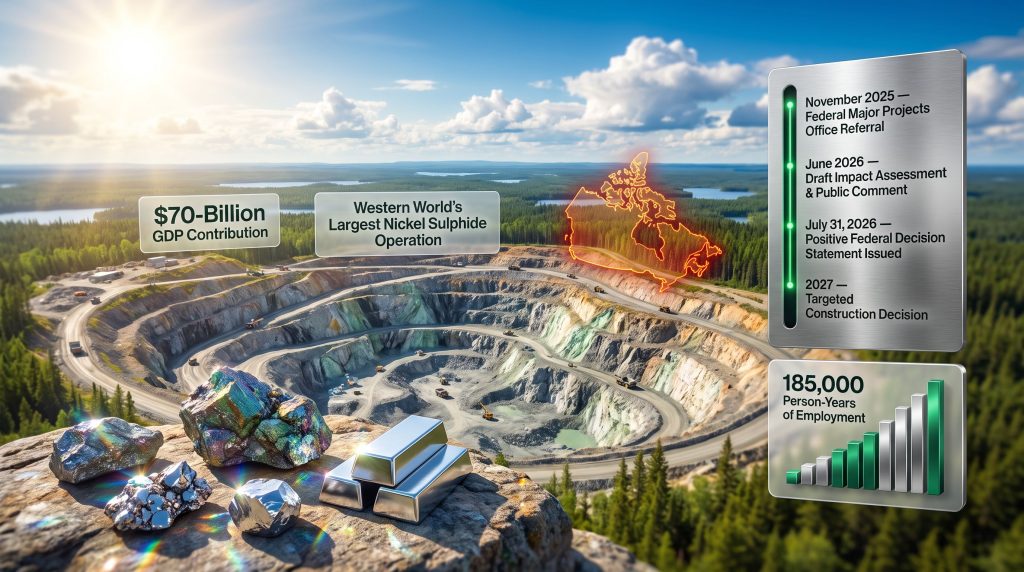
- Referral to Canada's federal Major Projects Office in November 2025, triggering formal federal coordination.
- The Impact Assessment Agency of Canada completing its draft environmental assessment report and opening the public comment period in June 2026.
- The positive federal Decision Statement issued on July 31, 2026, completing the federal review process.
Ontario's One Project, One Process framework played a structural role in this outcome. Designed to align provincial and federal review timelines, the framework reduces the sequential delays that have historically extended mining project timelines in Canada by preventing federal and provincial processes from running independently of each other.
| Milestone | Date / Status |
|---|---|
| Early exploration to feasibility study | Pre-2026 |
| Referral to Federal Major Projects Office | November 2025 |
| Draft Impact Assessment Report and Public Comment | June 2026 |
| Positive Federal Decision Statement Issued | July 31, 2026 |
| Remaining Provincial and Federal Permits | In Progress |
| Targeted Construction Decision | 2027 |
Crawford's Dual-Commodity Profile: Nickel and Chromium Together
Most commentary on Crawford focuses on its nickel credentials, but the project's chromium output may ultimately prove to be its most strategically differentiated attribute from a North American supply chain perspective.
Crawford is projected to become North America's only primary source of chromium upon entering production. This is not a marginal detail. North America currently relies almost entirely on imported chromium, a situation that creates measurable vulnerability across several critical industrial sectors:
- Stainless steel manufacturing, where chromium is an essential alloying element that provides corrosion resistance.
- Aerospace alloys, where chromium contributes to the high-temperature performance and structural integrity of turbine components and structural parts.
- Defence-grade materials, where supply chain sovereignty for chromium-containing alloys is a genuine national security consideration.
The combination of primary nickel sulphide output for EV battery supply chains and primary chromium production for industrial and defence applications positions Crawford as a genuinely multi-sector strategic asset. Consequently, this dual-output profile is uncommon among projects of Crawford's scale.
| End-Use Sector | Relevant Metal(s) | Crawford's Strategic Contribution |
|---|---|---|
| Electric Vehicle Batteries | Nickel | Western sulphide supply alternative to Indonesian laterite |
| Stainless Steel Manufacturing | Nickel, Chromium | Dual-metal domestic sourcing capability |
| Aerospace and Defence | Chromium, Nickel | North America's only primary chromium source |
| Advanced Manufacturing | Nickel, Chromium | Reduced import dependency across industrial sectors |
The Economic Dimensions: $70 Billion and 185,000 Person-Years
The economic case for Crawford extends well beyond the project gate. An independent economic analysis prepared by Mansfield Consulting estimates that Crawford will contribute approximately $70-billion to Canada's GDP across the operational life of the mine, while supporting around 185,000 person-years of employment.
To contextualise that figure, a $70-billion GDP contribution places Crawford among the most economically consequential single mining developments in Canadian history. The employment figure, spanning construction, operations, and downstream processing phases, implies multi-generational workforce engagement in Northern Ontario.
At $70-billion in projected GDP contribution, the Crawford project's economic footprint rivals or exceeds that of several major oil sands and base metals developments when measured across their full operational lives. For Northern Ontario specifically, the downstream multiplier effects on regional supply chains and community services could be transformative over a multi-decade horizon.
Furthermore, indirect economic benefits include supply chain development for mining services and equipment providers, infrastructure investment in transport and utilities, and expanded capacity in community-level services including healthcare and education in the project region. The growing critical minerals demand driven by the global energy transition only amplifies the long-term significance of these economic projections.
The next major ASX story will hit our subscribers first
Indigenous Engagement as a Legally Binding Condition
A less widely discussed but structurally important dimension of the Decision Statement is the role of Indigenous partnership as an enforceable regulatory condition, rather than a reputational commitment or voluntary practice.
The federal approval framework embeds Indigenous engagement requirements directly into the legally binding conditions attached to the Decision Statement. This means that Canada Nickel's obligations to Indigenous Nations in the Crawford project area are not discretionary commitments that can be modified under commercial pressure; they are regulatory requirements that carry the same legal weight as environmental performance standards.
This approach reflects an evolving interpretation of the duty to consult in Canadian resource project regulation. For future mining projects in Canada, Crawford's regulatory structure in this regard may serve as a reference point.
What Remains Before a 2027 Construction Decision
Federal approval is a pivotal achievement, but it does not represent the end of Crawford's regulatory journey. Several significant steps remain before Canada Nickel can commit to construction:
- Provincial authorisations from the Ontario government remain outstanding and represent the primary remaining regulatory pathway.
- Additional federal permits related to specific environmental and operational aspects of the project are still being progressed.
- Detailed engineering is being advanced in parallel with the permitting process to minimise schedule delays once all approvals are secured.
- Project financing must be secured in a global capital market environment that remains selective toward large greenfield mining developments.
The 2027 construction decision target implies a compressed window for resolving all remaining regulatory and financing requirements simultaneously. Investors and industry observers will be watching Ontario's provincial permitting progress closely as the most immediate indicator of whether Crawford's trajectory toward construction can be maintained.
A Regulatory Precedent With Implications for Canada's Critical Minerals Pipeline
Crawford's federal approval arrives at a moment when Canada's capacity to translate its critical mineral resource endowment into producing mines is under close scrutiny. The country holds world-class deposits of nickel, cobalt, lithium, copper, and rare earth elements, but converting geological advantage into supply chain relevance requires navigating a historically complex regulatory environment.
The Canada Nickel Crawford nickel project federal approval demonstrates that the amended Impact Assessment Act framework is capable of processing a complex, large-scale mining project to a final federal decision. It also demonstrates that the One Project, One Process coordination mechanism can meaningfully compress timelines when properly applied.
The federal Impact Assessment process is now being watched closely by other project proponents navigating Canada's assessment pipeline. Whether the regulatory momentum demonstrated at Crawford can be replicated consistently across other projects remains an open question.
However, as a demonstration that Canada's regulatory system can handle the complexity and scale of a project of Crawford's ambition, the July 31, 2026 Decision Statement stands as a landmark outcome for the country's critical minerals future.
Disclaimer: This article contains forward-looking statements and projections, including economic estimates and construction timelines, that are subject to material risks and uncertainties. Projections from third-party analyses such as those prepared by Mansfield Consulting are estimates only and do not constitute guaranteed outcomes. Readers should conduct independent due diligence before making investment decisions. Nothing in this article constitutes financial advice.
Want to Stay Ahead of the Next Major Critical Minerals Discovery?
Discovery Alert's proprietary Discovery IQ model scans ASX announcements in real time, instantly identifying significant mineral discoveries across nickel, chromium, and more than 30 other commodities — turning complex geological data into clear, actionable investment insights. Explore how major mineral discoveries have historically delivered extraordinary returns on Discovery Alert's dedicated discoveries page, and begin your 14-day free trial today to position yourself ahead of the broader market.