August 1, 2026
The Structural Advantage That Separates Tshipi From the Pack
In bulk commodity mining, the ability to flex production volumes without triggering major capital expenditure is a capability that most operations simply do not possess. Open-pit manganese mining in South Africa's Northern Cape province represents one of the rare exceptions. The Kalahari Manganese Field, which hosts the world's largest known land-based manganese ore deposit, provides a geological foundation so resource-rich that operations built upon it can scale output meaningfully within a single quarter. This is the environment in which Tshipi é Ntle Manganese Mining operates, and it goes a long way toward explaining why the Jupiter Mines Tshipi manganese mine output and sales figures for the June 2026 quarter deserve closer examination than a surface reading of the numbers might suggest.
When big ASX news breaks, our subscribers know first
What Tshipi Produces and Why the Ownership Structure Matters
Tshipi é Ntle Manganese Mining operates one of the most significant open-pit manganese operations in the Southern Hemisphere, situated within the Northern Cape province of South Africa. The Kalahari Manganese Field, which underlies this region, is estimated to contain roughly 80% of the world's identified manganese ore resources, making the province's geological endowment genuinely exceptional by global standards.
ASX-listed Jupiter Mines holds a 49.9% beneficial interest in Tshipi é Ntle Manganese Mining. This ownership structure means that the production, sales, and earnings figures reported by Jupiter reflect its proportional economic exposure to the underlying operation rather than full operational control. For investors reading quarterly reports, it is important to understand that headline numbers represent Jupiter's attributable share of Tshipi's total activity.
The mine's long-run operational baseline sits at approximately 3.4 million tonnes per year, but this figure should be understood as an average rather than a ceiling. Tshipi's open-pit design and ore body characteristics allow management to accelerate or moderate output in response to prevailing market conditions, a structural advantage that distinguishes it from fixed-rate bulk mining operations. Furthermore, this flexibility is increasingly relevant as critical minerals demand continues to evolve alongside global energy transition pressures.
The Kalahari Manganese Field: A Geological Context Worth Understanding
The ore mined at Tshipi is categorised within two broad mineralogical types common to the Kalahari deposit: braunite-kutnohorite ore and bixbyite-hausmannite ore. The manganese grades achievable from this deposit are among the highest of any open-pit operation globally, which is a key reason why Tshipi competes effectively on the international seaborne market. High ore grade translates directly into lower beneficiation costs and stronger price realisations per tonne shipped. In this respect, it shares characteristics with other manganese strategic deposit operations that benefit from geological depth and grade consistency.
The Kalahari Manganese Field hosts an estimated 80% of global identified manganese resources, giving Northern Cape producers a resource depth that competitors in Gabon, Australia, and Ghana cannot replicate at equivalent scale.
Q4 FY2026 Production and Sales: A Quarter of Genuine Operational Momentum
The June 2026 quarter delivered measurably stronger operational results for Tshipi across every volume metric reported.
Production Performance
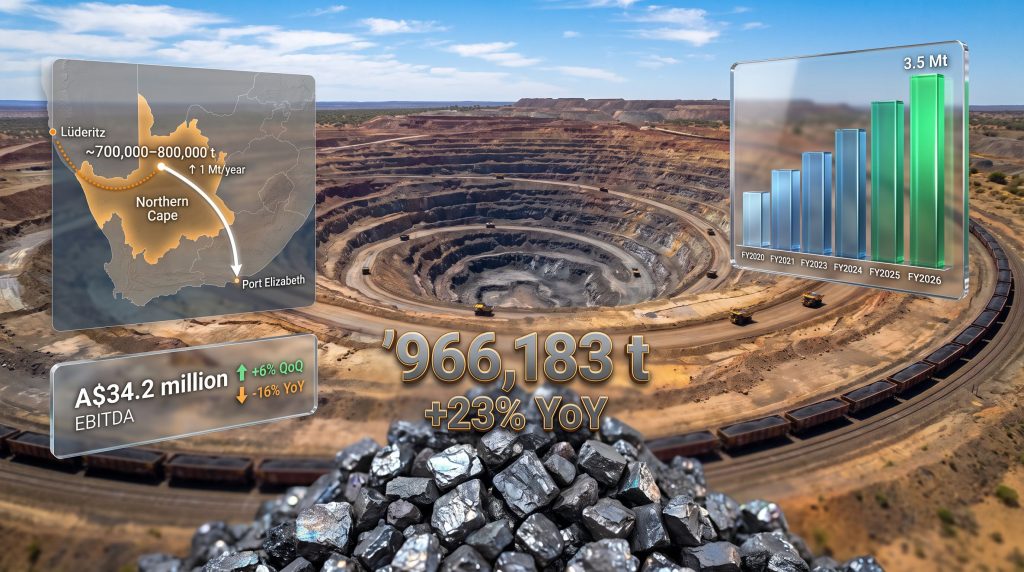
- Output of 966,183 tonnes of manganese ore was recorded for the quarter ended June 30, 2026
- This represented a 14% increase on Q3 FY2026 production
- On a year-on-year basis, the improvement was even more pronounced at +23% versus Q4 FY2025
- Logistics volumes for the quarter grew 3% quarter-on-quarter, enabling higher sales conversion rates
Sales Performance
- Quarterly sales volumes rose 12% quarter-on-quarter to approximately 943,740 tonnes
- Full-year FY2026 sales reached 3.5 million tonnes, surpassing both the historical annual average of 3.4 million tonnes and the prior year's comparable result
A full-year sales result of 3.5 million tonnes exceeding the long-run 3.4 million tonne average in an environment of compressed manganese pricing is operationally meaningful. It signals that demand absorption for Tshipi's ore remained robust even as price dynamics softened earnings.
How FY2026 Fits Within Tshipi's Multi-Year Production and Sales History
Understanding a single quarter's output in isolation provides limited analytical value. Placing the numbers within a multi-year context reveals more about the operation's trajectory and the market cycles that have shaped it.
| Financial Year | Production (Mt) | Sales (Mt) | Notable Context |
|---|---|---|---|
| FY2026 | ~3.5 Mt (est.) | 3.5 Mt | Q4 surge of +23% year-on-year |
| FY2025 | 3.6 Mt | 3.6 Mt | Record highs across both metrics |
| FY2024 | 3.4 Mt | 3.5 Mt | Steady, balanced throughput |
| FY2023 | 3.3 Mt | 3.4 Mt | In line with long-run average |
| FY2022 | 3.6 Mt | 3.2 Mt | Production outpaced sales absorption |
| FY2021 | 3.3 Mt | 3.4 Mt | Recovery from prior-year disruptions |
| FY2020 | 3.4 Mt | 3.4 Mt | Balanced output-to-sales ratio |
The FY2022 divergence between production and sales (3.6 Mt produced versus 3.2 Mt sold) is instructive for investors. When production significantly outpaces sales, ore inventory accumulates at the mine site, tying up working capital and creating exposure to price movements during the holding period. This is a risk that bulk manganese producers face when logistics constraints or weak demand prevent timely sales conversion. The FY2026 result, where sales closely tracked production, suggests more effective demand management and fewer logistics bottlenecks during the year.
EBITDA in Q4 FY2026: Volumes Rise While Earnings Face Pressure
The financial result for Q4 FY2026 illustrates a dynamic that investors in commodity mining companies encounter repeatedly across economic cycles: volume growth and earnings growth do not always move in the same direction.
Key EBITDA Figures
- Q4 FY2026 EBITDA: A$34.2 million
- Quarter-on-quarter change: +6% improvement
- Year-on-year change: -16% decline versus Q4 FY2025
When a high-volume, low-cost operation posts a +6% sequential earnings improvement alongside a -16% year-on-year decline, the underlying message is that manganese price softness is eroding margins faster than volume growth can compensate. This is margin compression in its most recognisable form.
What This Tells Investors About Manganese Pricing
The divergence between rising volumes and falling year-on-year EBITDA is a direct reflection of weaker manganese ore benchmark pricing. Manganese ore is primarily priced against the 44% manganese content CIF China benchmark, which serves as the reference point for most seaborne trading. When benchmark prices decline, even a high-throughput, low-strip-ratio operation like Tshipi will experience earnings pressure regardless of production efficiency.
Tshipi's cost structure remains among the more competitive globally, which means it is better positioned than higher-cost producers to weather a price downcycle. However, the FY2026 EBITDA trajectory demonstrates that no mining operation is fully insulated from commodity price cycles. The strategic value of production flexibility becomes most apparent in exactly this environment: rather than maintaining fixed output at uneconomic volumes, the mine can moderate production to protect unit cost metrics.
Logistics Strategy: The Two-Corridor Export Model Explained
One of the less-examined dimensions of Tshipi's operational strategy is its dual-corridor approach to manganese exports. Most analysis focuses on production volumes, but logistics architecture is equally critical for a landlocked bulk mining operation. For context, challenges around bulk commodity logistics have become increasingly prominent across multiple commodity sectors in recent years.
Primary Route: South African Port Infrastructure
The majority of Tshipi's manganese exports move through South African port infrastructure, with rail access to ports such as Port Elizabeth providing the preferred combination of cost efficiency and throughput reliability. During Q4 FY2026, the mine did not require road haulage to South African ports, which is a meaningfully positive operational signal.
The significance of this point is often underappreciated. Road haulage of bulk manganese ore is substantially more expensive per tonne-kilometre than rail transport and introduces greater variability in delivery timing. When rail access to South African ports is fully functional, Tshipi benefits from lower logistics costs and more predictable export scheduling.
Secondary Route: Port of Lüderitz, Namibia
The Namibian export corridor via the Port of Lüderitz represents Tshipi's geographic alternative to South African port infrastructure. The port sits considerably closer to the mine site in the Northern Cape, which in principle reduces haul distance.
Current throughput via the Lüderitz route stands at approximately 700,000 to 800,000 tonnes per year, with an ambition to scale this to up to 1 million tonnes annually. However, a key constraint is that manganese transported to Lüderitz currently moves by road rather than rail, which offsets a portion of the distance advantage with higher per-tonne transport costs.
Comparative Logistics Analysis
| Factor | South African Ports | Port of Lüderitz (Namibia) |
|---|---|---|
| Distance from Tshipi Mine | Greater haul distance | Shorter haul distance |
| Current Annual Volume | Majority of exports | ~700,000 to 800,000 t |
| Transport Mode | Rail-preferred | Road haulage required |
| Cost Competitiveness | Currently favoured at scale | Cost gap constrains growth |
| Expansion Target | Established capacity | Up to ~1 Mt/year aspirational |
| Q4 FY2026 Road Haulage Required | No | Yes |
The aspiration to grow Lüderitz throughput to 1 million tonnes per year is a medium-term logistics diversification objective rather than an imminent operational shift. Cost-competitiveness at that volume level would require either infrastructure investment to enable rail connectivity to the Namibian port or a structural change in the cost differential between road and rail transport.
The next major ASX story will hit our subscribers first
Why Logistics Diversification Matters More Than It Appears
South Africa's bulk commodity export infrastructure has faced well-documented challenges in recent years. Transnet Freight Rail, the state-owned logistics utility responsible for the country's rail network, has experienced capacity constraints and reliability issues that have affected manganese, iron ore, and coal exporters. These systemic pressures have periodically disrupted export schedules for producers across the Northern Cape.
Against this backdrop, Tshipi's development of the Lüderitz corridor as a secondary export route serves a risk management function that extends beyond pure cost optimisation. Even if the Namibian route is not currently the lowest-cost option at full scale, its existence provides an operational buffer when South African rail and port infrastructure underperforms.
For investors assessing the resilience of Jupiter Mines' earnings stream, the dual-corridor logistics strategy is a meaningful qualitative differentiator. A mine with two viable export routes is inherently less exposed to single-point logistics failures than one entirely dependent on a single national infrastructure system. Jupiter Mines' operations overview provides further detail on how this logistics architecture is managed at the site level.
Manganese's Dual Demand Drivers: Steel and Batteries
Manganese occupies an unusual position in the critical minerals landscape because it serves two fundamentally different end markets simultaneously.
Traditional demand: Approximately 90% of global manganese consumption is attributed to steel production, where it functions as an essential alloying agent improving steel hardness, strength, and resistance to abrasion. This demand base is large, relatively stable, and closely correlated with global construction and industrial activity.
Emerging demand: High-purity manganese is increasingly used in lithium-ion battery cathode chemistries, particularly in lithium manganese iron phosphate (LMFP) formulations gaining traction in electric vehicle applications. Battery-grade manganese requires significantly higher purity than metallurgical-grade ore, meaning not all manganese production is interchangeable across end markets. The trajectory of battery raw materials markets suggests this demand segment will grow considerably over the coming decade.
Tshipi's scale positions it as a relevant supplier primarily to the metallurgical market, but the Northern Cape's resource quality means future beneficiation investment could theoretically expand its addressable market into battery-grade supply chains over the longer term. This optionality, while not currently reflected in operational strategy, represents a dimension of the asset's long-term value that is not fully captured by near-term EBITDA metrics alone. Developments such as the Butcherbird manganese expansion in Australia further illustrate how producers globally are positioning for this dual-market opportunity.
Frequently Asked Questions: Jupiter Mines Tshipi Manganese Output and Sales
What is the Tshipi Manganese Mine's Annual Production Capacity?
Tshipi operates at a long-run average of approximately 3.4 million tonnes per year, with the flexibility to adjust output based on demand. The mine reached a record 3.6 million tonnes in FY2025.
How Much Manganese Did Tshipi Produce in Q4 FY2026?
Production totalled 966,183 tonnes during the June 2026 quarter, a 14% increase on the prior quarter and 23% above the same quarter in FY2025.
What Were Tshipi's Full-Year FY2026 Sales?
Full-year FY2026 sales reached 3.5 million tonnes, exceeding the historical annual average of 3.4 million tonnes. The Jupiter Mines Tshipi manganese mine output and sales result for FY2026 consequently represents one of the stronger volume years in the operation's recent history. The Tshipi mine overview provides additional context on how the operation achieves this level of throughput.
Why Does Tshipi Use the Port of Lüderitz in Namibia?
The port is geographically closer to the mine site than South African alternatives. Tshipi currently routes approximately 700,000 to 800,000 tonnes annually through Lüderitz, with an aspiration to grow this to 1 million tonnes per year as cost dynamics evolve.
What Was Tshipi's EBITDA in Q4 FY2026?
EBITDA reached A$34.2 million for the quarter, up 6% sequentially but down 16% versus Q4 FY2025, reflecting softer manganese pricing offsetting volume gains. In the context of the Jupiter Mines Tshipi manganese mine output and sales trajectory, this EBITDA outcome underscores how price cycles can compress margins even as operational volumes improve.
What Is Jupiter Mines' Stake in Tshipi?
Jupiter Mines holds a 49.9% beneficial interest in Tshipi é Ntle Manganese Mining, making the Jupiter Mines Tshipi manganese mine output and sales metrics central to understanding the company's overall financial performance.
This article is intended for informational purposes only and does not constitute financial advice. All production, sales, and EBITDA figures are sourced from publicly available company disclosures. Commodity price forecasts and operational projections involve inherent uncertainty. Readers should conduct independent research before making investment decisions. For further context on manganese mining operations and South African mineral export logistics, Mining Weekly (miningweekly.com) provides ongoing sector coverage.
Want to Catch the Next Major Mineral Discovery Before the Market Does?
Discovery Alert's proprietary Discovery IQ model scans ASX announcements in real time, instantly identifying significant mineral discoveries across manganese and more than 30 other commodities — turning complex data into clear, actionable opportunities for investors at every level. Explore how historic discoveries have generated substantial returns on the Discovery Alert discoveries page, and begin your 14-day free trial today to position yourself ahead of the broader market.