August 1, 2026
India's Deepwater Frontier: Why the Oceans Beneath Hold the Country's Energy Future
Across the history of global hydrocarbon exploration, the most transformative reserve additions have rarely come from well-understood basins. They have come from the edges of geological maps, from formations that required new technology, new capital, and new institutional will to unlock. Brazil's pre-salt revolution, the Gulf of Mexico's deepwater boom, and West Africa's offshore surge all followed the same pattern: a nation or company decided to look further, drill deeper, and accept higher upfront uncertainty in exchange for potentially generational reward. India now stands at a comparable inflection point.
The ONGC Samudra Manthan Mission represents India's most structured and heavily capitalised attempt to turn its deepwater sedimentary basins from geological curiosities into producing hydrocarbon provinces. Understanding the scale, logic, and implications of this programme requires looking not just at the announcement itself, but at the structural energy arithmetic that made it inevitable.
When big ASX news breaks, our subscribers know first
The Production Gap That Could No Longer Be Ignored
India imports roughly 85% of its crude oil requirements, making it one of the world's most import-dependent major economies in energy terms. Despite being the third-largest consumer of oil globally, the country's domestic production has stagnated for over a decade, constrained by the natural decline of ageing onshore fields and the limited exploration activity in frontier offshore territories.
This is not simply a commercial problem. Every percentage point of import dependence translates into foreign exchange outflows running into tens of billions of dollars annually, fiscal vulnerability to global oil price movements, and strategic exposure to supply chain disruptions. When crude prices spike, Indian inflation follows. When Middle Eastern shipping routes face pressure, Indian energy planning faces pressure.
The uncomfortable reality for Indian energy planners is that conventional onshore basins, particularly in Assam, Rajasthan, and Gujarat, are mature. Production from these regions has plateaued or is declining. Shallow-water continental shelf areas have been explored with progressively diminishing returns. The logical conclusion, well-supported by global geological evidence, is that the next major reserve additions for India must come from the deep.
What the Samudra Manthan Mission Actually Is
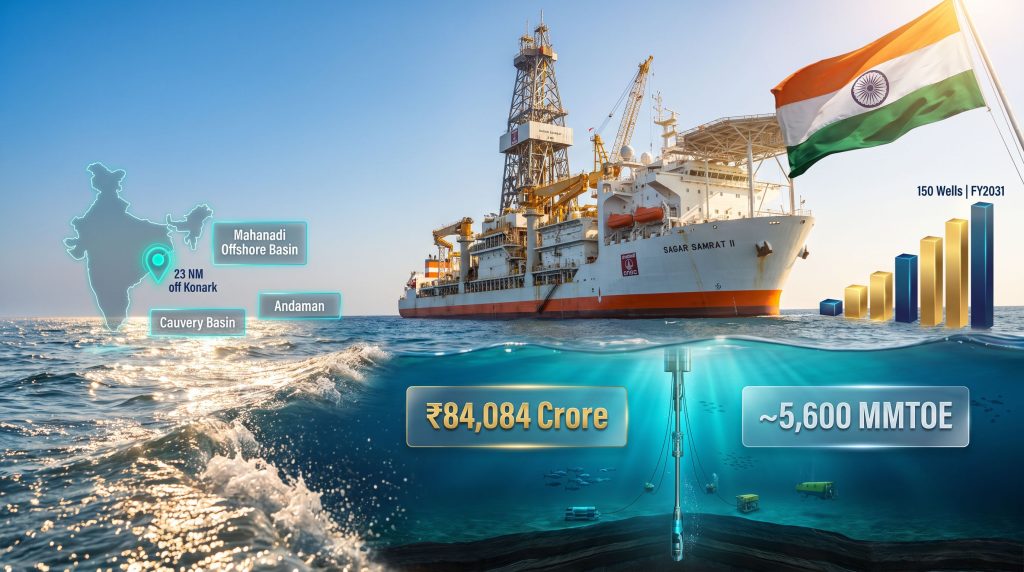
Formally designated as the National Offshore Exploration Scheme, the ONGC Samudra Manthan Mission received Union Cabinet approval on 31 July 2026 with a total committed outlay of ₹84,084 crore, to be deployed through financial year 2030-31. The programme is not a single drilling campaign but a multi-layered exploration architecture covering seismic surveying, exploratory drilling, technology adoption, digital programme management, and the development of common offshore infrastructure.
The name itself carries cultural resonance. Samudra Manthan translates from Sanskrit as the churning of the ocean, drawn from ancient Hindu cosmology in which gods and demons cooperated to churn the cosmic sea and extract invaluable treasures from its depths. The metaphor is deliberate and apt: extracting hydrocarbons from India's deep ocean floors requires sustained effort, advanced capability, and a willingness to accept that the rewards will not be immediate.
Key programme parameters at a glance:
- Total approved budget: ₹84,084 crore (approximately USD 10 billion)
- Programme duration: Through FY2030-31
- Total deepwater exploratory wells planned: 150
- Primary executing agency: Oil and Natural Gas Corporation (ONGC)
- Estimated deepwater hydrocarbon resource potential: approximately 5,600 MMTOE
- First well spudded: MN-DW18-1-H-D, on 25 July 2026
- Location of first well: approximately 23 nautical miles from Konark, off the Odisha coast
- Host basin of first well: Mahanadi Offshore Basin
Understanding the 5,600 MMTOE Opportunity
The figure of ~5,600 million tonnes of oil equivalent represents ONGC's combined estimate of deepwater and ultra-deepwater hydrocarbon potential across India's offshore sedimentary basins. To contextualise this number, it is worth understanding what MMTOE actually means in reserve terms.
MMTOE is a standardised unit that converts all hydrocarbon forms, including oil, natural gas, and condensates, into a single energy-equivalent figure. It allows geologists and planners to compare resources of fundamentally different compositions on a common scale. At 5,600 MMTOE, India's deepwater potential would, if even partially converted into proved reserves and then production, represent a transformational shift in the country's energy self-sufficiency profile. Furthermore, India energy market reforms currently underway may well accelerate how quickly such discoveries are monetised.
| Resource Category | Estimated Potential | Key Basins |
|---|---|---|
| Combined Deepwater Hydrocarbon Potential | ~5,600 MMTOE | Mahanadi, Cauvery, Andaman, others |
| Ultra-Deepwater Frontier Zones | Under active seismic assessment | Frontier offshore basins |
| Thermogenic Gas Presence | Confirmed indicators | Andaman region |
| Recent Discovery Zones | Utkal and Konark fields | Mahanadi Offshore Basin |
Critically, this figure represents resource potential, not proved reserves. Frontier basin exploration is inherently probabilistic. The 5,600 MMTOE estimate reflects what geophysical modelling and basin analogy suggest could exist, not what has been confirmed through drilling. The distinction matters for anyone interpreting these numbers in a commercial or investment context.
The DeepX Unit: Engineering an Exploration Capability From Scratch
One of the most structurally significant elements of the ONGC Samudra Manthan Mission is the creation of DeepX, ONGC's dedicated deepwater exploration task force. This is not a rebranded department within an existing corporate hierarchy but a mission-mode unit composed of more than 30 domain specialists working with explicit mandates to compress the discovery-to-development timeline.
The unit operates under a philosophy ONGC has described as "One Company, One Data", which aims to centralise all subsurface intelligence across the corporation's deepwater portfolio. In practice, this means geological data, seismic interpretation, well logs, and formation evaluation results from across different basins are consolidated into a unified analytical framework rather than existing in siloed departmental databases.
This approach addresses a chronic inefficiency in large national oil companies: the tendency for valuable geological insights generated by one team to remain inaccessible to exploration geologists working on adjacent or analogous formations elsewhere in the organisation. By centralising data, DeepX aims to identify cross-basin patterns, calibrate drilling risk more accurately, and prioritise targets with higher geological probability of success.
DeepX also integrates international technology partnerships as a core operating principle. Deepwater exploration at water depths exceeding 1,500 metres, and in some cases 3,000 metres or beyond, requires seismic imaging capabilities, drilling equipment, and reservoir evaluation tools that India's domestic oilfield services sector has not yet fully developed. Global collaboration is therefore not optional; it is a structural requirement of the programme.
The 150-Well Drilling Campaign: What It Means in Practice
Drilling 150 exploratory wells over seven years in deepwater conditions is a commitment of a scale that places India alongside the more ambitious national offshore programmes globally. To put this in perspective, a single deepwater exploratory well can cost anywhere from USD 50 million to USD 200 million or more, depending on water depth, well complexity, and rig day rates. At these economics, the 150-well programme represents not just a geological statement but a financial commitment of exceptional size.
The sequencing of the campaign is designed to move from near-field targets, where prior discovery data reduces geological uncertainty, toward increasingly frontier zones as the programme matures and India's deepwater drilling capability develops. The first well, MN-DW18-1-H-D, reflects this logic precisely: it targets the Mahanadi Offshore Basin where the Utkal and Konark discoveries have already provided encouraging subsurface data.
Large-scale 2D and 3D seismic surveys are the essential precursor to drilling. While 2D surveys provide broad basin-scale structural mapping, 3D seismic delivers the detailed subsurface imaging required to identify specific drilling targets, estimate trap geometry, and model reservoir quality. The Samudra Manthan programme allocates significant resources to both, ensuring that wells are drilled on the highest-quality geological targets rather than on poorly imaged prospects.
Common offshore infrastructure, including shared pipeline networks, processing facilities, and subsea systems, is another component of the programme. In deepwater environments, the cost of infrastructure is frequently the limiting factor in converting a discovery into a producing field. By developing shared infrastructure frameworks upfront, the programme aims to reduce the economic threshold at which individual discoveries become commercially viable.
The next major ASX story will hit our subscribers first
Mapping the Target Basins: Geology, Promise, and Risk
Mahanadi Offshore Basin
The Mahanadi basin off the coast of Odisha is the programme's leading near-term priority. The basin has already yielded the Utkal and Konark discoveries, which provide geological proof of concept for hydrocarbon accumulation in this province. The first Samudra Manthan well, drilled approximately 23 nautical miles from the town of Konark, builds directly on this prior work. The basin's sedimentary architecture, including its deep-water fan systems and structural traps, makes it one of the better-constrained frontier prospects in India's offshore portfolio.
Cauvery Basin
The Cauvery basin, located off India's southeastern coast near Tamil Nadu, has demonstrated promising structural and stratigraphic configurations. Its deepwater extension remains significantly under-explored relative to its geological complexity, and ONGC has identified it as a priority for seismic acquisition and subsequent drilling under the Samudra Manthan framework.
Andaman Region
The Andaman offshore zone is geologically distinct from India's other basins. It sits along a tectonically active margin with confirmed indicators of thermogenic gas, meaning gas generated by the breakdown of organic material under heat and pressure at depth rather than by microbial processes. Thermogenic gas systems are generally associated with larger, deeper accumulations. The Andaman region also carries strategic significance given its geographic position in the eastern Indian Ocean.
Why Frontier Basins Demand a Different Analytical Framework: Frontier basin exploration involves accepting a higher probability of dry holes in exchange for the possibility of discovering genuinely new hydrocarbon provinces. Global exploration history shows that frontier drilling success rates can be as low as one in five or one in ten wells, but the discoveries that do occur often define entire new producing regions. The Samudra Manthan programme's economic logic only holds if decision-makers maintain a portfolio perspective rather than evaluating each individual well in isolation.
Technology as the Decisive Variable
India's deepwater ambitions cannot be realised through conventional exploration methods. The technical demands of operating in water depths that can exceed 2,000 metres require capabilities that represent the frontier of the global oilfield services industry. In addition, keeping pace with technology and innovation trends across the broader resources sector will be essential if India is to close the capability gap with more established deepwater producers.
Key technology requirements for the programme include:
- Full-azimuth and wide-azimuth 3D seismic acquisition to image complex subsalt and deep structural targets
- Ocean bottom node (OBN) seismic technology, which provides significantly superior imaging in structurally complex areas compared to conventional streamer surveys
- Drillships and semi-submersible rigs capable of operating in ultra-deepwater conditions with managed pressure drilling capability
- Subsea completion and tieback technology for converting discoveries into production without fixed platform infrastructure
- Advanced formation evaluation logging-while-drilling tools to characterise reservoir quality in real time during drilling operations
The domestic oilfield services ecosystem in India currently has limited capability across several of these categories. The programme's emphasis on capacity building and domestic manufacturing development reflects an awareness that import dependency in technology mirrors import dependency in hydrocarbons: both represent strategic vulnerabilities that need to be systematically reduced.
Economic and Strategic Implications
The fiscal arithmetic of import substitution through domestic production is compelling when modelled at scale. If the Samudra Manthan programme ultimately unlocks even a fraction of its targeted resource potential, the reduction in crude import volumes would have a measurable impact on India's current account balance, foreign exchange reserves, and energy price inflation sensitivity.
Beyond the balance of payments, the programme carries industrial policy dimensions. Developing a deepwater hydrocarbon industry generates demand across a wide supply chain: steel fabrication, precision engineering, advanced materials, IT and data analytics, marine logistics, and specialised professional services. Countries that have successfully built indigenous offshore sectors, including Brazil, Norway, and Malaysia, have used hydrocarbon exploration as an anchor for broader industrial capability development.
The programme also aims to attract private and international investment into India's offshore basins. By reducing exploration risk through large-scale seismic coverage and demonstrating geological prospectivity through ONGC's own drilling, the framework is intended to make India's deepwater blocks more attractive to international oil companies and private capital that might otherwise deploy into more mature, better-understood basins elsewhere in the world. Moreover, India's broader resource and energy exports policy context, along with shifts in regional energy demand, will shape how receptive global partners are to participating.
Key Risks That Investors and Analysts Must Understand
No honest assessment of the ONGC Samudra Manthan Mission can omit a structured acknowledgment of its execution risks. The programme is ambitious by any global standard, and ambitious programmes carry proportionate risks.
Primary risk categories include:
- Geological risk: Frontier basin exploration fundamentally cannot guarantee commercial discoveries. The 5,600 MMTOE resource estimate is a probabilistic range, not a reserve figure. Dry holes are an expected and normal outcome of frontier exploration, not a programme failure.
- Capital deployment risk: Sustaining ₹84,084 crore in disciplined, well-sequenced expenditure over a five-to-seven-year window requires consistent institutional prioritisation and governance. Large capital programmes in state-owned enterprises face inherent risks of cost overrun, schedule slippage, and political interference.
- Technology and talent constraints: India currently lacks a deep domestic talent pool in ultra-deepwater drilling operations. Dependency on international specialists creates cost exposure and potential bottlenecks.
- Environmental considerations: Deepwater drilling in frontier areas, particularly the ecologically sensitive Andaman region, will require rigorous environmental impact assessment and regulatory engagement with multiple government bodies.
- Rig availability: The global market for ultra-deepwater drilling rigs is cyclical and can tighten rapidly when oil prices rise and exploration activity increases globally, potentially increasing rig day rates and compressing programme economics.
However, it is also worth noting that reduced import bills could partially offset these risks at a national level, particularly given India's significant exposure to India LNG import taxes and the ongoing cost of servicing a large hydrocarbon import portfolio.
How Samudra Manthan Compares Globally
| Programme Dimension | India: Samudra Manthan | Global Deepwater Benchmarks |
|---|---|---|
| Approved Budget | ₹84,084 crore (~USD 10 billion) | Major programmes often exceed USD 20-30 billion |
| Wells Planned | 150 over 7 years | Brazil pre-salt: hundreds over multiple decades |
| Primary Executing Agency | ONGC (state-owned) | Mix of NOCs and international oil companies |
| Technology Approach | Global collaboration with domestic capability build | Predominantly IOC-led with proprietary technology |
| Basin Maturity | Frontier to emerging | Ranges from mature to frontier globally |
| Strategic Driver | Import substitution and energy security | Revenue maximisation and reserve replacement |
Frequently Asked Questions
What does Samudra Manthan mean and why was this name chosen?
Samudra Manthan is a Sanskrit phrase meaning the churning of the ocean. It references a foundational episode in Hindu cosmology in which cooperation between opposing forces produces extraordinary treasures from the depths of the sea. The name reflects both the geographic nature of the programme and the sustained, large-scale effort required to extract value from India's deep offshore basins.
When was the programme officially approved?
The Union Cabinet approved the National Offshore Exploration Scheme, formally known as the ONGC Samudra Manthan Mission, on 31 July 2026.
How many wells will be drilled and over what period?
ONGC plans to drill 150 deepwater exploratory wells over a seven-year programme window, with expenditure running through FY2030-31.
Which was the first well drilled under the programme?
Well MN-DW18-1-H-D was the first well spudded under the Samudra Manthan campaign, with a spud date of 25 July 2026, located approximately 23 nautical miles from Konark off the Odisha coast in the Mahanadi Offshore Basin.
Will private or international companies participate?
The programme is structured to attract private and international investment by reducing exploration risk through large-scale seismic coverage and demonstrating basin prospectivity. However, ONGC is the primary executing agency, and the specific terms for third-party participation would be governed by India's Hydrocarbon Exploration Licensing Policy framework.
What happens if exploratory wells do not yield commercial discoveries?
Dry holes and non-commercial discoveries are a statistically expected outcome in any frontier exploration programme. The programme's portfolio logic anticipates a range of outcomes across 150 wells. Individual well results do not determine programme success; the aggregate reserve additions and geological learning generated across the full campaign do.
Milestones to Track Through FY2031
For those following the Samudra Manthan Mission over the coming years, the most meaningful progress indicators will include:
- Results from the MN-DW18-1-H-D well in the Mahanadi basin, which will set the tone for programme momentum in the near term
- Completion of large-scale 3D seismic acquisition across the Cauvery and Andaman frontier areas, providing the geological foundation for subsequent drilling decisions
- Announcement of additional well locations as the DeepX unit processes seismic data and prioritises prospects
- Progress on common offshore infrastructure frameworks that will ultimately determine the commercial threshold for any discoveries made
- The pace of domestic capability development in deepwater drilling and oilfield services, which will determine India's long-term ability to sustain and expand its deepwater exploration effort beyond the current programme window
The deepest measure of Samudra Manthan's ultimate success will not be visible for many years. Converting frontier exploration into producing fields typically takes a decade or longer from first discovery to first oil. What India is building now, through its seismic databases, its drilling experience, and its institutional knowledge, is the foundation on which a genuinely self-sufficient deepwater hydrocarbon industry could eventually stand.
Disclaimer: This article contains forward-looking statements, resource estimates, and programme projections sourced from publicly available information. Resource potential figures represent geological estimates, not proved reserves, and are subject to significant uncertainty. Nothing in this article constitutes financial or investment advice. Readers should conduct independent research before making any financial decisions related to the energy sector.
Want to Track the Next Major Resource Discovery Before the Market Does?
India's deepwater frontier illustrates precisely why positioning ahead of significant resource announcements can be transformative — and Discovery Alert's proprietary Discovery IQ model delivers real-time alerts the moment significant ASX mineral discoveries are announced, turning complex geological data into actionable opportunities. Explore how major discoveries have historically generated substantial returns on Discovery Alert's dedicated discoveries page, and begin your 14-day free trial today to ensure you're never behind the market again.