August 1, 2026
When Conservation Meets Critical Minerals: The Impossible Equation at the Heart of Raja Ampat
The global energy transition has a geography problem. The minerals required to build the batteries that power electric vehicles, store renewable energy, and decarbonise heavy industry are not distributed evenly across the Earth's crust. They concentrate in specific geological formations, many of which happen to sit beneath some of the planet's most ecologically irreplaceable landscapes. Nowhere is this tension more acute, or more consequential, than in the waters and islands of Raja Ampat, Indonesia, where nickel mining in Raja Ampat has become one of the most contested resource conflicts of the decade.
Understanding what is actually happening there, who the key actors are, and what is genuinely at stake requires moving beyond viral hashtags and into the structural realities of Indonesian mining governance, battery supply chain economics, and small-island ecology.
When big ASX news breaks, our subscribers know first
Raja Ampat's Ecological Irreplaceability: Why the Stakes Are So High
Located at the northwestern tip of Papua in Indonesia's easternmost region, Raja Ampat sits at the heart of the Coral Triangle, the area marine biologists designate as the global centre of marine biodiversity. The archipelago contains over 1,500 fish species, 700 mollusc species, and coral reef coverage that represents a significant proportion of the world's documented reef-building species. UNESCO's recognition of the region as a Global Geopark reflects not just the area's visual grandeur but its scientific significance as a living laboratory of evolutionary biology.
What makes small-island ecosystems like Raja Ampat disproportionately vulnerable to industrial disturbance is a principle well understood in conservation biology: limited land area means any given extractive footprint occupies a proportionally enormous share of the total available habitat. On a continental landmass, a mining concession of several thousand hectares may represent a fraction of a percentage point of the surrounding ecosystem. On a small island, however, the same concession can consume a majority of terrestrial habitat, severing connectivity between species populations and eliminating the ecological redundancy that allows systems to recover from disturbance.
Indigenous communities across the archipelago have maintained cultural and economic relationships with these marine and forest systems for generations. Their dependence is not simply material. It is embedded in social structures, cultural identity, and knowledge systems that have no equivalent elsewhere.
What Does the Science Say About Reef Vulnerability?
Oceanographic Magazine's reporting has highlighted that nickel mining poses a red-alert level threat to all life across Raja Ampat's reefs — not merely localised species. Furthermore, the interconnected nature of the Coral Triangle means that ecological damage does not respect administrative boundaries, amplifying the consequences of any single concession.
Indonesia's Strategic Nickel Ambition: The Economic Counterweight
Indonesia holds the world's largest nickel reserves and ranks among the top producers of nickel ore globally. This is not merely a geological fact. It has become a cornerstone of national industrial strategy. In 2020, Indonesia implemented a ban on raw nickel ore exports, a deliberate policy designed to force the construction of domestic processing infrastructure and capture more of the value generated along the battery supply chain. The Indonesian nickel industry has consequently expanded at a pace that few analysts anticipated when the export ban was first announced.
The downstream processing ambition is substantial. Indonesia Weda Bay Industrial Park (IWIP), located in Halmahera, is one of the country's flagship nickel processing hubs, attracting investment from China's Tsingshan Holding Group, the world's largest stainless steel and nickel processing enterprise, and France's Eramet. Ore from PT Gag Nikel on Gag Island feeds directly into this processing ecosystem.
Nickel's role in NMC (nickel manganese cobalt) and NCA (nickel cobalt aluminium) battery cathode formulations has fundamentally transformed its geopolitical weight. Higher nickel content in cathodes generally delivers greater energy density, which is why battery manufacturers have been progressively increasing nickel intensity in their formulations, a trend that directly amplifies demand pressure on Indonesian ore.
The role of nickel in the energy transition has consequently elevated Indonesia's strategic importance far beyond what conventional commodity markets would suggest. This creates a structural dilemma that no amount of protest messaging can dissolve: Indonesia possesses the reserves the global battery economy needs, and has constructed a national development model around monetising them at scale.
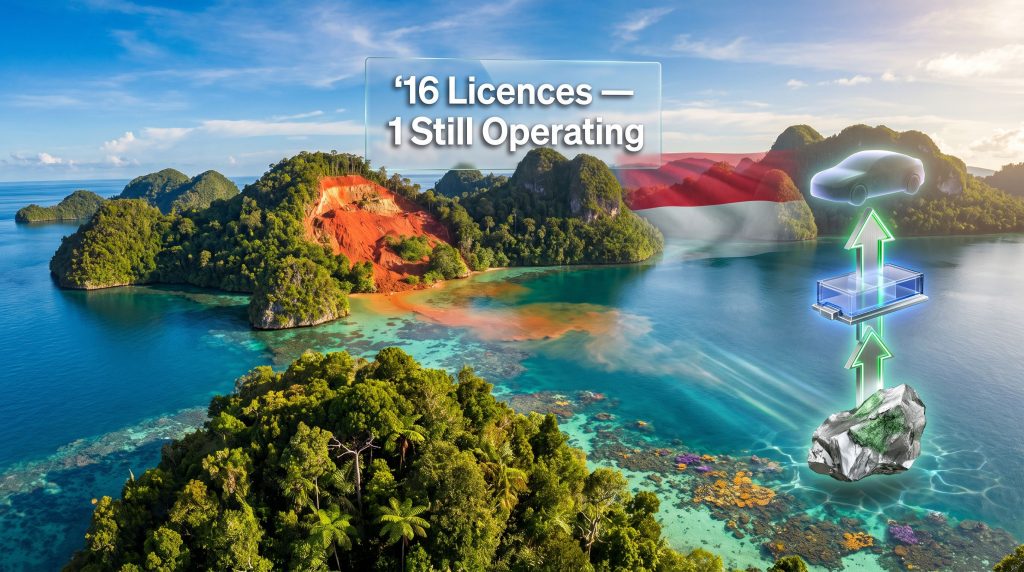
The 16-Licence Landscape: What the Permit Map Actually Shows
Greenpeace's July 2026 report, titled "Unprotected Paradise," documented the full licence landscape across Raja Ampat with findings that are more complex than the binary narrative of mining versus conservation typically presented in mainstream coverage.
| Licence Category | Number of Permits | Current Status |
|---|---|---|
| Revoked following 2025 protests | 4 | Cancelled |
| Under active processing (2026) | 3 | Being assessed |
| Operational (Gag Island) | 1 | Resumed September 2025 |
| Expired / Contested / Other | 8 | Various |
The four permit revocations that followed the 2025 protest wave were a genuine government response, but a selective one. The companies whose licences are currently being processed were not among those whose permits were revoked, according to Greenpeace's findings. PT Gag Nikel, the largest and most strategically significant operator in the archipelago, was also excluded from the revocations.
A critical regulatory distinction underlies the Gag Island situation. Antam has maintained that Gag Nikel's operations fall outside the designated Geopark boundary, which, if accurate, would place them outside the primary legal framework that the protest movement sought to invoke. However, the precise delineation of the Geopark boundary and how it intersects with active concession areas remains a source of genuine dispute between the operator, the government, and environmental organisations.
PT Gag Nikel, Antam, and the Audit That Raised More Questions Than It Answered
PT Gag Nikel's ownership structure places it at the intersection of state enterprise and international supply chains. As a subsidiary of Aneka Tambang (Antam), Indonesia's state-controlled mining conglomerate, Gag Nikel carries both the operational profile of a commercial miner and the institutional weight of a government-affiliated entity. Its ore supply relationship with IWIP connects it directly to some of the largest nickel processing investments in Southeast Asia.
The environmental audit at the centre of the current controversy is a February 2026 letter obtained by Greenpeace from Indonesia's environment ministry. The document identified two primary concerns:
- Elevated sediment levels in surrounding marine environments attributed to cleared land and active operations
- Failure to implement biodiversity protection principles required under applicable environmental standards
Antam's official response drew a sharp distinction between what the audit found and how Greenpeace characterised it. The company stated that the audit identified no environmental violations and that its findings constituted operational improvement recommendations rather than enforcement notices. This is not merely semantic. In Indonesian administrative law, the classification of a finding as a "recommendation" versus a "violation" determines whether enforcement mechanisms are triggered, whether operations can continue uninterrupted, and whether the company faces financial or legal consequences.
The interpretive gap between "operational guidance" and "documented environmental harm" is doing enormous regulatory work in this dispute. Both readings of the same document cannot simultaneously be correct, and the resolution of that interpretive question will determine Gag Nikel's operational future.
Gag Nikel resumed operations in September 2025 following a temporary suspension. By mid-2026, operations were continuing, with the audit process ongoing. Indonesia's environment ministry, Gag Nikel, and IWIP did not respond to requests for comment on the Greenpeace report when it was released on July 31, 2026. The country's mining ministry indicated it was reviewing the findings.
Ecological Damage: What Has Been Documented and What Remains Disputed
The environmental concerns associated with nickel mining in Raja Ampat span both confirmed findings and contested claims. Understanding the distinction matters for evaluating the severity of the situation.
| Environmental Concern | Source | Government Response |
|---|---|---|
| Increased sedimentation | February 2026 audit letter | Acknowledged as recommendation |
| Biodiversity protection failures | February 2026 audit letter | Classified as improvement guidance |
| Coral reef proximity risk | Greenpeace 2026 report | Disputed, operations said to be outside Geopark |
| Forest clearing on small islands | Multiple NGO reports | Not formally addressed |
| Indigenous livelihood disruption | Greenpeace and community reports | Tensions acknowledged |
Why Sedimentation Is Particularly Damaging on Small Islands
The sedimentation issue deserves particular attention because of how island hydrology differs from continental mining contexts. On small islands, rainfall interacts with cleared slopes and exposed soils to generate runoff that travels short distances before entering reef-adjacent marine environments. On continental mines, sediment plumes may travel through river systems over hundreds of kilometres before reaching sensitive ecosystems, allowing some degree of natural attenuation. On Gag Island, that buffer is minimal. The ecological pathway from mine activity to reef impact is compressed in both distance and time.
Forest clearing compounds this dynamic. Terrestrial vegetation on small islands provides critical functions: root systems bind soils, canopy cover reduces rainfall impact energy, and intact forest maintains the hydrological balance that prevents erosive runoff. When that cover is removed for mining operations, the remaining soil system is far more vulnerable to the kind of rainfall events that are regular occurrences in tropical Papua.
The next major ASX story will hit our subscribers first
The #SaveRajaAmpat Movement: Viral Success, Structural Limitations
The 2025 protest wave that propelled Raja Ampat into international consciousness demonstrated both the mobilising power of social media campaigns and their structural limitations as instruments of durable policy change. A graphic of the archipelago's turquoise waters shared with the hashtag #SaveRajaAmpat generated pressure sufficient to produce a tangible government response: four mining permits were revoked.
However, Greenpeace's 14-month assessment paints a more sobering picture of what followed. The companies whose licences are currently being processed were not among those whose permits were cancelled. Three new licence applications were advancing through the approval pipeline during a period of supposedly heightened regulatory scrutiny. No blanket moratorium on new mining applications within or adjacent to the Geopark was implemented.
The one operator whose strategic and economic significance made revocation most politically costly, PT Gag Nikel, resumed operations with its supply chain relationships intact. ABC News Australia's reporting on the battle to save Raja Ampat illustrates how community voices and international attention, whilst influential, have not yet translated into binding legal protection for the archipelago.
The indigenous dimension of this conflict is furthermore frequently underrepresented in coverage dominated by international environmental organisations. Community consent frameworks in Indonesian mining law have historically been difficult to invoke as binding constraints on permit approvals. Indigenous opposition carries different legal standing than NGO advocacy, and the intersection of customary land rights with Indonesia's national mining licensing regime creates jurisdictional complexities that remain largely unresolved.
Foreign Investment, ESG Exposure, and the Supply Chain Reckoning
Tsingshan Holding Group's presence in IWIP's investor base creates a reputational exposure that extends beyond Indonesia's regulatory environment. Chinese investment in Indonesian nickel has consequently become inseparable from the ESG conversations now unfolding in European and North American boardrooms. As the world's dominant nickel processor, Tsingshan sources material that flows into battery supply chains serving electric vehicle manufacturers operating in regulatory environments with growing ESG disclosure requirements.
Eramet's position is particularly nuanced. As a French company operating within the European Union's regulatory orbit, Eramet faces ESG investor scrutiny, potential obligations under emerging EU supply chain due diligence frameworks, and reputational risk in a market where premium consumers increasingly demand transparency about mineral sourcing. The fact that IWIP receives ore from a concession area operating under contested environmental findings, in proximity to a UNESCO-designated geopark, creates material reputational risk regardless of where the formal legal boundary lines are drawn.
In addition, emerging supply chain transparency frameworks, including the EU's Corporate Sustainability Due Diligence Directive, are beginning to require that downstream buyers assess and disclose environmental and social risks in their mineral sourcing chains. The broader battery metals investment landscape is consequently shifting, as investors begin pricing in regulatory and reputational risk alongside conventional commodity metrics. If these frameworks mature as currently projected, sourcing from Raja Ampat-adjacent operations may require disclosure that downstream manufacturers would prefer to avoid.
Governance Architecture: The Multi-Agency Accountability Gap
One of the least examined dimensions of the Raja Ampat situation is the fragmentation of regulatory authority across multiple Indonesian government bodies. The mining ministry issues concession permits. The environment ministry conducts environmental audits and sets biodiversity protection standards. The regional Papua government holds jurisdictional interests over land use and community relations. These agencies operate under different legislative mandates, with different institutional incentives, and without a unified enforcement architecture.
The mining ministry's response to the July 2026 Greenpeace report, indicating it was "checking the findings," illustrates this fragmentation in practice. A finding by the environment ministry that identifies sedimentation risks and biodiversity protection failures does not automatically trigger action by the ministry responsible for the permits that authorised the activity creating those risks.
UNESCO's Global Geopark designation, while symbolically powerful, is substantively weaker than World Heritage Site status in terms of the enforceable constraints it places on host country governments. Geopark designation is a recognition framework, not a prohibition framework. The question of critical minerals and energy security therefore sits at the very heart of why Indonesian authorities face such difficulty prioritising conservation outcomes over extraction revenue.
What Meaningful Protection Would Actually Require
The policy toolkit for genuinely protecting Raja Ampat while navigating Indonesia's legitimate development interests is neither simple nor cost-free. Credible protection would require:
- Legislative amendment establishing enforceable no-go zones within and adjacent to the Geopark boundary, with clear geographic definitions that cannot be disputed through boundary interpretation arguments
- Independent environmental monitoring with community participation, replacing the current system in which audit findings are interpreted primarily by the regulated entity and the issuing ministry
- Mandatory free, prior, and informed consent from indigenous communities as a precondition for any new mining permit approval in the archipelago
- Supply chain transparency requirements imposed on downstream buyers sourcing from Raja Ampat-adjacent operations, creating market-based pressure to complement regulatory enforcement
- International conservation financing mechanisms that offer economically viable alternatives to resource extraction for local communities, making protection financially sustainable rather than simply morally desirable
The fourteen-month interval between the peak of the #SaveRajaAmpat movement and Greenpeace's mid-2026 assessment has become a measure of governance credibility, not just environmental policy. How Indonesia navigates the remaining permit applications, the ongoing Gag Nikel audit, and the three licences currently being processed will signal whether the 2025 protest response represented substantive policy recalibration or a temporary political accommodation that left the underlying structural dynamics unchanged.
The world's demand for nickel will not diminish as the energy transition accelerates. But the question of whether that demand is satisfied at the cost of ecologically irreplaceable systems — or through governance frameworks that can genuinely balance extraction with conservation — remains unanswered at nickel mining in Raja Ampat, and increasingly urgent everywhere else.
Readers seeking additional reporting on the Raja Ampat nickel mining controversy may find coverage from Reuters and Mining.com informative, including documentation of Greenpeace's Unprotected Paradise findings published on July 31, 2026.
Want to Stay Ahead of the Next Major Mineral Discovery?
Discovery Alert's proprietary Discovery IQ model scans ASX announcements in real time, instantly identifying significant mineral discoveries — from nickel to battery metals — and translating complex data into actionable investment insights for traders and long-term investors alike. Explore how historic discoveries have generated extraordinary returns and begin your 14-day free trial at Discovery Alert to position yourself ahead of the broader market.