
July 31, 2026
Water in the Desert: Why Groundwater Confirmation Is the Hidden Gatekeeper of Critical Minerals Projects
Across the American Southwest, the most underappreciated constraint on industrial development is not land access, permitting complexity, or even capital availability. It is water. In arid basin environments where evaporation rates routinely exceed precipitation by a factor of ten or more, the question of whether a proposed industrial facility can secure a reliable, long-term freshwater supply often determines whether a project proceeds at all. For critical minerals processing operations, which depend on water-intensive hydrometallurgical techniques to separate and refine target elements, this constraint is especially acute.
It is within this context that the confirmation of substantial Yuma groundwater for EVelution Energy's cobalt plant carries significance well beyond a single project milestone. The results of an exploratory drilling program in Yuma County, Arizona have validated the hydrogeological foundation of a US$450 million solar-powered cobalt processing facility, while simultaneously demonstrating that deep artesian aquifer systems in arid Western states can serve as viable industrial water sources. Furthermore, this development intersects meaningfully with the broader critical minerals and energy security debate shaping US industrial policy.
When big ASX news breaks, our subscribers know first
The Hydrogeological Case for Yuma County
Understanding why Yuma County was selected as the site for the United States' first proposed commercial-scale cobalt processing facility requires an appreciation of both its advantages and its inherent constraints.
Yuma County occupies one of Arizona's most intensively irrigated agricultural corridors. The region draws heavily on both surface water allocations tied to the Colorado River system and groundwater resources, making water governance a foundational consideration for any new industrial entrant. Critically, the proposed project site sits outside an Arizona Active Management Area (AMA), a regulatory designation that would otherwise impose volumetric pumping restrictions on groundwater extraction. This locational characteristic gives the facility considerably greater operational flexibility.
Beyond regulatory positioning, the site benefits from exceptional solar irradiance conditions, supporting the project's ambition to operate as a fully solar-powered processing facility. This combination of regulatory positioning, solar resource availability, and proximity to existing agricultural and logistics infrastructure made Yuma County an operationally logical choice for a facility of this type.
What Arizona's Active Management Areas Actually Mean for Developers
Arizona's AMA framework, established under the 1980 Groundwater Management Act, divides the state into zones of varying regulatory intensity based on groundwater overdraft risk. Within designated AMAs, groundwater users face legally binding conservation requirements and pumping limits enforced by the Arizona Department of Water Resources. For high-volume industrial users, operating within an AMA can fundamentally restrict production scale and operational flexibility.
Projects sited outside AMAs are not entirely unregulated, but they operate under a substantially less restrictive framework. For a cobalt processing facility with significant process water demands, this distinction is not a bureaucratic technicality. It is a core element of project feasibility.
Drilling to 1,500 Feet: What BasinWells Associates Confirmed
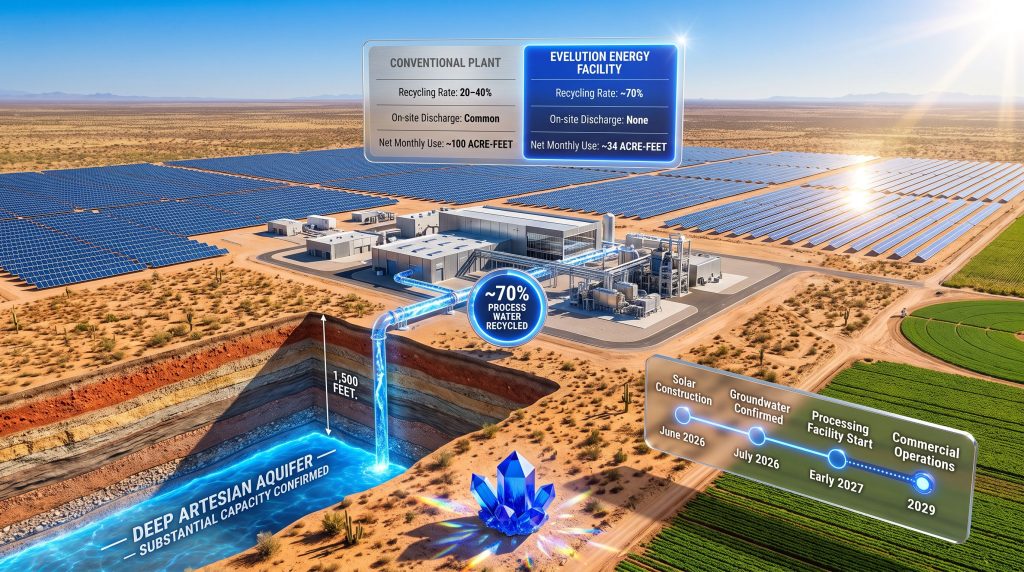
The exploratory drilling program, conducted by hydrogeological consultant BasinWells Associates, penetrated to a depth of 1,500 feet, accessing deep artesian aquifer zones beneath the Yuma County project site. Artesian aquifers differ from unconfined aquifers in a critically important way: they are pressurised by overlying impermeable rock layers, meaning water rises in a well bore without mechanical pumping and can sometimes flow freely at the surface.
This pressurised characteristic can reduce long-term pumping energy requirements and signals a well-isolated, rechargeable water body. According to EVelution Energy's official announcement, the testing programme encompassed three primary components:
- Aquifer characterisation and yield assessment to determine sustainable extraction rates
- Groundwater sampling and quality profiling to evaluate chemical composition and treatment requirements
- Hydrogeological mapping to delineate the spatial extent and bearing capacity of identified aquifer zones
Results confirmed substantial groundwater-bearing capacity across multiple aquifer horizons, with the confirmed volume sufficient not only to sustain the planned facility at its initial production scale but to support capacity expansion beyond the original design parameters. This expansion headroom represents a meaningful de-risking outcome for investors evaluating long-term project economics.
The Salinity Finding: A Challenge With a Built-In Solution
Water quality testing identified elevated salinity levels in the target artesian zones. This outcome, while requiring treatment investment, is not unusual for deep arid-region groundwater systems. In basin-and-range geological settings like those found in southern Arizona, long groundwater residence times and mineral dissolution from surrounding rock formations frequently produce elevated total dissolved solids (TDS) concentrations in deep aquifer intervals.
The elevated salinity finding actually reinforces the project's water management design logic. Deep artesian water with high TDS is unsuitable for direct agricultural application, meaning the facility's abstraction does not directly compete with the shallow groundwater resources that regional agricultural operators depend on.
EVelution Energy's response to the salinity challenge is integrated into the facility's core design. An onsite water treatment plant will process extracted groundwater to remove salinity and other dissolved constituents, producing treated water outputs suitable for agricultural reuse. This treated water stream creates a potential secondary benefit for the surrounding Yuma farming community.
| Parameter | Confirmed Finding |
|---|---|
| Drilling Depth | 1,500 feet |
| Aquifer Type | Deep artesian (pressurised) |
| Groundwater-Bearing Capacity | Substantial, confirmed across multiple zones |
| Water Quality | Elevated salinity, treatment required |
| AMA Jurisdiction | Outside Arizona Active Management Area |
| Expansion Potential | Capacity confirmed beyond initial design parameters |
The Closed-Loop Water Model: Engineering for Scarcity
What distinguishes EVelution Energy's facility design from conventional hydrometallurgical operations is not simply its use of recycled water, but the degree to which water conservation is embedded as a first-principles engineering constraint rather than an environmental compliance add-on.
Conventional hydrometallurgical processing plants typically recycle between 20% and 40% of process water. Discharge streams, tailings ponds, and evaporation ponds are standard features of the operational landscape. The environmental liabilities associated with these elements — including acid rock drainage risk, heavy metal leaching, and water table contamination — represent significant regulatory, financial, and reputational exposures for project operators.
EVelution Energy's facility architecture departs from this model across several dimensions:
- ~70% process water recycling rate, significantly exceeding industry norms
- Zero on-site process-water discharge, eliminating wastewater stream management requirements
- No tailings storage or disposal infrastructure, removing a major environmental liability category
- Deep artesian well sourcing, reducing direct competition with surface water allocations
- Full solar-powered operation, decoupling the facility's energy footprint from fossil fuel supply chains
| Feature | Conventional Hydrometallurgical Plant | EVelution Energy Facility (Planned) |
|---|---|---|
| Process Water Recycling Rate | Typically 20–40% | ~70% |
| On-site Discharge | Common | None |
| Tailings Storage | Standard requirement | Eliminated |
| Freshwater Source | Surface or shallow groundwater | Deep artesian wells |
| Net Monthly Consumption | Highly variable, often high | ~34 acre-feet/month |
| Solar Energy Integration | Rare | Full solar-powered operation |
Contextualising the 34 Acre-Feet Per Month Consumption Figure
Net freshwater consumption for the facility is estimated at approximately 34 acre-feet per month, a figure that requires context to properly evaluate. In agricultural terms, this volume is broadly equivalent to the annual irrigation requirements of roughly 70 acres of irrigated farmland in the Yuma region. Yuma County agriculture, however, encompasses hundreds of thousands of irrigated acres consuming millions of acre-feet annually.
The facility's projected monthly net freshwater consumption is, in practical terms, a rounding error against the backdrop of regional agricultural water demand. Deep artesian sourcing further ensures that this draw does not compete with the shallower groundwater systems that underpin Yuma's agricultural economy.
This consumption profile, achieved through the closed-loop recycling system, represents a compelling argument for the commercial viability of responsible industrial water use in arid environments. Consequently, it positions Yuma groundwater for EVelution Energy's cobalt plant as a model worth examining across the broader battery metals investment landscape.
Why Domestic Cobalt Processing Matters Now
The United States currently lacks a single commercial-scale domestic cobalt processing facility. Processed cobalt for lithium-ion battery cathode manufacturing — including the nickel-manganese-cobalt (NMC) and nickel-cobalt-aluminium (NCA) chemistries that dominate current EV battery production — travels through supply chains heavily concentrated through overseas refining infrastructure. This dependency creates measurable strategic and commercial exposure for US battery manufacturers.
Cobalt's role in battery chemistry is worth understanding at a technical level. In NMC cathodes, cobalt stabilises the crystal structure during charge-discharge cycling, improving capacity retention and thermal stability. Efforts to reduce cobalt content, including the development of NMC 811 and cobalt-free chemistries, have made meaningful progress but have not eliminated cobalt from the high-performance battery segment. The critical minerals demand surge projected through the 2030s only amplifies this supply chain urgency.
The US Department of Energy continues to classify cobalt as a critical mineral under its supply chain vulnerability framework. A domestically operated, solar-powered cobalt processing facility would represent a structural intervention in this architecture, creating a US-based processing node for cobalt sourced from international mining operations or domestic deposits. Furthermore, developments such as strategic antimony financing illustrate how the federal government is increasingly willing to back domestic critical minerals infrastructure across multiple material categories.
Project Development Timeline
| Milestone | Target Date |
|---|---|
| Solar energy facility construction commenced | June 2026 |
| Groundwater drilling and testing confirmed | July 2026 |
| Cobalt processing facility construction (expected start) | Early 2027 |
| Commercial operations target | 2029 |
The next major ASX story will hit our subscribers first
Hydrogeological Confirmation as a De-Risking Framework
For critical minerals projects in water-constrained environments, aquifer confirmation drilling is increasingly recognised as a foundational de-risking step — functionally equivalent in importance to ore reserve definition for mining operations. A project that cannot confirm an adequate, technically manageable water supply faces a fundamental viability question regardless of its mineral processing economics.
The Yuma drilling programme demonstrates several principles with broader applicability for critical minerals infrastructure development in the American Southwest:
- Deep artesian aquifer systems in arid basin geology can provide reliable industrial water supply when properly characterised
- Elevated salinity in deep arid-region groundwater is a manageable constraint, not a disqualifying factor, when treatment infrastructure is incorporated into facility design from inception
- Artesian well configurations may offer energy efficiency advantages over conventional pumped groundwater systems
- Confirming aquifer capacity beyond initial design requirements provides investors with production scalability optionality
In addition, advances in direct lithium extraction technology demonstrate that water-intensive critical minerals processing in arid regions can be reimagined through engineering innovation — a principle equally applicable to cobalt refining. If EVelution Energy's closed-loop water management system performs as designed at commercial scale, it could establish a new operational benchmark for hydrometallurgical facilities globally. Zero process-water discharge combined with a 70% recycling rate, validated at industrial scale, would represent a material advance over current industry practice.
Interesting Engineering notes that the combination of solar power and groundwater recycling at this facility could influence permitting standards for future projects in similarly water-stressed environments — a outcome that extends well beyond the immediate significance of Yuma groundwater for EVelution Energy's cobalt plant.
Disclaimer: This article contains forward-looking statements regarding project timelines, production capacity, water consumption estimates, and commercial outcomes. These statements are based on current expectations and assumptions and are subject to material risks and uncertainties. Actual outcomes may differ significantly from those projected. This article does not constitute financial or investment advice. Readers should conduct their own due diligence before making investment decisions.
Want to Stay Ahead of the Next Major Critical Minerals Discovery?
Discovery Alert's proprietary Discovery IQ model delivers real-time alerts on significant ASX mineral discoveries, transforming complex data across more than 30 commodities into clear, actionable insights for both short-term traders and long-term investors — explore historic examples of exceptional discovery returns to understand what's at stake, then begin your 14-day free trial at Discovery Alert to position yourself ahead of the broader market.