July 31, 2026
The Carbon Cost Equation Rewriting Global Aluminium Trade
Carbon pricing is reshaping the economics of international aluminium trade in ways that tariff schedules alone cannot capture. For decades, market access into the European Union was primarily a function of import duties, trade agreements, and origin rules. That calculus has fundamentally changed. The EU's Carbon Border Adjustment Mechanism has introduced a new variable into every export transaction: the carbon intensity of the production process itself. For Indian aluminium exporters, India-EU FTA CBAM compliance for aluminium exporters represents one of the most operationally complex trade challenges of the current era.
Understanding how these two instruments interact, where they diverge, and what practical steps exporters must take is no longer optional. It is a prerequisite for competitive participation in the EU market from 2026 onward. Furthermore, the broader shifts already reshaping aluminum and alumina markets globally add further urgency to getting compliance right.
When big ASX news breaks, our subscribers know first
The Carbon Border Adjustment Mechanism: Architecture and Financial Mechanics
CBAM is not a conventional import tariff. It functions as a carbon cost equalisation instrument, designed to ensure that goods entering the EU single market carry an equivalent carbon price to that borne by European producers under the EU Emissions Trading System (EU ETS). The financial exposure it creates scales directly with the carbon intensity embedded in the manufacturing process, making energy sourcing a competitive differentiator rather than merely an operational cost.
The mechanism covers several carbon-intensive sectors, with aluminium sitting alongside steel, cement, fertilisers, and electricity. For aluminium specifically, embedded emissions are calculated across two dimensions: direct process emissions generated during smelting and indirect emissions attributable to electricity consumption intensity. This dual calculation makes the power source used in production particularly consequential.
From Reporting to Real Financial Obligation: The Phase Transition
The CBAM has moved through two distinct operational stages:
| CBAM Phase | Period | Core Obligation |
|---|---|---|
| Transitional (Reporting Only) | October 2023 to December 2025 | Quarterly embedded emissions reporting to EU authorities |
| Definitive (Certificate Surrender) | From 1 January 2026 | Purchase and surrender of CBAM certificates proportional to verified embedded emissions |
| Full Integration | Ongoing post-2026 | Verified data submission plus certificate cost embedded in import pricing |
The shift to the definitive phase from 1 January 2026 represents a fundamental change in the stakes involved. During the transitional period, non-compliance carried reputational and administrative consequences. Under the definitive phase, EU importers must purchase CBAM certificates priced in alignment with EU ETS carbon allowances and surrender them against verified emissions data. The financial liability is now real, quantifiable, and directly tied to production carbon intensity.
Critical distinction: Operators who treated the transitional reporting phase as a low-priority administrative exercise now face a compressed window to build compliant data infrastructure before certificate obligations bite.
Why Coal-Dependent Production Carries Maximum Exposure
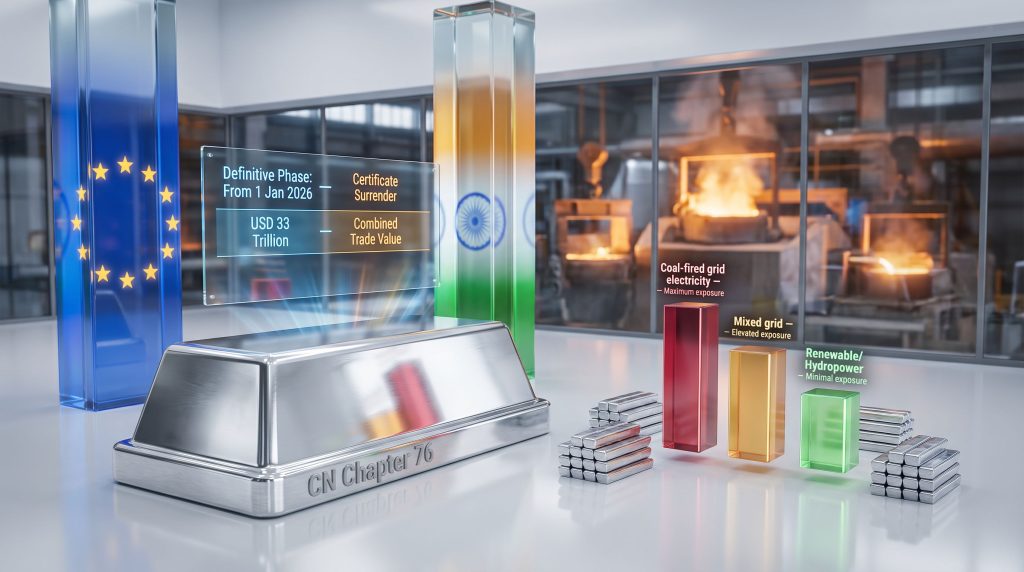
The electricity source used in aluminium smelting is the single largest determinant of CBAM certificate cost exposure. The following comparison illustrates the relative financial risk by energy source:
| Production Energy Source | Carbon Intensity Profile | CBAM Certificate Cost Exposure |
|---|---|---|
| Coal-fired grid electricity | High | Maximum exposure |
| Mixed grid incorporating renewables | Medium to High | Elevated exposure |
| Renewable or hydropower-based power | Low | Minimal exposure |
| Secondary or recycled aluminium content | Very Low | Significantly reduced |
India's aluminium smelting sector relies substantially on coal-fired power, placing many producers toward the higher end of this exposure spectrum. Producers operating on coal-intensive grids will face structurally higher CBAM certificate costs per tonne exported compared to counterparts using cleaner electricity. Consequently, this creates a carbon competitiveness gap that tariff improvements under a trade agreement cannot neutralise.
India-EU FTA and CBAM: Why These Are Two Separate Instruments
A widespread misconception circulating among Indian SME exporters is that FTA status translates into CBAM relief or exemption. This assumption is incorrect and commercially dangerous if acted upon without correction. In addition, the broader aluminium tariffs impact already reshaping global trade flows illustrates how policy instruments can interact in unexpected ways.
The India-EU FTA, with negotiations concluded in 2026 and formal signing expected later that year, delivers preferential tariff access to the EU market. This is meaningful: reduced or eliminated import duties improve export economics and competitive positioning. However, CBAM operates on an entirely separate legal and regulatory track within EU trade law. Tariff concessions and carbon border pricing are governed by different frameworks, and preferential trade status carries no mechanism to reduce, waive, or offset CBAM certificate obligations.
Indian aluminium exports to the EU remain subject to full CBAM compliance obligations regardless of FTA status. The two instruments address different problems and neither modifies the other's application.
What the India-EU FTA's CBAM Annexure Actually Delivers
While the FTA does not exempt exporters from CBAM obligations, it does include a dedicated CBAM annexure, described as a first-of-its-kind structural provision within India's bilateral trade agreements. This annexure establishes three operational pillars that create a framework for managing CBAM exposure over time:
-
Future flexibility provisions — India retains the right to benefit from any flexibility mechanisms the EU introduces for partner countries as the CBAM framework evolves. This ensures India is not locked out of preferential arrangements that may emerge through future EU regulatory changes.
-
SME compliance support architecture — The annexure includes specific measures directed at helping smaller Indian exporters meet carbon verification and data reporting requirements. Given that SMEs represent a significant share of India's aluminium export base, this provision addresses a genuine structural gap.
-
Carbon price recognition engagement — A formal bilateral channel has been established to negotiate whether carbon costs paid under India's emerging domestic carbon pricing mechanism can be offset against CBAM certificate obligations at the EU border. This mirrors provisions already embedded in CBAM's design for countries with recognised equivalent carbon pricing systems.
The Domestic Carbon Price Offset: Promising but Unconfirmed
India is actively developing a domestic carbon pricing framework. Under CBAM's foundational design, where an exporting country operates an equivalent carbon price, verified costs paid domestically can reduce the certificate obligation imposed at the EU border. Bilateral discussions are underway through the FTA's annexure mechanism to pursue this recognition for Indian producers.
However, this outcome remains unresolved. EU recognition of India's domestic carbon pricing mechanism has not been confirmed, and exporters should not incorporate assumed offset eligibility into their compliance planning until formal recognition is granted. Treating this as a solved problem before it is resolved could expose exporters to significant financial shortfalls in CBAM certificate budgeting.
Understanding the Compliance Obligation: Who Pays, Who Provides Data
One of the less understood aspects of CBAM is how the legal obligation and the practical burden are distributed between EU importers and Indian exporters. The legal responsibility to purchase and surrender CBAM certificates rests with the EU importer, formally designated as the authorised declarant. The Indian exporter does not directly purchase certificates.
However, the EU importer's ability to calculate accurate certificate liability depends entirely on installation-level, product-specific emissions data provided by the Indian exporter. Without this verified data, EU importers must apply EU default values, which are deliberately set conservatively high to incentivise proper data submission.
The practical commercial consequence is significant: an Indian exporter that cannot supply verified emissions data will face pricing pressure as EU buyers apply default values to calculate their certificate costs and then factor that premium into purchase price negotiations. The Indian exporter effectively subsidises the importer's elevated compliance cost through lower realised export prices.
Five Core Compliance Requirements for Indian Aluminium Exporters
-
CN Code Confirmation — Map all export product lines against EU aluminium CN Chapter 76 codes to confirm precisely which products fall within CBAM scope. Not all aluminium goods are automatically covered.
-
Installation-Level Emissions Accounting — Establish granular carbon accounting at the plant level covering both direct Scope 1 emissions from the smelting process and electricity-related indirect emissions. Generic corporate sustainability disclosures do not meet this standard.
-
Independent Third-Party Verification — Obtain verification from an EU-recognised verifier or an accepted equivalent. ESG reports, internal audits, and sustainability certifications are insufficient under CBAM's evidentiary requirements.
-
Shipment-Specific Data Delivery — Provide emissions data on a per-shipment basis to EU buyers ahead of import declaration filing. This requires operational integration between production monitoring systems and export documentation processes.
-
EU Importer Threshold Assessment — Confirm whether the EU buyer qualifies under any amended small-importer threshold exemptions that may simplify reporting obligations and reduce the data granularity required.
The SME Challenge: Disproportionate Burden on Smaller Exporters
While CBAM applies uniformly across exporters, its compliance burden falls disproportionately on smaller producers and exporters who lack the internal technical infrastructure to meet its requirements. The structural barriers are substantial:
-
Carbon verification complexity: Calculating embedded carbon content at the installation level requires specialist expertise, metering infrastructure, and data management systems that most SMEs have not historically needed.
-
Verifier recognition gap: EU authorities must recognise the third-party verifier engaged by the exporter. The pool of India-based verification agencies with established EU recognition remains limited, creating capacity constraints during a period of rising demand.
-
MRV infrastructure cost: Establishing a measurement, reporting, and verification system represents meaningful upfront capital expenditure relative to the export volumes of smaller producers.
-
Data granularity mismatch: Many SMEs have invested in general corporate sustainability reporting but have not built the product-level, installation-specific data architecture that CBAM's verification standards demand. These are fundamentally different exercises.
India's Commerce Ministry has acknowledged this structural challenge. A nationwide district-level outreach programme is being developed to educate businesses, particularly SMEs, on FTA provisions and CBAM compliance pathways. Digital tools are also being developed to assist exporters in identifying obligations and accessing compliance resources. The FTA's CBAM annexure creates a formal bilateral mechanism to escalate SME-specific concerns to EU regulatory authorities, providing a structured channel that did not previously exist.
Scale context: India and the EU together represent approximately one-third of global trade, with combined flows valued at around USD 33 trillion. Germany's automotive sector alone exports approximately USD 286 billion annually, illustrating the mutual commercial stakes that incentivise both parties to resolve compliance friction constructively.
Strategic Compliance Roadmap for Indian Aluminium Exporters
Phase 1: Product Scope and Data Infrastructure (Immediate Priority)
-
Audit all aluminium product lines against EU CBAM Annex I covered CN codes under Chapter 76 to establish which exports are in scope.
-
Commission a baseline carbon intensity assessment at the installation level, separately quantifying direct process emissions and electricity-attributable emissions.
-
Identify gaps between current data collection capability and the granularity CBAM's verification standards require.
Phase 2: Verification and EU Buyer Alignment (Short-Term)
-
Engage an EU-recognised third-party verifier early, given capacity constraints in India's verifier ecosystem. Early engagement also allows time to address data gaps before the first certificate surrender cycle.
-
Establish a standardised shipment-level data delivery protocol with EU buyers, ensuring emissions data is available prior to import declaration filing.
-
Clarify with EU buyers whether any small-importer threshold exemptions apply to their purchasing volumes, which may simplify documentation requirements.
Phase 3: Carbon Reduction and Offset Strategy (Medium-Term)
-
Assess the feasibility of transitioning to lower-carbon electricity sources to structurally reduce CBAM certificate cost exposure rather than simply absorbing it.
-
Monitor the progression of India's domestic carbon pricing mechanism and developments in bilateral carbon price recognition negotiations. In this regard, the EU metals action plan provides useful context on how EU policy frameworks are evolving.
-
Actively engage with India's Commerce Ministry outreach initiatives and the bilateral CBAM working group established under the FTA annexure.
The next major ASX story will hit our subscribers first
Frequently Asked Questions: India-EU FTA CBAM Compliance for Aluminium Exporters
Does FTA status exempt Indian aluminium from CBAM certificate obligations?
No. Preferential tariff treatment under the India-EU FTA operates on an entirely separate legal track from CBAM. Full compliance obligations under the definitive phase apply to Indian aluminium exports from 1 January 2026 irrespective of FTA status.
Who holds the legal obligation to purchase CBAM certificates?
The EU importer, acting as the authorised declarant, bears the legal obligation to purchase and surrender CBAM certificates. However, the cost is commercially reflected in pricing negotiations, and exporters who cannot supply verified emissions data face competitive disadvantage through the application of default values.
What data must Indian aluminium exporters provide?
Exporters must supply installation-level, product-specific embedded emissions data covering both direct process emissions and electricity consumption intensity. General ESG disclosures or corporate sustainability reports do not satisfy CBAM's evidentiary standards.
Can carbon costs paid in India offset EU CBAM obligations?
This is currently under bilateral negotiation through the FTA's dedicated CBAM annexure. India is developing a domestic carbon pricing framework, and discussions are ongoing regarding EU recognition for offset purposes. No formal offset eligibility has been confirmed and should not be assumed in current compliance planning.
Which aluminium products fall under CBAM?
Products covered under EU aluminium CN Chapter 76 and listed in CBAM Annex I are in scope. Exporters must confirm coverage for each specific product line, as coverage is not automatic across all aluminium goods.
CBAM as a Permanent Feature of EU Market Access Economics
CBAM is not a temporary compliance exercise. It is the EU's long-term instrument for aligning the carbon costs embedded in imported goods with those borne by European producers under the EU ETS. As EU ETS allowance prices evolve over time, CBAM certificate costs will scale accordingly, making carbon intensity a permanent and growing competitive variable for every aluminium exporter targeting European buyers.
Exporters who build robust measurement, reporting, and verification infrastructure now will gain a durable structural advantage as compliance requirements tighten. Furthermore, the green metals pricing trends emerging globally suggest that low-carbon production credentials will increasingly influence EU buyer procurement decisions. Those who delay risk not only financial penalties through default value application but progressive exclusion from EU supply chains as standards evolve.
The India-EU FTA creates genuine commercial opportunity. India and the EU together represent approximately one-third of global trade at around USD 33 trillion in combined value, and preferential tariff access will improve the economics of aluminium exports meaningfully. However, the green metals leadership benchmark being set globally underscores that market access alone is insufficient. India-EU FTA CBAM compliance for aluminium exporters is the operational capability that ultimately determines whether Indian producers can compete on equal terms within the EU market.
Readers seeking ongoing coverage of CBAM regulatory developments and aluminium trade dynamics may find AL Circle's sustainability section a useful resource for tracking updates in this space.
Want To Track The Next Major ASX Mineral Discovery Before The Market Moves?
Discovery Alert's proprietary Discovery IQ model scans ASX announcements in real time, instantly converting complex mineral data across 30+ commodities into clear, actionable investment insights — the same technology that identified transformative discoveries like De Grey Mining and WA1 Resources. Explore the historic returns major mineral discoveries have delivered and begin your 14-day free trial today to position yourself ahead of the broader market.