July 31, 2026
When Conservation Meets Critical Minerals: The Raja Ampat Nickel Crisis Explained
The global race to secure battery-grade nickel for electric vehicle production has quietly pushed one of the planet's most ecologically significant marine environments to the brink. As EV adoption accelerates across major economies and battery metals demand growth continues to climb through the 2030s, the uncomfortable reality is that some of the world's richest laterite nickel deposits lie directly beneath ecosystems science cannot afford to lose. Nowhere is this tension more acute than in Raja Ampat, Indonesia's remote Papua archipelago, where nickel mining in Raja Ampat has become one of the most contested resource governance stories of the decade.
When big ASX news breaks, our subscribers know first
Raja Ampat's Ecological Status: Why This Place Is Genuinely Irreplaceable
Raja Ampat is not simply a scenic tourist destination. It occupies a critical position within the Coral Triangle, the global epicentre of marine biodiversity, where species richness per square kilometre exceeds almost any other shallow marine environment on Earth. Scientists have documented coral species density, fish diversity, and endemic marine fauna at levels that make the archipelago a reference point for ocean health research worldwide.
UNESCO's designation of Raja Ampat as a Global Geopark reflects this irreplaceability. The archipelago's reef systems, coastal mangrove forests, and endemic terrestrial species exist on small islands with minimal ecological redundancy. Unlike continental ecosystems where degraded habitat may recover from adjacent intact zones, island-based reef systems face cascade failure risks when sedimentation, deforestation, or pollution disrupts even localised areas.
What makes the conservation stakes so unusually high is the intersection of geology and geography. The same laterite soil formations that make Raja Ampat's islands ecologically distinctive are also the reason they sit atop commercially viable nickel deposits. Laterite nickel forms from the prolonged weathering of ultramafic rock in tropical conditions, concentrating nickel and cobalt in surface and near-surface layers. The extraction of laterite deposits requires open-cut mining methods that involve clearing surface vegetation, generating substantial runoff, and fundamentally altering topography on islands where terrestrial and marine ecosystems are tightly coupled.
Understanding Laterite Nickel: The Ore Type Driving the Conflict
Not all nickel is equal from either a metallurgical or an environmental impact perspective. The nickel industry broadly distinguishes between two primary ore types:
- Sulphide nickel deposits, typically found in deeper geological formations, mined underground, and historically preferred for producing battery-grade nickel due to lower processing costs and higher purity yields.
- Laterite nickel deposits, near-surface oxide and silicate ores formed through tropical weathering, which require more energy-intensive processing via High Pressure Acid Leach (HPAL) or rotary kiln electric furnace (RKEF) smelting to extract usable nickel.
Indonesia's reserves are overwhelmingly laterite in character. The country's nickel is primarily converted through RKEF smelting into nickel pig iron (NPI) and ferronickel, which have historically served the stainless steel industry. However, the shift toward battery-grade nickel, specifically Class 1 nickel with purity above 99.8%, has accelerated investment in HPAL technology within Indonesia's processing zones, including the Indonesia Weda Bay Industrial Park (IWIP).
Furthermore, this processing evolution is commercially significant but environmentally costly. HPAL plants generate large volumes of acid tailings requiring careful containment, while RKEF smelters consume substantial electrical power. The integration of laterite mining with downstream processing infrastructure has created powerful economic lock-in effects that make curtailing extraction in any individual location politically and commercially difficult. These dynamics are well reflected in broader Indonesian nickel market trends that have shaped the sector over recent years.
The Licence Landscape: 16 Permits and a UNESCO Boundary That Carries No Legal Weight
Environmental investigations published by Greenpeace in July 2026 in the Unprotected Paradise report identified the full scope of nickel mining licence exposure across the Raja Ampat region. The numbers are considerably larger than public awareness had previously registered.
| Licence Category | Number of Licences | Status as of Mid-2026 |
|---|---|---|
| Total licences connected to Raja Ampat | 16 | Mixed: active, revoked, or pending |
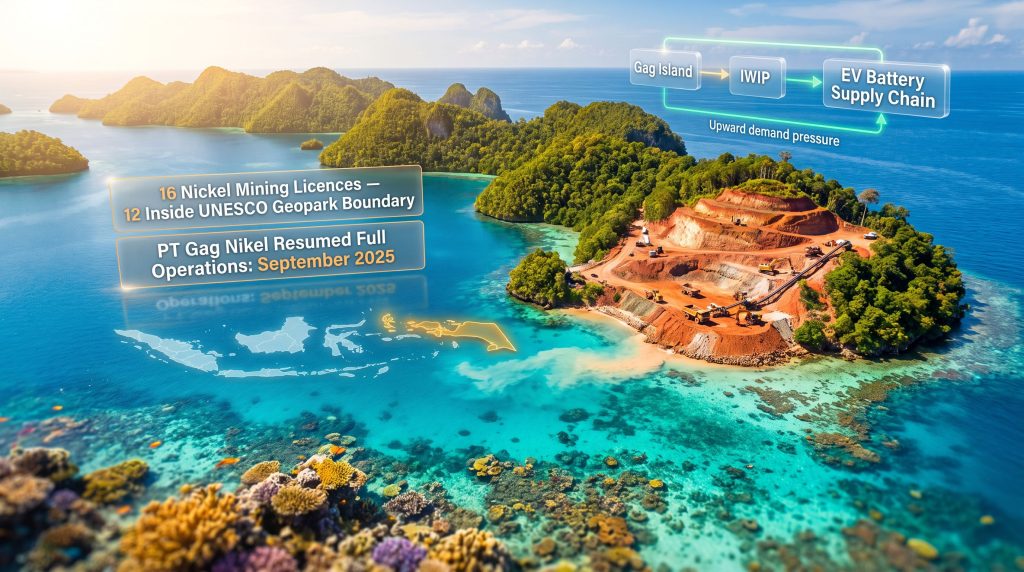
| Licences falling inside UNESCO Geopark boundary | 12 | Partially revoked, partially active |
| New licence applications under processing | 3 | Under review, including in highest-priority biodiversity zones |
| Permits revoked following 2025 protests | 4 | Cancelled |
| Active operational licence on Gag Island | 1 | Operational and continuing |
A critical legal detail explains why this exposure persists: the UNESCO Global Geopark designation is an international recognition framework, not an instrument of Indonesian domestic law. Indonesia's mining licensing system does not recognise UNESCO Geopark boundaries as exclusion zones for resource extraction. Permits can be, and have been, granted for land that falls squarely within the internationally designated protected area.
This governance gap is not unique to Indonesia, but its consequences are particularly visible in Raja Ampat because of the magnitude of ecological values at stake. The designation communicates global significance; it cannot compel national regulatory outcomes.
What the 2025 Protest Wave Achieved and What It Did Not
In 2025, a viral social media campaign centred on the hashtag #SaveRajaAmpat brought international attention to the scale of industrial activity within the archipelago. Images of the region's distinctive turquoise waters circulated widely, drawing public opposition that created political pressure the Indonesian government could not entirely ignore.
The government's response involved revoking business permits for four mining companies:
- PT Anugerah Surya Pratama
- PT Kawei Sejahtera Mining
- PT Mulia Raymond Perkasa
- PT Nurham
Indonesia's energy ministry also temporarily suspended the activities of PT Gag Nikel, a subsidiary of state-owned miner Aneka Tambang (Antam), pending an environmental audit.
However, what the protest response did not achieve is equally important to understand. The four revocations were targeted at specific companies; they established no precedent preventing new licence applications from being processed. The three applications currently under review as of mid-2026 belong to entirely separate entities from those whose permits were cancelled. The revocations addressed visible political liability without restructuring the underlying regulatory framework that allowed the licences to exist in the first place.
Indigenous communities across the archipelago continued to voice opposition throughout this period, raising concerns about land rights, traditional fishing access, and cultural heritage that extend beyond the immediate environmental debate.
Is Protest Enough to Create Lasting Change?
Consequently, the 2025 campaign demonstrated that public pressure can produce visible short-term government action. It has not, however, produced enforceable structural protections. The Indonesian nickel industry challenges surrounding governance, environmental oversight, and community rights remain largely unresolved despite the international attention the protests generated.
PT Gag Nikel: The Operation That Resumed and What the Audit Actually Found
The most consequential single case study in nickel mining in Raja Ampat is PT Gag Nikel's operation on Gag Island. After its temporary suspension in 2025, the company resumed full operations in September 2025, just months after protests peaked.
Antam has publicly maintained that Gag Nikel's operations are situated outside the UNESCO Geopark boundary and that the environmental audit returned no findings of formal violations. The company's position is that audit recommendations related only to operational improvements rather than substantive environmental breaches.
However, a February 2026 letter from Indonesia's environment ministry, obtained independently by Greenpeace, presents a more complicated picture. The audit identified material environmental risks including:
- Elevated sediment levels in the surrounding marine environment, a direct threat to adjacent coral reef systems
- Failure to implement biodiversity protection principles as required under Indonesian environmental law
The critical governance insight here is structural rather than company-specific. Under Indonesia's current regulatory architecture, an environmental audit can document material risks and recommend corrective action without automatically triggering operational suspension or financial penalty. The audit-without-enforcement dynamic means ecological damage can be formally acknowledged while extraction continues uninterrupted.
Nickel from PT Gag Nikel feeds directly into IWIP, a major integrated processing complex with significant foreign investment backing from Tsingshan Holding Group of China and Eramet of France. As of late July 2026, neither IWIP nor Eramet had publicly responded to the Greenpeace findings.
The next major ASX story will hit our subscribers first
The Supply Chain Accountability Problem: Where Raja Ampat Nickel Goes
Understanding where Gag Island nickel flows after leaving IWIP is essential context for evaluating ESG exposure across global battery supply chains.
IWIP processes Indonesian nickel ore into intermediate products, including mixed hydroxide precipitate (MHP) and nickel matte, which are inputs for battery precursor manufacturing. These intermediates flow toward battery cathode producers, primarily in China and South Korea, and ultimately into battery cells used by global EV manufacturers.
The physical traceability of nickel through this supply chain is poor. Once laterite ore is processed into MHP or matte at a facility like IWIP, the origin of individual ore batches becomes effectively invisible to downstream purchasers without specific contractual disclosure requirements.
This traceability gap creates real exposure for European automakers and battery manufacturers operating under emerging EU supply chain due diligence frameworks. The involvement of Eramet, a French company subject to EU regulatory and reputational scrutiny, makes this dynamic particularly acute. In addition, European sustainability reporting obligations are tightening, and the origin-blind nature of nickel supply chains makes proactive disclosure increasingly necessary rather than optional.
Why Indonesia's Domestic Politics Make Unilateral Conservation Action Unlikely
Indonesia's nickel strategy is not incidental to its economic policy architecture; it is central to it. Indonesia's nickel boom was catalysed by the government's raw ore export ban, implemented progressively from 2014 onward, which forced foreign capital to build downstream processing infrastructure inside Indonesia rather than export unprocessed ore for refining elsewhere. This policy has attracted tens of billions of dollars in foreign direct investment and created hundreds of thousands of industrial jobs.
| Country | Approach to Mining in Ecologically Sensitive Areas |
|---|---|
| Australia | Federal environmental impact assessment; Heritage Act protections enforceable against extraction |
| Canada | Indigenous consultation requirements; federal-provincial multi-stage review processes |
| Philippines | Has implemented bans on open-pit mining in environmentally critical areas |
| Indonesia (Raja Ampat) | UNESCO designation without binding extraction prohibition; audit-based oversight without automatic enforcement triggers |
Restricting nickel output in Raja Ampat carries genuine economic costs: reduced ore supply to IWIP, reduced foreign investment confidence, and potential diplomatic friction with Chinese industrial partners whose capital underwrites much of Indonesia's processing capacity. These are not trivial considerations for a government that has made downstream nickel processing a centrepiece of its industrial development strategy.
The Greenpeace Unprotected Paradise report, released in July 2026, concluded that fourteen months after the initial protest wave there is minimal evidence suggesting the Indonesian government intends to establish permanent protection for Raja Ampat against continued industrial extraction. Indonesia's mining ministry stated it was reviewing the report's findings; no formal moratorium has been declared. This outcome reflects a broader pattern observed across critical minerals demand debates globally, where economic imperatives frequently outweigh conservation commitments.
Stakeholder Positions: A Complex and Unresolved Landscape
| Stakeholder | Position as of Mid-2026 |
|---|---|
| Indonesian Mining Ministry | Reviewing Greenpeace findings; no moratorium declared |
| Indonesian Environment Ministry | Audit findings issued identifying risks; no confirmed enforcement action |
| PT Gag Nikel / Aneka Tambang (Antam) | Operations continuing; disputes Geopark boundary overlap claim |
| Greenpeace | Calling for full extraction moratorium; published Unprotected Paradise July 2026 |
| UNESCO | Global Geopark designation holder; no enforcement authority under Indonesian domestic law |
| Indigenous Communities | Actively opposing mining; tensions with government reported |
| IWIP (Tsingshan / Eramet) | No public response to Greenpeace report as of July 2026 |
What Genuine Protection Would Actually Require
Conservation analysts and environmental governance researchers have identified several structural changes that would be necessary to meaningfully protect Raja Ampat from continued industrial extraction. As reported by the ABC, the battle to protect the region requires coordinated action across legal, regulatory, and commercial frameworks. These measures include:
- Converting UNESCO Geopark recognition into a binding domestic legal instrument that explicitly prohibits the issuance of new mining licences within designated boundaries
- Immediately suspending the three active licence applications pending a fully independent environmental assessment conducted without ministerial oversight
- Reforming environmental audit procedures to include mandatory operational suspension triggers when audits document material ecological risks
- Requiring IWIP and its downstream partners to publish origin-specific nickel sourcing disclosures traceable to individual mining operations
- Formalising free, prior, and informed consent (FPIC) requirements for all extractive activities affecting indigenous community territories across the archipelago
None of these measures have been announced or confirmed as policy commitments by the Indonesian government as of the time of writing.
Frequently Asked Questions: Nickel Mining in Raja Ampat
Is nickel mining legal in Raja Ampat under current Indonesian law?
Yes. Indonesian mining law does not treat UNESCO Global Geopark designation as a legally binding exclusion zone. Licences can be granted and remain active within the Geopark boundary under current domestic legislation.
Why was PT Gag Nikel treated differently from the four companies that had permits revoked?
PT Gag Nikel is a subsidiary of state-owned Aneka Tambang (Antam), a government entity. Its activities were subject to temporary suspension pending audit rather than outright revocation. The company resumed full operations in September 2025 after the audit process concluded without formal enforcement action.
What is IWIP and why does it matter to the global nickel supply chain?
Indonesia Weda Bay Industrial Park is one of Indonesia's largest integrated nickel processing complexes, receiving ore from multiple operations including PT Gag Nikel and converting it into battery-relevant intermediates. Its investors include Tsingshan Holding Group and Eramet, connecting Raja Ampat ore to global EV battery supply chains.
What environmental damage has been formally documented?
The February 2026 environment ministry audit identified elevated sedimentation in marine environments surrounding Gag Island operations and failure to apply biodiversity protection principles required under Indonesian law. Greenpeace's Unprotected Paradise report also flags ongoing deforestation risks and reef proximity concerns at multiple islands including Gag, Kawe, and Manuran.
Disclaimer: This article is intended for informational purposes only and does not constitute financial, investment, or legal advice. Projections regarding EV demand and nickel supply chain dynamics involve inherent uncertainty. Readers should consult qualified professionals before making investment decisions related to any company, commodity, or sector discussed.
Want To Stay Ahead of Critical Mineral Discoveries Before the Market Catches On?
Discovery Alert's proprietary Discovery IQ model scans ASX announcements in real time, transforming complex mineral data across 30+ commodities into clear, actionable insights — so investors can identify significant opportunities the moment they emerge. Explore historic discoveries and their market returns, then start a 14-day free trial at Discovery Alert to position yourself ahead of the next major find.