
July 31, 2026
The Infrastructure Paradox at the Heart of Nigeria's Oil Economy
Few industrial contradictions are as striking as a nation sitting atop tens of billions of barrels of proven crude reserves while simultaneously struggling to feed its own refinery. This is not a hypothetical scenario or a future risk scenario to model. It is the operational reality facing Nigeria's energy sector today, and it raises a fundamental question that goes well beyond logistics: what does it mean to build world-class downstream infrastructure when the upstream sector cannot keep pace?
Understanding the Nigeria crude supply for Dangote refinery challenge requires stepping back from the headlines and examining the structural mechanics of how crude moves from wellhead to refinery gate, and who gets priority access when there is not enough to go around. Furthermore, the resource export challenges seen globally offer a useful comparative lens for understanding why even resource-rich nations routinely struggle with domestic supply allocation.
When big ASX news breaks, our subscribers know first
How Much Crude Does the Dangote Refinery Actually Need?
The Feedstock Arithmetic Behind 85% Operating Capacity
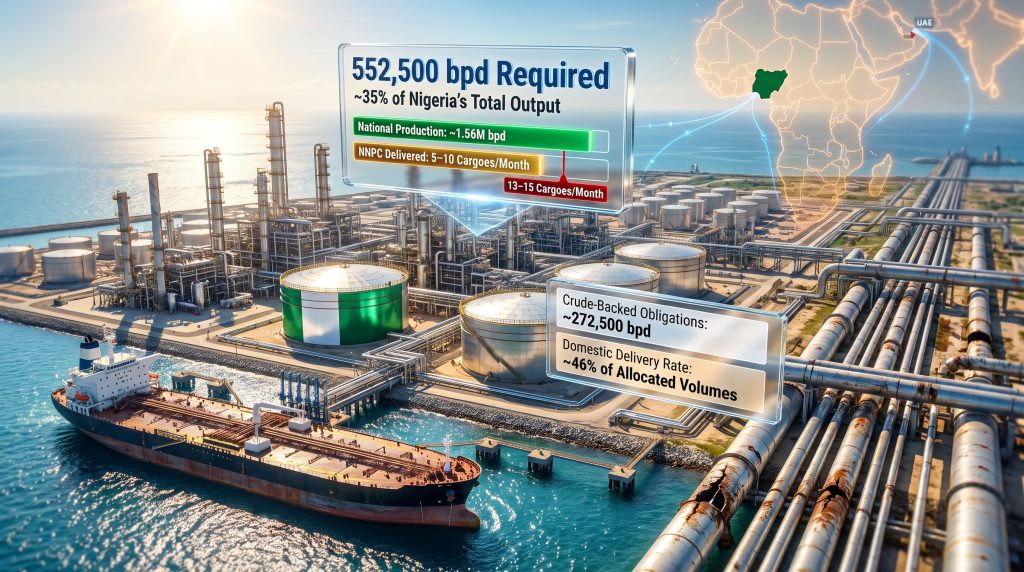
At roughly 85% of its rated operating capacity, the Dangote Petroleum Refinery requires approximately 552,500 barrels of crude oil per day. To contextualise that figure, Nigeria's total national crude production in June 2026 was approximately 1.56 million barrels per day. That means the refinery alone demands the equivalent of around 35% of the country's entire daily output just to sustain near-full throughput.
Translating that into cargo terms, the refinery requires between 13 and 15 crude tanker shipments per month to maintain consistent operational coverage. Each cargo represents a standard-size crude consignment, and sourcing that volume reliably demands uninterrupted upstream allocation at a scale that currently exceeds what domestic supply chains are delivering.
Nigeria's Daily Production vs. Refinery Demand
| Metric | Volume (Barrels Per Day) |
|---|---|
| Nigeria's total crude production (June 2026) | ~1,560,000 bpd |
| Dangote refinery requirement at 85% capacity | ~552,500 bpd |
| Remaining crude after Dangote allocation | ~1,010,000 bpd |
| Dangote refinery's share of national output | ~35% |
| NNPC crude pledged to oil-backed loan obligations | ~272,500 bpd |
After satisfying the Dangote refinery's feedstock requirements, approximately 1.01 million barrels per day remains available for smaller domestic processors, export commitments, and crude-backed financing obligations. Under normal operating conditions, that residual volume is technically sufficient. The problem is that Nigeria's upstream environment rarely delivers normal conditions. Pipeline disruptions, security incidents, and unplanned production outages routinely erode that margin.
Why Nigeria Cannot Fully Supply Its Own Flagship Refinery
Three Interlocking Structural Constraints
The crude supply shortfall is not the product of a single policy failure or a temporary operational glitch. It is the result of at least three reinforcing structural problems that compound each other.
1. Crude-Backed Debt Obligations Consume Priority Barrels
According to industry data cited by Petroleumprice.ng, Nigeria's state oil company, the NNPC, has committed approximately 272,500 barrels per day to service over $8.8 billion in crude-backed financing arrangements. These debt obligations carry contractual seniority over domestic allocations, meaning that before the refinery receives a single barrel under a Naira-denominated supply agreement, a significant portion of Nigeria's daily production is already legally ring-fenced for creditors. This structural priority claim significantly narrows the free crude available for domestic allocation.
2. Upstream Operational Failures Cap Daily Output
Nigeria's upstream sector operates under persistent pressure from multiple directions simultaneously. As reported by Punch Newspapers, the following upstream challenges continue to suppress national daily production:
- Widespread crude oil theft and pipeline vandalism across Niger Delta infrastructure, diverting formal supply chain volumes into illicit markets
- Unplanned production outages caused by aging field equipment and deferred maintenance
- Chronic underinvestment in upstream capacity expansion and infrastructure rehabilitation
- Security incidents that force production curtailments across onshore and shallow-water acreage
These are not new problems, but their cumulative effect has become increasingly consequential now that domestic refining demand has scaled to a level that genuinely competes with export commitments for available barrels.
3. Domestic Crude Supply Obligation Underperformance
Nigeria's Naira-for-crude framework was designed to shield domestic refiners from dollar-denominated price volatility by allowing them to purchase crude in local currency. In practice, as reported by Business Post Nigeria, actual deliveries under this arrangement have fallen dramatically short of allocated volumes. Reuters has reported that deliveries under the Domestic Crude Supply Obligation reached only approximately 46% of allocated volumes in the most recent quarter reviewed, meaning refineries received less than half of the crude formally committed to them.
The core issue, as energy analyst Aisha Mohammed of the Lagos-based Centre for Development Studies explained to BusinessDay, is that Nigeria simply does not pump sufficient oil to simultaneously satisfy its domestic refining ambitions, international export contracts, and crude-backed debt repayment schedules. This is a structural domestic challenge with no near-term resolution in sight.
How the Refinery Has Responded: Diversification and Foreign Feedstock
Month-by-Month Crude Supply Timeline (2026)
Rather than scaling back operations, the refinery pursued an active feedstock diversification strategy throughout the first half of 2026. The timeline below illustrates how supply sources evolved across key months:
| Period | Nigerian Cargoes Received | Notable Development |
|---|---|---|
| Early 2026 (baseline) | ~5 cargoes/month | Chronic shortfall well below operational requirements |
| March 2026 | ~10 cargoes | NNPC deliveries reportedly doubled from prior baseline |
| May 2026 | 7 cargoes (NNPC allocation) | Incremental improvement, still short of 13-15 cargo target |
| June 2026 | 5-7 cargoes | First-ever UAE crude import (approximately 2 million barrels) |
| May-June 2026 (blended) | 78% Nigerian, 22% imported | Refinery operating on mixed-origin feedstock |
The June 2026 UAE crude import represented a strategic inflection point. For the first time, the refinery sourced a meaningful volume of international feedstock from that origin, signalling a willingness to build out a genuinely diversified procurement network rather than remain dependent on NNPC allocations alone. As Bloomberg has reported, crude supply to the refinery doubled in March 2026, reflecting incremental upstream improvements, though volumes still fell short of full operational requirements.
The Cost Cascade of Dollar-Denominated Feedstock
When domestic Naira-priced crude allocations fall short, the operational response involves purchasing crude on international markets at dollar-denominated prices. This triggers a cascading cost effect through the system, and the commodity price impacts of these procurement decisions extend well beyond the refinery gates themselves.
- Processing costs rise as dollar-priced crude carries a higher landed cost than Naira-allocated domestic volumes
- Refined product prices increase as higher feedstock costs are passed downstream to fuel consumers
- Foreign exchange demand intensifies as dollar outflows for crude imports grow, adding pressure to Nigeria's currency reserves
- Inflationary feedback builds as elevated energy costs permeate transportation, food production, and industrial sectors
Under the deregulated downstream market framework, none of these cost escalations are buffered by government subsidies. Every upstream shock now registers at the retail pump in near real-time. The supply chain disruptions that ripple through global energy markets further complicate the refinery's ability to source reliable alternative feedstock at competitive prices.
Nigeria's Reserve Position vs. Daily Production Reality
Why Geology Is Not the Problem
Nigeria holds an estimated 37.28 billion barrels of crude oil and condensate reserves, positioning it firmly among Africa's most resource-endowed petroleum nations. This is a critical distinction that often gets obscured in discussions about the Nigeria crude supply for Dangote refinery challenge: the problem has nothing to do with how much oil is in the ground.
The constraint is entirely operational. Nigeria's challenge is the consistent capacity to lift, transport, allocate, and deliver sufficient daily volumes across three competing priority claims, each of which presses against the others.
Those three competing claims on every barrel Nigeria produces can be visualised hierarchically:
- First priority: Crude-backed loan obligations (~272,500 bpd, contractually senior)
- Second priority: International export contracts (supporting foreign exchange earnings)
- Residual allocation: Domestic refinery feedstock (including the Dangote refinery's 552,500 bpd requirement)
The structural problem is that the residual allocation sits at the bottom of this priority stack, yet it represents the largest single discrete demand in the system.
Deregulation's Role in Amplifying Supply Disruptions
How a Policy Shift Changed Everything for Nigerian Consumers
Nigeria's decision to substantially deregulate its downstream petroleum market fundamentally altered the transmission mechanism between upstream conditions and consumer prices. Under the previous subsidised framework, government expenditure absorbed price shocks before they reached petrol stations. That buffer no longer exists at meaningful scale.
The practical consequences of this shift are significant, and monitoring current crude oil prices has become an increasingly important activity for both operators and policymakers trying to anticipate downstream price movements:
- Crude supply disruptions translate directly and rapidly into pump price increases
- Exchange rate depreciation feeds into fuel costs with minimal lag or mitigation
- Production outages in the Niger Delta register at petrol stations within days, not weeks
- Any diversion of crude to dollar-priced international markets raises the domestic cost floor
A report from Lagos-based research firm PAC Research, cited by BusinessDay, identifies a 12 to 18 month risk window during which the interaction between refinery feedstock competition, export obligations, and crude-backed financing commitments will significantly shape fuel pricing trajectories, foreign exchange demand dynamics, inflation trends, and investor confidence in Nigeria's downstream energy sector. The oil price movements observed in global markets throughout 2025 have added further complexity to Nigeria's domestic pricing environment.
The next major ASX story will hit our subscribers first
Vertical Integration as a Long-Term Strategic Response
Why the Refinery May Be Forced Upstream
The persistent feedstock insecurity has accelerated thinking about vertical integration as a structural solution. If the refinery were to secure direct equity participation or binding offtake agreements in producing Nigerian oil fields, it could theoretically bypass the NNPC allocation bottleneck entirely and establish a self-controlled, cost-predictable supply chain.
| Scenario | Strategic Implication |
|---|---|
| Refinery acquires upstream equity stakes | Reduces structural dependency on NNPC allocation system |
| Direct field-level offtake agreements | Provides volume certainty and price predictability |
| Continued reliance on NNPC Naira allocations | Ongoing exposure to the 46% delivery rate underperformance |
| Expanded international crude imports | Higher dollar costs, greater FX demand, downstream price pressure |
As Business Post Nigeria has reported, the gap between Naira-allocated crude and actual deliveries is already pushing processors toward either importing foreign feedstock or purchasing Nigerian oil through third-party traders at dollar prices. Both pathways increase costs. Vertical integration offers a potential escape from that cycle, though it introduces its own complexity around capital commitment and operational risk in Nigeria's upstream environment.
Macroeconomic Consequences If the Supply Gap Persists
Five Second-Order Effects Nigeria Cannot Afford to Ignore
The Nigeria crude supply for Dangote refinery shortfall extends well beyond operational inconvenience for one facility. Its macroeconomic consequences ripple across Nigeria's broader economic architecture, and the commodity price impacts observed in comparable resource-dependent economies suggest these second-order effects can persist long after initial supply disruptions ease:
- Sustained fuel price elevation keeps energy costs elevated for households and businesses, compressing consumer purchasing power
- Foreign exchange outflows from dollar crude purchases add structural pressure to Nigeria's FX reserves and the Naira's stability
- Inflationary feedback loops embed higher energy costs into food, transport, and manufacturing price levels
- Reduced downstream investment confidence as feedstock uncertainty makes long-term refining investment calculations less reliable
- Regional ambition ceiling as Nigeria's aspiration to become a net fuel exporter and West African petroleum hub becomes structurally constrained by its inability to fully supply its own largest refinery
That last point carries particular strategic weight. The Dangote refinery was conceived in part as a platform to transform Nigeria from a chronic fuel importer into a regional supplier capable of servicing markets across West Africa. A refinery operating on blended foreign feedstock and receiving less than half its allocated domestic crude cannot consistently generate the exportable surplus volumes that ambition requires.
What Needs to Change for the Supply Gap to Close
Closing the Nigeria crude supply gap for the Dangote refinery is not a single-lever problem. It requires simultaneous progress across multiple fronts:
- Upstream production growth that sustainably lifts daily output beyond the current ~1.56 million bpd ceiling
- Meaningful reduction in oil theft and pipeline losses across Niger Delta infrastructure, which divert formal supply chain volumes
- Restructuring or partial refinancing of crude-backed debt obligations to release barrels currently ring-fenced for creditor repayment
- Improved delivery performance under the Domestic Crude Supply Obligation, which currently operates at approximately 46% of allocated volumes
- Accelerated investment in field maintenance and new well development to rebuild production capacity degraded by years of underinvestment
None of these changes are quick or simple. Each involves a different set of stakeholders, timelines, and political economy considerations. The geological endowment is not the constraint. The institutional, financial, and security architecture that governs how Nigeria's oil moves from the ground to a refinery gate is.
Disclaimer: This article is for informational purposes only and does not constitute financial or investment advice. Figures referenced reflect data available as of mid-2026 and are subject to revision as production and supply conditions evolve. Readers should consult independent sources and professional advisers before making decisions based on the information presented here.
Want to Stay Ahead of the Next Major Resource Discovery?
While Nigeria's infrastructure paradox illustrates how even the world's most resource-rich nations struggle to convert geology into reliable supply, the real opportunity for investors lies in identifying significant mineral discoveries at the moment they are announced — and Discovery Alert's proprietary Discovery IQ model does exactly that, delivering real-time ASX alerts that turn complex resource data into actionable insights. Explore historic discoveries and their returns to understand the scale of opportunity, then start your 14-day free trial at Discovery Alert to position yourself ahead of the broader market.