July 31, 2026
The Hidden Physics of Underground Coal Disasters
Every coal seam is, in geological terms, a pressurised reservoir of organic gas. The same decomposition process that transformed ancient vegetation into combustible rock also generated vast quantities of methane, which over millions of years became trapped within the molecular structure of the coal itself and in the surrounding rock voids. When miners drive shafts into these seams, they disturb a system that has been in equilibrium for geological timescales. What happens next depends almost entirely on the quality of the engineering response, and in Balochistan, that response has repeatedly proven inadequate.
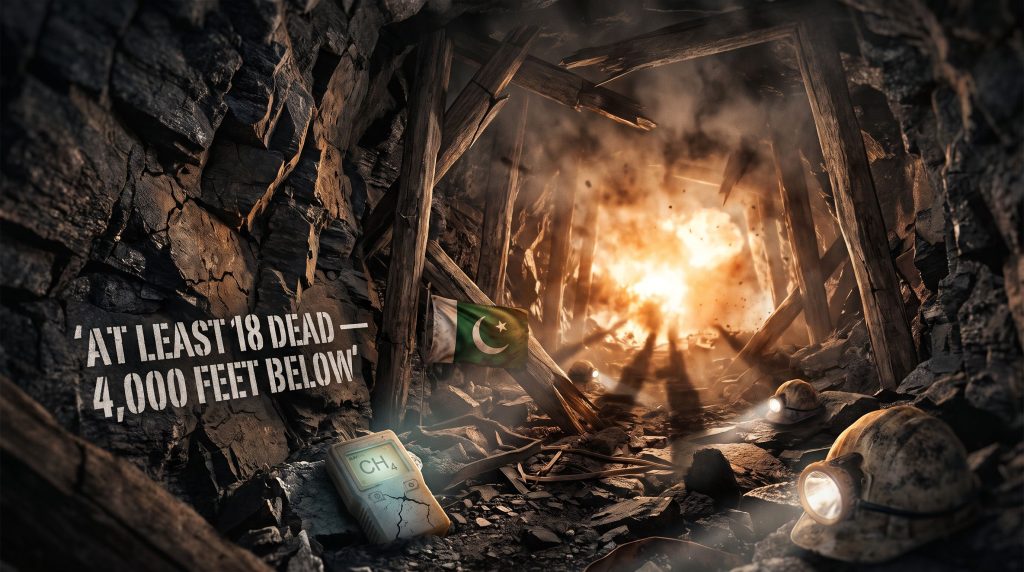
The Pakistan coal mine explosion that struck the Sorange mining complex in Balochistan on 31 July 2026 was, in its mechanics, entirely predictable. In its human cost, it was devastating. At least 18 miners were confirmed dead, with rescue operations ongoing at a depth of approximately 4,000 feet (1,219 metres) beneath the surface. Thirty-six workers were reported inside the affected section of the complex when the blast occurred across two adjacent mine shafts, and the survivability assessment issued by provincial mine inspection authorities was described as low, given the oxygen-depleting aftermath of a confined methane detonation.
What distinguishes this disaster from a random industrial accident is the pattern it continues. It is not a new story. It is the same story, repeated with grim regularity across Balochistan's coal fields, and the failure to interrupt that pattern represents one of the most consequential regulatory shortcomings in South Asia's extractive industries. Consequently, understanding mining safety and permitting frameworks becomes essential to appreciating just how wide the gap truly is.
When big ASX news breaks, our subscribers know first
Methane Physics and Why Balochistan's Geology Makes It Worse
Methane gas, chemically CH₄, is generated during the biogenic and thermogenic decomposition of organic material buried under geological pressure. In coal seams, it exists in three states simultaneously: adsorbed onto the surface of coal molecules, dissolved in groundwater within the seam, and as free gas occupying fractures and voids in the surrounding rock matrix.
When coal is mined, the reduction in confining pressure causes adsorbed methane to desorb and migrate into the mine atmosphere. The rate of desorption depends on several factors:
- Coal rank and matrix permeability: Higher-rank coals, such as bituminous and anthracite, tend to adsorb greater volumes of methane per tonne than lower-rank coals.
- Seam depth: Deeper seams operate under higher confining pressure, meaning more methane is held in adsorbed form and released more rapidly upon excavation.
- Geological structure: Faulting, folding, and the presence of adjacent gas-bearing strata can create localised zones of extreme gas concentration that standard ventilation calculations fail to account for.
Balochistan's coal deposits are geologically complex. The region's seams sit within folded and faulted Cretaceous and Paleocene strata, creating irregular gas accumulation zones that are difficult to predict without sophisticated pre-mining gas drainage programmes. At the operational depths seen in Sorange, the combination of elevated gas pressure, structural complexity, and limited pre-drainage infrastructure creates precisely the conditions where methane concentrations can breach the lower explosive limit of 5% without triggering detection systems.
The critical and often overlooked technical point is that methane explosions in enclosed mine environments kill through multiple simultaneous mechanisms. The primary blast wave causes immediate structural collapse. The fireball that follows consumes available oxygen in the affected tunnels. Carbon monoxide and carbon dioxide generated by the explosion then flood the remaining atmosphere. For miners caught beyond the blast zone, it is frequently not the explosion itself but the resulting asphyxiation environment that proves fatal, and this dramatically compresses the window within which rescue operations can reasonably expect to find survivors.
The survivability window following a confined methane detonation in a deep underground mine is typically measured in hours rather than days, a fact that fundamentally shapes how rescue priorities and resource deployment must be structured.
A Detailed Look at the Sorange Incident
The explosion at Sorange, situated in a remote coal-producing district on the periphery of Quetta, affected two adjacent mine shafts simultaneously. The involvement of two proximate shafts is a technically significant detail, suggesting either a shared ventilation corridor connecting the two workings or a gas pocket spanning the geological boundary between them. Either scenario points to a failure in the compartmentalisation of mine atmospheres, a standard engineering control in modern mining practices.
Incident Data at a Glance
| Metric | Confirmed Figure |
|---|---|
| Workers in the affected section | 36 |
| Confirmed fatalities | At least 18 |
| Miners still unaccounted for | 14 (as of latest update) |
| Rescue operational depth | 4,000 feet (1,219 metres) |
| Mine shafts affected | 2 adjacent shafts |
| Cause of explosion | Methane gas ignition |
| Survival probability assessment | Assessed as low by provincial authorities |
Balochistan's Minister for Mines and Mineral Development confirmed that 36 workers were present in the collapsed section. By late Thursday night, 25 remained unaccounted for, a figure that later consolidated as the confirmed death toll rose and ongoing recovery efforts continued. Furthermore, Reuters reporting on the March 2024 explosion confirms this is far from the first such tragedy in the province.
Why Deep-Mine Rescue Operations Fail
Rescue at 4,000 feet below surface is not simply a logistical challenge. It is a fundamentally different operating environment from surface or shallow-seam recovery. In addition to the physical dangers, several compounding factors reduce operational effectiveness:
- Equipment limitations: Standard rescue breathing apparatus operates within defined pressure and temperature tolerances that approach their boundaries at extreme depths.
- Structural instability: Post-explosion collapse debris must be cleared incrementally to avoid triggering secondary roof falls, dramatically slowing progress.
- Residual gas hazards: Methane pockets not consumed by the initial explosion remain present throughout the recovery operation, creating ongoing ignition risk for rescue teams.
- Heat and humidity: At depths exceeding 1,000 metres, ambient rock temperature and humidity create thermal stress for rescue personnel, limiting sustained working periods.
- Communication degradation: Radio and electronic communication systems lose reliability at extreme depths, complicating coordination between surface teams and underground rescue personnel.
The tunnel collapse risks associated with post-blast structural instability are, moreover, not unique to Pakistan. However, they are significantly amplified where pre-explosion ground support and ventilation standards are already substandard.
Systemic Failure: Why Balochistan's Mining Sector Keeps Producing Disasters
The Sorange explosion is not a statistical outlier. It is the latest data point in a consistent pattern of methane-related fatalities across Balochistan's coal sector. A comparable methane explosion in March 2024 killed 12 miners in the same province. Across the prior decade, dozens of miners have died annually in gas-related incidents at various Balochistan sites, according to records compiled by labour advocacy organisations tracking extractive industry casualties in Pakistan.
Historical Pattern of Major Balochistan Mining Incidents
| Year | Location | Primary Cause | Reported Fatalities |
|---|---|---|---|
| March 2024 | Balochistan | Methane gas explosion | 12 |
| July 2026 | Sorange, near Quetta | Methane gas explosion | 18+ |
| Multiple prior years | Various Balochistan sites | Gas buildup, tunnel collapse | Dozens annually |
The structural drivers of this pattern are well documented and interconnected:
- Provincial regulatory fragmentation: Mine safety oversight in Pakistan falls under provincial jurisdiction, meaning Balochistan applies its own regulatory framework independently of federal standards. The province lacks the institutional capacity of wealthier jurisdictions to sustain a properly resourced mine inspectorate.
- Absence of mandatory pre-drainage requirements: In modern coal mining jurisdictions, seams above defined methane emission thresholds require gas drainage before and during mining operations. No equivalent mandatory standard exists for Balochistan's smaller mine operators.
- Outdated detection infrastructure: Many active Balochistan coal mines rely on dated or absent real-time atmospheric monitoring. Without continuous methane sensors providing alert thresholds to surface control rooms, dangerous concentrations can develop unseen.
- Informal labour arrangements: A significant proportion of Balochistan's coal workforce operates without formal employment contracts, removing access to compensation mechanisms following injury or death and reducing the economic leverage workers might otherwise use to demand safety improvements.
The absence of binding enforcement mechanisms transforms safety regulations from operational requirements into advisory guidelines, a distinction that proves fatal when methane concentrations reach ignition thresholds.
How Pakistan's Mine Safety Framework Compares Internationally
The contrast between Pakistan's regulatory architecture and those of leading coal-producing nations illustrates that the technology required to prevent methane disasters is neither novel nor inaccessible. The gap is institutional, not technological. Furthermore, effective mining risk management in comparable jurisdictions demonstrates that practical solutions already exist.
| Country | Key Safety Mechanism | Outcome |
|---|---|---|
| China | Mandatory gas drainage, real-time monitoring, strict closure of non-compliant mines | Annual fatalities fell from several thousand in the early 2000s to under 300 by the mid-2020s |
| Australia | Independent safety case submissions, continuous atmospheric monitoring, mandatory rescue station infrastructure | Among the lowest underground coal fatality rates globally |
| United States | Federal Mine Safety and Health Act requiring quarterly underground inspections with closure enforcement powers | Sustained long-term reduction in coal mine fatalities since the 1970s |
| Pakistan (Balochistan) | Provincial oversight without equivalent mandatory inspection or enforcement regime | Recurring methane fatalities with no demonstrable reduction trend |
China's trajectory is particularly instructive. In the early 2000s, Chinese coal mines were experiencing thousands of fatalities annually. The country's subsequent dramatic reduction in mine deaths was achieved not primarily through technological innovation but through centralised regulatory enforcement, mandatory gas drainage requirements, and the political will to close thousands of non-compliant small mines. The parallel to Balochistan's current situation is direct and uncomfortable.
The Economic Trap Keeping Miners Underground
Understanding why workers continue entering mines that fall below minimum safety thresholds requires engaging with the economic geography of Balochistan. The province is among Pakistan's least economically developed regions, with limited formal employment sectors and significant reliance on natural resource extraction as a primary income source for communities surrounding the coal fields.
For many families in districts near Sorange and across Balochistan's coal belt, underground mining represents not a preferred livelihood choice but an economic necessity with no available substitute. This structural vulnerability is exploited, often without deliberate intent, by operational models that externalise safety costs onto workers and their communities.
The informal labour arrangements common across Balochistan's smaller mining operations compound this dynamic significantly. When workers are engaged without formal contracts, they lose access to several important protections:
- Legally enforceable compensation following workplace injury or death
- The ability to report unsafe conditions without risk of immediate dismissal
- Access to formal dispute resolution mechanisms
- Inclusion in any provincial or national occupational health data systems
This invisibility within formal data systems has a compounding effect: it understates the true human cost of Balochistan's coal sector, reducing the statistical pressure that might otherwise accelerate regulatory reform.
The next major ASX story will hit our subscribers first
What Meaningful Reform Actually Requires
The reforms required to materially reduce methane-related fatalities in Balochistan's coal sector are technically well understood. The challenge is political and financial rather than scientific. A functional mine safety framework requires:
- Mandatory real-time atmospheric monitoring at all underground operations beyond defined depth and seam gas emission thresholds, with surface alert systems and automatic ventilation responses.
- Pre-mining gas drainage requirements for seams classified above minimum methane content levels, eliminating the practice of mining into undrained high-gas zones.
- Independent mine safety authority with statutory powers to suspend or close operations without requiring ministerial approval, removing political economy considerations from enforcement decisions.
- Pre-positioned rescue infrastructure with deep-mine capable equipment and trained teams stationed within defined response-time distances from active mining zones.
- Enforceable worker compensation framework that functions independently of whether a worker held a formal employment contract at the time of injury.
- Engagement with international technical assistance through bodies such as the International Labour Organization, which maintains occupational safety programmes specifically designed for extractive industries in lower-income jurisdictions.
Proper mine lifecycle management also demands that safety investment is treated not as an operational cost to be minimised, but as a foundational requirement from the earliest stages of development through to closure.
Pakistan's Energy Ambitions and the Human Cost Equation
Pakistan's domestic energy strategy has historically included expanding production from Balochistan's coal fields as a mechanism for reducing reliance on expensive imported fuels. The economic logic is straightforward: domestic coal is cheaper on a per-unit basis than liquefied natural gas imports, and reducing the import bill alleviates pressure on Pakistan's chronically strained foreign exchange reserves.
However, this energy security calculus contains an unaccounted variable. Repeated high-casualty Pakistan coal mine explosion events in Balochistan's coal sector generate political pressure that complicates operational continuity, deter the international investment needed to modernise mine infrastructure, and increasingly attract scrutiny from development finance institutions that condition energy sector funding on demonstrable worker safety improvements.
The sustainable path to domestic coal security runs directly through mine safety investment, not around it. A sector that kills dozens of workers annually cannot attract the capital, regulatory legitimacy, or social licence required for long-term production growth. The Sorange explosion of July 2026, like the Pakistan coal mine explosion disasters before it, makes this case with brutal clarity.
Disclaimer: Casualty figures and operational details referenced in this article are based on reporting as of 31 July 2026 and may change as rescue and recovery operations continue. Readers seeking additional context on international mine safety standards and occupational safety frameworks in extractive industries are encouraged to consult reports published by the International Labour Organization and ET EnergyWorld at energy.economictimes.indiatimes.com.
Want to Stay Ahead of Significant ASX Mineral Discoveries as They Happen?
Discovery Alert's proprietary Discovery IQ model scans ASX announcements in real time, instantly transforming complex mineral data into actionable insights for traders and investors across more than 30 commodities — begin your 14-day free trial today to gain a market-leading edge, or explore Discovery Alert's dedicated discoveries page to understand the historic returns that significant mineral discoveries can generate.