July 31, 2026
The Industrial Template Quietly Reshaping Critical Mineral Geopolitics
Most critical mineral projects begin the same way: exploration licences, drill programmes, environmental impact statements running into thousands of pages, and capital expenditure that stretches across a decade before a single tonne of product reaches a customer. The Alcoa Western Australia gallium project breaks almost every one of those conventions. Rather than carving a new mine from untouched land, it proposes to extract a strategically vital element from a liquid stream that already exists inside an operating alumina refinery. That distinction matters enormously, both for the economics of gallium production and for the broader question of how allied nations intend to rebuild supply chains that have become dangerously concentrated over the past two decades.
Understanding why this project has attracted trilateral government involvement requires understanding gallium itself: what it does, where it comes from, and why its current supply geography represents a structural vulnerability for technology-intensive economies.
When big ASX news breaks, our subscribers know first
Gallium's Role in the Technology Economy
Why a Trace Element Commands Strategic Attention
Gallium sits in an unusual position within the periodic table of industrial relevance. Produced in relatively small global volumes compared to metals like copper or nickel, it underpins some of the most critical functions in modern technology infrastructure. Gallium nitride (GaN) semiconductors have become the dominant power conversion technology in 5G base stations, electric vehicle charging systems, and the high-efficiency power supplies now being deployed across artificial intelligence data centres at scale.
The metal's applications span an unusually broad range of sectors:
- Semiconductors: GaN chips enable faster switching speeds and lower energy losses than silicon, making them foundational to next-generation power electronics
- Defence systems: Gallium arsenide and GaN are integral to radar arrays, electronic warfare platforms, and high-frequency communications equipment used across allied military forces
- 5G telecommunications: High-frequency signal amplification in millimetre-wave 5G networks relies heavily on GaN-based components
- Artificial intelligence hardware: Data centre power density demands are accelerating adoption of GaN power systems capable of handling higher loads with less heat generation
- Renewable energy: Gallium is used in certain thin-film photovoltaic cell architectures and remains a core input for high-efficiency LED lighting
- Laser systems: Industrial cutting lasers and medical-grade laser diodes depend on gallium-containing compound semiconductors
The strategic exposure created by gallium's applications is compounded by its supply geography. Global primary gallium production has been overwhelmingly concentrated in a single country, with China accounting for the vast majority of refined output for decades. Furthermore, that concentration became acutely visible in 2023 when China imposed export restrictions on gallium, triggering immediate price volatility and forcing allied governments to accelerate diversification planning. The export controls impact on downstream industries was swift and significant.
The 2023 Chinese export restrictions on gallium sent spot prices sharply higher and functioned as a live demonstration of the supply chain fragility that policymakers had been warning about for years. The episode effectively validated the strategic case for building alternative production capacity outside China's influence.
How the Wagerup Facility Actually Works
Ion Exchange Extraction: The Technical Mechanism Behind the Project
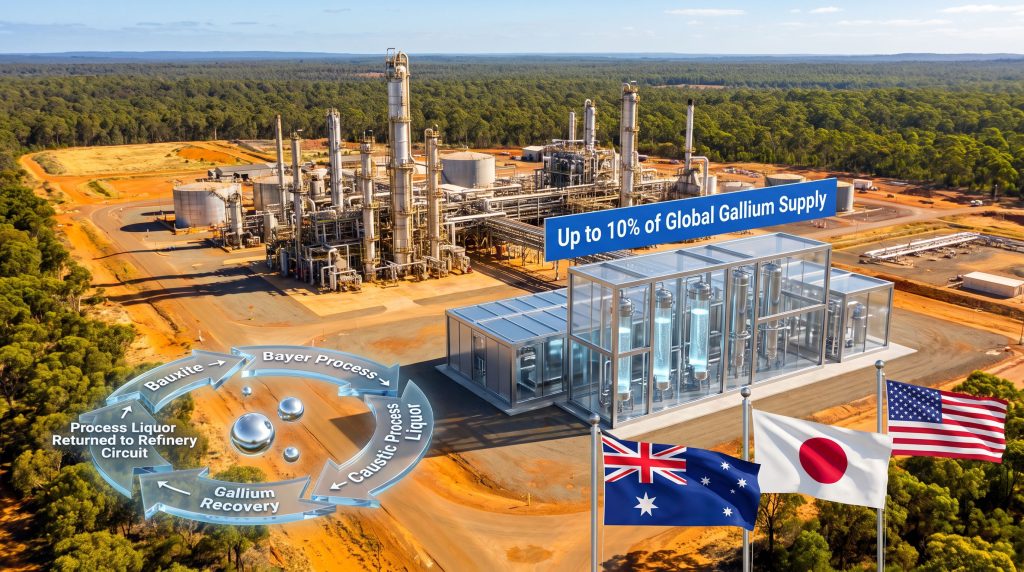
Gallium's relationship with aluminium production is not coincidental. Both elements share geochemical affinity within bauxite deposits, meaning gallium occurs as a trace constituent within the same aluminium-bearing minerals that bauxite miners target for alumina production. During the Bayer process, the standard industrial method for refining alumina from bauxite, gallium gradually concentrates within the caustic soda liquor that circulates through the refinery system.
This concentration effect creates an opportunity. Rather than allowing gallium to remain dissolved in process liquor indefinitely or accumulate in waste streams, ion exchange technology can be applied to selectively capture dissolved gallium from the liquor stream. The process uses specially engineered resin media that preferentially bind gallium ions, stripping them from solution while allowing the bulk of the caustic liquor to pass through. The gallium-loaded resin is then treated with an elution solution to recover the metal in concentrated form, while the stripped liquor is returned to the refinery circuit.
The elegance of this approach lies in what it does not require. No new ore body needs to be drilled out and characterised. No new processing plant needs to be built from a greenfield position. No new tailings storage facility needs to be permitted and constructed. The gallium recovery system is, in technical terms, a parasitic process that draws on the existing material flows of an already operating refinery.
Wagerup: Infrastructure, Location, and Operational Context
Alcoa's Wagerup alumina refinery sits approximately 120 kilometres southeast of Perth within Western Australia's Darling Range region. It forms part of one of the world's largest integrated bauxite-to-alumina supply chains, which also encompasses refining operations at Pinjarra and Kwinana. The underlying bauxite supply chain infrastructure is a key reason the Wagerup site is uniquely suited to this type of co-recovery model.
The physical footprint of the proposed gallium facility is approximately three hectares of already-cleared land within the existing refinery boundary. No vegetation clearing or new land disturbance is required for the facility itself. The co-located design eliminates the need for any standalone feedstock logistics chain, since the process liquor containing gallium is already present on site as a product of normal refinery operations.
| Project Feature | Specification |
|---|---|
| Location | Wagerup, Western Australia (~120 km SE of Perth) |
| Host Facility | Existing Alcoa alumina refinery |
| Extraction Technology | Ion exchange from process liquor |
| Additional Bauxite Mining Required | None |
| Site Footprint | ~3 hectares (existing cleared land) |
| Construction Phase Employment | ~200 positions |
| Operational Employment | ~20 direct positions |
| Potential Global Supply Share | Up to 10% of global gallium output (Reuters) |
| Final Investment Decision | July 2026 |
The Trilateral Investment Decision and Its Strategic Logic
Australia, Japan, and the United States: A Supply Chain Alliance in Action
The final investment decision, confirmed in July 2026, formalised the participation of three allied governments alongside Alcoa Corporation in establishing the Wagerup gallium facility. The involvement of Australia, Japan, and the United States reflects a coordinated approach to reducing dependency on geographically concentrated critical mineral supply chains. According to the official announcement from Alcoa, this decision is consistent with the broader architecture of the Minerals Security Partnership, a multilateral initiative involving allied nations co-investing in upstream critical mineral diversification.
Alcoa's role within the project structure is specifically defined as construction manager and operating manager of the facility. The company has confirmed that its participation, including these management responsibilities, is not expected to have a material impact on its overall financial position or results of operations. This framing positions the project as strategically motivated rather than financially transformative for Alcoa in the near term, with the primary value accruing through strengthened government relationships, long-term offtake alignment with allied partners, and portfolio diversification beyond alumina and aluminium.
Alcoa's chief executive confirmed that the decision reflects a jointly held commitment between governments and industry to build resilience into critical mineral supply chains, and that the project underscores the strategic importance of Western Australia's role in delivering materials essential to the global economy. In this context, the alignment between critical minerals and energy security objectives across allied nations has never been more evident.
It is worth noting that the Minerals Security Partnership and associated allied frameworks create policy tailwinds for projects of this nature broadly, but project-specific government support should be assessed based on confirmed investment commitments rather than inferred from policy alignment alone.
The Environmental Debate: Separating Current Scope from Future Speculation
What the Jarrahdale Forest Protectors Are Actually Arguing
The Jarrahdale Forest Protectors raised concerns following the final investment decision announcement, and their argument requires careful disaggregation. The organisation is not primarily objecting to the Wagerup gallium facility as currently designed. Their concern centres on a forward-looking scenario in which the establishment of gallium production as a national security priority creates political conditions that could facilitate future legislative changes enabling expanded strip mining across the Northern Jarrah Forest and the broader Darling Range region.
The group described the Northern Jarrah Forest as a globally significant biodiversity hotspot, which is accurate in ecological terms. The Jarrah forest ecosystem is endemic to southwest Western Australia and contains high concentrations of species found nowhere else on Earth. Conservation concerns regarding the long-term trajectory of bauxite mining within this ecosystem predate the gallium project by decades and represent a genuine and longstanding tension between industrial land use and biodiversity protection in the region.
The Bauxite Grade Question: A Technical Assessment
The organisation also raised a technical question about whether Western Australian bauxite represents the most appropriate feedstock for gallium extraction, given that gallium concentrations in bauxite globally typically fall within the range of 30 to 80 parts per million. The group contended that bauxite in the Northern Jarrah Forest sits toward the lower end of this concentration range compared to deposits available in other global mining regions, and questioned the energy intensity of multi-stage gallium refining from lower-grade feedstock.
This is a legitimate technical consideration, though it needs to be evaluated against a more complete set of project economics. Gallium concentration in bauxite is one variable among many that determine whether a particular feedstock source makes commercial sense. Infrastructure readiness, processing scale, energy costs, geopolitical alignment, and the absence of incremental environmental approvals all factor into the real-world economics of gallium recovery. Consequently, the total-cost picture often looks quite different from what ore-grade comparisons alone suggest.
| Evaluation Factor | Wagerup (WA) | Higher-Grade Global Alternatives |
|---|---|---|
| Gallium Concentration | Lower end of 30-80 ppm range | Higher in some competing deposits |
| Incremental Mining Required | None | Varies by project type |
| Infrastructure Status | Existing refinery operational | Greenfield development in most cases |
| Geopolitical Alignment | Australia-Japan-US partnership | Variable and often uncertain |
| Environmental Permitting | Within existing refinery footprint | New approvals typically required |
| Time to Production | Shorter given existing infrastructure | Longer for new project development |
The ore grade debate is a familiar one in mining economics, but it consistently undervalues the role of existing infrastructure in determining project viability. A deposit with a higher gallium concentration that requires a decade of permitting and billions in greenfield capital may be less strategically useful than a lower-grade source that can be brought into production within a fraction of that time and cost.
The Critical Distinction Alcoa Has Made Clear
Alcoa has been explicit that the Wagerup gallium facility requires no additional bauxite mining. The feedstock is existing refinery process liquor, not new ore. The environmental group's concerns about future legislative scenarios are therefore materially separate from the current project as approved and designed. Investors and observers should distinguish between objections to the approved project scope and broader policy advocacy regarding future potential developments that have not been proposed, approved, or committed to by any party.
Lesser-Known Dimensions of the Gallium Recovery Model
The Co-Recovery Concept as a Broader Industrial Paradigm
One aspect of the Wagerup project that receives insufficient attention is its potential to function as a proof-of-concept for a wider industrial paradigm: the systematic recovery of trace critical minerals from existing heavy industrial process streams. Alumina refineries are not the only industrial facilities where valuable trace elements accumulate within process liquors or waste streams. The principle of applying selective extraction technology to already-flowing material streams has applications across industries including copper refining, phosphate processing, and steel production.
If the Wagerup facility demonstrates commercially viable recovery rates and operational reliability, it could accelerate interest in deploying similar co-recovery models at other alumina refineries globally. This is particularly relevant given the broader push around critical raw materials transition strategies being pursued across allied economies. Alcoa alone operates refining capacity across multiple continents, and other major alumina producers maintain similarly large integrated operations.
The aggregate gallium recovery potential across the global alumina refining industry, were this model to be broadly adopted, would be substantially larger than any single project's output. The Alcoa Gallium Project Factsheet outlines the technical parameters that could inform replication of this approach at other facilities.
What 10% of Global Supply Actually Means
Reuters reporting indicated that the Wagerup facility could supply up to 10% of global gallium output once operational. To contextualise that figure, global refined gallium production in recent years has been estimated at roughly 300 to 400 tonnes per year, with the vast majority originating from Chinese operations. A facility contributing 10% of that total from a geopolitically aligned jurisdiction would represent a meaningful structural shift in the supply landscape available to allied manufacturers.
For industries where gallium is a critical but low-volume input, such as GaN semiconductor fabrication, a reliable allied source of supply matters disproportionately to the absolute volume involved. Supply chain security premiums are real: manufacturers in defence-adjacent electronics have demonstrated willingness to pay above spot market prices for material with traceable, allied-nation provenance. Furthermore, the broader significance of gallium deposits in Western Australia extends well beyond this single facility's contribution.
The next major ASX story will hit our subscribers first
Economic Implications and What Comes Next
Jobs, Costs, and the Strategic Value Calculus
The facility is expected to generate approximately 200 construction-phase jobs and sustain around 20 direct operational positions once production commences. As an embedded component of an existing refinery, indirect employment effects flow through Alcoa's established Wagerup workforce and local supply chain rather than requiring a standalone community infrastructure investment.
From Alcoa's perspective, the project's value is primarily expressed through strategic positioning rather than near-term financial contribution. Confirming the company's role as a trusted critical mineral supplier to three allied governments creates a durable relationship that could inform future project development, offtake arrangements, and industrial policy engagement across multiple jurisdictions.
Risks That Warrant Ongoing Monitoring
Several risk factors deserve attention from those following the project's development:
- Legislative trajectory in Western Australia: While the current project requires no additional mining, future changes to land access or environmental frameworks governing the Darling Range could alter the broader operational context for Alcoa's Western Australian operations.
- Gallium price dynamics: Gallium spot prices have historically been volatile, influenced heavily by Chinese production decisions and export policy. The project's long-term economics will depend partly on whether gallium maintains pricing levels that justify recovery at the concentration grades present in Wagerup's process liquor.
- Technology yield performance: Ion exchange recovery efficiency in real-world industrial conditions can differ from laboratory or pilot-scale results. Actual gallium recovery rates and production consistency will be critical to determining whether the facility delivers on its strategic promise.
- Allied government commitment continuity: The trilateral framework supporting the project reflects current policy priorities that, while deeply grounded in strategic logic, could shift with changes in government in any of the three partner nations.
Disclaimer: This article contains forward-looking statements and market projections based on currently available information. These projections involve uncertainty and should not be interpreted as financial advice. Readers should conduct independent research and consult qualified advisers before making investment decisions.
A Template for the Next Generation of Critical Mineral Development
The Alcoa Western Australia gallium project demonstrates that the most commercially viable path to critical mineral supply diversification does not always require a new mine. By leveraging existing industrial infrastructure, eliminating incremental environmental disturbance, and embedding gallium recovery within an already-operating refinery's process flows, the Wagerup facility achieves something that most greenfield critical mineral projects cannot: a credible path from investment decision to production within a timeframe that actually matches the urgency of the supply chain security challenge it is designed to address.
However, whether the model can be replicated at scale across the global alumina refining industry remains to be seen. The Minerals Council of Australia has noted that the strategic logic is compelling and that allied nations have spent years identifying the problem of critical mineral concentration. Wagerup represents a concrete, operational answer to that problem, built not from a blank slate but from the foundations of infrastructure that already exists.
Want to Know Which ASX Companies Are Positioned in the Critical Minerals Boom?
Discovery Alert's proprietary Discovery IQ model scans ASX announcements in real time, instantly identifying significant mineral discoveries — including the critical minerals reshaping global supply chains — and delivering actionable alerts to subscribers before the broader market reacts. Explore historic discoveries and their extraordinary returns, then begin your 14-day free trial to position yourself ahead of the next major find.