
July 31, 2026
When the World's Biggest Bulk Port Stops Loading, Everyone Pays Attention
Few industrial chokepoints carry as much global economic weight as Port Hedland. On any given week, hundreds of millions of dollars worth of iron ore passes through its loading infrastructure, bound primarily for steel mills across China, Japan, and South Korea. The port is not simply a logistics node — it is the arterial outlet for one of Australia's most consequential export industries. When workers at that facility begin coordinating strike action, the ripple effects extend well beyond a single enterprise agreement and into the fiscal accounts of both a state government and a national economy.
The BHP Port Hedland strike unfolding across July and August 2026 is the most significant industrial action in the Pilbara's resources sector in a generation. Understanding why it matters requires looking past the headline figures and into the structural dynamics of how bulk commodity ports operate, how multi-union bargaining environments work, and why timing in industrial action is rarely accidental.
When big ASX news breaks, our subscribers know first
Why Port Hedland Cannot Simply Be Replaced or Rerouted
The Infrastructure Logic Behind a Single Export Terminal
Port Hedland handles a volume of iron ore that no other Australian facility can absorb. Its position as the world's largest bulk export port is not a marketing label — it reflects decades of capital investment, purpose-built infrastructure, and geographic proximity to the Pilbara's most productive iron ore deposits. The port serves as the primary gateway connecting BHP's Pilbara operations to Asian steel markets, and its throughput capacity is deeply integrated into the company's production and logistics planning.
Unlike road or rail freight, which can be partially diverted, bulk ship-loading at a dedicated export terminal has no practical alternative pathway. Ships arrive on contracted schedules, loading windows are pre-assigned, and demurrage costs accumulate quickly when vessels wait idle at anchor. A stoppage of even moderate duration does not simply pause exports — it creates a compounding backlog that takes days or weeks to clear. Consequently, the Onslow iron logistics corridor, for instance, offers no meaningful redundancy for Port Hedland's scale of throughput.
The Concentrated Workforce Problem
Port operations are fundamentally different from open-cut mining. Loading infrastructure requires skilled workers operating in tightly coordinated shift rotations, and the functions they perform — electrical maintenance, mechanical servicing, cargo handling — cannot be readily substituted through management secondments or contractor deployments. The workforce is small relative to the revenue it enables, which creates an unusual leverage dynamic: a relatively compact group of workers controls an outsized share of BHP's daily export capacity.
Three unions hold bargaining rights across this workforce: the Electrical Trades Union (ETU), the Australian Manufacturing Workers Union (AMWU), and the Australian Workers Union (AWU). Each represents distinct occupational groups with partially overlapping but institutionally separate priorities. Reaching agreement requires not just closing the gap between workers and management, but achieving internal alignment across three organisations with different memberships, cultures, and negotiating histories.
The BHP Port Hedland Strike: A Structured Timeline
From Ballot to Escalating Action
The sequence of industrial action has followed a clear escalation pattern, moving from authorisation through to executed stoppages and, now, formal notice of expanded action.
| Date | Event |
|---|---|
| June 2026 | Workers vote to authorise industrial action after prolonged enterprise bargaining failure |
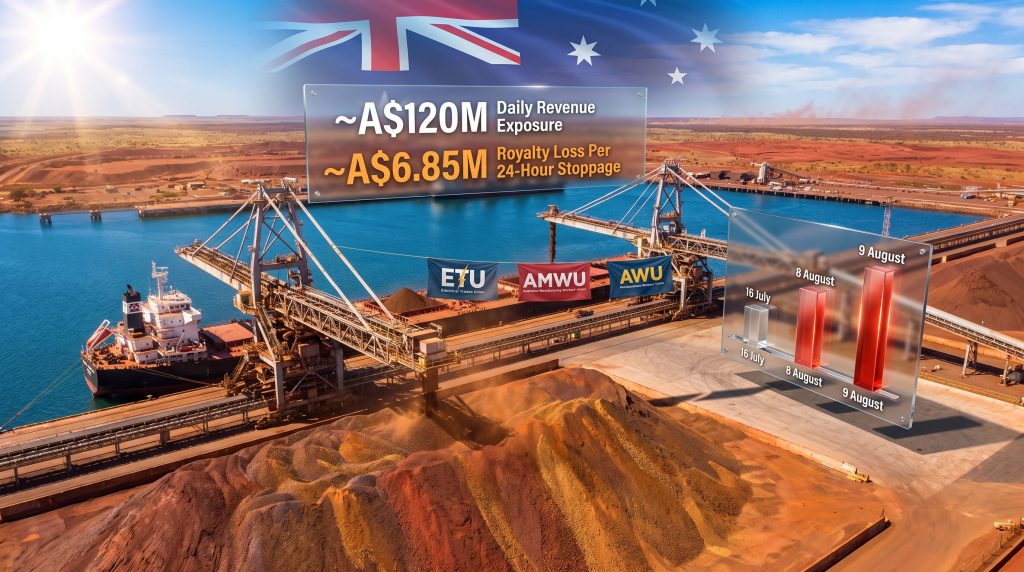
| 16 July 2026 | First stoppage: eight-hour strike from 2:00 pm to 10:00 pm local time |
| Late July 2026 | Bargaining meetings resume without Fair Work Commission involvement; talks stall again |
| 8 August 2026 | 24-hour ship-loading ban scheduled |
| 9 August 2026 | Full 24-hour strike from 5:30 am, subject to bargaining failure at FWC meeting |
The first strike in the Pilbara in decades attracted approximately 100 workers, union staff, and supporters — fewer than the 150 to 200 anticipated. BHP confirmed that seven vessels were loaded during that eight-hour window, suggesting contingency staffing was effective in absorbing short-duration disruption. The August 9 action, however, represents a fundamentally different scale of operational challenge.
What Each Union Is Demanding
The three unions involved have framed the dispute around structural issues rather than simply headline wage rates. This framing is significant — it signals the dispute is unlikely to be resolved by a single financial concession.
- ETU: Focused on pay transparency and the clarity of classification structures, with ETU WA Secretary Adam Woodage publicly stating that BHP's proposal lacked fairness and transparency, and that workers wanted an honest written agreement in unambiguous terms
- AMWU: Seeking a written enterprise agreement that genuinely reflects workers' daily contributions, with AMWU WA Secretary Steve McCartney describing the action as a direct consequence of BHP's failure to engage seriously after months of negotiation
- AWU: Aligned with the broader coalition's demands around pay equity and conditions
Unions characterised progress in bargaining discussions as moving at a glacial pace — language that signals the dispute is as much about procedural respect and bargaining conduct as it is about specific dollar outcomes.
BHP's public position framed the union's bargaining approach as lacking clarity and genuine engagement, with the company calling for greater specificity around what unions were actually proposing, and formally requesting Fair Work Commission oversight to facilitate a resolution.
Financial Exposure: Breaking Down the Real Cost of the BHP Port Hedland Strike
Revenue and Royalty Risk at Scale
The financial stakes attached to a 24-hour stoppage are substantial, though headline figures require careful contextualisation.
| Metric | Estimated Figure |
|---|---|
| BHP daily revenue exposure | ~A$120 million |
| WA Government royalty loss per 24-hour stoppage | ~A$6.85 million |
| Ships loaded during July 16 eight-hour strike | 7 vessels |
| Workers who participated in July 16 action | ~100 |
The A$120 million daily revenue exposure figure represents a theoretical maximum based on BHP's iron ore throughput rates and prevailing iron ore prices. Actual disruption costs during the July 16 stoppage were materially lower because contingency operations kept loading infrastructure partially functional. A full 24-hour workforce stoppage, however, removes the operational buffer that made short-duration absorption possible.
Furthermore, the Western Australian government's royalty exposure of approximately A$6.85 million per day is a concrete fiscal consequence that operates independently of BHP's internal contingency capacity. State royalties are calculated on export volumes, not operational effort — if ore does not move, royalties do not accrue.
Why Escalation Changes the Risk Calculus
The progression from an eight-hour strike to a 24-hour ship-loading ban followed by a full 24-hour workforce stoppage represents a deliberate escalation strategy. Each step is designed to test BHP's contingency capacity at a higher threshold:
- Eight-hour action: Tests whether management staffing can absorb a partial shift disruption
- 24-hour loading ban: Targets the specific revenue-generating function without a full workforce withdrawal
- Full 24-hour strike: Removes all operational contingency simultaneously
Risk note: The compounding nature of escalating industrial action means the financial impact is not linear. A 24-hour full stoppage creates vessel queuing, contract delay penalties, and scheduling disruption that extends the effective economic impact well beyond the stoppage window itself.
The National Economic Dimension
Why the Chamber of Minerals and Energy Is Paying Attention
Western Australia's Chamber of Minerals and Energy has characterised the return of industrial action to the Pilbara as a threat to national economic stability. This framing reflects the fiscal interdependencies at stake. Iron ore remains Australia's largest single export commodity by value, and Port Hedland is the dominant throughput point for that trade. Disruption at the port therefore translates directly into federal export revenue impact, state royalty shortfalls, and potential sovereign reliability concerns for Australian iron ore as a traded commodity.
The WA resources sector impact on state finances creates a specific fiscal incentive for state-level political attention to the dispute, even though enterprise bargaining is a federal industrial relations matter. When a single 24-hour work stoppage costs the state approximately A$6.85 million in foregone royalty revenue, the political calculus around intervention becomes more concrete. In addition, Australia's export challenges in maintaining supply reliability make this dispute particularly sensitive for trading partners.
Record Production Timing and Its Strategic Significance
One detail that received limited attention in mainstream coverage is that BHP achieved record iron ore production volumes in the period immediately preceding the July 16 strike action. This timing was not coincidental from a union strategy perspective.
Industrial action timed to coincide with peak production periods maximises financial pressure on employers in several specific ways:
- BHP's revenue exposure per day is highest when production volumes are at their peak
- Record production creates a strong implicit argument against the company's claim of constrained capacity to improve worker compensation
- Disrupting a record production period contradicts the narrative that industrial action causes permanent production capability damage, since the baseline being interrupted is itself exceptional
The equity framing advanced by unions — that workers enabling record profits deserve transparent and fair compensation structures — gains material credibility when the company has just posted production records. This is a well-established pattern in resource sector industrial relations, and the broader iron ore demand outlook makes the stakes even higher: workers in export-critical facilities tend to time action to moments of maximum company profitability.
The Fair Work Commission's Role in Resolution
What the FWC Can Actually Do
The Fair Work Commission functions as Australia's primary industrial tribunal. In enterprise bargaining disputes, its toolkit includes facilitated conciliation, mediation, and in extreme circumstances, the suspension or termination of protected industrial action where significant third-party harm can be demonstrated.
BHP has formally requested FWC involvement to accelerate resolution. The bargaining meeting scheduled for the week of 4 August 2026 was expected to occur before the Commission, representing the first structured FWC participation in the negotiation process.
The available pathways break down as follows:
| FWC Mechanism | Description | Likelihood |
|---|---|---|
| Facilitated conciliation | FWC commissioner guides structured dialogue | High near-term |
| Suspension of industrial action | Requires evidence of significant economic harm | Possible if 24-hour action proceeds |
| Binding arbitration | FWC imposes a determination | Low — rarely used in enterprise bargaining |
Both parties publicly accusing the other of failing to bargain in good faith is a consistent signal that bilateral resolution is unlikely without structured external facilitation. FWC-guided conciliation typically accelerates timelines but cannot force agreement if fundamental trust has broken down.
The next major ASX story will hit our subscribers first
Public Opinion and the Politics of the Dispute
Survey Findings and Their Limitations
A survey of 1,503 respondents conducted by YouGov on behalf of the ETU found that 71 per cent of those surveyed expressed support for workers taking industrial action at Port Hedland. The result was released in the week preceding the August 9 strike notice.
Surveys of this type serve a specific strategic function in major industrial disputes: they frame the action as having community legitimacy, which can constrain an employer's ability to pursue aggressive contingency strategies without reputational cost, and can influence political pressure from state and federal governments.
It is worth applying appropriate methodological caution here. The survey was commissioned by one of the disputing parties, and question framing in commissioned polls can materially influence response distributions. Independent polling on the same question would provide a more neutral benchmark. The 71 per cent figure should be understood as indicating broad directional community sympathy rather than a precise measurement of public opinion.
Why Public Sentiment Has Practical Consequences
In disputes involving nationally significant infrastructure, public opinion functions as a form of soft constraint on both parties. Strong worker support signals make it politically costly for BHP to be seen pursuing hard-line contingency responses without visible good-faith bargaining effort.
Simultaneously, they create pressure on the WA government — which has a direct fiscal interest in resolution — to encourage a negotiated outcome rather than allow the dispute to escalate toward arbitration or extended rolling action. The China steel and iron ore market also adds an external dimension, as prolonged supply uncertainty can accelerate Chinese buyers' diversification efforts toward alternative suppliers. Analysts have noted that the strategic timing of this action was deliberately calculated to apply maximum financial pressure on BHP.
Key Takeaways for Understanding the BHP Port Hedland Strike
The current dispute illuminates several structural features of Australian industrial relations that are not always visible in day-to-day coverage:
- Multi-union complexity is the core negotiating challenge. Reaching agreement requires alignment across three institutionally distinct organisations, each with separate membership priorities. This is structurally harder than single-union bargaining regardless of the financial parameters involved.
- Leverage is location-specific, not workforce-size specific. The concentrated nature of port loading operations means a small workforce controls disproportionate economic leverage at a critical export node.
- Escalation structure reveals bargaining intent. The deliberate step-up from eight hours to 24 hours indicates unions are prepared to absorb the reputational and membership cost of extended action if no substantive movement occurs before the August FWC meeting.
- The equity framing matters more than it appears. When unions consistently frame the dispute around transparency and fairness rather than simply wage rates, resolution typically requires structural changes to classification and remuneration architecture, not just a pay increase. That takes longer to negotiate.
- FWC involvement is a necessary but not sufficient condition for resolution. Commission-facilitated conciliation improves the probability of agreement but cannot substitute for genuine willingness to move from entrenched positions on both sides.
Disclaimer: Revenue exposure estimates and royalty impact figures cited in this article represent publicly reported approximations based on throughput data and prevailing market conditions. Actual economic impacts depend on the extent of operational disruption, BHP's contingency capacity, and iron ore price movements at the time of any stoppage. This article is informational and does not constitute financial or investment advice.
Want to Stay Ahead of Major ASX Opportunities in the Resources Sector?
When industrial disputes disrupt iron ore exports at scale, downstream effects ripple across ASX-listed mining and exploration companies — and identifying the right opportunities quickly is where Discovery Alert's proprietary Discovery IQ model delivers a decisive edge. Powered by real-time analysis of ASX announcements across more than 30 commodities, Discovery Alert transforms complex mineral data into actionable insights, with a dedicated discoveries page showcasing the historic returns that significant mineral discoveries have generated — start a 14-day free trial today and position ahead of the broader market.