July 30, 2026
When Environmental Law Closes the Door on Legacy Mining Rights
For decades, the conventional wisdom among mining executives operating in Latin America held that securing a concession title was the hard part. Once a company held a concession, the reasoning went, environmental permitting was a procedural formality that could be navigated, negotiated, or deferred. Mexico's regulatory architecture is now dismantling that assumption in a systematic and legally durable way.
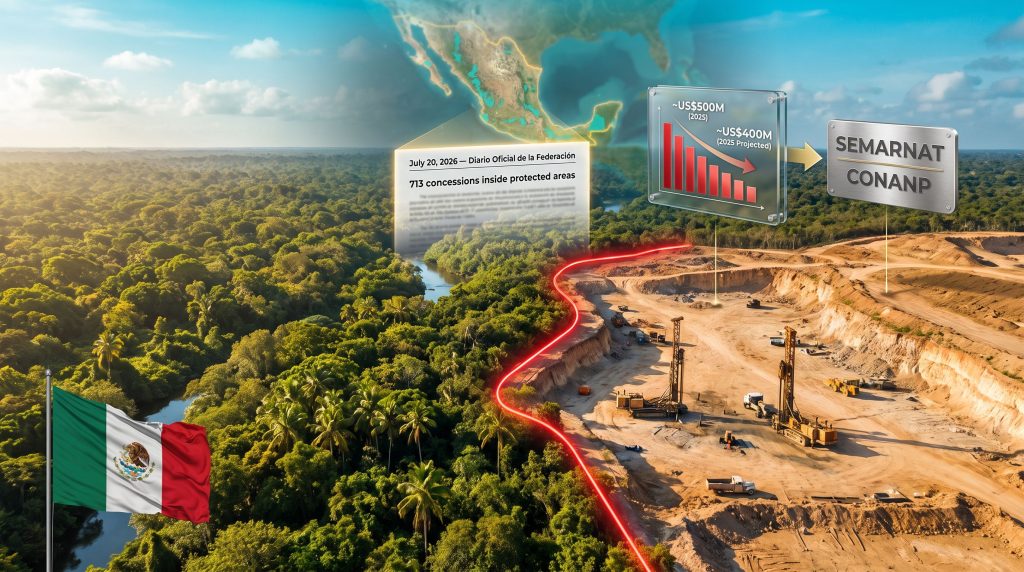
The July 20, 2026 agreement published by SEMARNAT in the Diario Oficial de la Federación represents the most operationally consequential single regulatory instrument affecting SEMARNAT mining permits in protected natural areas since the landmark 2023 mining reform. It does not merely restate existing policy. It closes an administrative gap that had allowed legacy concession holders to argue, sometimes successfully, that their pre-reform titles preserved a viable pathway to environmental clearance. That gap is now sealed.
When big ASX news breaks, our subscribers know first
Understanding Mexico's Protected Natural Area Network
The Scale and Structure of the ANP System
Mexico operates one of the largest federally managed protected area networks in the Western Hemisphere. The system currently encompasses approximately 232 designated zones covering roughly 98 million hectares of national territory, a footprint so vast that a meaningful proportion of Mexico's historically productive mining belt falls within or adjacent to its boundaries.
The ANP framework is not a monolithic category. It includes several distinct classification types, each carrying different land-use restrictions:
- Biosphere reserves: The most restrictive classification, covering core zones where virtually all extractive activity is prohibited
- National parks: Protected for scenic, scientific, or recreational value, with broad restrictions on industrial use
- Flora and fauna protection areas: Designated specifically to safeguard biodiversity hotspots, often including marine and coastal zones
- Natural monuments: Typically smaller, site-specific protections for features of exceptional natural or cultural significance
Prior to July 2026, the operational boundary between holding a mining concession and needing separate environmental authorisation remained ambiguous for legacy permit holders, particularly those whose titles predated the May 2023 reform. Companies in this position could credibly argue that their pre-existing concessions entitled them to at least apply for environmental clearance under transitional provisions. The July 20 agreement formally eliminates that argument.
The Institutional Architecture Governing the Prohibition
Understanding how the prohibition operates requires mapping the institutional relationships between four key bodies:
| Institution | Role Under the New Framework |
|---|---|
| SEMARNAT | Federal environmental authority; now prohibited from issuing any mining-related authorisation inside ANPs |
| CONANP | Conservation agency; elevated from consultative reviewer to binding technical gatekeeper |
| LGEEPA | Statutory framework enforcing Article 107 Bis restoration obligations |
| SCJN | Supreme Court; upheld the 2023 reform's constitutionality, closing the non-retroactivity avenue for legal challenges |
The institutional shift most consequential for operators is not the prohibition itself but the elevation of CONANP's authority. Previously, CONANP's assessments functioned as advisory inputs that SEMARNAT could weigh alongside competing technical evidence. The July 2026 agreement restructures this relationship entirely, making CONANP's opinion determinative rather than consultative.
What the July 2026 Agreement Actually Prohibits
A Precise Scope of Denied Authorisations
The agreement instructs all SEMARNAT administrative units and decentralised bodies, including the Directorate General of Environmental Impact and Risk, to deny a specific set of authorisations inside federally designated ANPs:
| Prohibited Authorisation Type | Applies Inside ANPs | Applies to Pre-2023 Concessions |
|---|---|---|
| Environmental impact authorisations (MIAs/EIAs) for exploration | Yes | Yes |
| Environmental permits for mineral extraction or exploitation | Yes | Yes |
| Authorisations for ore beneficiation and processing works | Yes | Yes |
| Final disposal of mining and metallurgical waste in ANPs, wetlands, riverbeds | Yes | Yes |
| Licences or favourable resolutions linked to any of the above | Yes | Yes |
The Concession vs. Authorisation Distinction: The Structural Logic
The legal architecture enabling this prohibition to function without violating Mexico's constitutional non-retroactivity principle rests on a single doctrinal distinction: a mining concession grants the right to claim a mineral deposit; it has never constituted an automatic right to extract. Environmental authorisation is a legally separate, sequentially independent requirement. Understanding mining permitting basics helps clarify why these two processes remain distinct in nearly every jurisdiction.
A mining concession and an environmental permit are two entirely distinct legal acts evaluated under different statutory frameworks. The SCJN confirmed that assessing a new permit application under current law does not retroactively alter the terms of a pre-existing concession title. This separation of rights is what allows the July 2026 prohibition to apply in effect to legacy concession holders.
This reasoning, upheld by the SCJN in its 2025 to 2026 rulings validating the 2023 mining reform, is what allows the prohibition to reach backward in time without technically breaching constitutional protections. The court found that the environmental permit, not the underlying concession, is the act being evaluated under current rules.
The Regulatory Sequence That Built This Outcome
A Legislative and Judicial Timeline
The July 2026 agreement did not emerge in isolation. It is the administrative culmination of a multi-year legislative and judicial sequence:
- May 8, 2023: Mexico publishes sweeping reforms to the Mining Law, National Waters Law, and LGEEPA; new restrictions on concessions inside ANPs take effect
- 2023 to 2025: Industry legal challenges allege the reform violates non-retroactivity protections for pre-existing concession holders
- 2025 to 2026: The SCJN issues rulings upholding the reform's constitutionality, confirming that environmental permit evaluations are governed by law in force at the time of application
- Early 2026: President Claudia Sheinbaum discloses that more than 1,126 mining concessions covering 889,502 hectares, including 713 concessions inside protected areas, had been returned to the federal government to prevent speculative land-holding and protect ecosystems
- July 20, 2026: SEMARNAT publishes the ANP mining prohibition agreement in the DOF, signed by Minister Alicia Bárcena Ibarra, effective the following day
- July 27, 2026: The ICSID tribunal issues its final award in the Vulcan Materials/Calica arbitration, largely upholding Mexico's environmental enforcement position
What the Scale of Returned Concessions Signals
The return of over 1,126 concessions is not a routine enforcement action. It signals a structural policy orientation away from speculative land-holding in environmentally sensitive zones, with the 713 concessions specifically inside ANPs representing the direct target population of the July 2026 agreement.
The cumulative regulatory effect on investment flows is already measurable. Mining exploration investment in Mexico contracted from approximately US$500 million in 2023 to a projected US$400 million in 2025, a decline of roughly 20% attributable in part to the uncertainty generated by the reform cycle and the narrowing of viable project locations. Approximately 160 mining projects nationwide remain stalled under the 2023 reform framework.
Importantly, the government's approach is explicitly selective rather than blanket. SEMARNAT's authorisation of Defiance Silver's San Acacio drilling expansion in Zacatecas demonstrates that environmental clearances continue to advance for projects outside protected areas that align with the government's critical-mineral priorities. The July 2026 agreement sharpens this distinction rather than reversing it.
CONANP's New Binding Authority: A Fundamental Shift
From Advisory Voice to Determinative Gatekeeper
The procedural mechanics of the new framework represent a more profound institutional change than the headline prohibition itself. Under the previous structure, CONANP's technical assessments in the EIA review process were inputs SEMARNAT could weigh, accept, or contest alongside other technical submissions. That discretion has been removed. This kind of government intervention in mining — restructuring which agencies hold binding authority — is increasingly common across resource-rich jurisdictions.
Before July 20, 2026:
- CONANP issued consultative opinions on mining EIA applications
- SEMARNAT retained discretion to weigh CONANP findings against competing technical evidence
- Outcomes varied based on the relative strength of conflicting assessments
After July 20, 2026:
- Every mining-related EIA filing must be immediately reported to CONANP
- CONANP issues a binding technical opinion determining whether the project affects an ANP directly or indirectly
- SEMARNAT's final decision is determined by CONANP's finding, with no discretion to override
The Indirect Impact Extension: The Most Expansive Provision
The most operationally significant element of the agreement for projects currently in the EIA pipeline is not the prohibition on projects physically located inside ANPs. It is the extension of that prohibition to projects outside ANP boundaries that are capable of generating indirect environmental impacts on a protected area.
The agreement does not restrict its reach to projects physically located inside ANP boundaries. Any mining development situated outside an ANP but capable of generating indirect environmental impacts on a protected area triggers the same CONANP review and the same prohibition on authorisation.
This proximity trigger substantially expands the geographic footprint of the prohibition beyond the 98 million hectares formally designated as ANPs. Legal analysis from Holland & Knight and ALN Abogados has flagged the indirect-impact provision as the most operationally significant expansion in the agreement for projects currently moving through the EIA pipeline.
For operators, this creates a new layer of mandatory due diligence. Spatial analysis must now extend beyond a project's direct footprint to evaluate hydrological connectivity, atmospheric pathways, and ecological linkages to nearby protected zones. A mine that sits comfortably outside an ANP boundary on a map may still trigger CONANP review if drainage patterns or wildlife corridors connect it to a protected area.
Compliance Obligations for Companies With Existing Authorisations
The 15-Business-Day Transitional Requirement
The agreement creates an urgent compliance deadline for a specific subset of operators: those holding environmental authorisations granted before May 8, 2023 for mining activities inside ANPs that have not yet submitted a mine restoration, closure, and post-closure programme under Article 107 Bis of LGEEPA.
Step-by-step compliance pathway for affected operators:
- Determine authorisation date: Confirm whether the environmental authorisation predates May 8, 2023
- Confirm ANP overlap: Verify whether authorised works are physically located inside a federally designated ANP
- Assess restoration filing status: Determine whether an Article 107 Bis restoration, closure, and post-closure programme has already been submitted to SEMARNAT
- If not filed, initiate within 15 business days: The agreement requires the filing process to begin within this window, accompanied by a financial guarantee instrument such as a bond
- Evaluate work programme rescheduling: Companies with unexecuted or partially executed approved activities inside ANPs may need to formally request rescheduling of their approved work programmes to maintain compliance standing
According to legal analysis from ALN Abogados, initiating the restoration filing within the 15-business-day window is sufficient to preserve legal standing whilst the process proceeds. The agreement does not automatically revoke existing authorisations granted before May 8, 2023. It establishes a compliance clock for those that remain unexecuted or only partially executed.
What the Agreement Does Not Do
It is equally important to understand the limits of the July 2026 prohibition:
- It does not automatically revoke environmental authorisations already granted before May 8, 2023
- It does not reopen the constitutional debate over the 2023 mining reform; the SCJN has closed that avenue
- It does not apply uniformly to all mining projects in Mexico; projects outside ANPs that demonstrate no indirect impact on protected areas retain a viable permitting pathway
- It does not constitute a blanket ban on mining investment, as evidenced by continued approvals for critical-mineral projects in compliant locations
The next major ASX story will hit our subscribers first
The Vulcan Materials Arbitration as a Policy Validation Signal
The ICSID Outcome and What It Means for Mexico's Enforcement Posture
The Vulcan Materials/Calica dispute provided the highest-stakes international legal test of Mexico's environmental enforcement approach against extractive industry operators near protected ecosystems:
| Dispute Parameter | Detail |
|---|---|
| Operator | Vulcan Materials via its subsidiary Calica, Quintana Roo |
| Operations halted | 2022, underwater quarrying shut by Mexican authorities |
| Grounds cited | Environmental damage and permitting irregularities |
| Arbitration forum | ICSID under NAFTA/USMCA investment protection rules |
| Damages originally sought | Approximately US$1.7 billion |
| Treaty violation found | Limited to closure of a single Calica parcel in January 2018 |
| Final award against Mexico | Approximately US$17 million, less than 1% of claimed amount |
| Tribunal ruling date | July 27, 2026 |
| Post-ruling land status | Designated as the Felipe Carrillo Puerto Flora and Fauna Protection Area |
The US$17 million award against a US$1.7 billion claim represents a dismissal rate exceeding 99% of the original damages sought. This outcome materially reduces the financial deterrent that investor-state arbitration had previously represented for Mexico's environmental enforcement posture. Furthermore, international arbitration tribunals operating under USMCA investment protection rules declined to second-guess Mexico's environmental enforcement decisions near protected ecosystems in the overwhelming majority of the claims presented.
The permanent designation of the Calica-linked land as the Felipe Carrillo Puerto Flora and Fauna Protection Area closes that site to any future mining activity regardless of ownership or concession history, embedding the outcome into the ANP framework itself.
Civil Society Pressure as a Political Reinforcement Mechanism
The policy direction has been reinforced by significant civil society mobilisation. Opposition to the Perfect Day Mexico tourism development near Mahahual generated a Change.org petition exceeding 4 million signatures and more than 14,000 citizen submissions during SEMARNAT's public consultation process.
Whilst that dispute is not mining-specific, it illustrates the political environment in which SEMARNAT chose to formalise the ANP restriction through a published DOF agreement rather than applying it quietly through administrative discretion.
This combination of judicial validation, international arbitration precedent, and public mobilisation creates a reinforcing policy ecosystem that makes regulatory reversal politically and legally costly regardless of future administration changes.
Mapping the New Investment Risk Landscape
Projects Blocked vs. Projects With a Viable Pathway
| Investment Category | Permitting Status Under July 2026 Framework |
|---|---|
| Exploration inside a federally designated ANP | Effectively blocked regardless of concession vintage |
| Extraction inside an ANP | Effectively blocked; no environmental authorisation pathway |
| Project outside ANP with CONANP-confirmed indirect impacts | Subject to same prohibition as ANP-interior projects |
| Critical-mineral project outside ANP with no ANP connectivity | Viable pathway, though approval timelines remain extended |
| Legacy authorisation pre-May 2023 with restoration filing complete | Preserved under existing authorisation framework |
The investment contraction in context:
| Metric | 2023 | 2025 Projected | Change |
|---|---|---|---|
| Mexico mining exploration investment | ~US$500 million | ~US$400 million | Approximately 20% decline |
| Concessions returned to state | Baseline | 1,126+ | Structural shift |
| Concessions inside ANPs returned | Baseline | 713+ | Direct target population |
| Federal ANP coverage | ~98 million ha | ~98 million ha | Stable |
The Selective Approval Logic: Critical Minerals vs. Legacy Extraction
The Sheinbaum administration has consistently maintained a policy distinction between speculative or legacy extraction near sensitive ecosystems and strategic critical-mineral development in compliant locations. The July 2026 agreement on SEMARNAT mining permits in protected natural areas sharpens rather than reverses this distinction.
Companies operating in lithium, copper, and other critical-mineral categories outside ANP boundaries face a slower but navigable approval environment. Companies with ANP-overlapping or ANP-adjacent legacy concessions, however, now face a structurally closed pathway to new environmental authorisation. The two groups are operating under fundamentally different regulatory realities, and conflating them in investment analysis would produce materially misleading conclusions.
Practical Compliance Checklist for Mining Operators in Mexico
Immediate Actions Required Following the July 2026 Agreement
- Spatial audit: Map all active and pending concessions against the 232 federally designated ANPs covering approximately 98 million hectares
- Indirect impact assessment: Evaluate hydrological, ecological, and atmospheric connectivity between project footprints and nearby ANP boundaries
- Authorisation inventory: Identify all environmental authorisations granted before May 8, 2023 for activities inside ANPs
- Restoration filing status: Confirm whether Article 107 Bis restoration programmes have been submitted for all pre-reform authorisations inside ANPs
- 15-business-day compliance clock: If restoration filings are outstanding, initiate the process immediately and secure the required financial guarantee
- Work programme review: Assess whether any approved but unexecuted work programmes inside ANPs require formal rescheduling requests to SEMARNAT
- CONANP notification protocol: Establish internal procedures to ensure all new EIA submissions trigger the mandatory immediate CONANP notification
- Legal counsel engagement: Consult with environmental law specialists, including firms with demonstrated LGEEPA compliance expertise such as Holland & Knight and ALN Abogados, to assess project-specific exposure under the indirect-impact provisions
Frequently Asked Questions: SEMARNAT Mining Permits in Protected Natural Areas
Does the July 2026 agreement apply to concessions granted before 2023?
Yes. The agreement explicitly covers concessions granted before the May 8, 2023 mining reform. Because a mining concession and an environmental authorisation are treated as legally independent procedures, holding a pre-reform concession does not exempt an operator from current environmental permitting requirements. Any new or pending environmental authorisation application is evaluated under the rules in force at the time of application, as confirmed by the SCJN. In addition, the mining claims framework in comparable jurisdictions similarly treats concession rights and environmental permits as wholly separate legal instruments.
Can a company operate inside an ANP if it already holds an environmental authorisation?
Existing authorisations granted before May 8, 2023 are not automatically revoked. However, operators with unexecuted or partially executed activities inside ANPs must initiate the Article 107 Bis restoration, closure, and post-closure filing within 15 business days of the agreement's effective date and must provide a financial guarantee. Failure to meet this deadline risks non-compliance with the new regulatory framework.
What happens if a project is located near but not inside an ANP?
The agreement extends its reach to projects outside ANP boundaries that could generate indirect environmental impacts on a protected area. For any mining-related EIA submission, SEMARNAT is required to notify CONANP, which issues a binding technical opinion. If CONANP determines that indirect impacts are probable, the same prohibition on authorisation applies as for projects physically located inside an ANP. Consequently, a thorough definitive feasibility study should now incorporate a dedicated ANP proximity and indirect-impact analysis as a standard component of project evaluation.
Is CONANP's technical opinion now binding on SEMARNAT?
Yes. Under the July 2026 agreement, CONANP's technical opinion on whether a mining project affects an ANP directly or indirectly is determinative for SEMARNAT's final permitting decision. This represents a significant institutional shift from the previous consultative role CONANP held in the EIA review process.
Are any mining projects in Mexico still receiving SEMARNAT approvals?
Yes. The prohibition applies specifically to projects inside ANPs or those capable of indirectly affecting them. Projects outside protected areas and without ANP connectivity retain a viable pathway to environmental authorisation. The government's selective approach is evidenced by continued approvals for critical-mineral exploration projects in states such as Zacatecas that fall outside protected area boundaries. Furthermore, broader mining permits reform trends across North America highlight how permitting environments are shifting simultaneously in multiple directions, making jurisdiction-specific analysis essential.
Disclaimer: This article is intended for informational purposes only and does not constitute legal or investment advice. Regulatory frameworks and their application may change. Companies operating in Mexico's mining sector should seek qualified legal counsel to assess their specific compliance obligations. Investment-related observations involve inherent uncertainty and should not be construed as financial recommendations.
Want To Track ASX Mineral Discoveries Before The Broader Market Does?
Discovery Alert's proprietary Discovery IQ model delivers real-time alerts on significant ASX mineral discoveries, cutting through complex geological and regulatory data to surface actionable investment opportunities the moment they are announced. Explore historic discovery returns to understand the scale of what early positioning can mean, then begin your 14-day free trial to gain a market-leading edge.