July 30, 2026
The Governance Gap at the Heart of Modern Tailings Management
Across the global mining sector, the volume of data generated by tailings storage facilities has grown faster than the systems designed to make sense of it. A decade ago, the average tailings facility operated with a handful of geotechnical instruments. Today, advanced sites routinely deploy thousands of sensors generating millions of data points every single day. The leap in instrumentation density has been remarkable. The corresponding leap in decision-making capability has not always followed.
This asymmetry sits at the core of a deepening challenge in tailings performance management: the risk that high volumes of monitoring data create an illusion of control without delivering the engineering insight that genuine safety and compliance require. When operators move from ten instruments to thousands within five years, as has been documented at some modern tailings storage facilities (TSFs), the governance architecture must scale accordingly. In most cases, it has not.
Understanding why this gap exists, and how structured performance management frameworks can close it, is now one of the most consequential questions in mining operations. Furthermore, the pressure to address this challenge is intensifying as regulatory expectations and community scrutiny continue to rise.
When big ASX news breaks, our subscribers know first
What Is Tailings Performance Management and Why Has It Become Critical?
From Passive Storage to Active Engineered Systems
The historical framing of tailings facilities as waste containment structures has long understated their complexity. A modern TSF is an engineered geotechnical structure that evolves continuously throughout its operational life. Embankment geometry changes as deposition raises facility height. Pore water pressures shift with seasonal rainfall patterns and deposition rates. Seepage chemistry fluctuates as the tailings mass consolidates over time.
Tailings performance management is the discipline that treats these facilities not as passive storage but as active systems requiring continuous evaluation against defined engineering expectations. It encompasses:
- Establishing measurable performance objectives tied to original design parameters
- Deploying monitoring infrastructure to capture real-time facility behaviour
- Evaluating observed data against design intent and regulatory thresholds
- Triggering defined responses when indicators approach or breach critical limits
- Maintaining defensible, auditable records of all observations, decisions, and actions
The distinction between collecting monitoring data and genuinely managing performance is not semantic. It represents the difference between a facility that generates records and a facility that generates decisions. Approaches to natural capital in mining increasingly reinforce why this distinction matters for broader environmental accountability.
The Regulatory Catalyst: GISTM and the Evidence-Based Conformance Requirement
The Global Industry Standard on Tailings Management (GISTM), published in 2020 and developed through a collaboration between the United Nations Environment Programme, the Principles for Responsible Investment, and the International Council on Mining and Metals, fundamentally redefined what operators must demonstrate to regulators, investors, and communities. Importantly, GISTM does not merely require data collection. It requires evidence-based conformance, meaning operators must be able to show that each applicable requirement has been assessed, that responsible ownership exists, and that gaps are being addressed through documented corrective action.
Under GISTM, data gaps in monitoring records are treated as conformance failures. This is a significant departure from earlier frameworks that focused primarily on design standards rather than ongoing operational evidence.
The Mining Association of Canada's Towards Sustainable Mining (TSM) Tailings Management Protocol operates alongside GISTM as a complementary framework, adding further governance obligations around independent review, tailings management policy, and emergency preparedness. Together, these standards have created an environment where fragmentary documentation practices are no longer defensible.
The Four Pillars of a Robust Tailings Performance Management Framework
Pillar 1: Performance Objectives and Design-Intent Benchmarking
Effective tailings performance management begins before a single sensor is installed. It starts with encoding the facility's design intent into a set of measurable, verifiable performance objectives. These objectives define what safe operation looks like in quantifiable terms, connecting piezometric limits, freeboard requirements, deformation thresholds, and seepage parameters directly to the original engineering design.
Without this foundation, monitoring data has no reference point. A pore water pressure reading of a given value means nothing unless it can be compared against the design threshold above which stability assumptions begin to degrade. Performance objectives transform raw data into meaningful engineering signals.
These objectives should also be linked explicitly to risk appetite, environmental compliance thresholds, and long-term closure planning. A facility approaching end of operational life will have different performance sensitivities than one in active deposition.
Pillar 2: Continuous Monitoring and Surveillance Architecture
Modern tailings monitoring encompasses geotechnical, environmental, and operational domains simultaneously. Instrument types typically deployed across a large TSF include:
- Vibrating wire piezometers for pore water pressure monitoring within embankments
- Inclinometers and extensometers for deformation and settlement tracking
- Surface water and seepage chemistry monitoring stations for environmental compliance
- Automated weather stations for rainfall correlation with pore pressure responses
- InSAR (interferometric synthetic aperture radar) for satellite-based surface displacement detection across large areas
- Drone-based photogrammetry systems for periodic volumetric and geometric surveys
A critical distinction that is frequently overlooked is the difference between data collection and data quality assurance. Sensor networks generate readings continuously, but those readings require verification before they can reliably enter engineering workflows. An unusual piezometer reading may reflect genuine pore pressure elevation, or it may reflect instrument malfunction, a broken cable, a transmission failure, or calibration drift. Without contextual verification, these signals cannot be safely separated.
Automated anomaly detection systems can flag statistical outliers, but genuine engineering-level signal interpretation requires human context. The two are not interchangeable. In addition, data-driven mining operations are increasingly demonstrating how structured data governance can elevate signal quality across complex monitoring environments.
Pillar 3: Performance Evaluation and Threshold Management
Trigger Action Response Plans (TARPs) are the operational backbone of performance evaluation in tailings management. A well-structured TARP defines specific monitoring thresholds at escalating alert levels, the actions required at each level, the responsible personnel for each action, and the resolution criteria that allow an alert to be closed.
TARPs are not static documents. Tailings facilities do not remain in a fixed condition, and neither do their risk profiles. A TARP written at the time of facility commissioning may be materially inappropriate for the same facility operating at three times its original design height with a changed deposition method. Best practice requires TARP review whenever facility conditions change materially, including changes in embankment geometry, deposition rates, seasonal conditions, or geotechnical findings from periodic reviews.
Pillar 4: Corrective Action, Change Management, and Audit Trails
The chain of accountability from warning detection through to resolution is where many tailings performance management systems fail in practice. Identifying an anomaly is only the first step. The performance management system must also answer:
- Who received the alert and when?
- Who was assigned responsibility for investigation?
- What action was taken, and by whom?
- Was the action completed within the required timeframe?
- What was the resolution, and who approved closure of the event?
Industry practitioners have observed that critical decisions are frequently recorded across disconnected systems, appearing in email threads, individual spreadsheets, handwritten field notes, and isolated software platforms. This fragmentation creates two serious problems: it makes audit and independent review exercises extremely difficult, and it means that institutional knowledge about past events and decisions is not systematically preserved when personnel change.
Immutable, timestamped records that preserve the full history of each monitoring event, including all participants, actions, approvals, comments, and attachments, are now a compliance requirement rather than a best practice aspiration.
How Data Volume Creates Risk Instead of Reducing It
The Proliferation Problem
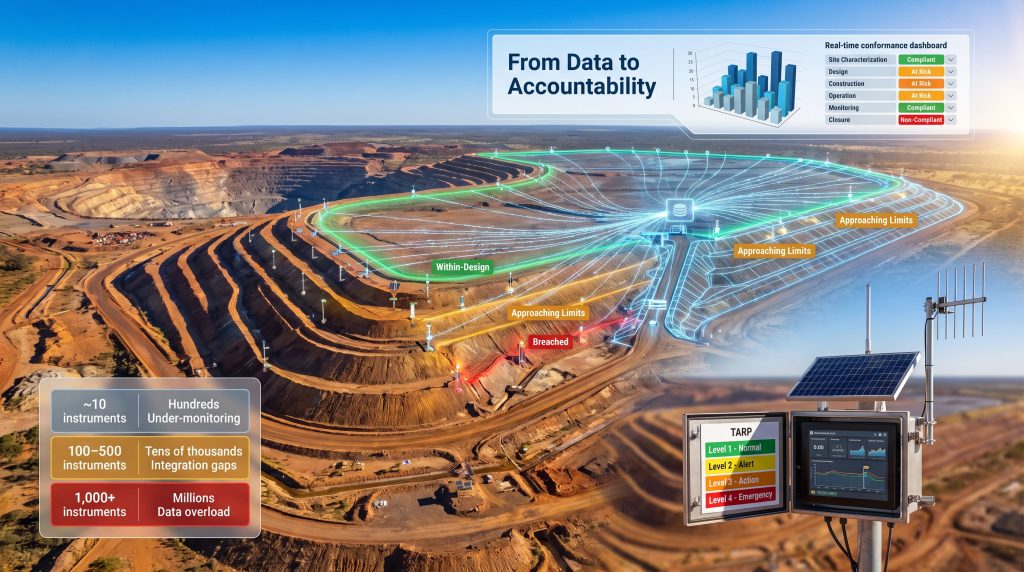
One of the least discussed risks in modern tailings management is the hazard created by data overload itself. The table below illustrates how monitoring scale has transformed the nature of the operational challenge:
| Monitoring Scenario | Instrument Count | Daily Data Points | Primary Risk |
|---|---|---|---|
| Legacy operation (pre-2020) | ~10 instruments | Hundreds | Under-monitoring, blind spots |
| Transitional operation | 100 to 500 instruments | Tens of thousands | Integration gaps, siloed systems |
| Advanced modern operation | 1,000+ instruments | Millions | Signal-to-noise failure, data overload |
The progression from ten instruments to thousands represents a genuine improvement in physical coverage of a facility. However, it simultaneously creates a new category of risk: the possibility that critical signals are buried within noise, or that engineers are spending so much time processing data that their capacity for genuine interpretation is diminished.
Industry practitioners have documented sites where operators have so many active alarms firing simultaneously that alarm fatigue sets in. When everything signals urgency, nothing does. Consequently, the industry's broader mining sustainability transformation agenda must grapple with this data governance challenge directly.
The Silo Problem
A single tailings facility may simultaneously operate monitoring hardware from multiple vendors, using incompatible data formats and proprietary software platforms. This creates an environment where no single system holds a complete picture of facility behaviour. Environmental monitoring data sits in one platform, geotechnical data in another, and operational data in a third.
Integrating these data streams into a single trusted data foundation is a prerequisite for reliable performance management. Without it, the engineers responsible for the facility are perpetually engaged in the manual exercise of assembling a picture from fragments rather than evaluating an integrated view of facility behaviour. This is not a technology problem alone. It is a governance problem.
GISTM-Aligned Performance Management: Mapping Requirements to Operations
What GISTM Actually Demands in Practice
Operators frequently underestimate the specificity of GISTM's monitoring requirements. The standard calls for continuous performance monitoring systems, not periodic or intermittent data collection. It requires that conformance evidence be documented in a form that supports independent review. And it positions each requirement as having a named responsible owner within the operating organisation.
The conformance gap that most commonly appears during independent reviews is not an absence of monitoring data, but an inability to connect that data to specific GISTM requirements in a structured, auditable way.
| GISTM Requirement Area | Operational Implication | Common Compliance Gap |
|---|---|---|
| Continuous performance monitoring | Real-time or near-real-time data systems | Instrument downtime and transmission gaps |
| Evidence-based conformance | Documented proof of requirement fulfilment | Evidence dispersed across disconnected systems |
| Accountable governance | Named ownership of each requirement | Diffuse responsibility at site level |
| Periodic independent review | Audit-ready records | Inconsistent documentation standards |
From Requirement to Conformance Evidence
Enterprise-level conformance management approaches allow senior leadership and governance bodies to navigate from a geospatial view of all operating facilities down to the specific conformance status of individual requirements at a specific TSF. This capability allows executives to identify, in real time, which requirements are fully met, which are partially met, and which are not met, along with clear ownership assignment for any gap.
This does not remove the need for engineering judgement or automate the conformance process. It makes it possible to connect monitoring information with responsibilities, supporting evidence, and the actions needed to address gaps, in a way that dispersed documentation systems cannot support.
The Living Virtual Twin: Engineering Design Meets Real-World Behaviour
What a Virtual Twin Is and How It Functions
A tailings virtual twin integrates the engineering design model of a facility with live sensor data to create a continuously updated representation of facility behaviour. This is conceptually distinct from a monitoring dashboard, which displays current readings without reference to design intent.
A virtual twin allows engineers to assess not just what a sensor is reading, but whether that reading is consistent with what the design model predicts the facility should be doing at that point in its operational life, under the prevailing loading conditions.
When integrated monitoring data and engineering design models are combined in this way, it becomes possible to identify divergence between expected and actual performance as it develops, rather than after threshold exceedance has already occurred.
Step-by-Step: How a Virtual Twin Supports a Performance Review Cycle
- Baseline establishment — Encode design intent, geotechnical parameters, and performance thresholds into the engineering model
- Live data integration — Ingest real-time sensor readings from geotechnical, environmental, and operational instruments across the facility
- Deviation detection — Automatically flag where observed behaviour diverges from design expectations at defined sensitivity levels
- Engineering review — Qualified engineers assess flagged deviations with full contextual information, not isolated data points
- TARP activation or update — If thresholds are breached, trigger the appropriate response plan; update the plan if facility conditions have materially changed
- Audit trail creation — Record all actions, approvals, timestamps, and participants against the relevant instrument or monitoring event
- Conformance reporting — Map reviewed and resolved events to GISTM or other applicable standard requirements in a documented, retrievable form
The next major ASX story will hit our subscribers first
Where AI Fits Into Tailings Performance Management
The Precondition: Trusted and Integrated Data
Artificial intelligence tools applied to tailings management carry a risk that is seldom discussed openly: when AI operates on fragmented, unverified, or siloed data, it does not produce unreliable outputs that are obviously wrong. It can produce outputs that appear plausible but are built on an incomplete picture of facility conditions. This is arguably more dangerous than an obvious error.
The foundational requirement for AI to add genuine value in tailings management is a verified, integrated data layer. AI in mining efficiency applied to a clean, complete, contextually verified dataset can meaningfully assist engineers. However, AI applied to fragmented data amplifies the existing governance problem rather than solving it.
What AI Can and Cannot Do
| AI Capability | Practical Application | Important Limitation |
|---|---|---|
| Knowledge retrieval | Identifying relevant response plans for a specific instrument alert | Cannot replace engineering judgement on novel or unprecedented conditions |
| Risk summarisation | Surfacing key risks across multiple instruments simultaneously | Output quality depends entirely on knowledge base completeness |
| Action planning and tracking | Generating and assigning tasks linked to a specific monitoring event | Requires human approval and accountability at each decision step |
| Pattern recognition | Identifying trends across large sensor datasets over time | May identify correlations without establishing causation |
The legitimate value proposition of AI in tailings performance management is reducing the time that qualified engineers spend locating, organising, and assembling information, freeing expert capacity for the interpretation and decision-making work that cannot be delegated to any automated system. The goal is not to remove engineering accountability from the process. It is to improve the efficiency with which engineers access the information they need to exercise that accountability effectively.
Critical governance note: When AI-assisted analysis informs an action taken on a tailings facility, accountability for that action still rests with the named responsible engineer, not with the system that surfaced the recommendation. Governance frameworks must be explicit on this point to prevent the diffusion of accountability that AI tools can inadvertently create.
Key Performance Indicators for Tailings Performance Management
Operational KPIs
- Piezometric levels and pore water pressure readings measured against design limits
- Freeboard measurements relative to minimum required levels under current deposition conditions
- Seepage rates and seepage chemistry at all designated monitoring points
- Embankment deformation and settlement rates compared against design predictions
- Instrument uptime and data transmission reliability rates across all active sensors
Governance KPIs
- Percentage of GISTM requirements with documented, current, and independently reviewable evidence
- Average time-to-resolution for flagged monitoring anomalies by alert classification level
- Frequency and completeness of TARP reviews relative to material changes in facility conditions
- Independent review completion rates and the closure rate of findings from those reviews
- Proportion of performance requirements with clearly assigned and current ownership
Why Key Risk Indicators matter more than Key Performance Indicators in tailings management: KPIs measure what has already happened. KRIs measure where performance is drifting toward a threshold before that threshold is crossed. Treating KRI exceedance as a governance event, not simply an operational note, is a meaningful indicator of organisational maturity in tailings performance management.
Common Failure Modes in Tailings Performance Management Systems
Technical Failure Modes
- Instrument dropout and data transmission gaps that create false confidence in the completeness of facility surveillance
- Sensor calibration drift that produces readings appearing within normal range while masking genuine changes in facility behaviour
- Incompatible data formats across vendors preventing meaningful cross-system integration
Organisational Failure Modes
- Responsibility diffusion, where no single individual has unambiguous accountability for monitoring gaps or anomaly resolution
- Documentation fragmentation, where decisions of engineering significance are recorded in emails or personal files rather than auditable systems
- TARP staleness, where response plans no longer reflect the current geometry, loading, or risk profile of a facility that has continued to develop since the plan was last updated
Systemic Failure Modes
- Treating data volume as a proxy for safety, assuming that deploying more instruments constitutes improved risk management independent of how that data is used
- Disconnecting monitoring from engineering context, reading sensor outputs without reference to the design model that gives those readings meaning
- Compliance theatre, in which conformance documentation is generated without the genuine performance evaluation that is supposed to underpin it
Furthermore, effective mining waste management practice depends on avoiding precisely these systemic failures, as they undermine the integrity of the entire performance assurance chain.
Building a Tailings Performance Management System: A Practical Phase Framework
Phase 1: Establish a Trusted Data Environment
Consolidate monitoring data from all instruments and vendors into a single integrated platform. Implement data quality verification to distinguish genuine facility signals from instrument or transmission errors. Establish an immutable record of all monitoring data with full timestamps, source attribution, and chain-of-custody documentation. The ICMM's tailings management guidance provides a useful reference point for understanding the governance expectations that underpin this phase.
Phase 2: Define Performance Objectives and Accountability
Document performance objectives tied to design intent, regulatory requirements, and risk thresholds. Assign named ownership to each performance requirement and monitoring obligation. Develop or update TARPs to reflect current facility conditions and the current risk profile.
Phase 3: Connect Monitoring With Engineering Context
Integrate live monitoring data with the facility's engineering design model to enable meaningful deviation detection. Build scenario modelling capability within the virtual twin to support proactive risk assessment under changing conditions.
Phase 4: Demonstrate Conformance and Maintain Accountability
Map monitoring data and engineering reviews to applicable standard requirements. Maintain complete, auditable records of all anomalies, responses, approvals, and resolutions. Enable enterprise-level reporting that gives governance bodies real-time visibility of conformance status across all operating facilities simultaneously.
The transformation of tailings performance management from a data collection exercise into a genuine decision-support and accountability discipline is not a technology question. It is an organisational one. The technology exists to integrate, verify, and contextualise monitoring data at scale. Whether operators build the governance architecture to use that technology effectively is the variable that separates facilities with genuine performance visibility from those that are, in practice, buried in data and short on insight.
Want to Stay Ahead of the Next Major ASX Mineral Discovery?
While tailings governance demands rigorous data management and accountability, so does identifying transformative investment opportunities before the broader market catches on — Discovery Alert's proprietary Discovery IQ model scans ASX announcements in real time, delivering actionable alerts on significant mineral discoveries directly to subscribers. Explore historic discoveries and their remarkable returns, then begin your 14-day free trial at Discovery Alert to position yourself ahead of the market.