July 30, 2026
The New Geometry of Energy Warfare: Why Floating Infrastructure Is the Frontline
For decades, analysts studying energy security focused their attention on pipelines, refineries, and fixed onshore terminals as the primary targets of geopolitical disruption. That calculus is shifting. The evolution of low-cost, precision-capable drone technology has opened an entirely new category of vulnerability: floating energy infrastructure moored in coastal port environments, exposed, difficult to harden, and strategically irreplaceable in the short term.
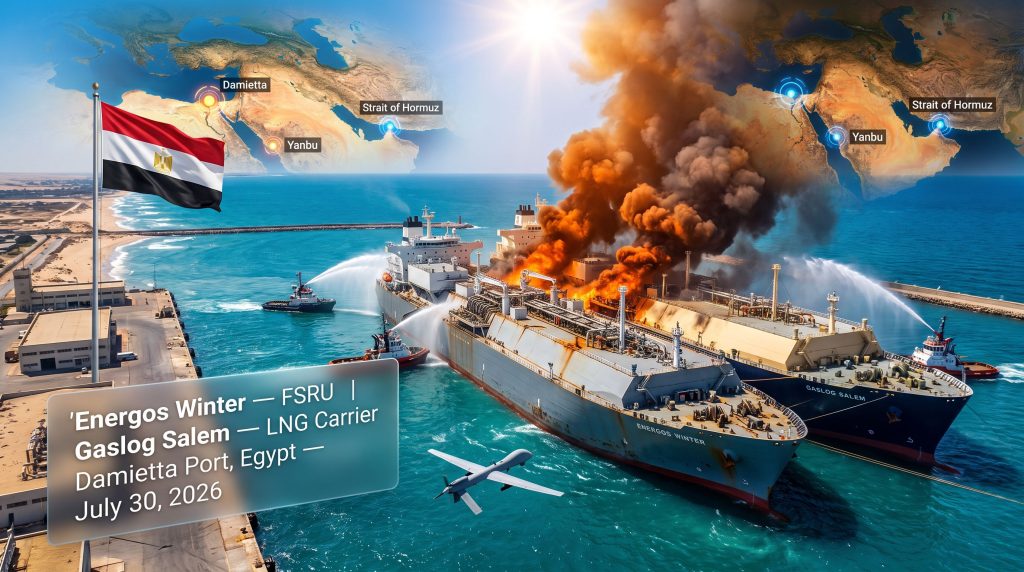
The drone attack on ships at Egypt's Damietta port on July 30, 2026, illustrates this shift with striking clarity. Two gas vessels berthed at the Damietta LNG terminal on Egypt's Mediterranean coast were struck in what Egyptian authorities confirmed was a drone attack following a cabinet-level preliminary investigation. The incident did not merely damage two ships. It exposed a structural weakness in the architecture of Mediterranean energy supply at one of its most critical nodes.
When big ASX news breaks, our subscribers know first
What Unfolded at Damietta on July 30, 2026
The two vessels caught up in the attack were the Energos Winter, a U.S.-owned floating storage and regasification unit (FSRU), and the Gaslog Salem, an LNG carrier that caught fire after the initial strike. Fires broke out aboard both vessels before emergency response teams, operating under Egypt's approved rapid response protocols, brought the blazes under control. Crews were evacuated safely, and no fatalities or injuries have been reported.
Both vessels were subsequently moved away from the berth area to allow damage assessment to proceed. Egypt's Ministry of Petroleum and Mineral Resources confirmed the fires, while Egypt's cabinet concluded through a preliminary investigation that a drone was responsible. Footage of the incident was obtained by international wire services through the Damietta Port Authority.
What has not been established is attribution. No group, state, or non-state actor has claimed responsibility for the attack as of the time of writing.
The absence of a claimed responsibility is analytically significant in its own right. It may indicate a state-level actor prioritising deniability, or a non-state group calculating that attribution would trigger a disproportionate response.
Understanding FSRUs: Why the Energos Winter Was Such a High-Value Target
To appreciate the strategic weight of this attack, it helps to understand what a Floating Storage and Regasification Unit actually does and why it occupies such an outsized role in modern gas supply chains.
An FSRU is a specialised vessel that performs two functions simultaneously: it stores liquefied natural gas in cryogenic tanks and converts that LNG back into gaseous form for injection into onshore pipeline networks. This process, known as regasification, is the final step before LNG can be used by power stations, industrial consumers, or residential networks.
FSRUs became commercially dominant over the past two decades for several reasons:
- They can be deployed in six to twenty-four months, compared to the five to ten years typically required to build an equivalent onshore terminal
- Their capital cost is substantially lower, often 60 to 70 percent less than a land-based regasification facility of comparable throughput
- They can be relocated if geopolitical or commercial conditions change, offering a flexibility that fixed terminals cannot match
- They operate on a lease or charter model, allowing importing nations to access regasification capacity without full ownership commitment
This flexibility, however, creates a distinct vulnerability. Unlike a reinforced onshore terminal protected by layered physical security, an FSRU is a vessel moored in a port, accessible from the water, the air, and the shoreline. Anti-drone defence systems designed for military installations are rarely deployed around commercial maritime energy infrastructure.
| Vessel | Type | Ownership | Function at Damietta |
|---|---|---|---|
| Energos Winter | FSRU | U.S.-owned | LNG storage and regasification for onshore distribution |
| Gaslog Salem | LNG Carrier | Gaslog Ltd. | LNG transport and short-term floating storage |
Damietta's Role in Egypt's Energy Architecture and Mediterranean Gas Flows
Egypt operates two primary LNG terminals on its Mediterranean coast: Damietta and Idku. Together, these facilities have historically served a dual purpose, supporting both domestic gas consumption and Egypt's ambitions as a regional LNG re-export hub connecting East Mediterranean producers to European buyers. Understanding the broader LNG supply outlook helps contextualise how critical this infrastructure has become.
Egypt's geographic position is genuinely strategic. It sits at the intersection of East Mediterranean gas fields operated by Israeli and Cypriot producers and the European import terminals desperately seeking non-Russian supply since 2022. The Eastern Mediterranean Gas Forum, of which Egypt is a founding member, reflects this transit role at an institutional level.
The Damietta FSRU is not a peripheral asset in this system. It is a core piece of import infrastructure that directly affects Egypt's ability to balance domestic gas demand during periods when its own field production falls short. Egypt has faced recurring domestic energy shortfalls in recent years, making import regasification capacity doubly critical.
Furthermore, any sustained outage at Damietta would create compounding pressure:
- Domestic supply shortfalls in Egypt's power generation and industrial sectors
- Reduced re-export capacity affecting European buyers counting on Egyptian LNG flows
- Increased procurement costs as Egypt would need to source alternative regasification solutions or redirect volumes through Idku
- Market signal effects across the broader Mediterranean gas trading complex
The Regional Escalation Architecture Surrounding the Damietta Strike
The drone attack on ships at Egypt's Damietta port did not occur in a vacuum. It landed in the middle of one of the most concentrated weeks of energy infrastructure targeting the Middle East has seen in years. Consequently, the geopolitical risk landscape across the broader region has shifted considerably.
In the days surrounding the Damietta incident, the following events were confirmed:
| Attack Vector | Target | Responsible Actor | Status |
|---|---|---|---|
| Drone strike on LNG vessels | Damietta port, Egypt | Unclaimed | Confirmed by Egyptian cabinet investigation |
| Pipeline sabotage | Yanbu crude pipeline, Saudi Arabia | Houthis (self-claimed) | Claimed Monday, July 28, 2026 |
| Drone strikes on oil infrastructure | Riyadh and Eastern Province, Saudi Arabia | Iran-aligned Iraqi militias | Confirmed this week |
| Attempted missile attack | U.S. forces, Middle East | IRGC | Triggered U.S. retaliatory strikes |
| Joint airstrikes | Iraqi militia positions | U.S. and Saudi Arabia | Conducted Tuesday, July 29, 2026 |
The Houthi forces in Yemen claimed earlier in the week that they targeted the pipeline infrastructure used to move Saudi crude to the Red Sea port of Yanbu. That pipeline has carried growing strategic importance as Iran's ongoing disruption of tanker traffic through the Strait of Hormuz has forced Saudi Arabia to reroute oil export volumes overland to the Red Sea. The Houthis also declared a maritime embargo against Saudi Arabia in the days preceding the Damietta strike, adding a naval dimension to the pressure campaign.
Iran-aligned militia groups operating out of Iraq launched separate drone strikes against oil infrastructure in Saudi Arabia's Riyadh and Eastern Province regions. The United States and Saudi Arabia responded with joint airstrikes against those militia positions on Tuesday. On Wednesday, the United States launched a renewed wave of strikes against Iran itself, in response to what U.S. officials characterised as an attempted surprise missile attack by the Islamic Revolutionary Guard Corps against American forces in the region.
The convergence of Houthi maritime embargoes, IRGC offensive operations, Iraqi militia drone campaigns, and the unclaimed Damietta strike within a single week points toward either coordinated escalation or a pattern of opportunistic sequencing, in which each actor reads the regional environment as permissive for infrastructure targeting.
Pressure on the Strait of Hormuz and the Yanbu Multiplier
A critical and often underappreciated dimension of this escalation cycle is the compounding effect of simultaneous disruptions across multiple chokepoints and routing alternatives.
Iran's strategy of harassing tanker traffic through the Strait of Hormuz, which carries approximately 20 percent of global oil trade, has already forced significant rerouting of Saudi crude exports. The East-West Pipeline through Saudi Arabia, which terminates at the Red Sea port of Yanbu, became a primary alternative routing mechanism precisely because it bypasses the Strait entirely.
The Houthi strike on Yanbu pipeline infrastructure directly targets this bypass. If the Yanbu route is degraded simultaneously with Hormuz disruptions, Saudi Arabia's oil export options narrow significantly. This is not an accidental coincidence in targeting logic. It represents a sophisticated understanding of interdependent infrastructure vulnerabilities and mirrors the kind of oil price disruption risks that markets have been stress-testing for some time.
Layering the Damietta FSRU disruption onto this picture creates a Mediterranean pressure point that compounds the Red Sea and Gulf chokepoint pressures. European buyers who have spent three years diversifying away from Russian pipeline gas toward LNG, including Egyptian re-exports, now face supply-side uncertainty from a direction they had considered relatively stable. The knock-on effects are already visible across global oil futures markets.
The next major ASX story will hit our subscribers first
What Remains Unknown and Why It Matters
The analytical picture surrounding the drone attack on ships at Egypt's Damietta port is incomplete in ways that have genuine policy and market consequences.
What has been confirmed:
- A drone was the confirmed cause, per Egypt's cabinet preliminary investigation
- Both the Energos Winter and the Gaslog Salem were affected
- Fires were extinguished and no casualties were recorded
- Both vessels were moved from the port berth area
What remains unestablished:
- No group or government has claimed responsibility
- The type of drone, its launch platform, and its point of geographic origin are not publicly known
- Full structural damage assessment for both vessels has not been completed or publicly reported
- No restoration timeline has been provided for either vessel's return to operational status
The drone type question carries particular analytical weight. Long-range one-way attack drones capable of striking coastal port facilities can be launched from distances of several hundred kilometres, making attribution through flight path analysis alone extremely difficult without radar data that is rarely disclosed publicly. The distinction between a maritime-launched drone and a land-based launch is also relevant to determining which actor possesses both the capability and the geographic access to execute such a strike against an Egyptian Mediterranean port.
The Tactical Evolution of Drone Strikes Against Floating Energy Assets
The Damietta incident represents more than a regional escalation milestone. It signals a tactical evolution in how asymmetric actors approach energy warfare that will have lasting implications for infrastructure security investment worldwide. Indeed, the global trade war impacts already straining supply chains make this kind of physical disruption all the more consequential.
Fixed onshore terminals have long been integrated into national security frameworks with physical perimeter protections, surveillance systems, and, in some cases, active defence installations. Floating infrastructure has historically received less hardening attention, partly because its mobility was considered a protective attribute and partly because the economics of commercial port operations resist the layering of military-grade security measures.
The use of drones to bridge that gap is not a new idea theoretically, but the demonstrated willingness to execute such strikes against a major Mediterranean LNG terminal raises the stakes considerably for terminal operators, FSRU lessors, vessel insurers, and national energy security planners globally. Reports from regional analysts suggest war risk insurance premiums for vessels operating in the Eastern Mediterranean were already under review following earlier Houthi activity in the Red Sea, and the Damietta attack introduces a fresh set of actuarial considerations for Mediterranean-specific coverage.
Energy security planners and port authorities across the Mediterranean and Persian Gulf will likely accelerate evaluation of counter-drone systems designed specifically for maritime and port environments, a market segment that has seen growing commercial activity but remains far from standard deployment across civilian LNG infrastructure.
Frequently Asked Questions: Drone Attack on Ships at Egypt's Damietta Port
What ships were hit in the Damietta drone attack?
The two vessels affected were the Energos Winter, a U.S.-owned floating storage and regasification unit, and the Gaslog Salem, an LNG carrier. Both vessels caught fire following the drone strike on July 30, 2026.
Who is responsible for the Damietta port drone attack?
As of the latest available reporting, no group or government has claimed responsibility. Egypt's cabinet confirmed through a preliminary investigation that a drone caused the fires aboard both vessels.
Was anyone killed or injured in the Damietta attack?
No fatalities or injuries have been reported. Crews were evacuated from both vessels and the fires were extinguished by port emergency response teams operating under Egypt's approved rapid response protocols.
What is Damietta's role in Egypt's energy system?
Damietta is one of Egypt's two primary LNG terminals on the Mediterranean coast. It performs regasification operations critical to Egypt's domestic gas supply balance and supports Egypt's broader role as a gas transit and re-export hub connecting East Mediterranean producers with European import markets.
What is an FSRU and why is it a target?
A Floating Storage and Regasification Unit stores liquefied natural gas and converts it back into pipeline-ready natural gas for onshore distribution. FSRUs are critical infrastructure nodes deployed in coastal port environments, where their exposure to drone and missile attack is substantially greater than hardened onshore terminals.
How does the Damietta attack fit into the broader regional conflict?
The strike occurred during a week of escalating attacks on energy infrastructure involving Houthi forces targeting Saudi pipeline infrastructure, Iran-aligned Iraqi militias striking Saudi oil facilities, an attempted IRGC missile attack on U.S. forces, and subsequent American and Saudi retaliatory strikes.
Disclaimer: This article contains forward-looking analysis and scenario assessments based on information available at the time of writing. The regional situation described is actively developing, and readers should consult current reporting for the latest confirmed information. Nothing in this article constitutes financial, investment, or security advice.
Want to Stay Ahead of ASX Mineral Discoveries Amid Rising Geopolitical Risk?
As energy infrastructure disruptions reshape commodity markets and supply chains, identifying significant ASX mineral discoveries before the broader market becomes increasingly valuable — Discovery Alert's proprietary Discovery IQ model delivers real-time alerts on major discoveries directly to subscribers, turning complex market signals into actionable investment opportunities. Begin your 14-day free trial at Discovery Alert today and position yourself ahead of the market.