July 30, 2026
Brazil's Mineral Sector and the Four Pillars of AI-Driven Operations
Few industrial environments on earth test the limits of digital technology quite like a large-scale open-pit mine. The combination of extreme physical conditions, distributed infrastructure, safety-critical decisions made under time pressure, and the compounding financial consequences of unplanned downtime creates a proving ground unlike any other. Understanding how artificial intelligence in the mineral sector in Brazil functions within this environment requires moving beyond headlines and examining the operational architecture that makes AI adoption genuinely transformative rather than merely cosmetic.
Brazil's standing as a top-five global producer of iron ore, lithium, nickel, copper, and rare earth elements is not simply a matter of geological fortune. It reflects decades of infrastructure investment spanning deep-processing facilities, integrated rail and port networks, and exploration programs reaching into some of the most logistically challenging terrain on earth. This combination of scale, complexity, and strategic mineral importance creates exactly the conditions where AI delivers outsized returns relative to simpler industrial deployments.
When big ASX news breaks, our subscribers know first
What Does AI Actually Do Across a Mining Value Chain?
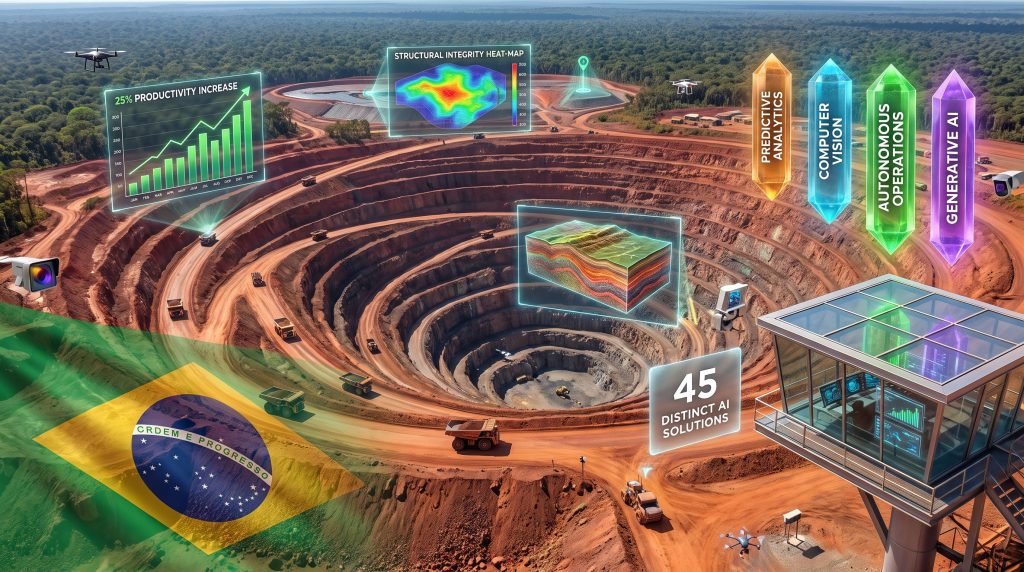
Before evaluating deployment maturity or regional benchmarks, it is worth establishing a clear functional taxonomy. Mining AI is not a monolithic technology. It encompasses four distinct capability pillars, each addressing different operational problems with different technical architectures.
| AI Capability Pillar | Core Function | Primary Operational Benefit |
|---|---|---|
| Predictive Analytics | Equipment health monitoring, failure forecasting | Reduced unplanned downtime, lower maintenance costs |
| Computer Vision | Camera, radar, and sensor-based anomaly detection | Improved safety, structural monitoring, intrusion detection |
| Autonomous and Remote Operations | AI-guided haulage, dispatch, and equipment management | Safer operations in high-risk zones, labour efficiency |
| Generative AI and Technical Intelligence | Document analysis, compliance validation, reporting | Faster decision cycles, reduced manual workload |
The relevance of each pillar shifts depending on the operational context. For Brazil specifically, the country's unique regulatory and physical environment amplifies the value of structural monitoring AI beyond what peer mining nations typically prioritise. The dam failures at Mariana in 2015 and Brumadinho in 2019 created not just regulatory imperatives but a social licence dimension that has elevated AI-assisted structural integrity monitoring to a strategic necessity rather than an efficiency preference.
Processing Plants: Where AI Delivers Measurable Productivity Gains
The mineral processing plant represents one of the most data-rich environments in any mining operation, and consequently one of the most fertile grounds for AI-driven optimisation. Machine learning models applied to flotation circuits, grinding mill operations, and real-time grade control systems enable continuous parameter adjustments that were previously impossible at the speed and precision that plant economics demand.
Documented cases from Brazilian processing operations have reported productivity improvements of approximately 25% following AI-driven modernisation programs, alongside improved mineral recovery rates and meaningful reductions in manual intervention requirements. The transition from periodic batch-processing analytics to continuous AI inference at the plant level represents a fundamental architectural shift, not an incremental improvement.
Several factors make this particularly relevant to Brazil's iron ore operations, which account for a substantial share of global seaborne supply. Even marginal improvements in recovery rates across Brazil's high-volume processing infrastructure translate into significant additional revenue. Furthermore, AI mining efficiency tools that manage the complex interplay between ore variability, grinding energy consumption, and downstream metallurgical performance are now being actively exploited by major operators.
Integrated Operations Centres: Centralised Intelligence Across Distributed Assets
Beyond individual plant optimisation, major Brazilian mining companies have invested heavily in centralised command infrastructure where AI aggregates simultaneous data streams from multiple mine sites, processing facilities, rail networks, and port terminals. This architectural approach, sometimes called an integrated operations centre model, shifts decision-making authority from individual site supervisors toward centralised analytical teams supported by AI-generated recommendations.
AI-powered dispatch systems within these environments analyse equipment positioning, load cycle data, fuel consumption patterns, and real-time road conditions to dynamically optimise fleet movements across entire operations. The economic value of this optimisation compounds quickly when applied across fleets of hundreds of vehicles operating continuously across mine networks spanning hundreds of square kilometres.
Safety, Surveillance, and Structural Monitoring Systems
Brazil's post-disaster regulatory environment has generated AI investment priorities that differ meaningfully from those observed in peer mining nations. Multi-sensor architectures combining thermal cameras, radar arrays, LiDAR scanning, and video analytics are being deployed not primarily for efficiency gains but for structural deformation detection in tailings storage facilities and dam walls.
Key Industry Insight: Unlike Australia or Canada, where AI safety applications focus predominantly on equipment collision avoidance and worker proximity, Brazil's unique regulatory context has created a distinct category of structural integrity AI that is generating exportable expertise relevant to any jurisdiction managing ageing tailings infrastructure.
Real-time anomaly detection systems can flag millimetre-scale structural changes in embankment geometry before those changes become visible to site inspectors. Worker safety systems monitor personnel proximity to heavy equipment, fatigue indicators through behavioural pattern recognition, and PPE compliance through computer vision. In addition, AI in drilling and blasting applications reduce personnel exposure in blast-risk zones through remote-controlled operations guided by AI-assisted geological models.
Autonomous Haulage and Fleet Intelligence
Brazil has active deployments of autonomous haulage systems operating in open-pit environments, where AI manages vehicle routing, collision avoidance, and load optimisation without continuous human intervention. The coordination of mixed fleets — autonomous vehicles operating alongside human-operated equipment — represents a technically complex integration challenge that Brazilian operators are actively solving in production environments.
Key capabilities within these systems include:
- Dynamic route optimisation that responds to real-time road condition data
- Load sensing and cycle time monitoring that identifies inefficiencies across the entire haul fleet
- Predictive tyre wear modelling that schedules maintenance before failures occur
- Energy consumption optimisation that reduces fuel costs per tonne moved
The labour efficiency implications are significant, particularly in remote operations where accommodation and logistics costs for large workforces represent a substantial operating cost component.
Exploration Intelligence and Geological Modelling
The application of AI to mineral exploration represents one of the less publicised but potentially most economically significant use cases in the sector. Machine learning algorithms applied to historical drillhole databases, geophysical survey data, and geochemical sampling records can identify mineralisation patterns across multidimensional datasets that would require months of manual geological interpretation.
Integration of satellite imagery, drone-collected hyperspectral data, and ground-penetrating sensor arrays with AI interpretation layers is compressing the timeline from exploration concept to resource definition. For instance, AI in mineral exploration directly affects project financing timelines by enabling faster resource characterisation, which means earlier feasibility milestones and improved timing of capital access.
This dynamic is particularly relevant for Brazil's critical minerals pipeline. Lithium projects in Minas Gerais, rare earth element deposits in the Amazon basin, and nickel occurrences in mafic and ultramafic complexes are all subjects of intensifying exploration activity where AI-assisted targeting is accelerating the identification of economically meaningful mineralisation.
Moreover, 3D geological modelling tools are increasingly being paired with AI interpretation to deliver more accurate subsurface representations, helping project teams and stakeholders make faster, better-informed decisions.
Speculative Perspective: Some geological practitioners argue that AI-driven exploration targeting, when trained on incomplete or historically biased drillhole databases, can systematically replicate the blind spots of past exploration rather than identifying genuinely novel targets. This limitation is not widely acknowledged in technology marketing but represents a real methodological risk that geologists working with AI tools need to actively manage.
The next major ASX story will hit our subscribers first
Critical Minerals: The Next AI Frontier in Brazil
Greenfield critical mineral projects — particularly those targeting lithium, heavy rare earth elements, and battery-grade nickel — occupy a structurally different position in the AI adoption landscape compared to established iron ore operations. The absence of legacy operational technology infrastructure means these projects can integrate AI-native workflows from the design phase rather than retrofitting modern systems onto decades-old process architectures.
Rare earth element separation deserves specific attention. The hydrometallurgical processes used to separate individual rare earth elements from mixed concentrates are notoriously complex, requiring precise control of pH, temperature, reagent addition rates, and solvent extraction chemistry across multiple processing stages. AI optimisation of these circuits carries direct implications for both recovery rates and reagent consumption costs.
The global investor community's focus on ESG performance and supply chain traceability is also creating demand for AI-enabled provenance verification systems. This is particularly relevant given the rising critical minerals demand driven by the global energy transition, with Brazilian projects targeting European and North American offtake markets where battery mineral supply chain due diligence requirements are tightening.
Brazil's Domestic AI Ecosystem for Mining
One of the less commonly recognised dimensions of artificial intelligence in the mineral sector in Brazil is the emergence of a domestic technology development ecosystem. Major Brazilian mining companies have established dedicated AI research centres capable of developing, testing, and scaling proprietary solutions rather than relying entirely on international technology vendors.
These internal centres have generated portfolios reported to exceed 45 distinct AI solutions deployed across mining operations, logistics networks, port facilities, railway systems, and exploration functions within single corporate value chains. The financial impact documented across these programmes reflects significant operational savings, though precise figures vary considerably by application and site conditions.
Simultaneously, domestic technology firms are developing purpose-built AI products tailored specifically to Brazil's operational and regulatory mining context. Academic institutions supported by Brazilian science funding bodies including FAPESP are actively advancing research into digital mining applications, creating a feedback loop between university innovation and industrial deployment that is accelerating the pace of adoption across the sector.
Structural Barriers That Limit Adoption Speed
A realistic assessment of artificial intelligence in the mineral sector in Brazil must acknowledge the structural constraints that slow deployment timelines:
- Connectivity gaps: Remote operations in the Amazon basin and Cerrado regions face telecommunications infrastructure limitations that constrain real-time data transmission and cloud-based AI processing
- Legacy OT integration: Operational technology environments in older facilities were not designed for data interoperability, creating significant complexity when deploying modern AI systems
- Data quality: Inconsistent data standardisation across multiple mine sites, equipment generations, and historical databases remains a foundational challenge before reliable AI model performance is achievable
- Workforce transition: Reskilling requirements across technical, operational, and management functions represent investment demands comparable to the technology deployment costs themselves
- Regulatory evolution: AI-generated data used in environmental monitoring and compliance reporting must meet evidentiary standards that Brazilian regulatory bodies are still in the process of defining
How Brazil Compares: A Regional and Global Benchmark
| Dimension | Brazil | Chile | Australia | Canada |
|---|---|---|---|---|
| Autonomous Haulage Deployment | Active, growing | Mature | Most advanced globally | Advanced |
| AI Safety and Structural Monitoring | Highest priority tier | Moderate | High | Moderate-High |
| Domestic AI Ecosystem | Emerging but substantive | Early stage | Mature | Mature |
| Critical Minerals AI Integration | Early adopter phase | Growing | Advanced | Growing |
| Research and Academic Support | Strong (FAPESP, universities) | Moderate | Strong | Strong |
Brazil's distinctive prioritisation of structural monitoring AI, driven by its post-disaster regulatory environment, represents a genuinely differentiated capability relative to peer nations. Where Australia leads in autonomous haulage maturity and Canada has sophisticated predictive maintenance ecosystems, Brazil is generating global expertise in a category of safety AI that will become increasingly relevant as ageing tailings infrastructure becomes a sector-wide challenge across multiple mining jurisdictions.
The Outlook Through 2030
The convergence of falling AI infrastructure costs, improving remote connectivity through satellite broadband expansion, and growing domestic technical capability points toward an accelerating adoption curve through the late 2020s. Critical minerals projects entering construction and commissioning phases between 2025 and 2030 are positioned to become the most AI-integrated operations in Brazilian mining history.
Generative AI applications for technical documentation workflows — including exploration reporting, environmental impact assessment compilation, and regulatory submission preparation — are expected to transition from experimental to standard practice within major Brazilian mining companies within the next three to five years. This shift has practical implications for the speed at which projects can navigate Brazil's complex environmental licensing regime, though the evidentiary acceptability of AI-generated compliance documentation will depend on regulatory guidance that has not yet been finalised.
Disclaimer: This article contains forward-looking statements and analytical projections based on publicly available information and industry research. These projections involve inherent uncertainty and should not be construed as investment advice. Readers should conduct independent due diligence before making investment decisions related to any companies or projects discussed.
Want to Invest in the Mineral Discoveries Driving the Next Wave of Critical Minerals Demand?
Discovery Alert's proprietary Discovery IQ model delivers real-time alerts on significant ASX mineral discoveries — instantly translating complex geological data into actionable investment opportunities for both short-term traders and long-term investors. Explore why major mineral discoveries have historically generated substantial returns on Discovery Alert's dedicated discoveries page, and begin your 14-day free trial today to position yourself ahead of the broader market.