
July 30, 2026
The Quiet Revolution in Mining Procurement: How Capability Beats Symbolism
For decades, the relationship between Australian mining companies and Traditional Owner communities was largely defined by negotiated benefit-sharing arrangements, royalty flows, and community investment funds. These mechanisms, while meaningful, kept Indigenous communities at arm's length from the actual commercial machinery of resource extraction. The transition now underway across parts of the Australian mining sector tells a fundamentally different story, one where Traditional Owner businesses are moving from passive beneficiaries to active operational participants embedded directly within major supply chains.
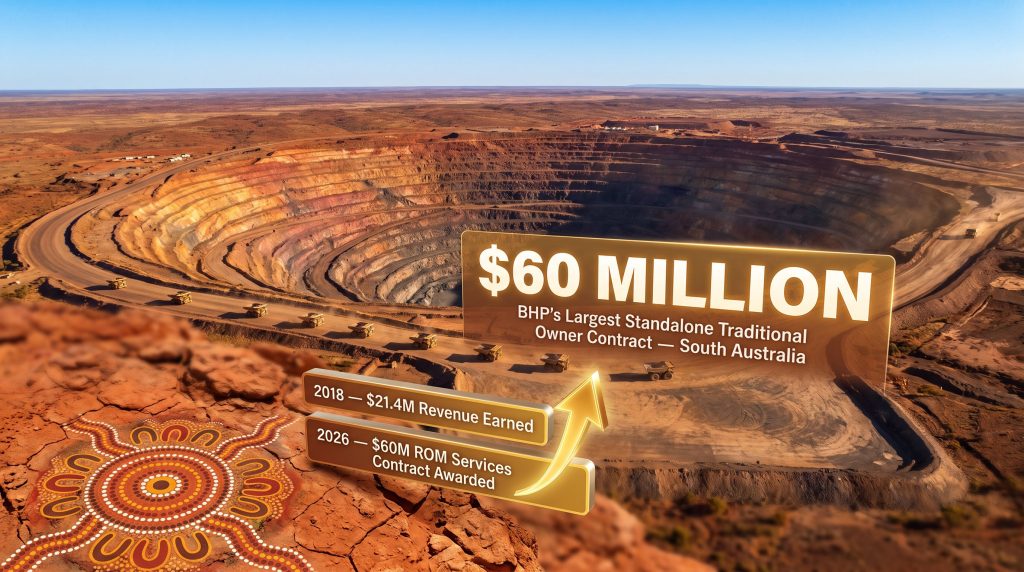
The BHP Traditional Owner partnership at Prominent Hill is among the most concrete expressions of this shift to date. Valued at $60 million over five years, the run-of-mine services contract awarded to AMY Nominees represents not just a procurement decision, but the output of a carefully constructed, multi-year commercial development pathway that has broader implications for how the mining industry structures Indigenous engagement going forward.
When big ASX news breaks, our subscribers know first
Understanding Prominent Hill and Its Significance Within BHP's Portfolio
Prominent Hill is a copper-gold mine located in the far north of South Australia, approximately 650 kilometres north-northwest of Adelaide. The underground mine is a significant asset within BHP's Australian operations, producing copper concentrate alongside meaningful gold and silver credits. BHP acquired Prominent Hill as part of its 2023 acquisition of OZ Minerals, a transaction valued at approximately $9.6 billion, which also brought the Carrapateena copper-gold mine into BHP's portfolio.
The mine operates in the Gawler Craton, a geological province recognised for hosting large iron oxide copper-gold (IOCG) deposits. Furthermore, our IOCG deposits guide explains how these systems like Prominent Hill are characterised by their structural complexity and depth, requiring sophisticated underground mining techniques. The ore body at Prominent Hill extends to considerable depth and has supported continuous operations since 2009, with mine life extensions underpinned by ongoing resource definition drilling.
From a procurement standpoint, Prominent Hill's remote location and the scale of its underground operations create a substantial service contract opportunity, and it is within this context that the AMY Nominees partnership carries its greatest significance.
Who Are the Antakirinja Matu-Yankunytjatjara People and What Is AMY Nominees?
The Antakirinja Matu-Yankunytjatjara people are the Traditional Custodians of a vast area of the South Australian outback that encompasses the Prominent Hill mine site. Their connection to this country is ancient and ongoing, and their engagement with the resources sector has evolved considerably over recent decades as native title recognition has expanded across Australia's critical minerals landscape.
The Antakirinja Matu-Yankunytjatjara Aboriginal Corporation, known as AMYAC, is the representative body for this community. AMY Nominees functions as the commercial vehicle through which AMYAC participates in the resources economy, enabling the community to pursue direct operational and procurement opportunities rather than relying exclusively on passive financial flows.
This distinction is important. Unlike royalty arrangements, which channel payments through administrative structures with limited community control over timing or deployment, a commercial contracting entity like AMY Nominees generates revenue through performance, builds organisational capability over time, and creates employment outcomes that are directly connected to operational activity at the mine site.
From Labour Hire to ROM Services: The Eight-Year Journey
The $60 million contract did not emerge from a single negotiation. It is the product of more than eight years of structured commercial relationship-building, beginning in 2018 when AMY Nominees first began providing labour, cleaning, and plant hire services at Prominent Hill under what were then relatively modest commercial arrangements.
When BHP completed its acquisition of OZ Minerals and assumed operational ownership of Prominent Hill in 2023, it inherited not only the physical asset but also the existing relationship with the Antakirinja Matu-Yankunytjatjara community. Crucially, BHP chose to deepen that relationship rather than reset it, recognising the accumulated trust and capability that had been built over the preceding years.
The period between 2023 and 2026 was defined by a structured initiative known as Project Pulkaringanyi, a Yankunytjatjara word with cultural significance to the community. This programme brought together BHP, AMY Nominees, and major mining contractor Thiess to systematically build the operational capabilities required for AMY Nominees to transition into a larger and more technically complex service delivery role.
The revenue trajectory tells its own story:
| Phase | Timeframe | Revenue | Services |
|---|---|---|---|
| Early-stage commercial arrangements | 2018 to 2026 | $21.4 million | Labour, cleaning, plant hire |
| ROM services contract (projected) | 2026 to 2031 | $60 million | Run-of-mine operations |
| Combined estimated total | 2018 to 2031 | ~$81.4 million | Diversified mining services |
This progression from $21.4 million across early-stage services to a $60 million contracted engagement reflects a compounding of capability, trust, and commercial readiness that few Indigenous enterprises in the Australian resources sector have achieved at this scale.
What Run-of-Mine Services Actually Involve
Understanding why ROM services represent a strategically significant contract type for an emerging Indigenous business requires some technical grounding. Run-of-mine operations refer to the handling, management, and processing of ore as it comes directly from the mining face, before it undergoes concentration or further treatment.
In an underground mine like Prominent Hill, ROM services typically encompass:
- Management and movement of ore from the underground workings to surface stockpiles
- Loading, hauling, and tipping functions at the ROM pad
- Stockpile management and feed control to the processing plant
- Equipment operation including loaders, haul trucks, and ancillary machinery
- Data recording and compliance with operational schedules tied to plant feed requirements
These activities sit at the operational heart of any underground mine. Getting ROM services right directly affects mill throughput, processing efficiency, and ultimately, metal recovery and revenue generation. Awarding this contract to AMY Nominees signals a level of confidence in the company's operational maturity that goes well beyond symbolic participation.
The workforce implications are also substantial. ROM operations at a mine the size of Prominent Hill require a trained, reliable, and safety-conscious workforce operating on a continuous roster. This creates durable employment outcomes for community members with transferable skills that extend across the broader mining services sector.
Project Pulkaringanyi: A Replicable Framework for Indigenous Business Development
The structured capability-building initiative at the core of this partnership deserves particular attention because it represents a model that diverges sharply from how Indigenous engagement has historically been managed in Australian mining.
Conventional approaches often involved either passive benefit-sharing (royalties and community funds) or small-scale, low-complexity subcontracts that offered limited pathway to larger opportunities. Project Pulkaringanyi was designed around a different premise: that with deliberate investment in skills, systems, and mentored operational experience, an Indigenous business could be brought to a point of genuine readiness for major contract delivery.
Thiess, as one of Australia's largest mining contractors with deep expertise in open cut and underground mining services, played a central enabling role in this process. The knowledge transfer facilitated through this arrangement gave AMY Nominees access to operational methodologies, safety management systems, and workforce development practices that would otherwise have required many additional years to develop independently.
This phased approach to Indigenous business development, where an anchor contractor provides structured mentorship alongside a patient and committed mine operator, created the conditions that made a $60 million outcome commercially viable for all parties involved.
The question for the broader industry is whether this model can be systematically replicated, and what conditions are required to make it work. Key enabling factors appear to include:
- A long-term horizon from the mining company, with genuine commitment to the development pathway rather than tick-box procurement
- An established contractor willing to invest in knowledge transfer as a commercial priority rather than a philanthropic gesture
- A well-governed Indigenous corporation with the legal and financial infrastructure to manage commercial contracts
- Incremental scope expansion that matches capability growth, avoiding the risk of overextension
- Cultural safety mechanisms that allow community members to participate in the workforce on terms that respect their obligations and values
The next major ASX story will hit our subscribers first
Benchmarking the BHP-AMY Nominees Deal Against the Broader Sector
To appreciate the scale of this achievement, it helps to contextualise the BHP Traditional Owner partnership at Prominent Hill within the broader landscape of Indigenous procurement in Australian mining. In addition, the broader trend of mining industry consolidation has created larger operational footprints that, in turn, generate greater opportunity for Traditional Owner businesses to access significant contract scopes.
| Mining Company | Traditional Owner Partner | Contract Scope | Jurisdiction |
|---|---|---|---|
| BHP | AMY Nominees (AMYAC) | ROM services, $60M over 5 years | South Australia |
| Rio Tinto | Various Pilbara groups | Infrastructure, services, various values | Western Australia |
| BHP | Various WA-based groups | Maintenance, logistics, various values | Western Australia |
This table reflects publicly available information and is indicative only. Contract values for comparative entries are not uniformly disclosed.
What distinguishes the Prominent Hill arrangement is its designation as BHP's largest standalone Traditional Owner contract in South Australia, combined with the documented multi-year capability development pathway that preceded it. Many Indigenous contracting arrangements in the sector remain at a smaller scale or involve joint ventures with established operators as the primary delivery entity, rather than the Indigenous business itself holding the prime contract.
The ESG Dimension: Why Institutional Investors Are Watching
The commercial significance of this partnership extends into the ESG reporting and investor relations domain. Institutional investors, particularly those operating under sustainability mandates, are applying increasing scrutiny to how mining companies demonstrate substantive Indigenous engagement as distinct from performative compliance.
Metrics that are gaining traction in ESG frameworks relevant to the Australian resources sector include:
- Total value of contracts awarded to Indigenous-owned businesses as a percentage of total procurement spend
- Number of Indigenous employees in operational (as opposed to administrative) roles
- Evidence of structured capability development programmes with measurable progression milestones
- Governance quality of the Indigenous corporation receiving commercial benefits
The Prominent Hill partnership scores strongly across several of these dimensions. The $60 million contract value, the documented eight-year development trajectory, and the operational nature of the ROM services scope all represent the kind of substantive, verifiable engagement that ESG analysts and sustainability-focused investors are increasingly requiring before allocating capital to major mining companies.
As institutional capital continues to flow toward companies with credible Indigenous engagement track records, deals like the BHP-AMY Nominees partnership are likely to become both a competitive differentiator and a practical prerequisite for social licence maintenance in jurisdictions with strong native title presence.
Native Title, the AMYAC Structure, and the Legal Architecture of Commercial Participation
The legal framework underpinning this partnership is worth understanding for those unfamiliar with how Traditional Owner communities structure their commercial interests. The Native Title Act 1993 (Cth) provides the legislative foundation for recognising the rights and interests of Aboriginal and Torres Strait Islander peoples in land and waters across Australia.
In practical terms, the Antakirinja Matu-Yankunytjatjara Aboriginal Corporation operates as a Registered Native Title Body Corporate, giving AMYAC the legal standing to negotiate agreements with resource companies operating on country. AMY Nominees is the separate commercial entity established to pursue business opportunities that arise from, and beyond, these agreements.
This two-entity structure, with the Aboriginal Corporation managing rights and cultural obligations while the commercial vehicle manages procurement and service delivery, is increasingly recognised as an effective governance model. It separates the fiduciary responsibilities associated with native title management from the commercial risks and liabilities associated with operating as a contractor in a complex industrial environment.
What the Future Holds for Traditional Owner Businesses in Australian Mining
The Prominent Hill example raises a compelling question about the ceiling for Traditional Owner business participation in the Australian resources sector. If an eight-year investment in capability development can produce a $60 million ROM services contract, what does the next decade of investment enable? For context, similar dynamics are already emerging in other resource-rich regions, such as the development of a major copper system where stakeholder engagement models are evolving rapidly.
Several dynamics suggest the conditions for scaling this model are strengthening:
- Regulatory trajectory: South Australia and other jurisdictions are progressively raising expectations around Indigenous procurement as part of mining approval conditions and operational compliance frameworks, though specific project-level mandates vary considerably
- Corporate strategy alignment: Major miners are integrating Indigenous procurement targets into their public sustainability commitments, creating internal incentives for procurement teams to identify and develop capable Traditional Owner suppliers
- Capital access: Emerging financial instruments, including Indigenous business funds and blended finance structures, are beginning to address the historical barrier of capital access that has limited the growth of Aboriginal enterprises in capital-intensive industries
- Precedent effect: Documented success stories like AMY Nominees provide a commercial proof of concept that other Traditional Owner corporations can reference when negotiating with mining companies
The risk of overextension remains real. Indigenous businesses moving into larger and more technically complex contracts face genuine operational challenges, and the consequences of underperformance extend beyond financial loss to affect community cohesion and future negotiating credibility. The structured, incremental approach embodied in Project Pulkaringanyi appears to be a critical risk mitigation mechanism.
Frequently Asked Questions
What is the value of BHP's contract with AMY Nominees at Prominent Hill?
The contract is valued at $60 million over a five-year term, covering run-of-mine services at the Prominent Hill copper-gold mine in South Australia. It is identified as BHP's largest standalone Traditional Owner contract in South Australia.
Who are the Traditional Owners of the Prominent Hill mine site?
The Antakirinja Matu-Yankunytjatjara people are the Traditional Custodians of the country on which Prominent Hill operates. Their representative body, the Antakirinja Matu-Yankunytjatjara Aboriginal Corporation (AMYAC), holds native title rights over the area.
What services will AMY Nominees deliver under the new contract?
AMY Nominees will deliver run-of-mine services, which involve the operational management of ore from the underground mining face through to stockpile management and plant feed. These are core operational services within the mine's production cycle.
How long has BHP been working with the Antakirinja Matu-Yankunytjatjara community?
The commercial relationship between AMY Nominees and the Prominent Hill operations dates to 2018, when early-stage service arrangements began. BHP inherited and deepened this relationship following its acquisition of OZ Minerals and Prominent Hill in 2023.
What is Project Pulkaringanyi and what role did it play in the contract award?
Project Pulkaringanyi was a structured capability-building initiative involving BHP, AMY Nominees, and Thiess, operating between approximately 2023 and 2026. It was designed to systematically develop AMY Nominees' operational readiness for larger and more technically demanding mining service contracts, providing the foundation for the $60 million ROM services award in July 2026.
How does the cut-off grade economics affect contracts like this one?
Understanding cut-off grade economics matters here because the viability of mine operations — and consequently the scale and duration of service contracts — is fundamentally tied to economic ore thresholds. A mine that maintains strong cut-off grade discipline supports a longer and more stable operational life, which in turn underpins multi-year contracting arrangements like the one awarded to AMY Nominees.
How does this contract compare to other Indigenous procurement deals in Australian mining?
The contract represents one of the largest documented standalone Traditional Owner contracts in South Australia's mining sector. While Rio Tinto and BHP's Western Australian operations involve multiple Indigenous contracting arrangements, the combination of scale, operational scope, and the documented development pathway makes the BHP Traditional Owner partnership at Prominent Hill a notable benchmark.
When did BHP take ownership of Prominent Hill?
BHP completed its acquisition of OZ Minerals, including Prominent Hill, in 2023 as part of a transaction valued at approximately $9.6 billion.
Key Takeaways
- The $60 million ROM services contract is BHP's largest standalone Traditional Owner contract in South Australia, awarded to AMY Nominees in July 2026
- AMY Nominees generated $21.4 million in revenue through predecessor service arrangements between 2018 and 2026 before securing the major contract
- The partnership spans more than eight years of relationship development, with Project Pulkaringanyi providing a structured capability acceleration programme from 2023 onward
- BHP assumed ownership of Prominent Hill in 2023 following the acquisition of OZ Minerals, inheriting and committing to the existing Traditional Owner relationship
- The model demonstrates that phased commercial development, supported by an anchor contractor like Thiess and a patient long-term approach from the mine operator, can bridge the gap between early-stage Indigenous business participation and major contract delivery
- ESG-focused investors are increasingly treating substantive Indigenous procurement outcomes as a material factor in assessing the social licence and long-term risk profile of major mining companies
This article contains forward-looking observations and analysis regarding trends in Indigenous procurement, ESG metrics, and industry trajectory. These observations are based on publicly available information and should not be construed as financial advice. Readers should conduct independent research before making investment decisions.
For further coverage of procurement, Traditional Owner partnerships, and policy developments across the Australian resources sector, visit the Australian Mining Review at australianminingreview.com.au.
Want to Spot the Next Major ASX Mineral Discovery Before the Market Does?
Discovery Alert's proprietary Discovery IQ model delivers real-time alerts on significant ASX mineral discoveries — instantly transforming complex mineral data into actionable investment insights for both new and experienced investors. Explore historic discoveries and the returns they generated, then start your 14-day free trial today to position yourself ahead of the broader market.