July 29, 2026
When Geopolitics and Weather Collide: The Hidden Mechanics of LNG Price Volatility
Global LNG markets operate under a set of pricing dynamics that most energy consumers rarely encounter. Unlike pipeline gas, which moves through fixed infrastructure at regulated tariffs, LNG is a seaborne commodity subject to simultaneous pressures from weather events, geopolitical disruptions, contract structures, and maintenance cycles. When two or more of these forces converge within the same reporting window, the resulting output and revenue impacts can be dramatically amplified. That interplay sits at the heart of understanding why Woodside Q2 output falls as cyclone and maintenance hit LNG production represented one of the more complex operational quarters in the company's recent history.
When big ASX news breaks, our subscribers know first
Q2 2026 Production Snapshot: Parsing the Numbers
The April to June 2026 quarter produced a set of production figures that tell two distinct stories simultaneously. On the volume side, the results were unambiguously weak. On the pricing side, they reflected a global supply environment that partially compensated for the operational shortfall.
| Metric | Q2 2026 Result | Movement |
|---|---|---|
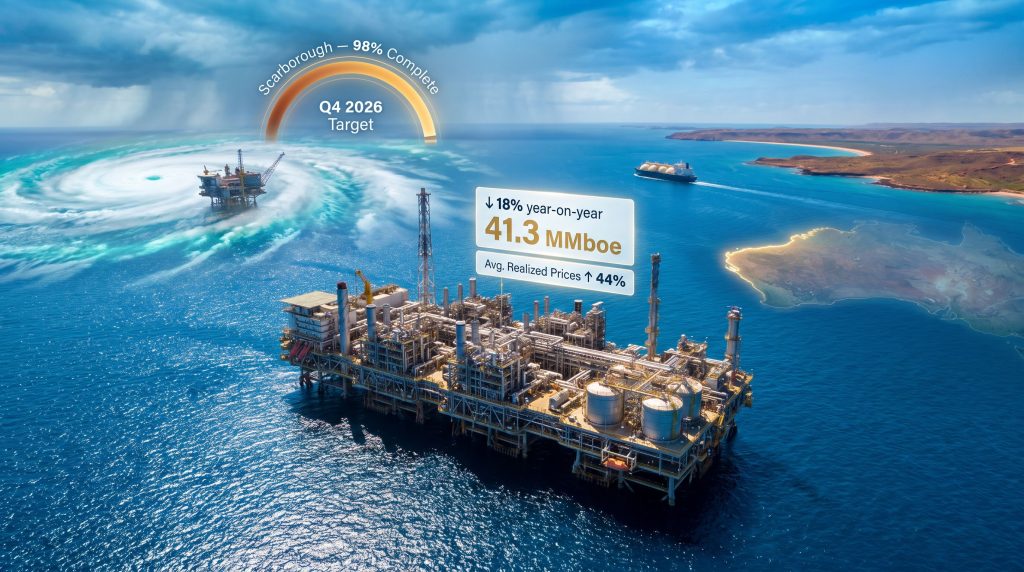
| Total Production | 41.3 MMboe (454 Mboe/d) | Down 18% year-on-year |
| Gas Production | Below prior year | Down 27% year-on-year |
| Quarter-on-Quarter Change | 41.3 MMboe | Down 9% from Q1 2026 |
| Average Realized Prices | Above prior year | Up 44% year-on-year |
The gap between the 18% total output decline and the steeper 27% gas production fall is instructive. It reveals that the disruptions were concentrated specifically in gas-processing and LNG-export infrastructure rather than being spread evenly across the asset portfolio. Oil-producing assets were comparatively insulated, which is why the overall production decline was less severe than the gas-specific figure.
Key Structural Insight: The divergence between total output decline and gas-specific decline is a diagnostic tool for investors. When gas falls disproportionately harder than total output, it almost always points to facility-level disruptions at LNG processing trains rather than upstream reservoir underperformance.
Understanding the Triple Production Pressure
Pluto Train 1: Scheduled Maintenance at the Wrong Time
Pluto Train 1 is one of Woodside's flagship LNG processing facilities on the Burrup Peninsula in Western Australia. Scheduled maintenance outages at LNG trains are unavoidable components of asset management, typically planned years in advance to coincide with periods of lower expected demand or market softness. However, the timing of Pluto's maintenance in Q2 2026 aligned with two additional, separate sources of production disruption, compounding what would otherwise have been a routine downtime event.
LNG processing trains are complex pieces of cryogenic infrastructure. They cool natural gas to approximately minus 162 degrees Celsius, reducing its volume by roughly 600 times to enable seaborne export. Maintenance on these facilities typically involves inspecting heat exchangers, compression turbines, and refrigerant circuits — tasks that cannot be performed while the train is in operation. The resulting downtime, even when well-managed, removes meaningful export capacity from the market for weeks at a time.
Cyclone Narelle: Unplanned Disruption to Wheatstone LNG
The second pressure point originated from Severe Tropical Cyclone Narelle, which forced an unplanned operational outage at the Wheatstone LNG facility. Wheatstone, located near Onslow on Western Australia's northwest coast, sits within a coastal corridor that experiences some of the most intense tropical cyclone activity in the Southern Hemisphere. According to reporting on the cyclone's impact, the outages materially cut Australia's Woodside output during the affected period.
Northwest Australia's cyclone season historically runs from November through April, meaning a late-season event pushing into the April reporting window is not unprecedented but remains operationally disruptive. Repair and recovery work at Wheatstone following Cyclone Narelle extended into April 2026, meaning the unplanned outage consumed a portion of the early-quarter production window.
The structural vulnerability this exposes is significant. Unlike hurricane-prone facilities in the Gulf of Mexico, which have decades of standardised storm preparedness protocols and offshore evacuation frameworks, northwest Australian LNG facilities face unique logistical challenges given their relative geographic isolation and the scale of their fixed coastal infrastructure.
North West Shelf: A Third Layer of Volume Reduction
Adding further downward pressure to the quarter, Woodside's equity share of pipeline gas from the North West Shelf project declined. The North West Shelf future is a matter of ongoing strategic importance, given that it is one of the world's largest LNG projects whilst also being a maturing asset with declining reservoir pressure and a progressively shifting equity and operational profile. A reduced allocation of pipeline gas from this source represents a structural headwind that is distinct from the cyclone and maintenance disruptions, as it reflects longer-term field dynamics rather than temporary operational events.
The convergence of all three pressures — one planned, one weather-driven, and one structural — created an unusually concentrated downtime window that stretched across virtually the entire quarter.
The Strait of Hormuz Effect: How Geopolitics Rescued Realised Pricing
While production volumes were falling, the global LNG pricing environment was moving sharply in Woodside's favour. Average realised prices rose 44% year-on-year during Q2 2026, driven in substantial part by supply disruptions linked to the closure of the Strait of Hormuz. Furthermore, the broader LNG supply outlook for 2025 and beyond had already flagged tightening conditions that amplified these price movements.
The Strait of Hormuz is a critical maritime chokepoint through which a significant portion of global LNG trade transits. Qatar, the world's largest LNG exporter by volume, routes a substantial share of its cargo through this passage. When the strait experienced closure or restricted access during the quarter, Qatari LNG shipments to key Asian and European buyers were disrupted, tightening the global spot and term market considerably.
Pricing Mechanism Note: LNG pricing in long-term contracts is frequently indexed to oil benchmarks, particularly Japan Crude Cocktail (JCC) or Brent oil benchmarks. Spot LNG, by contrast, trades against real-time supply-demand fundamentals. The Q2 2026 pricing surge reflects a combination of both dynamics, with tighter spot markets feeding through into benchmark price revisions.
Woodside also flagged that favourable Q2 pricing conditions would not be fully captured in the June quarter results due to standard contract price lag mechanisms. Under these structures, the price realised in a given month often reflects market conditions from one to three months prior. This means the pricing tailwind from Q2's tighter market is expected to be more completely reflected in Q3 2026 financial results.
For investors, this creates a counterintuitive dynamic: the quarter with the largest volume disruption may not be the quarter with the worst financial outcome, precisely because of how LNG contract pricing lags are structured.
Scarborough: The Volume Recovery Anchor
98% Complete and Targeting Q4 2026 First LNG
The Scarborough gas field development in offshore Western Australia has reached 98% completion as of the Q2 2026 reporting date, as confirmed in Woodside's official quarterly report. This milestone positions Scarborough as the single most consequential near-term catalyst in Woodside's operational calendar, with a first LNG cargo targeted for the fourth quarter of 2026.
Scarborough's significance extends beyond its raw volume contribution. The project represents Woodside's primary mechanism for restoring gas output toward the growth trajectory that the disruption-heavy first half of 2026 has temporarily interrupted. Successfully commissioning Scarborough on schedule would demonstrate the company's capacity to deliver complex deepwater-to-LNG supply chains within committed timelines — a capability that LNG buyers increasingly scrutinise when evaluating long-term supply agreements.
Industry analysts have pointed to Scarborough's Q4 start-up as a critical execution test. A successful commissioning would reinforce confidence in Woodside's project delivery capability, whilst any delay would likely intensify scrutiny of the company's broader capital programme management.
What Asian LNG Buyers Are Actually Seeking
The demand signal from Asian LNG buyers deserves closer examination. Woodside's chief executive has noted that customers have expressed strong interest not only in securing offtake agreements from new Australian supply projects, but also in taking equity participation stakes. This distinction matters strategically.
Equity participation by buyers — a practice common among Japanese and South Korean utilities — provides those counterparties with supply security that goes beyond contractual offtake. It gives them a degree of production-side influence and creates aligned incentives around project timelines and operational performance. The appetite for this type of arrangement signals that Asian buyers view Australian LNG not merely as a commodity source but as a strategic infrastructure investment.
Three-Project Pipeline: The Medium-Term Growth Architecture
Beyond Scarborough, Woodside's production growth narrative is anchored to a geographically diversified project pipeline spanning three separate jurisdictions and two distinct hydrocarbon types.
| Project | Location | Commodity | Target Milestone |
|---|---|---|---|
| Scarborough LNG | Western Australia | Gas/LNG | First LNG cargo: Q4 2026 |
| Trion Oil Field | Gulf of Mexico, Mexico | Oil | First oil: 2028 |
| Louisiana LNG | United States | LNG | First shipment: 2029 |
Each project introduces its own operational risk profile:
- Scarborough carries execution risk around deepwater tie-in completion and the commissioning of a new LNG processing train at Pluto
- Trion involves deepwater drilling in the Gulf of Mexico under a joint venture structure with Mexican national energy interests, adding regulatory and partnership complexity
- Louisiana LNG operates within the U.S. federal permitting environment for LNG export terminals, a regulatory landscape that has historically involved extended review timelines
The geographic spread across Australia, Mexico, and the United States is a deliberate risk management strategy. Different cyclone corridors, regulatory calendars, and buyer market orientations reduce the probability that a single exogenous event could simultaneously disrupt multiple projects, though it also introduces the complexity of managing assets across three distinct regulatory and logistical environments.
The next major ASX story will hit our subscribers first
Full-Year 2026 Guidance: What the Narrowing Signals
Following the Q2 disruptions, Woodside revised its full-year 2026 production guidance to a narrowed band of 174 MMboe to 185 MMboe. The critical detail here is not that guidance changed, but that it narrowed rather than shifted downward in its midpoint.
Guidance Interpretation: In the LNG sector, a narrowed guidance range following a disruption-heavy half-year typically signals that management has high confidence in the recovery trajectory for the second half. The tightening of the band implies that the variables are becoming more predictable, not less — most likely because Scarborough's commissioning timeline has become sufficiently well-defined to anchor back-half volume expectations with greater precision.
Woodside shares responded positively to the quarterly disclosure, rising as much as 1.2% to A$32.68 in Sydney trading, helped also by broader oil price movements where Brent gained as much as 4.8% on the same day.
Australian LNG Infrastructure and Cyclone Corridor Risk: A Structural Consideration
The Wheatstone disruption raises a question that extends beyond a single quarterly result. Western Australia's northwest coast hosts the majority of Australia's energy exports in LNG form, including Woodside's Pluto and Wheatstone facilities, as well as the North West Shelf plant and Chevron's Gorgon LNG. This concentration of critical export infrastructure within an active tropical cyclone corridor represents a systemic exposure that the broader LNG industry has yet to fully resolve.
Unlike offshore Gulf of Mexico platforms, which can be evacuated and are designed to withstand significant wave action, coastal LNG processing facilities present a different set of vulnerabilities. The interconnected nature of LNG trains, storage tanks, marine loading arms, and utility systems means that damage to one component can cascade into extended shutdowns across multiple production units.
The Q2 2026 experience involving Cyclone Narelle illustrates how even a single unplanned weather event, when combined with pre-scheduled maintenance at an adjacent facility, can produce a disproportionate volume impact across an entire reporting quarter.
Comparing the Three Q2 2026 Disruption Types
| Disruption | Facility | Category | Duration Impact |
|---|---|---|---|
| Scheduled maintenance | Pluto Train 1 | Planned | Bounded within Q2 |
| Cyclone Narelle damage | Wheatstone LNG | Unplanned weather | Repairs completed April 2026 |
| Reduced equity gas | North West Shelf | Structural/ongoing | Continuing headwind |
Key Signals to Watch Through the Rest of 2026
For investors and industry observers tracking Woodside's recovery trajectory, several concrete milestones will define the narrative in the second half of 2026:
- Scarborough first LNG cargo confirmation in Q4 2026 remains the single most operationally significant event on the calendar
- Q3 2026 realised pricing is expected to fully capture the elevated price environment established during Q2, given standard contract lag mechanics
- Trion and Louisiana LNG development progress will shape medium-term production growth credibility beyond the Australian asset base
- Cyclone season preparedness disclosures for northwest Australian facilities become relevant again as the November-to-April weather window approaches
- North West Shelf equity and gas volume trajectory warrants monitoring as a structural production component with long-term decline characteristics
The Q2 2026 result is best understood not as evidence of a structural deterioration in Woodside's business, but as the financial expression of an unusually concentrated disruption period. Whether that characterisation holds depends almost entirely on the operational execution that follows — starting with Woodside Q2 output falls as cyclone and maintenance hit LNG production serving as the baseline from which the Scarborough commissioning must now deliver a meaningful recovery.
Readers seeking additional context on Australian LNG infrastructure and global energy market dynamics can explore related reporting and analysis through World Oil and other upstream industry publications covering the Australasia region. This article contains forward-looking statements and production guidance figures sourced from Woodside's Q2 2026 regulatory filing. Actual outcomes may differ materially from those described. Nothing in this article constitutes financial advice.
Want to Stay Ahead of the Next Major ASX Resource Discovery?
Discovery Alert's proprietary Discovery IQ model delivers real-time alerts the moment significant mineral discoveries are announced on the ASX, transforming complex resource data into clear, actionable investment opportunities for traders and long-term investors alike. Explore Discovery Alert's discoveries page to see the historic returns major discoveries have generated, and begin a 14-day free trial to position yourself ahead of the broader market.