July 29, 2026
The Hidden Economics Driving Underground Fleet Electrification
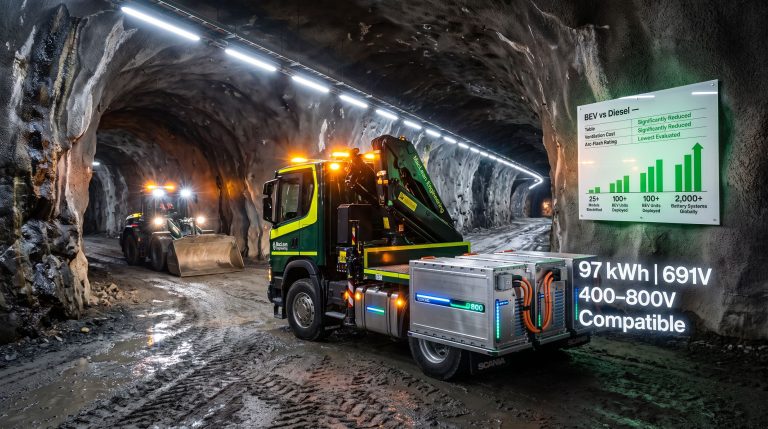
Every tonne of ore extracted from deep underground carries a cost that surface mining operators rarely encounter at the same scale: the compounding burden of diesel in confined spaces. Underground mines must engineer elaborate ventilation systems not because workers need fresh air alone, but because diesel combustion produces nitrogen oxides, particulate matter, and heat loads that accumulate rapidly in tunnel networks. The energy consumed by ventilation fans in a large underground operation can represent 15 to 40 percent of total site electricity consumption, according to industry engineering analyses. When fuel prices rise, the pain is felt twice: once at the fuel bowser and again on the electricity bill keeping exhaust gases moving.
This dual cost structure is precisely why the economics of underground electrification are more compelling than surface equivalents, and why the decision by MacLean Engineering to formalise Scania batteries for MacLean mining EVs as its primary battery platform carries significance well beyond a single procurement agreement.
When big ASX news breaks, our subscribers know first
Why Diesel Underground Is a Structural Cost Problem, Not Just an Emissions One
The ventilation cost multiplier is the single most underappreciated financial argument for underground fleet electrification. On the surface, removing a diesel vehicle from a fleet saves fuel. Underground, it also reduces the volume of air that must be mechanically circulated, which in turn lowers fan energy consumption, reduces refrigeration requirements in deep hot mines, and decreases the frequency of equipment evacuation during blast clearance cycles.
Beyond energy costs, diesel underground imposes a series of cascading infrastructure demands. Furthermore, the mining electrification shift is increasingly being driven by these compounding cost pressures rather than regulatory obligations alone:
- Exhaust scrubbing systems on equipment add weight and mechanical complexity, increasing maintenance frequency
- Diesel particulate filters require regeneration cycles that consume additional fuel and generate heat
- Fuel storage and logistics underground introduce fire risk, spill management obligations, and supply chain complexity
- Heat generation from combustion engines can push ambient temperatures in deep mines above safe working thresholds, triggering mandatory cooling investments
Battery-electric vehicles eliminate all four of these cost vectors simultaneously. The residual thermal output from electric motors and battery packs is significantly lower than internal combustion equivalents, and the absence of exhaust chemistry removes the primary driver of forced ventilation demand.
Underground electrification is not just a decarbonisation strategy. For mines operating below 1,000 metres, it is increasingly a precondition for economic viability as diesel costs and ventilation infrastructure expenses compound against deeper ore bodies.
Scania Core 800: The Technical Architecture Behind the Partnership
The selection of Scania Industrial Batteries as MacLean's primary battery supplier followed what MacLean described as an extensive global evaluation process covering technical performance, regulatory compliance, safety architecture, and long-term service support. The outcome of that process centred on a single product: the Core 800 industrial battery pack.
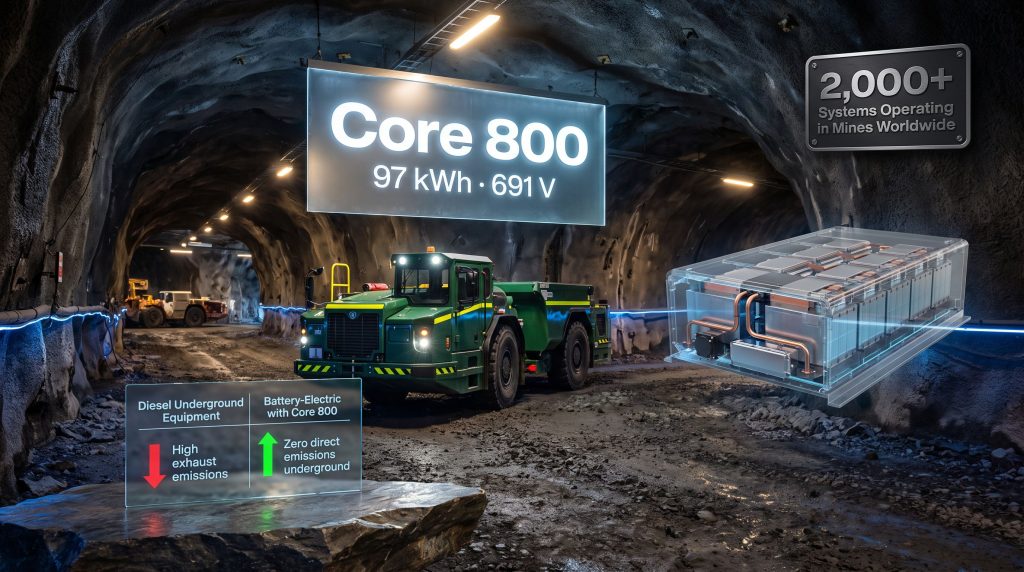
Core 800 Specifications at a Glance
| Specification | Core 800 Detail |
|---|---|
| Installed Energy Capacity | 97 kWh per pack |
| Nominal Voltage | 691 V |
| Powertrain Voltage Range | 400 V to 800 V |
| Scalable Energy Range | 21 kWh to 768 kWh |
| Thermal Management | Advanced integrated system |
| Battery Management System | Proprietary BMS included |
| Safety Standard | ISO 13849-compliant controls |
| Global Underground Deployments | More than 2,000 systems in mines worldwide |
The scalability of the Core 800 platform is one of its most strategically important characteristics. A configuration range of 21 kWh to 768 kWh means the same battery architecture can serve a light utility runner in a narrow-vein operation at the lower end, or a large-format loader or drill rig requiring multiple packs at the upper end.
For an OEM like MacLean, which produces diverse underground equipment types, this flexibility allows a single supplier relationship to cover the full product range rather than requiring separate battery partnerships for different equipment categories. In addition, renewable energy in mining continues to advance alongside these battery developments, reinforcing the broader case for fleet electrification.
Arc-Flash Risk: The Safety Factor That Changed the Evaluation
A detail that is frequently overlooked in discussions of mining electrification is the occupational hazard created by high-voltage maintenance in underground environments. Arc-flash events, which occur when electrical current passes through the air between conductors or between a conductor and ground, can release thermal energy sufficient to cause severe burns, ignite nearby materials, and damage equipment.
In a tunnel environment where evacuation is constrained, the consequences of an arc-flash incident are amplified compared to surface workshops. MacLean elevated arc-flash incident energy reduction to a primary evaluation criterion during its battery supplier assessment.
The Core 800's design specifically addresses this risk through its integrated safety architecture, which operates under ISO 13849-compliant functional safety controls. This standard governs the safety-related performance of control systems and is well-established in industrial machinery design, but its application to mining battery packs reflects a maturation of the sector's approach to high-voltage underground equipment.
The inclusion of a proprietary battery management system further reduces technician exposure by enabling remote state monitoring, fault isolation, and controlled discharge procedures before physical access is required.
MacLean's Sourcing Evolution: From Sub-Pack Assembly to Industrial Battery Platform
MacLean's battery sourcing history provides important context for understanding what the Scania partnership represents strategically. The Canadian manufacturer previously relied on a combination of in-house battery assemblies and sub-pack sourcing from Michigan-based Exalt Energy.
This approach is common among early-stage EV OEMs in industrial sectors: integrating available components into bespoke configurations allows faster market entry but creates constraints around scalability, service standardisation, and warranty management. However, as the mining energy transition accelerates, the limitations of this model become increasingly apparent.
The transition to a dedicated industrial battery supplier with a purpose-engineered platform and an established global service network represents a qualitatively different level of battery integration maturity. Rather than assembling battery systems from constituent parts, MacLean is now deploying a fully validated industrial battery product that arrives with its own thermal management, BMS, safety compliance, and service infrastructure already embedded.
This evolution mirrors patterns seen in other industrial electrification markets, where the initial phase of OEM-led battery integration eventually gives way to specialist supplier relationships as volume requirements grow and customer uptime expectations increase.
Real Zero 2040: Why Carbon Offsets Are Not Part of This Equation
The MacLean-Scania partnership is formally anchored to MacLean's commitment to Fortescue's Real Zero 2040 initiative, a pledge that carries more specific obligations than conventional net-zero targets.
Understanding the Distinction Between Net Zero and Real Zero
| Concept | Net Zero | Real Zero |
|---|---|---|
| Fossil Fuel Use | Permitted if offset elsewhere | Must be eliminated at the source |
| Carbon Credits | Accepted as offset mechanism | Explicitly rejected |
| Reforestation/CCUS | Counts toward target | Does not count toward target |
| Timeline Focus | Flexible pathway to balance | Direct substitution of fossil fuels |
| Primary Mechanism | Compensation and offsetting | Renewable power, electrification, green fuels |
Fortescue has been direct in its characterisation of net-zero approaches that rely on offsets: the position articulated on its Real Zero webpage holds that offsetting does not resolve the underlying emissions problem but rather relocates it. Real Zero demands that fossil fuels be replaced at the point of use, not compensated for at a distance.
MacLean formalised its Real Zero 2040 commitment at MINExpo 2024, where it simultaneously announced a joint development program with Fortescue to produce 30 battery-electric GR8 surface graders for iron ore operations in Western Australia. The Scania battery partnership builds directly on that commitment by providing the industrial battery platform necessary to scale MacLean's underground EV lineup in alignment with the 2040 target.
MacLean's position is that expanding its portfolio of battery-electric underground mining equipment is among the most impactful contributions it can make toward the Real Zero objective, both through its own operational emissions and through the diesel displacement it enables across its customer base.
Operational Performance: Battery-Electric vs Diesel Underground
For mine operators evaluating fleet transition decisions, the performance comparison between diesel and battery-electric underground equipment spans more dimensions than emissions alone. Consequently, the case for electric mining vehicles underground is increasingly being made on operational and financial grounds rather than purely environmental ones.
| Operational Factor | Diesel Underground Equipment | Battery-Electric with Core 800 |
|---|---|---|
| Exhaust Emissions | High, requires extensive ventilation management | Zero direct emissions underground |
| Ventilation Infrastructure Cost | Significant and ongoing energy expenditure | Substantially reduced requirement |
| Thermal Load on Tunnel Environment | High heat generation from combustion | Lower thermal output from electric drivetrain |
| Fuel Cost Exposure | Directly exposed to diesel price volatility | Decoupled from fossil fuel markets |
| Drivetrain Maintenance Complexity | Engine, exhaust system, and fluid management | Simplified drivetrain with BMS-managed battery |
| Arc-Flash Risk During Maintenance | Not applicable | Addressed through Core 800 integrated safety design |
| Noise Levels Underground | High, contributing to hearing risk | Substantially reduced |
The noise reduction dimension is one that tends to receive less attention than emissions and energy costs, but underground noise exposure is a significant occupational health issue. Electric drivetrains reduce the cumulative acoustic load in tunnel environments, which has measurable implications for worker health outcomes over extended career periods.
The next major ASX story will hit our subscribers first
What the Partnership Agreement Covers and What Remains Undisclosed
The MacLean-Scania strategic battery partnership establishes a framework for joint deployment support across current and future battery-electric vehicle rollouts, with Scania providing battery technology alongside service and technical support through its existing global mining network. The practical significance of that network is reinforced by the more than 2,000 Scania battery systems already operating in mines worldwide, which means service personnel and spare parts infrastructure are not being built from scratch but rather extended to cover MacLean's equipment.
What the two companies have not yet disclosed is equally informative:
- No specific MacLean underground vehicle models have been named as initial Core 800 recipients
- Battery procurement volumes and supply schedules have not been made public
- Customer-facing delivery timelines for Scania-powered MacLean equipment remain unannounced
This level of disclosure is consistent with a strategic partnership announcement rather than a product launch, suggesting the commercialisation phase is still being structured rather than already in market.
The Competitive Dynamics Reshaping Underground Mining Equipment
The MacLean-Scania model reflects a broader structural shift in how underground mining equipment is being differentiated in 2026. Historically, mining OEMs competed primarily on mechanical engineering: the robustness of their booms, the hydraulic performance of their loaders, the turning radius of their trucks in narrow drifts.
Battery technology is now an independent competitive variable. An OEM that integrates a superior industrial battery platform gains advantages in uptime, safety compliance, service cost, and emissions performance that are increasingly visible to procurement teams making fleet decisions.
Conversely, an OEM that continues to rely on internally assembled battery systems faces growing comparison risk as purpose-engineered industrial battery products with proven underground track records become available through supplier partnerships. The decarbonisation economics of this shift are also becoming clearer, with total cost of ownership analyses increasingly favouring battery-electric platforms.
Scania Industrial Batteries operates as a distinct industrial division, separate from its parent company's commercial vehicle operations. This distinction matters because it indicates that the Core 800 and its associated engineering support are developed for the specific demands of off-highway industrial applications rather than adapted from road transport battery programs.
Underground mining imposes thermal cycling patterns, vibration profiles, and duty cycle characteristics that differ substantially from highway freight, and purpose-designed industrial battery systems are engineered around those specific conditions.
Frequently Asked Questions: Scania Batteries and MacLean Mining EVs
What is the Scania Core 800 industrial battery pack?
The Core 800 is Scania Industrial Batteries' flagship product for off-highway applications. It delivers 97 kWh of installed energy at a nominal voltage of 691 volts, incorporates an advanced thermal management system and proprietary BMS, and is compatible with powertrains operating between 400 and 800 volts. Its scalable architecture allows energy configurations ranging from 21 kWh to 768 kWh.
Why did MacLean select Scania after its global evaluation?
MacLean assessed battery suppliers across technical performance, safety design, regulatory compliance, and service support capability. Scania was selected based on the Core 800's engineering quality, its arc-flash risk mitigation features, Scania's demonstrated experience with more than 2,000 systems already operating in underground mines, and the collaborative engagement Scania demonstrated during the evaluation process.
What does Real Zero 2040 require of MacLean as a signatory?
Real Zero 2040 requires the complete elimination of fossil fuel use through direct substitution with renewable power, electrification, and green fuels. Carbon credits, offsets, and compensatory mechanisms are not accepted as meeting the standard. MacLean formalised this commitment at MINExpo 2024.
How does underground battery-electric equipment reduce operating costs?
Electrification reduces direct diesel expenditure and simultaneously lowers the energy cost of underground ventilation, which must work significantly harder to manage combustion exhaust in confined tunnels. The combined savings from both vectors can substantially reduce total underground fleet operating costs, with the ventilation component often representing a larger financial benefit than the fuel saving alone.
Which MacLean vehicles will use Core 800 battery packs first?
MacLean and Scania have not yet publicly identified specific underground vehicle models for initial Core 800 integration, nor have they disclosed procurement volumes or delivery schedules.
The Long Arc: What This Partnership Signals for the Industry
The formalisation of Scania batteries for MacLean mining EVs across an integrated platform partnership is unlikely to remain an isolated development. As underground mining operations descend to greater depths, the thermal and ventilation economics of diesel become progressively less viable.
At the same time, industrial battery technology is maturing rapidly enough that purpose-engineered systems with proven underground track records are now commercially available from specialist suppliers, reducing the technical risk that once made OEM-assembled battery systems the default choice.
The convergence of operator decarbonisation obligations, industrial battery supply chain maturity, and OEM electrification commitments is creating conditions for accelerated fleet transition in the second half of the 2020s. Mine designers are beginning to factor zero-emission underground fleets into ventilation engineering from the outset, rather than retrofitting electrical infrastructure around diesel-optimised layouts. This represents a fundamental change in how underground mines are planned and capitalised.
For MacLean, the Scania relationship provides the battery foundation needed to scale its Real Zero 2040 commitments from pledge to product. For the broader underground mining equipment sector, it offers a template for how OEM-supplier battery partnerships can deliver competitive differentiation, safety performance, and emissions outcomes simultaneously. The economic logic that made diesel dominant underground for decades is not merely weakening. It is being systematically dismantled from multiple directions at once.
Readers seeking further context on underground mining electrification and battery technology developments in the sector can explore related coverage at Metal Tech News.
Want to Know Which ASX Mining Companies Are Leading the Electrification Charge?
Discovery Alert's proprietary Discovery IQ model scans ASX announcements in real time, delivering instant alerts on significant mineral discoveries and the emerging mining opportunities that accompany transformative shifts like underground fleet electrification — the same economic forces reshaping how mines are planned and capitalised today. Explore historic discoveries and their returns on Discovery Alert's dedicated discoveries page, then begin a 14-day free trial to position yourself ahead of the broader market.