July 29, 2026
The Engineering Constraints That Make Underground Batteries a Different Problem Entirely
Battery technology has advanced rapidly across the transport and energy storage sectors, but one application environment continues to expose the limits of conventional EV engineering: the underground mine. Hard-rock mining operations present a combination of mechanical, thermal, and electrical stressors that surface vehicle platforms were simply never designed to withstand. Understanding why requires a close look at what actually happens to a battery system once it descends below the collar of a shaft and enters continuous production service.
Underground environments subject battery systems to persistent vibration loads transmitted through steel-wheeled tramming on uneven rock surfaces, temperature extremes caused by geothermal gradients and machine heat in poorly ventilated headings, and high ambient humidity from groundwater and rock cooling systems. Unlike a road freight vehicle that operates at variable load across a mixed duty cycle, underground mining equipment frequently runs at or near peak draw for extended continuous periods.
Electric mining vehicles completing rapid load-haul-dump cycles, boom trucks servicing active stopes, and drill rigs demanding sustained peak current impose degradation pathways on battery cells that bear little resemblance to the charge-discharge profiles used to validate automotive battery packs.
This fundamental mismatch is why the underground mining industry has increasingly moved away from adapted automotive supply chains and toward purpose-built industrial battery architectures. The Scania MacLean underground electric vehicles partnership, announced in July 2026, represents one of the clearest expressions of that shift to date.
Comparing Underground Battery Requirements Across Vehicle Classes
Not all underground mining equipment places identical demands on a battery system. The stress profile varies considerably by vehicle class, which is why any battery architecture intended to serve a multi-vehicle fleet must accommodate a wide operational envelope.
| Vehicle Class | Voltage Requirement | Typical Energy Capacity | Primary Stress Factor |
|---|---|---|---|
| Electric loaders | 400–800V | High (scalable) | Continuous draw cycles |
| Boom trucks / utility rigs | 400–800V | Moderate–High | Vibration and thermal load |
| Personnel carriers | 400V | Lower | Cycle frequency |
| Heavy-duty drill rigs | 600–800V | High | Peak current demand |
Scalable battery architectures capable of spanning 400V to 800V powertrains are increasingly regarded as the baseline requirement for multi-vehicle underground fleet electrification programmes, not a premium specification. This range reflects the genuine diversity of underground equipment classes, from lighter personnel transport to heavy-duty production drilling.
When big ASX news breaks, our subscribers know first
What the Scania Core 800 Battery System Actually Delivers
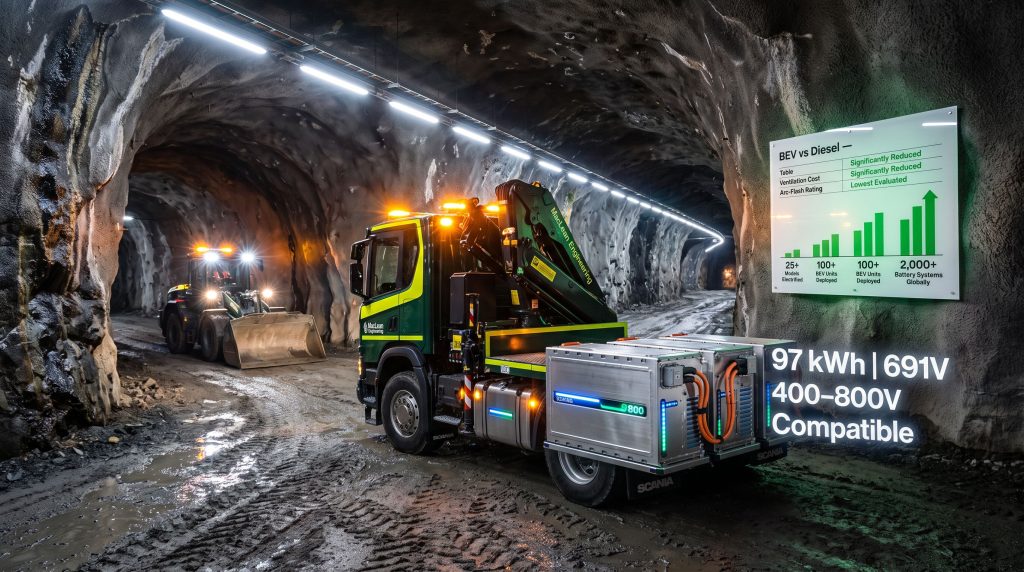
Scania Industrial Batteries has built its underground mining product around a flagship unit known as the Core 800. At the system level, the Core 800 delivers 97 kWh of installed energy at a nominal operating voltage of 691 volts. It supports powertrain configurations spanning 400V to 800V, and its modular architecture allows scalable energy deployment ranging from 21 kWh up to 768 kWh depending on the number of units and configuration requirements of a given vehicle platform.
What distinguishes the Core 800 from adapted commercial EV battery packs is the engineering integration that surrounds the cells themselves. The system incorporates:
- A purpose-engineered thermal management system designed for sustained underground duty cycles rather than intermittent road use
- A proprietary battery management system (BMS) providing real-time cell-level monitoring, active fault isolation, and continuous state-of-health reporting
- Structural and enclosure design specifications targeting resistance to vibration loads, humidity, and the mechanical stresses specific to off-highway underground environments
Critically, Scania's industrial battery division reports a global installed base of more than 2,000 battery systems currently operating across underground mining operations worldwide, spanning electric rigs, loaders, and heavy-duty underground vehicles across multiple continents. This operational footprint matters because it represents field validation at scale in production mining environments, not controlled laboratory or simulation conditions.
Furthermore, this distinction between field-proven and simulation-validated performance is increasingly shaping procurement decisions among underground mine operators who need battery systems to sustain production availability targets rather than simply meet nameplate specifications.
Electrification in demanding off-road applications places exceptionally high requirements on safety, reliability, and system integration, according to Elin Åkerström, managing director at Scania Industrial Batteries, as reported in the July 27, 2026 MacLean Engineering news release.
Arc-Flash Safety: The Technical Metric That Determined the Outcome
What an Arc-Flash Study Actually Measures
Among the technical criteria evaluated during MacLean Engineering's battery supplier selection process, arc-flash performance emerged as the decisive filter. To understand why, it helps to understand what an arc-flash study actually quantifies.
An arc-flash study evaluates the electrical distribution architecture of a mining operation to calculate the potential energy released during an arc-flash event at energised equipment. The key outputs of such an assessment include:
- Incident energy levels expressed in calories per centimetre squared, representing the thermal energy that would be delivered to an exposed worker at a defined distance from the fault point
- Arc-flash boundary distances defining the minimum safe working zones around energised equipment
- Personal protective equipment (PPE) classifications specifying the minimum thermal protection required for maintenance personnel working within those zones
- Risk mitigation recommendations addressing system design, operational procedures, and equipment selection
In underground environments, arc-flash events carry substantially elevated risk relative to surface applications. Confined spaces limit evacuation options, restricted airflow affects thermal dissipation, and personnel are frequently in close physical proximity to energised equipment during routine maintenance tasks.
Why Scania's Systems Produced the Lowest Rating
MacLean Engineering conducted comparative arc-flash assessments across a broad range of commercially available battery systems. According to MacLean's vice-president of product management and marketing, Maarten van Koppen, as reported in CIM Magazine, Scania's systems recorded the lowest arc-flash rating by a wide margin across all evaluated options.
This outcome had direct procurement implications. Lower arc-flash ratings translate into:
- Reduced PPE requirements for maintenance technicians servicing battery systems underground
- Wider safe working boundaries that improve operational flexibility during maintenance windows
- Lower liability exposure for site operators responsible for worker safety in energised work environments
- Simplified compliance pathways against mine electrical safety standards across jurisdictions including Canada, Australia, Mexico, and South Africa
MacLean's stated position on battery safety, as conveyed through Maarten van Koppen to CIM Magazine, is that the company applies an uncompromising standard covering both customer-site maintenance personnel and its own technical staff. That framing elevated safety performance above both energy density and unit cost as the primary selection criterion, a notable inversion of the weighting often applied in commercial EV battery procurement.
MacLean Engineering's Electrification Timeline: A Decade of Hard-Rock Deployment
MacLean Engineering's commitment to underground fleet electrification predates many of the policy and market tailwinds now accelerating BEV adoption across the mining sector. The programme was formally initiated in 2015 and publicly launched at MINExpo 2016, establishing an early-mover position in a segment that has since attracted significant industry attention. In addition, this mining electrification journey reflects a decade of hard-won operational learning in genuinely demanding underground conditions.
Key Milestones in MacLean's BEV Programme
| Year | Development Milestone |
|---|---|
| 2015 | Fleet electrification programme formally initiated |
| 2016 | First BEV sold; programme publicly launched at MINExpo |
| 2015–2026 | More than 25 mining vehicle models electrified |
| By 2026 | Over 100 BEV units sold across four countries |
Geographic Deployment Footprint
MacLean's BEV units have been deployed across underground operations in Canada, Mexico, Australia, and South Africa, representing a diverse range of mining environments and regulatory jurisdictions. The geographic spread also reflects the variation in underground conditions the equipment must perform under, from the cold, deep hard-rock gold mines of northern Ontario to the high-altitude, thermally challenging underground environment of Torex Gold's Media Luna gold-copper project in Guerrero, Mexico.
Fleet electrification at the engineering level is considerably more complex than a single-vehicle powertrain swap. Each vehicle model requires independent arc-flash assessment, BMS integration testing, and duty-cycle validation against its specific operational profile. Systematic redesign of powertrain architecture, hydraulic systems, thermal management, and control electronics must be completed before each model enters commercial service.
Real-World Deployment: Where MacLean's BEV Equipment Has Been Tested
The operational credibility of MacLean's BEV platform rests substantially on its deployment record across active production mines. Several projects stand out for the specific validation conditions they represent:
Discovery Mining's Borden Gold Mine, Ontario
Among the earliest Canadian underground operations to integrate a battery-electric fleet at scale. Borden was designed from the outset as a diesel-free underground mine, making BEV performance reliability a direct production dependency rather than a supplementary efficiency measure.
Glencore's Onaping Depth Project, Ontario
A deep extension project where the economic case for diesel elimination is amplified by the capital and operating costs associated with ventilation infrastructure at depth. BEV deployment here carries direct ventilation dividend implications.
Agnico Eagle's Odyssey Gold Mine, Quebec
A large-scale underground gold operation integrating BEV equipment as part of a broader zero-emission underground strategy, reflecting the growing alignment between major mining company ESG commitments and equipment procurement decisions.
Torex Gold's Media Luna Project, Guerrero, Mexico
A high-altitude, deep underground gold-copper operation presenting extreme thermal and environmental stress conditions. Successful battery performance in this environment constitutes a meaningful validation of thermal management capability under conditions that would stress systems designed to narrower specifications.
The Total Cost Case: Why Underground BEV Economics Go Beyond Fuel Substitution
Diesel vs. BEV Cost Architecture
| Cost Category | Diesel Fleet | Battery-Electric Fleet |
|---|---|---|
| Fuel / energy cost | High (diesel pricing + logistics) | Lower (grid electricity, potentially renewable) |
| Ventilation operating cost | High (exhaust dilution requirement) | Significantly reduced |
| Heat load management | High (engine heat in confined spaces) | Substantially lower |
| Maintenance labour | Moderate–High (engine, exhaust systems) | Lower (fewer moving parts, no exhaust) |
| Battery replacement | Not applicable | Lifecycle cost factor |
| Regulatory compliance trajectory | Increasing cost pressure | Aligned with zero-emission direction |
The Ventilation Dividend
One of the least discussed but most financially significant consequences of underground fleet electrification is its effect on ventilation economics. Diesel-powered underground fleets require large volumes of fresh air to dilute exhaust gases, including diesel particulate matter and nitrogen oxides, to concentrations within regulatory limits. Furthermore, renewable mining solutions are increasingly being paired with BEV fleets to maximise the overall emissions and cost benefits across underground operations.
Ventilation infrastructure, including primary and booster fans, ducting networks, ventilation raises, and the energy costs of moving air through deep underground workings, consistently ranks among the largest operating cost categories for deep mines. Transitioning to battery-electric equipment reduces the ventilation air volume requirement substantially, creating an operational and capital dividend that can be realised in several ways:
- Downsizing planned ventilation infrastructure in new mine designs, reducing capital expenditure
- Reallocating existing ventilation capacity to deeper working areas without additional infrastructure investment
- Reducing ongoing energy costs associated with running large ventilation fan arrays
- Enabling access to ore bodies at depths where ventilation costs for a diesel fleet would compromise project economics
For mine operators evaluating the total cost of ownership of BEV fleets against diesel equivalents, the ventilation dividend frequently represents the most compelling single economic argument, independent of fuel price differentials or emissions compliance obligations.
The next major ASX story will hit our subscribers first
What Standardised Battery Supply Means for Fleet Operators
The integration of Scania Core 800 battery packs as MacLean's standardised primary power source across its updated BEV platform carries operational implications that extend well beyond individual vehicle performance. For mine operators managing multi-vehicle underground fleets, battery supplier consolidation delivers:
- A consistent BMS architecture across all vehicle types, enabling fleet-wide state-of-health monitoring from a unified data platform
- Simplified spare parts inventory management, reducing the stocking complexity associated with sourcing components across multiple battery supplier relationships
- Standardised technician training requirements, lowering the cost and complexity of maintaining in-house or contracted maintenance capability
- Predictable energy infrastructure planning based on a common voltage and capacity specification
However, for large underground fleet operators, reducing the number of active battery supplier relationships is not a minor administrative convenience. It directly affects maintenance scheduling, spare parts logistics, and the depth of technical expertise maintainable within a site-level workforce. Consequently, data-driven mining operations stand to benefit substantially from the fleet-wide visibility that a unified BMS architecture enables, supporting more accurate maintenance scheduling and energy planning.
MacLean's stated intention to revamp its broader electric vehicle design alongside the Scania battery integration, targeting improved operational performance and reduced total cost of ownership, signals that the partnership is positioned as an architectural refresh rather than a component substitution. The company's net-zero target of 2040 provides the strategic horizon against which this technical investment is being made.
Key Takeaways for Mine Operators and Industry Observers
The Scania MacLean underground electric vehicles partnership encodes several shifts in how the underground mining equipment sector is approaching electrification. Moreover, the mining technology transformation underway reflects a fundamental rethinking of what underground equipment must deliver across safety, efficiency, and environmental performance. Key conclusions include:
- Arc-flash safety performance has become a primary procurement filter in underground battery selection, outranking energy density and unit economics in at least one major OEM's formal evaluation process
- Field-proven industrial battery systems with documented underground deployment records carry decisive credibility advantages over automotive-adapted supply in serious hard-rock mining applications
- Scalable voltage and energy configurations spanning 400–800V and 21–768 kWh are becoming the baseline technical expectation for underground BEV battery systems
- Standardised battery architecture across multi-vehicle fleets is emerging as an operational efficiency priority, not merely a procurement convenience
- The ventilation dividend continues to strengthen the economic case for underground electrification independently of regulatory emissions pressure, particularly for deep mining projects where ventilation infrastructure represents a major capital and operating cost line
- Purpose-built thermal management and BMS integration are non-negotiable requirements for underground applications, distinguishing industrial battery systems from commercial EV supply chains adapted for surface transport
Disclaimer: This article is intended for informational purposes only and does not constitute financial, investment, or procurement advice. Forecasts, timelines, and performance claims are based on publicly available information and should be independently verified before forming the basis of commercial decisions.
Want to Stay Ahead of the Next Major ASX Mining Discovery?
As underground electrification reshapes the economics of hard-rock mining, the companies advancing these technologies on the ASX represent significant investment potential — Discovery Alert's proprietary Discovery IQ model scans ASX announcements in real time, delivering instant notifications on significant mineral discoveries so subscribers can act before the broader market catches on. Explore historic discovery returns on Discovery Alert's dedicated discoveries page and begin your 14-day free trial to secure a genuine market-leading edge.