July 28, 2026
The Machine That Built Modern Underground Mining Is Gone. What Replaced It Tells Us Everything.
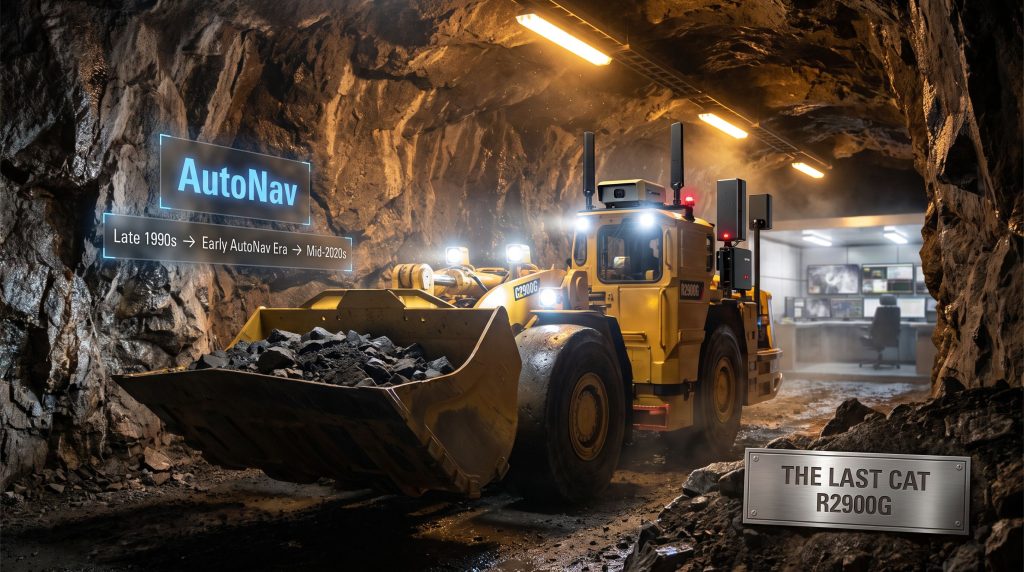
For decades, underground hard-rock mining operations have wrestled with a fundamental tension: how do you extract ore efficiently from environments that are inherently dangerous for the humans operating the machinery? The answer, slowly assembled across thirty years of incremental innovation, is automation. The story of the last Cat R2900G fitted with RCT's AutoNav, before entering service at a Queensland silver and lead mine, captures that entire arc in a single machine.
When big ASX news breaks, our subscribers know first
Understanding the Cat R2900G: A Platform That Defined an Era
The Caterpillar R2900G earned its reputation as one of the most widely deployed underground load-haul-dump (LHD) loaders in Australian hard-rock mining. Built for high-capacity production in confined underground environments, the R2900G combined diesel-powered muscle with a relatively compact profile suited to narrower drive widths typical of metalliferous operations. Its longevity across multiple mine sites speaks to a platform that balanced raw productivity with mechanical robustness.
LHD loaders perform a specific and physically brutal role: scooping broken ore from a drawpoint immediately following blasting, then tramming that material to an orepass or crusher. The environment is dusty, seismically active, and frequently characterised by poor ventilation. For most of the R2900G's operational life, a human operator sat inside the machine cab during every one of those cycles.
Caterpillar has since retired the R2900G model entirely, with its successor platform, the R2900XE, incorporating hybrid drive technology as the OEM responds to mounting pressure around underground emissions and energy efficiency. The final R2900G unit sold globally was an NLK-specification machine delivered to the Queensland operation, and RCT technicians at the Mount Isa branch completed the AutoNav installation on all four of the site's newly acquired R2900G loaders, including that final unit.
The retirement of a diesel-dominant LHD platform is not simply a product lifecycle event. It reflects a structural shift in what mine operators now expect from underground equipment: automation readiness, emissions reduction pathways, and data integration capability are no longer optional features.
Furthermore, the broader mining automation transformation underway across the industry means that this single machine's retirement signals a much larger transition in how underground operations are conceived and managed.
What Is RCT's AutoNav System and How Does It Work Underground?
RCT, operating as RCT Powered by Epiroc, developed AutoNav as a scalable, multi-machine automation and control platform specifically designed for underground LHD fleets. The system allows a single operator to manage multiple loaders simultaneously from a control station, rather than the traditional one-operator-per-machine model that has dominated underground loading for generations.
Core Technical Architecture
AutoNav functions across several integrated layers:
- Digital wireless communications infrastructure providing reliable underground network coverage across production levels
- Operator control centres (AutoNav Centres) positioned either on the surface or at strategic underground locations, giving operational flexibility
- Machine-mounted systems that interpret operator commands and enable guided automation of the loading and tramming cycle
- Multi-machine supervisory capability allowing a single operator to transition between loaders or manage concurrent operations across a fleet
The distinction between tele-remote operation and full AutoNav guided automation is important to understand, as mines typically progress through these stages incrementally.
| Feature | Tele-Remote Operation | AutoNav Guided Automation |
|---|---|---|
| Operator location | Underground or basic surface station | Dedicated AutoNav Centre (surface or underground) |
| Machines per operator | 1:1 ratio | Multi-machine capable |
| Communications dependency | Analogue or early digital | Digital wireless network |
| Automation level | Fully operator-controlled | Guided automation with operator oversight |
| Primary safety outcome | Reduced cab time | Complete cab removal from hazard zones |
| Infrastructure requirement | Moderate | High (digital comms prerequisite) |
OEM-Agnostic Design as a Strategic Differentiator
One of the less-discussed but commercially significant aspects of the AutoNav platform is its OEM-agnostic architecture. Underground mines rarely operate a single-brand fleet, and fleet renewal cycles mean that new machines from different manufacturers enter production alongside legacy equipment. A control and automation system that locks operators into one OEM's ecosystem creates substantial long-term risk.
RCT's cross-platform compatibility means that AutoNav deployments documented on Cat R2900G units can extend to other loader brands and, critically, to the next generation of machines including the Cat R2900XE. In addition, RCT has already completed AutoNav installations on R2900XE hybrid units at Stawell Gold Mine in 2025, demonstrating that the platform's relevance does not expire with any single machine generation.
The Role of Digital Communications in Enabling Automation Performance
Underground automation is only as reliable as the communications infrastructure supporting it. This is a frequently underestimated component of total automation investment. Approximately 18 months before the final R2900G was fitted with AutoNav, the Queensland site completed an upgrade to RCT's digital communications system across its underground workings.
The practical results of that upgrade extended across three dimensions:
- Wireless reliability improved, reducing dropout events that had previously interrupted remote operation cycles
- System uptime increased, delivering more consistent production hours per shift
- Visual clarity for remote operators improved, which directly affects operating confidence and cycle time efficiency
This sequencing matters for mine operators evaluating automation investment. The communications layer is not a parallel consideration to automation deployment; it is a prerequisite. Sites that attempt to deploy advanced automation systems without first ensuring the underlying digital infrastructure can support them frequently encounter performance gaps that erode the projected return on investment.
Nearly Three Decades of Automation: What This Queensland Mine Reveals About Technology Adoption
The Queensland silver and lead mine's automation journey is one of the most longitudinally documented examples of progressive LHD automation in Australian underground mining. The timeline reveals how incremental commitment to automation technology compounds into structural operational advantage over time.
- Late 1990s: The site adopted RCT's tele-remote systems, placing it among the earliest underground mining operations in Australia to embrace remote LHD control
- Early AutoNav era: The operation transitioned from tele-remote to AutoNav, and became one of the first sites in the country to operate underground loaders from a surface control station
- Recent fleet renewal cycle: Four new Cat R2900G LHDs were introduced to replace ageing machines, all fitted with AutoNav by RCT's Mount Isa branch technicians
- Approximately 18 months before the final installation: Digital communications infrastructure upgraded to RCT's current digital wireless platform
The value of this nearly 30-year partnership extends beyond the technology itself. Long-term relationships between mine operators and automation system providers generate accumulated site-specific knowledge that compresses deployment timelines and reduces integration risk. Consequently, when RCT technicians install AutoNav on a new machine at this site, they are not working from a generic template but from decades of operational familiarity with that specific underground environment.
For mine operators currently evaluating automation investment, this case provides a useful counterpoint to greenfield automation thinking. The compounding benefit of incremental technology upgrades, built on a stable long-term partnership, consistently outperforms the projected efficiency of late-stage wholesale automation deployments.
Safety and Productivity: Two Sides of the Same Automation Argument
Removing Operators From the Production Face
The primary safety case for underground LHD automation is straightforward but worth articulating precisely. Underground hard-rock environments expose operators to several distinct and overlapping hazard categories:
- Ground fall and rockburst events, which are unpredictable and often occur near active production faces
- Blast fume and particulate exposure, particularly relevant during re-entry periods after firing
- Equipment collision risk in confined drives where visibility is limited
- Vibration and noise fatigue accumulated across extended shift cycles
AutoNav Centres, whether positioned on surface or in purpose-built underground locations away from production levels, physically separate operators from all of these hazard categories. This is a fundamentally different approach to risk management than adding protective equipment or improving cab engineering, as it removes the human from the hazardous environment rather than hardening them against it.
Productivity Mechanics of Multi-Machine Operation
The productivity gains from AutoNav are less intuitive than the safety case but equally significant. Multi-machine operation allows a single trained operator to maintain production across two or more loaders during periods that would otherwise create gaps, including:
- Shift handover transitions, where single-operator machine pairs create sequential downtime
- Periods of lower task intensity where one loader is tramming while another is waiting at a drawpoint
- Situations where environmental conditions require temporary withdrawal, but do not require a full production stop
The ergonomic improvement of operating from a dedicated AutoNav Centre also sustains attention and performance across extended shifts in ways that traditional cab operation cannot match. This directly supports data-driven mining operations by ensuring that operator fatigue does not introduce inconsistency into production data streams.
The next major ASX story will hit our subscribers first
Where Underground Automation Goes After the R2900G Era
Hybrid and Electric Platforms Introduce New Integration Considerations
The Cat R2900XE hybrid represents the immediate successor to the diesel R2900G lineage, and its automation integration characteristics differ from its predecessor in meaningful ways. Battery and hybrid drive management systems introduce new data streams that automation platforms must accommodate. Emissions monitoring requirements shift as diesel particulate concerns are partially replaced by battery thermal management and charging cycle coordination.
RCT's documented AutoNav deployment on R2900XE units at Stawell Gold Mine demonstrates that the platform has already navigated this transition. However, the broader industry shift toward fully battery-electric underground fleets will continue to raise the integration requirements for automation system providers. Indeed, electrifying mine fleets introduces layered operational complexity that automation systems must be designed to accommodate from the outset.
The Pathway to Increasing Machine Intelligence
The progression from tele-remote to guided automation to fully autonomous operation follows a logic that underground mines can engage with incrementally. The key capabilities being developed across the industry include:
- Real-time fleet telemetry allowing centralised monitoring of machine health, position, and productivity across entire underground fleets
- Predictive maintenance in mining that uses machine data to anticipate component failure before it interrupts production
- AI-assisted path planning for automated tramming cycles in complex underground drive networks
Furthermore, AI in mining is accelerating the sophistication of these capabilities, meaning that OEM-agnostic, scalable platforms like AutoNav are architecturally better positioned to absorb these additions than closed, OEM-proprietary systems.
Frequently Asked Questions: Underground LHD Automation
What is the Cat R2900G and why was it discontinued?
The Cat R2900G was a diesel-powered underground load-haul-dump loader manufactured by Caterpillar, widely used in hard-rock underground mining operations globally. Caterpillar retired the model as part of a broader product strategy shift toward hybrid and electric underground platforms, with the R2900XE representing the successor generation. The last Cat R2900G fitted with RCT's AutoNav was an NLK-specification machine delivered to a Queensland silver and lead mine.
What is RCT's AutoNav and how does it work in underground mines?
AutoNav is a multi-machine, scalable automation platform developed by RCT that enables underground LHD loaders to be controlled remotely from surface or underground AutoNav Centres. Operators can manage multiple machines simultaneously using digital wireless communications infrastructure, removing them physically from underground hazard zones while maintaining full production capability.
How does underground LHD automation improve safety outcomes?
By relocating operators from machine cabs to dedicated control environments, automation eliminates direct exposure to ground fall, blast fume, equipment collision, and vibration hazards. This addresses the root cause of underground injury risk rather than applying protective measures within an inherently dangerous workflow.
What is the difference between tele-remote and AutoNav automation?
Tele-remote operation maintains a one-to-one relationship between operator and machine, with the operator controlling all machine movements directly. AutoNav, however, introduces guided automation and multi-machine capability, allowing a single operator to oversee and control multiple loaders with the system assisting in cycle execution.
Can AutoNav be installed on loaders from different manufacturers?
Yes. RCT's OEM-agnostic design philosophy means AutoNav is compatible across multiple machine brands and models. This cross-platform capability is a significant advantage for operations running mixed-brand underground fleets, as it allows a single automation ecosystem to span the entire loader fleet regardless of manufacturer.
Which Australian mines use RCT's AutoNav system?
Documented deployments include the Queensland silver and lead mine discussed in this article, which has used RCT automation technology since the late 1990s, and Stawell Gold Mine in Victoria, where AutoNav installations on Cat R2900XE hybrid loaders were completed in 2025.
This article is intended for informational purposes only and does not constitute financial or investment advice. References to productivity improvements, safety outcomes, and technology performance are based on publicly available industry reporting and should be evaluated in the context of specific operational conditions. Past deployment outcomes do not guarantee equivalent results at other sites.
Want to Know Which ASX Mining Companies Are Leading the Automation Revolution?
Discovery Alert's proprietary Discovery IQ model scans ASX announcements in real time, instantly identifying significant mineral discoveries and the companies embracing transformative technologies — much like those reshaping underground mining today. Explore historic discoveries and their remarkable returns on Discovery Alert's dedicated discoveries page, or begin your 14-day free trial at discoveryalert.com.au to position yourself ahead of the market.