July 28, 2026
The Quiet Collapse of a Nation's Refining Sovereignty
For most of the twentieth century, the ability to refine crude oil domestically was considered as fundamental to national security as the ability to manufacture weapons or grow food. That principle eroded quietly across the Western world as globalised supply chains made imported refined products cheaper than locally processed fuel. Australia followed this path further than almost any other developed, resource-rich economy, and the consequences are now pressing hard against the nation's industrial foundations.
The decision by both the Australian federal government and the Western Australian state government to jointly fund a study into a potential new oil refinery near Karratha is not, at its core, a story about one company or one project. It is a story about what happens when a country that produces roughly 924 million tonnes of iron ore per year — a cornerstone of Australia's resource and energy exports — discovers it cannot reliably fuel the trucks, trains, and excavators that make that production possible.
When big ASX news breaks, our subscribers know first
From 800,000 Barrels Per Day to a Fragile Rump: The Decline That Left Australia Exposed
How Decades of Closure Decisions Created a Structural Vulnerability
Between 2013 and 2021, Australia lost more than 570,000 b/d of domestic refining capacity as successive operators concluded that ageing facilities could not compete economically with large, modern Asian refineries operating at significantly lower cost structures. The closure of BP's 146,000 b/d Kwinana refinery in Western Australia in 2021 was the most consequential single event in that sequence. As Australia's largest refinery at the time of its closure, Kwinana had processed crude into the fuels that powered the entire industrial base of the state. Its conversion into a petroleum products import terminal crystallised a fundamental shift: WA would now receive finished fuels from abroad rather than producing them at home.
Today, national refining capacity stands at just 229,000 b/d, split between two surviving facilities:
| Refinery | Operator | Capacity | Location |
|---|---|---|---|
| Geelong Refinery | Viva Energy | 128,000 b/d | Victoria |
| Lytton Plant | Ampol | 109,000 b/d | Queensland (near Brisbane) |
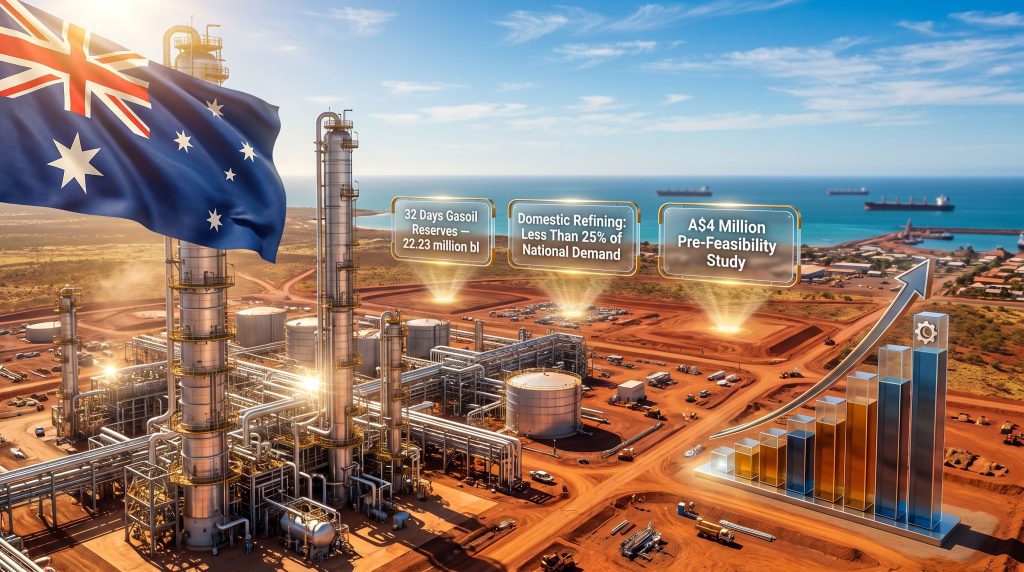
These two refineries collectively serve a country with one of the world's most geographically dispersed industrial economies. Domestic production now meets less than 25% of national fuel demand, meaning that more than three-quarters of Australia's refined fuel requirements travel across international shipping lanes before reaching end users.
The Gasoil Problem: Why Mining Drives the Urgency
Not all fuel types carry equal strategic weight. Gasoline demand, for instance, is already showing early signs of structural moderation. Battery electric vehicle sales reached 23.4% of all new vehicle purchases in Australia during June 2026, up sharply from just 8.3% for the full year of 2025. Gasoline consumption fell by 7.1% year-on-year to 251,000 b/d in May 2026, reflecting both price sensitivity following the onset of the US-Iran conflict and the accelerating EV transition.
Gasoil, however, tells a very different story. Heavy industry, mining, freight, and agricultural operations run on diesel and have no near-term substitute. The Pilbara region, which anchors Australia's iron ore industry, consumes gasoil at a scale that leaves the entire sector exposed to import chain disruptions. Furthermore, the broader iron ore demand outlook adds further complexity to the region's fuel requirements:
- Port Hedland: approximately 40,000 b/d of gasoil imports annually
- Dampier: approximately 21,000 b/d of gasoil imports annually
These are not marginal volumes. A sustained disruption to the shipping routes or loading terminals supplying these ports would not merely inconvenience the mining sector; it would threaten the operational continuity of an industry worth approximately A$90 billion to the national economy.
What the Perdaman Pre-Feasibility Study Actually Involves
Understanding Perdaman's Position and the Study's Scope
The company proposing the refinery, Perdaman, is primarily recognised as a fertiliser producer currently constructing its 2.3 million tonne per year Project Ceres urea plant on the Burrup Peninsula, north of Karratha. Project Ceres has a first production target that could be as early as 2027, though a firm date has not been confirmed. The proposed oil refinery would be co-located within the same broader Pilbara industrial geography, potentially creating infrastructure and logistics synergies — including alignment with existing Pilbara haul road infrastructure — that a standalone greenfield proposal could not replicate.
The refinery's intended capacity has not yet been determined. Establishing whether a commercially viable capacity exists for a Pilbara refinery is precisely what the A$4 million pre-feasibility study is designed to answer.
Key Definition: A pre-feasibility study sits between an initial concept assessment and a full feasibility study. It evaluates whether the technical, economic, environmental, and infrastructure parameters of a proposed project are sufficiently promising to justify the considerably larger expenditure required for a comprehensive definitive feasibility study.
The study will examine:
- Economic viability under realistic market price scenarios for crude feedstock and refined product sales
- Optimal refinery capacity to balance capital efficiency with regional demand requirements
- Infrastructure needs including port integration, logistics corridors, and utilities
- Government support mechanisms that may be required, such as concessional financing or long-term offtake arrangements
- Alignment with national fuel security policy objectives
If the study returns favourable findings and a full feasibility study subsequently confirms viability, any refinery constructed would represent Australia's first new large-scale oil refinery since the 1960s.
The Policy Architecture Behind the Funding Decision
Federal Budget Allocation and the Co-Funding Model
The Australian federal government allocated A$10 million in its most recent federal budget specifically to support feasibility studies into new or expanded domestic refining capacity. This allocation was made approximately three months after the onset of the US-Iran conflict, which sharpened policymakers' awareness of the risks embedded in Australia's import dependency. Consequently, the oil market disruption risks associated with geopolitical instability have become a central driver of this policy response.
The funding is structured as a co-investment model: federal dollars are available only when matched by state or territory government contributions. Western Australia's decision to partner with the federal government on the Perdaman study makes it the first state to activate this co-funding mechanism, establishing a template that other states could follow for separate refinery or fuel security proposals.
| Dimension | Federal Government Role | Western Australian Government Role |
|---|---|---|
| Budget Allocation | A$10mn for national feasibility studies | Co-funding contributor for Perdaman PFS |
| Policy Driver | National supply resilience post-US-Iran conflict | Protecting WA's A$90bn mining sector |
| Study Trigger | Import vulnerability across all states | Pilbara gasoil dependency at Port Hedland and Dampier |
| Combined Study Budget | A$4mn total for Perdaman PFS | Shared contribution |
WA Energy Minister Amber-Jade Sanderson framed the refinery study as a mechanism for building systemic resilience into the state's energy infrastructure and protecting the long-term continuity of its mining economy.
Western Australia's First-Mover Stance on Fuel Reserves
WA's proactive posture on fuel security predates the Perdaman study. In April 2026, the state became the first Australian state to establish its own strategic gasoil reserve, acquiring approximately 25,000 barrels for storage at Wyndham in the Kimberley region. Later that month, the state expanded its holdings by a further ~75,000 barrels distributed across facilities at Esperance and Kwinana. The states of South Australia and Victoria have since followed WA's lead in building their own reserves.
These reserve-building decisions, while prudent, underscore the inadequacy of the current national position. As of 21 July 2026, Australia's fuel stockpile stood at the following levels:
| Fuel Type | Days of Consumption Held | Volume |
|---|---|---|
| Gasoil (Diesel) | 32 days | 22.23 million bl |
| Gasoline (Petrol) | 42 days | 11.41 million bl |
| Jet Fuel | 32 days | 5.61 million bl |
Critical Context: The International Energy Agency recommends that member nations maintain a minimum of 90 days of oil consumption in reserve. Australia's 32-day gasoil buffer falls dramatically short of this benchmark, highlighting why the refinery feasibility investment is being treated as an urgent policy priority rather than a long-term planning exercise.
The Kwinana Lesson: Why Previous Refining Investments Failed
The Structural Economics That Doomed Australian Refining
The BP Kwinana closure provides the most instructive case study for assessing whether a new Perdaman refinery could succeed where its predecessors failed. Kwinana processed 146,000 b/d at its peak and operated for decades as the backbone of WA's fuel supply. Its closure in 2021 was driven by a combination of factors that did not resolve themselves when the plant shut down; they remain present and must be addressed in the Perdaman pre-feasibility study.
Key risk factors that contributed to the wave of Australian refinery closures between 2013 and 2021 include:
- Import cost competitiveness: Singapore-based refineries, along with large-scale facilities across Northeast Asia, operate at structural cost advantages derived from scale, proximity to crude supply, and lower labour costs
- Policy inconsistency: BP's subsequent proposal for a 10,000 b/d renewable diesel and sustainable aviation fuel (SAF) plant at the former Kwinana site was frozen due to uncertainty around government biofuel mandates, illustrating how policy volatility destroys investment confidence
- Capital expenditure burden: Maintaining regulatory compliance and environmental standards across ageing Australian facilities required ongoing capital outlays that could not be recovered in competitive product markets
- Hydrogen investment cancellation: BP also cancelled a proposed 105MW H2Kwinana renewable hydrogen plant in June 2026 after failing to secure state subsidy commitments, reinforcing the pattern of stranded investment decisions in WA's energy transition
The critical question the Perdaman pre-feasibility study must answer is whether a new-build refinery in 2026, benefiting from modern design, optimal capacity sizing, and potential government support mechanisms, changes the fundamental economics sufficiently to avoid repeating this history.
Scenario Analysis: Three Possible Outcomes from the Perdaman Study
What Each Outcome Means for Australia's Energy Future
The pre-feasibility study will ultimately resolve into one of three broad outcome pathways, each with distinct implications for policy, investment, and energy security:
Scenario 1: Full Commercial Viability
The study confirms that regional gasoil demand, access to competitive crude feedstock, port infrastructure, and return on capital metrics support a commercially self-sustaining refinery. Private capital proceeds without sustained government underwriting, and the refinery could conceivably become operational by the early-to-mid 2030s, structurally reducing WA's import dependence.
Scenario 2: Conditional Viability Requiring Government Support
The study identifies a project with viable economics only under specific conditions, such as concessional loan arrangements, long-term offtake guarantees from major mining operators, or ongoing operating support mechanisms. The refinery proceeds as a public-private partnership, achieving fuel security objectives at a fiscal cost. This scenario would set a significant precedent for future industrial policy interventions across Australia's energy sector.
Scenario 3: Non-Viability
The study concludes that construction and operating costs cannot be recovered under realistic market conditions even with government assistance. In this case, the project is shelved, and policy focus redirects toward deepening strategic reserves, diversifying import sources, and managing demand through other mechanisms.
The next major ASX story will hit our subscribers first
The Singapore Protocol: A Complementary Strategy Running in Parallel
Bilateral Agreements as a Short-Term Hedge
On 27 July 2026, Australia and Singapore signed a Protocol on Economic Resilience and Essential Supplies, committing both nations to avoid imposing export restrictions on agreed essential commodities including diesel and LNG. The protocol is being incorporated into the existing Singapore-Australia Free Trade Agreement.
The significance of this agreement is difficult to overstate. Singapore supplies:
- 55% of Australia's gasoline imports
- 15% of Australia's gasoil imports
- 23% of Australia's jet fuel imports
Any policy or conflict-driven disruption affecting Singapore's refining or export capacity would immediately cascade through Australia's fuel supply chain. The protocol provides a diplomatic safeguard against deliberate export restrictions, though it cannot protect against physical supply disruptions caused by conflict, infrastructure damage, or force majeure events.
The Perdaman refinery study and the Singapore protocol are best understood as two complementary tracks within the same national fuel security strategy. The protocol addresses immediate vulnerability through bilateral commitments; the refinery study pursues the longer-term goal of reducing structural import dependence altogether. Neither alone is sufficient.
Key Takeaways for Energy Policy Observers and Industry Stakeholders
The Australia to fund study on new Perdaman oil refinery announcement carries implications that extend well beyond a single A$4 million feasibility exercise. Several structural observations are worth distilling:
- The co-funding model between federal and state governments establishes a replicable mechanism for future energy sovereignty investments across other jurisdictions
- The Pilbara location is strategically deliberate, placing potential refining capacity within direct proximity of Australia's largest gasoil consumption base
- Perdaman's concurrent development of the 2.3 million tonne per year Project Ceres urea plant creates industrial infrastructure context that may offer logistical and operational synergies for a co-located refinery
- The study is a policy signal, not a construction commitment, reflecting government acknowledgement that the current architecture is inadequate without yet knowing whether the commercial solution is viable
- The 32-day gasoil reserve buffer, measured against an international benchmark of 90 days, quantifies the urgency that is driving this investment in feasibility assessment
- The BP Kwinana precedent serves as both a warning and a design brief: any new refinery proposal must directly confront the structural economics that ended its predecessor
Disclaimer: This article contains forward-looking analysis, scenario projections, and commentary on policy developments. It does not constitute financial or investment advice. Outcomes related to the Perdaman pre-feasibility study, refinery construction timelines, and government support mechanisms are subject to significant uncertainty and should not be relied upon for investment decisions without independent verification.
Frequently Asked Questions: Australia's Perdaman Oil Refinery Study
What is the Perdaman oil refinery pre-feasibility study?
A jointly funded study costing A$4 million, contributed by both the Australian federal government and the Western Australian state government, designed to determine whether a new oil refinery proposed by fertiliser company Perdaman is technically and economically feasible for construction in WA's Pilbara region.
Where would the refinery be located?
The proposed site is in the Pilbara region of Western Australia, near Karratha, adjacent to Australia's iron ore mining heartland and close to the major fuel import ports of Port Hedland and Dampier.
Why does Australia need a new oil refinery?
Domestic refining capacity has declined by more than 570,000 b/d since 2013, leaving the country covering less than 25% of its fuel needs domestically. With only 32 days of gasoil reserves on hand and heavy dependence on Singapore and other Asian suppliers, Australia faces acute vulnerability to import chain disruptions.
When could a refinery potentially be operational?
No construction timeline has been established. The pre-feasibility study must be completed before any full feasibility assessment can be commissioned. If all project stages proceed favourably, operational commissioning would realistically extend into the early-to-mid 2030s at the earliest.
What other refineries currently operate in Australia?
Australia retains only two operational refineries: Viva Energy's Geelong refinery in Victoria at 128,000 b/d and Ampol's Lytton plant near Brisbane at 109,000 b/d.
Want to Stay Ahead of the Resource Opportunities Driving Australia's Industrial Future?
Discovery Alert's proprietary Discovery IQ model scans ASX announcements in real time, delivering instant alerts on significant mineral discoveries — so whether Australia's refining sovereignty reshapes Pilbara investment dynamics or unlocks new resource opportunities, subscribers are positioned to act before the broader market. Explore historic examples of major discovery returns and begin your 14-day free trial today.