
August 6, 2026
The Hidden Cost of Three Decades of Refinery Closures
When an economy systematically dismantles its domestic production infrastructure over thirty years, the vulnerabilities created are not immediately visible. They accumulate quietly, masked by the apparent efficiency of global supply chains, until a geopolitical disruption strips away that illusion entirely. Australia is now confronting precisely this reality within its liquid fuel sector, where decades of refinery closures have left the nation structurally exposed in ways that only become apparent when international supply routes come under pressure.
The proposal to build Australia's first domestic oil refinery in 60 years is not simply an infrastructure announcement. It is an acknowledgment that the economic logic which drove Australia's refining capacity offshore has collided with a new geopolitical reality, one where the cost of import dependency is no longer theoretical.
When big ASX news breaks, our subscribers know first
Australia's Fuel Import Dependency: A Structural Problem Decades in the Making
From Eight Refineries to Two: The Long Retreat
At the turn of the millennium, Australia maintained eight operational domestic oil refineries, a network built primarily during the 1950s and 1960s when energy self-sufficiency was considered a fundamental pillar of national infrastructure policy. That era's logic was straightforward: a geographically isolated continent, distant from major refining hubs, needed the capacity to process its own fuel.
What followed over the next quarter century was a systematic retreat driven by economics. Large-scale refining facilities constructed across Asia, particularly in South Korea, Singapore, and India, introduced processing capacities and cost structures that Australian facilities built for a domestic market simply could not match. High labour costs, regulatory compliance expenses, and the relatively small throughput volumes of Australian refineries all contributed to an uncompetitive cost base.
By mid-2026, only two domestic refineries remain operational:
- Ampol's Lytton refinery in Brisbane, Queensland
- Viva Energy's Geelong facility in Victoria
Both are located on Australia's eastern seaboard, leaving the country's western half entirely dependent on imported refined product.
Western Australia's Complete Refining Void
The most stark illustration of this structural retreat is Western Australia's current position. In 2021, BP converted its Kwinana refinery into a fuel import terminal. At the time of closure, Kwinana was processing 146,000 barrels per day, making it a facility of genuine scale. Its conversion was not a surprise — it followed the same economic logic that had claimed every other closure before it.
What made the Kwinana decision particularly consequential was geography. Western Australia is not only Australia's largest state by area, it is also home to the Pilbara region, one of the world's most resource-intensive industrial corridors. Mining and resources operations in the Pilbara consume enormous volumes of diesel and refined fuel products. Sourcing all of that from import terminals introduces a supply chain dependency that has no domestic redundancy whatsoever.
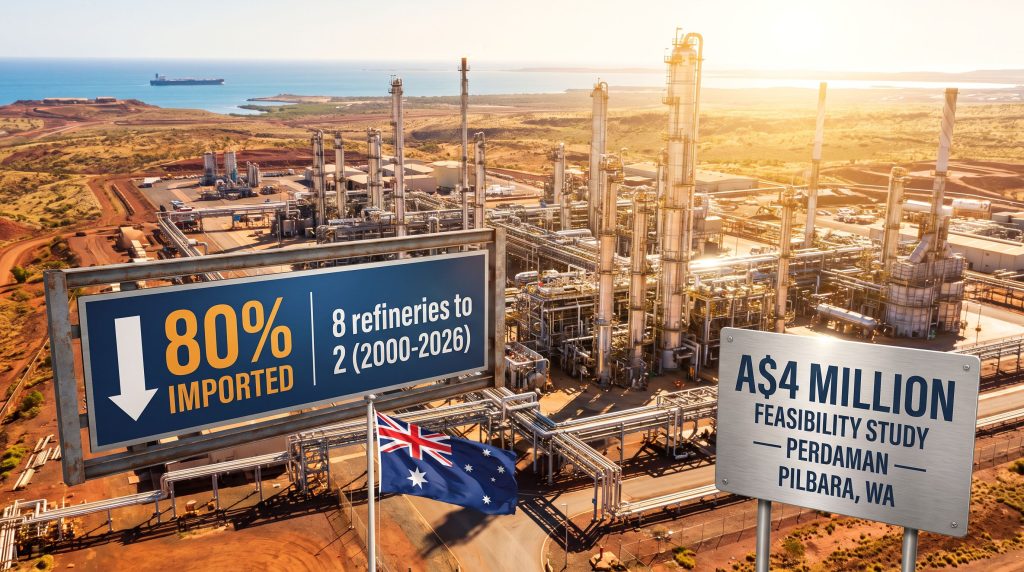
The transition from eight refineries in 2000 to two in 2026 represents a 75% reduction in domestic refining infrastructure. That contraction has left approximately 80% of Australia's total fuel requirements sourced from overseas markets.
Furthermore, Australia's resource and energy exports face compounding pressure when the fuel infrastructure underpinning those very operations remains wholly import-dependent. This creates a strategic vulnerability that extends well beyond the domestic energy market.
The Geopolitical Trigger: Why 2026 Is the Inflection Point
Middle East Conflict and the Fragility of Global Fuel Markets
Australia's fuel import exposure has been a known policy concern for years, but urgency crystallised in 2026 as conflict in the Middle East intensified and its effects rippled through global refined fuel markets. The transmission mechanism is not always direct. Australia does not import exclusively from the Middle East, but global oil and refined product markets are interconnected, meaning regional supply disruptions alter inventory levels, shipping costs, and price benchmarks across all import-dependent economies.
An Australian Treasury briefing provided to Treasurer Jim Chalmers over the weekend prior to the announcement identified that global oil markets had developed weaker buffers against supply shocks, with inventory levels declining as Middle Eastern conflict intensified. Refined fuel markets were assessed as being at risk of further tightening, a conclusion that moved the refinery question from long-term policy consideration to near-term strategic priority. Reporting from Capital Brief confirms that discussions between the Albanese government and Perdaman have been ongoing as this strategic urgency mounted.
The Sovereign Capability Framing
Prime Minister Anthony Albanese made the refinery announcement on 28 July 2026 from Karratha in Western Australia's Pilbara region, a location choice that was itself deliberate. Speaking from the heart of Australia's resource extraction corridor, where fuel supply continuity is operationally critical, Albanese framed domestic refining capacity as a matter of national resilience and sovereign capability rather than purely commercial infrastructure.
This framing matters because it shifts the cost-benefit calculus. When domestic refining is assessed purely against import cost benchmarks, it almost always loses. Asian mega-refineries operating at economies of scale will typically undercut the cost of domestic production in a smaller market like Australia. However, when refining capacity is assessed through the lens of sovereign capability, the equation includes risk premiums, strategic redundancy, and the cost of supply disruption — factors that conventional economic modelling historically underweights.
This same sovereign capability language has emerged across multiple Australian industrial policy debates in recent years, spanning defence manufacturing, critical minerals processing, and pharmaceutical supply chains. The refinery proposal is best understood as part of this broader pattern of strategic reassessment rather than as an isolated energy policy decision.
The Perdaman Proposal: Scope and Feasibility
Who Is Perdaman and Why Western Australia?
Perdaman is an industrial chemical producer with existing operations in Western Australia. The company has been identified as the proposed developer of the new large-scale refinery, with the Pilbara region, and specifically the Karratha area, cited as a potential site. The location carries genuine strategic logic beyond symbolic politics.
Key factors supporting the Pilbara site include:
- Proximity to offshore oil and gas infrastructure along Western Australia's northwest shelf
- Established deep-water port infrastructure capable of handling large vessel volumes
- Position within Australia's primary resource extraction corridor, where fuel demand is both large and geographically concentrated
- Existing industrial zoning and workforce infrastructure from the LNG and resources sector
The A$4 Million Feasibility Study: What It Actually Determines
The Australian federal government and Western Australian state government have jointly committed A$4 million (approximately USD $2.8 million) to fund a feasibility study for the proposed facility. It is important to contextualise what this investment represents and what it does not.
A$4 million is not a construction commitment. It is a structured decision gate, designed to answer the questions that must be resolved before any capital commitment becomes rational:
- Site selection from candidate locations within Western Australia
- Economic viability modelling against import terminal alternatives
- Capital cost estimation for construction of a large-scale refining facility
- Supply chain integration analysis covering crude input sources and refined product distribution
- Demand projection for domestic fuel consumption over a 20–30 year operational horizon
Industry context is critical here. While the feasibility study itself costs A$4 million, constructing a new large-scale oil refinery is broadly estimated to require billions of dollars in capital investment. The study will determine whether that capital commitment can be justified on economic, strategic, or combined grounds.
The Economic Viability Challenge: Why This Is Hard
The Cost Competitiveness Gap
The core tension that closed Australia's previous refineries has not disappeared. Australian operational costs, encompassing labour, regulatory compliance, and environmental standards, remain structurally higher than competing Asian refining hubs. A new refinery built in 2026 or later would face these same competitive pressures, likely intensified by the capital servicing costs of modern construction.
The two refineries that have survived — Ampol's Lytton and Viva Energy's Geelong facility — have done so with the assistance of government support mechanisms. This precedent is directly relevant to assessing the viability of a new facility. In addition, the energy transition in mining across Western Australia's resource sector is gradually reshaping demand patterns, a factor the feasibility study will need to account for carefully.
Import Terminal vs. Domestic Refinery: The Strategic Trade-Off
| Factor | Import Terminal Model | Domestic Refinery Model |
|---|---|---|
| Capital Cost | Low (conversion) | High (billions AUD) |
| Operational Cost | Lower | Higher (vs. Asian peers) |
| Supply Chain Risk | High (import-dependent) | Lower (domestic processing) |
| Strategic Value | Minimal | High (sovereign capability) |
| Employment Impact | Limited | Significant |
| Geopolitical Resilience | Vulnerable | Resilient |
What Government Support Might Look Like
For a domestic refinery to be commercially viable in competition with Asian mega-refineries, some form of structural government support is almost certainly necessary. Mechanisms under consideration could include:
- Long-term offtake agreements from government and defence sector users providing revenue certainty
- Capital co-investment reducing the private sector's upfront exposure
- Operational subsidies benchmarked against the import price differential
- Mandated domestic content requirements for government fuel procurement
Albanese stated clearly that the project must demonstrate economic viability before proceeding, signalling that commercial feasibility remains a genuine threshold condition rather than a foregone conclusion.
Three Scenarios: Where This Project Could Land
Scenario 1: Full Project Proceeds
If the feasibility study returns a favourable outcome across site selection, capital cost modelling, and long-term demand projections, a full project commitment becomes possible. Major refinery construction projects typically require 5 to 10 years from approval to first output, meaning a facility commissioned today would not be operational until the early-to-mid 2030s at the earliest. The employment and economic multiplier effects for the Pilbara region would be substantial across both the construction and operational phases.
Scenario 2: Scaled-Down or Specialised Facility
A modified outcome — perhaps a smaller refinery focused on aviation fuel, defence-grade products, or specific refined products where supply security is most critical — represents a credible middle path. This approach would reduce capital requirements and operational complexity while still delivering targeted sovereign capability in the highest-priority product categories.
Scenario 3: Alternative Policy Mechanisms
If the feasibility study identifies structural barriers that cannot be overcome within a commercially viable model, the policy response may pivot toward strengthening minimum stockholding requirements, diversifying import sources away from Middle East dependency, or accelerating electrification of transport to structurally reduce liquid fuel demand over the medium term.
The feasibility study is not a rubber stamp. It is a genuine decision gate. The A$4 million committed to the study reflects the government's willingness to invest in rigorous analysis before committing billions in capital — a structurally sound approach to major infrastructure planning.
The next major ASX story will hit our subscribers first
The Gladstone Parallel and the Question of Market Size
Separate refinery proposals have also been reported for Gladstone, Queensland, distinct from the Western Australia study and without the same level of confirmed government involvement. The existence of parallel proposals raises an important structural question that the feasibility study will need to address: does Australia's domestic fuel demand actually support more than one new refinery?
The answer is not self-evident. Australia's liquid fuel demand is significant but not unlimited, and the economics of refinery construction are heavily dependent on throughput volume. A market that might support one viable facility would likely not sustain two competing domestic refineries both seeking government support to bridge the gap with Asian import costs.
Fuel Security Within Australia's Broader Energy Policy Architecture
The Decarbonisation Tension
Perhaps the most complex dimension of this proposal is its relationship to Australia's climate and energy transition commitments. Investing in new oil refining infrastructure carries a useful life expectation of several decades, a timeframe that sits uncomfortably alongside decarbonisation trajectories that anticipate substantial reductions in liquid fuel consumption as electrification of transport accelerates.
Governments globally are navigating this same tension, with the dominant emerging logic being that fossil fuel infrastructure investment during a transition period is justified on security grounds even where it conflicts with longer-term climate targets. A domestic refinery in this context functions as a bridge asset, providing supply security during the transition rather than as a permanent feature of a post-transition energy economy.
Existing Policy Frameworks and the Stockholding Gap
Australia already maintains fuel security standards and minimum stockholding obligations, but these requirements address the volume of refined product held in reserve rather than the domestic capacity to produce it. The refinery proposal addresses a fundamentally different dimension of supply security, one that stockholding requirements alone cannot resolve if global supply routes face sustained disruption.
The intersection of this proposal with Australia's critical minerals strategy is also worth noting. Western Australia's Pilbara region is central to both the resources sector's fuel demand and the critical minerals extraction that underpins global battery and technology supply chains. A domestic refinery serving this corridor would support not only general fuel security but also the operational continuity of mining and processing operations that carry their own strategic significance.
Consequently, the refinery discussion connects to broader industrial transformation underway in Australia. Initiatives such as green iron production and South Australia's green iron push reflect a wider national effort to build sovereign industrial capability across multiple sectors simultaneously. The Queensland state government's own refinery history — with its final fully functioning facility now turning 61 — underscores just how long Australia has gone without building new refining infrastructure.
Key Data Reference: Australia's Oil Refining Landscape
| Metric | Data Point |
|---|---|
| Current domestic fuel import dependency | ~80% |
| Operational refineries (2026) | 2 |
| Operational refineries (2000) | 8 |
| Kwinana refinery closure year | 2021 |
| Kwinana processing capacity at closure | 146,000 barrels per day |
| Feasibility study budget | A$4 million (~USD $2.8M) |
| Proposed developer | Perdaman |
| Proposed location | Western Australia (Pilbara region) |
| Original refinery construction era | 1950s to 1960s |
| Announcement date | 28 July 2026 |
Frequently Asked Questions
Why would Australia's first domestic oil refinery in 60 years be significant?
The proposed Perdaman facility would be the first large-scale domestic oil refinery constructed in Australia since the 1950s and 1960s era of refinery building. Its significance lies not only in adding processing capacity but in addressing a fundamental sovereign capability gap that has left Australia sourcing approximately 80% of its fuel from overseas markets.
Why did so many Australian refineries close?
The closures were driven by structural cost disadvantages relative to large-scale Asian refining facilities. Australian refineries, built for a domestic market, could not match the throughput volumes or cost efficiencies of regional competitors, making them progressively unviable without sustained government intervention.
What is the realistic timeline if the project proceeds?
Major refinery construction projects of this scale typically require between 5 and 10 years from final investment decision to first output. A project approved following a positive feasibility study result would therefore not be operational before the early-to-mid 2030s under optimistic assumptions.
Does the feasibility study commitment mean the refinery will be built?
No. The A$4 million feasibility study is a structured decision gate, not a construction commitment. Prime Minister Albanese has stated explicitly that the project must demonstrate economic viability before proceeding. The study will determine whether that threshold can be met.
Disclaimer: This article contains forward-looking statements, scenario projections, and policy analysis based on information available at the time of writing. Infrastructure feasibility outcomes, construction timelines, and government support mechanisms are subject to change. This content is for informational purposes only and does not constitute financial or investment advice. Readers are encouraged to consult independent sources and professional advisers before drawing conclusions relevant to investment or commercial decisions.
Want to Track the ASX Stocks That Could Benefit From Australia's Resource Sector Shifts?
Infrastructure decisions of this scale — from refinery construction to critical minerals processing — reshape the investment landscape across Australia's resource sector. Discovery Alert's proprietary Discovery IQ model delivers real-time alerts the moment significant ASX mineral discoveries are announced, transforming complex data across more than 30 commodities into clear, actionable insights for both short-term traders and long-term investors. Begin your 14-day free trial today and explore historic discovery outcomes that demonstrate just how transformative early positioning on major finds can be.