August 6, 2026
When a Training Academy Becomes a Flashpoint: Resource Governance and the Geography of Benefit in Mozambique
Across Africa's extractive industries, a persistent structural problem has quietly shaped community relationships with large-scale resource projects for decades. The pattern is familiar: natural wealth is drawn from peripheral regions, often among the most economically marginalised in a country, while the institutional infrastructure built to manage and support that extraction gravitates toward capital cities and their established networks. Training academies, procurement offices, regulatory bodies, and centres of professional development tend to cluster where political power already resides. The communities living closest to the extraction site absorb the environmental disruption, the security pressures, and the social upheaval, yet find themselves at the back of the queue when it comes to receiving the promised developmental dividends.
This dynamic is now playing out in sharp relief in northern Mozambique, where the Mozambique LNG Academy backlash in Cabo Delgado has crystallised a debate that goes well beyond the logistics of where a technical training program should be hosted. It touches on post-conflict recovery, the credibility of local content commitments, and the fundamental question of whether mega-project governance in Africa can be reformed from the inside out. Furthermore, it raises broader questions about mining sustainability transformation and whether current approaches are genuinely fit for purpose.
When big ASX news breaks, our subscribers know first
Understanding the Mozambique LNG Academy: Structure, Scale, and Intent
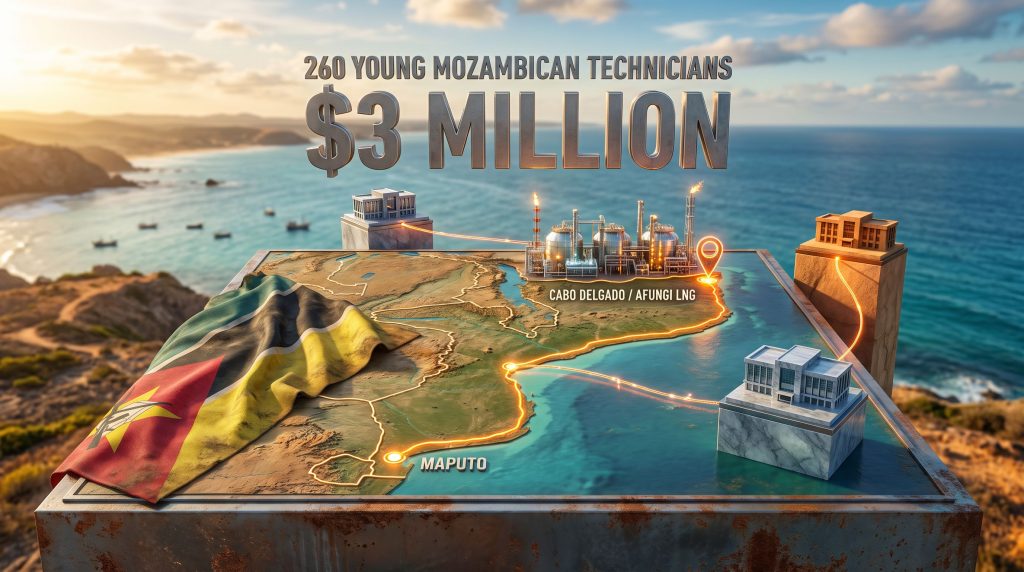
On July 28, three institutional parties formalised an agreement that was presented as a milestone in Mozambique's effort to build a domestic workforce for its emerging LNG sector. TotalEnergies, Mozambique's Ministry of Education, and the Matola Industrial and Commercial Institute signed a $3 million accord to establish the Mozambique LNG Academy, with the stated goal of training 260 young Mozambican technicians for operational and maintenance roles at the Afungi LNG complex in Palma, Cabo Delgado province.
The program architecture was structured in two phases:
| Phase | Duration | Location | Primary Focus |
|---|---|---|---|
| Classroom Instruction | 1 year | Matola Industrial and Commercial Institute, Maputo area | Technical theory, foundational skills |
| Practical Training | 3 years | Afungi LNG site, Palma, Cabo Delgado | Hands-on operations and maintenance |
The academy was not designed in isolation. It sits within a broader local content ecosystem that the operating consortium has built around the Afungi project. According to figures provided by the consortium, over 9,000 Mozambican workers are currently engaged in construction activities at the site. Capacity-building support has been extended to approximately 500 small and medium-sized enterprises, and more than 1,700 young Mozambicans had already received technical training before the academy's formal establishment.
In March, TotalEnergies held a procurement seminar in Pemba specifically to present supply chain opportunities to local businesses, a move that positioned Pemba as a meaningful node in the project's commercial network. That context made the subsequent decision to anchor Phase 1 training in Maputo all the more jarring for Cabo Delgado stakeholders.
The FOCADE Statement: Civil Society Draws a Line
Exactly one week after the academy's launch, on August 4, the Forum of Civil Society Organizations of Cabo Delgado issued a formal statement opposing the geographic placement of the initial training phase. FOCADE's intervention was notable for its precision: the group did not oppose the academy as a concept, nor did it dispute the value of training 260 technicians for the LNG sector. The objection was structural and philosophical.
FOCADE's argument, reframed analytically, rests on a principle of proportional benefit. A province that absorbs the disruption of industrial mega-project development, including displacement of communities near the Afungi peninsula, heightened security pressures, and years of accumulated uncertainty, must also become a centre of the knowledge economy that the project generates. The group contended that Pemba, as the provincial capital and the operational coordination hub for the LNG project since construction resumed in January, already possesses the institutional capacity to host a training program of this nature.
The civil society position can be distilled into a core governance challenge:
Local content policies that are designed and administered at the national level frequently favour institutions embedded in capital city networks, producing a structural bias against host communities that is rarely visible in project documentation but acutely felt on the ground.
This is not a minor complaint about inconvenience. For trainees from Cabo Delgado, relocating to Maputo for a year of instruction represents a significant personal and financial burden, one that may deter participation from exactly the communities the academy is intended to serve.
Why Does Location Matter So Much?
The geographic dimension of this dispute is inseparable from the broader context of natural capital in mining and resource extraction. Consequently, when training infrastructure is placed far from the host community, it signals a prioritisation of institutional convenience over genuine community investment. This perception, however unintended, compounds existing grievances in a province already scarred by conflict and broken development promises.
The Provincial Business Council Joins the Chorus
What distinguishes this episode from routine civil society activism is the breadth of the coalition that formed against the Maputo-based model. The Provincial Business Council of Cabo Delgado independently aligned with FOCADE's position, adding an economic dimension to what might otherwise have been framed as a purely social concern.
The business community's argument follows a straightforward logic: training 260 technicians to operate facilities located in Afungi should, both practically and ethically, occur within the province. Embedding training infrastructure in Cabo Delgado would create secondary economic activity, support local hospitality, transport, and services sectors, and reinforce the province's long-term position as a centre of technical expertise rather than simply a site of extraction.
The convergence of civil society and business voices signals something important: the concern about the academy's location is not ideologically narrow. It reflects a shared assessment among diverse stakeholders that the current model is misaligned with both the spirit and the practical outcomes of local content policy.
A Structural Critique: Capital Bias and the Northern Periphery
Mozambican researcher João Feijó has articulated a deeper structural critique of the situation, arguing that the decision to locate training in the south reflects a long-standing pattern in which Mozambique's central government tends to overlook the needs and capacities of northern populations when designing nationally significant programs. Feijó's concern is that this pattern, if left unaddressed, risks compounding social discontent in a province that has already endured years of Islamist insurgency, mass displacement, and broken development expectations.
This observation deserves particular weight. Cabo Delgado has been the epicentre of an armed insurgency since 2017, a conflict that forced TotalEnergies to declare force majeure and suspend all operations in April 2021. The human cost of that period, measured in displacement, loss of life, and destroyed livelihoods, was borne overwhelmingly by northern communities. Construction at Afungi resumed in January following improved security conditions, but the social landscape of Cabo Delgado remains deeply fragile.
Against that backdrop, the impacts of the LNG industry on Cabo Delgado are already extensive and well-documented. A training academy that routes its first year of instruction through a capital city institute, more than 2,000 kilometres from the project site, carries a symbolic weight that cannot be dismissed as merely logistical. It reinforces, perhaps unintentionally, a governance hierarchy in which Maputo decides and the north delivers.
How Does This Reflect Wider Governance Patterns?
The mining geopolitical landscape across southern and eastern Africa reveals that this is far from an isolated case. However, Mozambique's particular combination of post-conflict fragility, resource wealth concentration, and institutional centralisation makes the stakes here unusually high. Effective mining risk communication between operators and host communities is therefore not merely a best-practice recommendation — it is an operational necessity.
How the Current Model Compares to Best-Practice Local Content Standards
Across Africa's major LNG and extractive industries, a maturing body of practice has emerged around what genuinely effective local content looks like at the community level. Comparing the Mozambique LNG Academy's current design against these benchmarks reveals meaningful gaps:
| Criterion | Mozambique LNG Academy (Current) | Best-Practice Local Content Model |
|---|---|---|
| Training location | Maputo (Matola), ~2,000 km from project site | Host province or adjacent region |
| Community integration | Limited during Phase 1 | Embedded from program inception |
| SME linkage | Broader consortium program (500 SMEs) | Formal integration with training pipeline |
| Institutional anchoring | National ministry and capital-city institute | Provincial institutions as co-anchors |
| Phase 1 duration | 1 year in Maputo | Typically aligned with host-region delivery |
| Practical training | 3 years at Afungi | Aligned with operational phase timelines |
It is worth acknowledging the legitimate operational consideration on the other side of this debate. The Matola Industrial and Commercial Institute may possess specialised technical infrastructure, equipment, or curriculum depth that is not yet replicated in Pemba. If that is the case, it represents a genuine constraint rather than simple indifference to Cabo Delgado. However, what is striking is that TotalEnergies and the Ministry of Education have not publicly addressed this question directly, leaving a transparency gap that civil society has moved to fill with its own interpretations.
The next major ASX story will hit our subscribers first
Social Licence to Operate: The Hidden Cost of Early Community Alienation
The concept of social licence to operate has become a core framework in extractive industry risk management. Unlike a regulatory permit or a contractual obligation, social licence cannot be obtained through a signing ceremony or a press release. It is earned incrementally through consistent, verifiable evidence that a project's benefits are reaching the communities that bear its costs, and it can be lost rapidly when that evidence is absent.
The speed with which organised opposition to the academy emerged, within seven days of its launch, is a meaningful data point. It suggests that the reservoir of trust available to the Mozambique LNG project in Cabo Delgado is not deep. For a facility designed to operate for several decades, that is a material risk, not a reputational footnote.
Several risk dimensions compound for the operating consortium if the backlash is not addressed constructively:
- Reputational exposure: International scrutiny of TotalEnergies' community engagement practices in Cabo Delgado has been sustained and critical; the academy controversy adds a new, concrete dimension to that record
- Operational continuity: Sustained community grievance in a post-insurgency environment can translate into security vulnerabilities and project disruption in ways that are difficult to anticipate or contain
- Regulatory evolution: Mozambique's local content legislation may face pressure to introduce geographic specificity requirements, mandating that host-province communities receive training benefits directly rather than through capital-city intermediaries
- Talent pipeline risk: If trainees from Cabo Delgado find the Maputo-based model inaccessible, the academy may fail to reach its intended beneficiary population, undermining the entire rationale for the program
What Would a More Equitable Model Look Like?
The path forward does not necessarily require dismantling what has already been agreed. A hybrid governance model, one that acknowledges the Matola Institute's existing capacity while committing to an accelerated transition toward Pemba-based delivery, would address the core concern without abandoning the program's operational foundations.
Specific steps worth considering include:
- Transparent justification of the criteria used to select the Matola Institute as Phase 1 host, published in accessible language for Cabo Delgado stakeholders
- Formal engagement with FOCADE and the Provincial Business Council as co-designers of the academy's governance structure, not merely as recipients of its outputs
- A provincial capacity roadmap that identifies what infrastructure, equipment, or accreditation Pemba institutions would need to host future cohorts, with committed timelines
- A scholarship or relocation support mechanism for trainees from Cabo Delgado who must relocate to Maputo during Phase 1, reducing the financial barrier to participation
- A hybrid delivery pilot in which a portion of foundational instruction is delivered in Pemba through partner institutions, running concurrently with Matola-based classes
In addition, responsible mining training frameworks developed across comparable African contexts consistently demonstrate that embedding host communities as genuine partners, rather than passive beneficiaries, produces more durable and operationally stable outcomes over the lifecycle of a project.
Frequently Asked Questions: Mozambique LNG Academy and Cabo Delgado
What is the Mozambique LNG Academy?
A technical training program established through a $3 million tripartite agreement between TotalEnergies, Mozambique's Ministry of Education, and the Matola Industrial and Commercial Institute. It aims to prepare 260 young Mozambican technicians for operational and maintenance roles at the Afungi LNG complex in Cabo Delgado.
Why is there a Mozambique LNG Academy backlash in Cabo Delgado?
Civil society groups, business councils, and researchers object to the decision to conduct Phase 1 training in Maputo rather than in Cabo Delgado, where the project is located. They argue this undermines local content principles and denies host communities access to the institutional benefits of a project they have borne significant costs to support.
Who is FOCADE?
FOCADE is the Forum of Civil Society Organizations of Cabo Delgado, a civil society body that advocates for the rights and development interests of communities in the province. They issued a formal statement on August 4, one week after the academy's launch, opposing the Maputo-based training model.
How far is Maputo from the Afungi LNG site?
Maputo is located more than 2,000 kilometres from Cabo Delgado province, where the Afungi LNG complex and the communities most directly affected by the project are situated.
What is the current status of the Mozambique LNG project?
Construction at Afungi resumed in January following a suspension caused by the Cabo Delgado insurgency, which led TotalEnergies to declare force majeure in April 2021. The project currently engages over 9,000 Mozambican workers and is expected to operate for multiple decades.
What does local content mean in the context of LNG projects?
Local content refers to the requirement that a meaningful portion of employment, procurement, training, and institutional investment generated by a large-scale project benefit nationals of the host country and, ideally, communities in the host province. In the Mozambique context, this includes workforce development programs like the LNG Academy, SME procurement support, and technical training initiatives.
Key Takeaways: What the LNG Academy Dispute Reveals About Resource Governance in Africa
- Geographic specificity matters: Broad national-level commitments to workforce development are insufficient when they structurally favour capital-city institutions over host-province communities
- Civil society mobilisation is faster and more organised: The seven-day window between the academy's launch and FOCADE's formal statement reflects a more assertive, better-informed civil society landscape in Cabo Delgado than may have existed a decade ago
- Business and civil society alignment amplifies pressure: When commercial interests and social advocates converge on the same concern, the legitimacy of that concern becomes harder for project operators to dismiss
- Social licence compounds over time: For a project designed to run for decades, every early misstep in community relations creates a compounding liability that becomes progressively more expensive to resolve
- Hybrid governance models offer the most durable path forward: Embedding provincial institutions, civil society bodies, and local business councils as co-designers of local content delivery, rather than passive recipients, is increasingly recognised as the standard for durable community acceptance in African extractive industries
This article is intended for informational and analytical purposes. It does not constitute financial, investment, or legal advice. Readers seeking to act on information related to the Mozambique LNG project or affiliated companies should consult qualified professional advisers. Forward-looking statements and scenario projections are speculative in nature and subject to material change based on evolving political, security, and regulatory conditions in Mozambique.
Want to Stay Ahead of the Next Major Resource Discovery Before the Market Moves?
Discovery Alert's proprietary Discovery IQ model scans ASX announcements in real time, instantly identifying significant mineral discoveries and translating complex data into clear, actionable opportunities — whether you're a short-term trader or a long-term investor. Explore how historic discoveries have delivered exceptional returns and begin your 14-day free trial at Discovery Alert to position yourself ahead of the broader market.