August 6, 2026
The Hidden Architecture of Energy Vulnerability: Why Mexico's Gas Strategy Is Bigger Than Fracking
Energy security debates often fixate on production volumes, overlooking the structural architecture that determines whether supply gains actually translate into resilience. Mexico's evolving position on unconventional gas extraction is a case study in exactly this distinction. The country sits atop geological formations with transformative resource potential, yet its domestic energy system remains structurally exposed in ways that drilling programmes alone cannot fully address.
Understanding the full picture of Mexico fracking pilots in Tamaulipas and Coahuila requires looking beyond wellhead economics. It demands an honest assessment of regulatory architecture, storage deficits, water constraints, geopolitical dynamics, and the layered environmental governance frameworks that will ultimately determine whether this policy evaluation becomes a functioning production programme, or stalls at the pilot stage indefinitely.
When big ASX news breaks, our subscribers know first
Why Mexico's Natural Gas Import Dependency Has Become a Strategic Liability
The 75% Problem: Quantifying Mexico's Exposure to US Gas Supply Chains
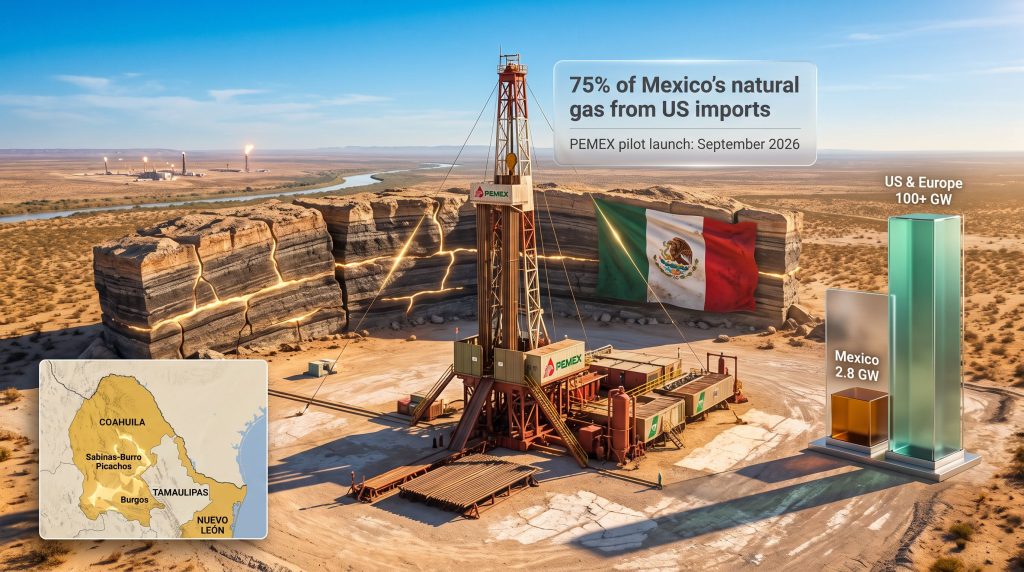
Mexico's natural gas supply structure is built on a single dominant pillar: imported gas from the United States. Approximately 75% of national consumption arrives via pipeline infrastructure connecting to Texas production fields, creating a dependency relationship that is simultaneously cost-effective under normal market conditions and acutely vulnerable when those conditions shift.
This is not a theoretical risk. Cross-border supply chains face exposure to price volatility, seasonal demand spikes, infrastructure outages, and the global trade war impacts that exist entirely outside Mexico's control. PEMEX's domestic production currently averages 4.84 billion cubic feet per day (Bcf/d) of natural gas, alongside 1.65 million barrels per day (MMb/d) of crude oil and condensate. These figures have come under sustained pressure as conventional reserves experience structural decline, narrowing the domestic production buffer available when import flows are disrupted.
The arithmetic is straightforward but sobering. If US export infrastructure experiences a disruption comparable to the February 2021 Texas freeze event, Mexico's ability to absorb that shock through domestic reserves and storage is fundamentally limited.
Storage Infrastructure as the Hidden Vulnerability
The deeper and less-discussed dimension of Mexico's gas vulnerability is not its production shortfall but its storage deficit. Mexico holds approximately 2.8 gigawatts (GW) of natural gas storage capacity, a figure that sits in stark contrast to the more than 100 GW deployed across European and US energy systems.
Juan Paulo Cervantes, Commercial Director at Solensa, has articulated this distinction clearly in industry forums. His core argument is that pipeline connectivity and storage capacity are fundamentally different risk management instruments, and conflating the two creates a dangerous blind spot. A well-connected pipeline grid can move gas efficiently under normal operating conditions, but it cannot absorb demand spikes or upstream supply failures when no buffer exists.
Mexico's grid is pipeline-rich but storage-poor, meaning disruptions propagate through the system with minimal dampening capacity. Furthermore, this storage gap is a critical piece of context for evaluating the fracking pilot programme.
Key Insight: The gap between pipeline reach and storage depth represents a compounding risk factor. Even substantial gains in domestic production from unconventional sources cannot substitute for the buffering function that large-scale storage provides. These are complementary investments, not interchangeable ones.
Production increases are necessary but not sufficient for genuine energy security. Without parallel investment in underground storage capacity, LNG regasification terminals, and pipeline redundancy, Mexico remains structurally exposed regardless of what happens at the wellhead. The LNG supply outlook for 2025 and beyond adds further context to this structural challenge.
What Are the Mexico Fracking Pilots in Tamaulipas and Coahuila?
Defining the Pilot Scope: What Is Currently Under Evaluation
President Claudia Sheinbaum's administration is actively evaluating pilot hydraulic fracturing projects across the northern states of Coahuila and Tamaulipas. Importantly, as of the most recent reporting, no official federal approval has been issued. The programme remains in the technical assessment and policy review phase, with the findings of a dedicated scientific committee serving as the primary input into the final policy decision.
If authorised, PEMEX has been positioned to commence initial pilot operations as early as September 2026, according to Reuters reporting citing four sources familiar with the discussions. This timeline is contingent on federal authorisation and does not account for the additional regulatory processes that would be required before commercial-scale deployment could begin.
The administration's shift from its earlier opposition to hydraulic fracturing reflects a recalibrated position on newer extraction technologies. Federal officials have indicated that advances in biodegradable chemical additives and closed-loop water recycling systems may offer materially lower environmental impacts than conventional fracturing methods, prompting a reassessment rather than a reversal of principle.
The Target Basins and Their Geological Significance
Mexico's unconventional resource base is distributed across several geologically distinct formations, each with different characteristics, challenges, and development priorities.
| Basin | Location | Key Characteristic |
|---|---|---|
| Sabinas-Burro Picachos | Coahuila (near US border) | Priority evaluation zone; adjacent to Eagle Ford formation |
| Burgos | Coahuila / Nuevo León / Tamaulipas | Established unconventional gas potential |
| Tampico-Misantla | Veracruz / Tamaulipas | Largest unconventional hydrocarbon potential in Mexico |
| Chicontepec | Veracruz | Prior PEMEX hydraulic fracturing activity documented |
Current government assessments are prioritising the Burro-Picachos platform in Coahuila, a sparsely populated zone that borders the Eagle Ford Shale in Texas. The geological proximity to Eagle Ford is significant as a performance benchmark. That formation produced 4.3 Bcf/d of gas in June, a volume broadly comparable to PEMEX's entire national output, illustrating the scale of unconventional potential available in structurally adjacent territory.
While the Tampico-Misantla basin holds Mexico's largest unconventional hydrocarbon potential, water scarcity constraints and population density make Burro-Picachos the administratively and operationally simpler starting point.
PEMEX's Existing Unconventional Footprint
PEMEX is not entering unconventional territory without any prior experience. The national oil company has already drilled 25 exploratory wells across the Sabinas-Burro Picachos, Burgos, and Tampico-Misantla basins. Hydraulic fracturing techniques have been deployed previously at the Chicontepec project, establishing a limited but documented operational baseline.
These activities provide a technical foundation for pilot scale-up, but they fall well short of the commercial-scale deployment being evaluated. The gap between exploratory drilling and sustained unconventional production requires a fundamentally different capital and operational commitment.
How Does PEMEX's Unconventional Strategy Fit Into Its 2035 Development Framework?
Production Trajectory and Reserve Projections
PEMEX's unconventional strategy is structured around a phased development timeline that acknowledges both the technical complexity and capital intensity involved.
| Time Period | Strategic Phase | Projected Output |
|---|---|---|
| 2026–2028 | Pilot and early-scale development | Modest incremental volumes |
| 2029–2030 | Scaled unconventional ramp-up | Larger commercial volumes |
| Through 2030 (cumulative) | Full unconventional programme | 197 MMb crude oil + 303 billion ft³ natural gas |
| Overall resource potential | Basin-level estimate | ~64 billion barrels of oil equivalent |
The phased structure is technically rational. Shale and tight gas formations exhibit steep production decline curves, a characteristic that distinguishes unconventional resources from conventional reservoirs in a critical way. Output from individual horizontal wells typically drops by 60–80% within the first 12 to 18 months of production, requiring a continuous drilling programme to maintain aggregate output levels.
This is not a one-time capital investment but an ongoing industrial operation requiring sustained well inventory and capital deployment. Scaling to volumes that would meaningfully reduce Mexico's 75% import dependency would require hundreds of wells across multiple basins, consistent multi-year capital allocation, and the development of a supporting services ecosystem that does not currently exist at scale within Mexico.
Industry Reality Check: The rapid decline rate of unconventional wells is one of the most frequently misunderstood dynamics in shale economics. A production target is not achieved through a fixed number of wells but maintained through continuous drilling activity. This has profound implications for capital planning, cost forecasting, and long-term fiscal commitments.
What Environmental and Regulatory Barriers Could Delay or Block the Programme?
The Scientific Committee: Mandate, Composition, and Scope
The Sheinbaum administration's decision to establish a multidisciplinary scientific committee before committing to any policy direction represents a structurally different approach than the permissive regulatory models that enabled rapid US shale development. The committee is coordinated jointly by SENER (Ministry of Energy) and SEMARNAT (Ministry of Environment), with scientific leadership provided by Rosaura Ruíz of SECIHTI.
The institutional breadth of participation is notable:
- UNAM, led by President Leonardo Lomelí
- IPN (National Polytechnic Institute)
- UAM (Autonomous Metropolitan University)
- State universities across Tamaulipas, Nuevo León, Veracruz, and Coahuila
- IMP (Mexican Petroleum Institute)
- IMTA (Mexican Institute of Water Technology)
This structure ensures that the review incorporates geological, hydrological, environmental, and engineering perspectives. The committee has been evaluating specific technical approaches designed to reduce the ecological footprint of unconventional extraction:
- Biodegradable chemical additives as substitutes for conventional fracturing fluids containing persistent synthetic compounds
- Closed-loop water recycling systems to minimise freshwater consumption and reduce wastewater generation volumes
- Use of mine runoff or saline water as fracturing fluid sources, reducing direct competition with agricultural and municipal water users in water-stressed northern states
Careful water and waste management will be essential to the programme's long-term viability, particularly given the arid conditions across the target states.
Why the Scientific Committee Is Not the Final Word
A critical distinction for anyone tracking this regulatory pathway is that the scientific committee's report is an input into policy, not the totality of the approval process. Jesús Pablo-Dorantes, Environmental Vice President at CARAL, has emphasised that formal commercial deployment involves a significantly longer and more complex regulatory sequence than an expedited technical review can address.
Full commercial-scale development would require:
- Strategic Environmental Assessments (SEA) evaluating cumulative ecological impacts at the basin level, not just individual well sites
- Mandatory community consultations with ejidos and indigenous groups under binding international agreements
- Formal Environmental Impact Assessments (EIA) administered by autonomous regulatory bodies, including ASEA
Each of these processes is subject to legal challenge by civil society organisations and affected communities. Environmental groups maintain that hydraulic fracturing cannot be made ecologically sustainable regardless of the chemical or water management technologies applied, a position that is unlikely to soften regardless of the scientific committee's findings.
Regulatory Reality: Mexico does not currently possess a comprehensive commercial-scale regulatory framework for unconventional hydrocarbon development. Building that architecture while simultaneously running pilots creates a sequencing problem that could extend timelines well beyond the September 2026 launch window.
What Are the Geopolitical and Operational Risks Specific to Coahuila and Tamaulipas?
Regional Governance and Security Constraints
The two priority states for Mexico fracking pilots in Tamaulipas and Coahuila present distinct but overlapping risk profiles that have no equivalent in comparable US shale operating environments.
| State | Key Risk Factor | Implication for Operations |
|---|---|---|
| Coahuila | Opposition-governed state administration | Potential friction between federal energy policy and state-level cooperation |
| Tamaulipas | Organised crime activity | Security costs for drilling crews, supply chains, and infrastructure assets |
| Tampico-Misantla basin | Severe local water scarcity | Limits fluid sourcing options; heightens community conflict risk |
The Burro-Picachos priority zone mitigates some of these concerns through its sparse population density, but Coahuila's opposition governance structure introduces a distinct layer of political complexity. Federal energy mandates and state-level administrative cooperation are not automatically aligned in Mexico's federal system, and unconventional resource development requires sustained coordination across multiple regulatory jurisdictions.
Tamaulipas presents a more acute operational risk environment. Security infrastructure costs and logistical constraints in areas affected by organised crime activity could materially increase the cost per well relative to comparable US shale operations. In addition, government intervention risks at both federal and state levels could further complicate the investment case for external operators considering participation.
Cross-Border Dynamics: Eagle Ford Proximity as Both Benchmark and Complication
The geographic adjacency of Burro-Picachos to the Eagle Ford Shale creates a natural performance benchmark but also introduces a geopolitical dimension that is rarely discussed in domestic policy framing. Eagle Ford's June output of 4.3 Bcf/d demonstrates the geological productivity achievable in structurally similar formations, but any meaningful expansion of Mexican unconventional production would directly affect US natural gas export volumes to Mexico.
Consequently, this creates a potential trade and diplomatic dimension. The US natural gas price forecast for 2025 and beyond is partly shaped by export demand from Mexico, meaning a successful domestic unconventional programme there would reverberate through North American energy markets. US gas exporters and pipeline operators have a commercial interest in Mexico's continued import dependency, creating incentives for various forms of competitive or diplomatic friction that operate well outside the formal energy policy debate.
The next major ASX story will hit our subscribers first
How Does Mexico's Fracking Debate Compare to Global Unconventional Gas Policy?
Comparative Policy Frameworks: A Snapshot
| Country / Region | Fracking Policy Status | Key Regulatory Approach |
|---|---|---|
| United States | Commercially active at scale | State-level regulation; EPA oversight |
| European Union | Largely banned or moratoria in place | Precautionary principle; SEA requirements |
| Argentina | Active development (Vaca Muerta) | Federal concession model; environmental licensing |
| Mexico (current) | Pilot evaluation phase | Scientific committee review; SENER/SEMARNAT coordination |
Mexico's regulatory posture aligns more closely with the precautionary models dominant in the European Union than with the permissive frameworks that enabled rapid US shale development. Argentina's Vaca Muerta development provides a more directly comparable emerging-market reference point, where a federal concession model and streamlined environmental licensing enabled faster commercial deployment, though in a different political and social context.
The multi-agency oversight structure in Mexico, spanning SENER, SEMARNAT, ASEA, the scientific committee, and multiple state-level bodies, creates a more complex approval pathway than operators in most comparable unconventional plays have faced. This is not inherently negative, but it does mean that timelines will extend beyond what geological and commercial logic alone would suggest.
What Would Full-Scale Development Actually Require? An Operational Reality Check
Capital, Infrastructure, and Water Requirements
The operational realities of commercial unconventional gas development in northern Mexico are demanding in ways that pilot-scale activity does not fully reveal. Water demand per well in hydraulic fracturing operations typically ranges from 5 to 15 million litres, creating significant pressure on water resources across the arid states under evaluation.
The committee's evaluation of mine runoff and saline water as alternative fluid sources directly addresses this constraint, but the technical viability at commercial scale remains unproven in Mexican geological and logistical contexts. Infrastructure requirements extend well beyond the wellhead. Commercial unconventional production requires:
- Gathering pipeline networks connecting well pads to processing facilities
- Gas processing infrastructure capable of handling varying composition streams
- Compression stations to maintain pipeline pressure across dispersed production areas
- Produced water disposal or recycling facilities scaled for commercial volumes
- Road and logistics infrastructure capable of supporting continuous drilling campaigns
None of this infrastructure exists at scale in the target regions. Building it while simultaneously managing regulatory approvals, community consultations, and security considerations represents a genuinely complex multi-year programme.
The Storage Infrastructure Gap as a Parallel Investment Priority
Even if pilot programmes succeed and are subsequently scaled, Mexico's 2.8 GW domestic storage capacity compared to over 100 GW in the US and Europe means production gains could be partially offset by continued vulnerability to supply disruptions. Fracking pilots address the supply side of Mexico's natural gas challenge. However, closing the storage gap requires a parallel and equally substantial investment programme in underground storage facilities, LNG regasification capacity, and pipeline redundancy.
These two investment tracks are not substitutes. They address different points of vulnerability in the same system, and progress on one does not compensate for inaction on the other. According to the International Energy Agency, strategic gas storage remains one of the most critical yet underfunded components of energy security planning in emerging economies.
Frequently Asked Questions: Mexico Fracking Pilots in Tamaulipas and Coahuila
Has Mexico Officially Approved Fracking Pilots in Tamaulipas and Coahuila?
No official federal approval has been issued as of the most recent reporting. The Sheinbaum administration is in an active evaluation phase, with a scientific committee's findings serving as a key input into the final policy decision.
When Could PEMEX Start Fracking Operations if Approved?
Reuters reporting indicates that PEMEX could launch initial pilot operations as early as September 2026, contingent on receiving federal authorisation.
Which Basin Is the Priority for Mexico's Fracking Pilots?
Government assessments are currently prioritising an area within the Burro-Picachos platform in Coahuila, near the US border, due to its sparse population and geological proximity to the productive Eagle Ford formation in Texas.
Why Did President Sheinbaum Change Her Position on Fracking?
The administration has indicated that newer extraction technologies, including biodegradable chemical additives and water recycling systems, may offer materially lower environmental impacts than conventional hydraulic fracturing methods, prompting a reassessment of the earlier opposition stance.
What Regulatory Approvals Are Required Beyond the Scientific Committee Review?
Full commercial deployment would require Strategic Environmental Assessments, mandatory community consultations with ejidos and indigenous groups, and formal Environmental Impact Assessments administered by ASEA, among other regulatory processes.
What Is Mexico's Current Natural Gas Storage Capacity?
Mexico holds approximately 2.8 GW of natural gas storage capacity, compared to over 100 GW in Europe and the United States.
What Comes Next: Key Decision Points and Timeline Markers
Near-Term Milestones to Monitor
- Scientific committee report delivery to the presidency, the foundational trigger for any formal policy announcement
- Federal authorisation decision, expected to follow the committee's findings, with September 2026 cited as the earliest possible pilot launch date
- State-level coordination with Coahuila's opposition administration, a prerequisite for operational access to the priority evaluation zone
- Community consultation processes, legally required under international agreements and capable of extending timelines significantly if contested
Medium-Term Structural Indicators
- PEMEX capital allocation decisions for unconventional programmes within its 2026–2028 budget cycle
- Progress on parallel gas storage infrastructure investment, which will determine whether production gains translate into genuine supply resilience
- Regulatory framework development for commercial-scale unconventional operations, currently absent from Mexico's energy governance architecture
- Water management framework development addressing the competing demands of fracturing operations, agriculture, and municipal use in northern Mexico's arid regions
This article contains forward-looking projections and timeline estimates based on publicly available reporting as of the date of publication. Production forecasts, regulatory timelines, and policy outcomes are subject to material change. Nothing in this article constitutes investment advice. Readers should conduct independent research before making decisions based on information contained herein.
Want to Stay Ahead of the Next Major Resource Discovery?
Discovery Alert's proprietary Discovery IQ model delivers real-time alerts on significant ASX mineral discoveries — cutting through complex data across more than 30 commodities to surface actionable investment opportunities the moment they emerge. Explore how historic discoveries have generated substantial returns and begin your 14-day free trial today to position yourself ahead of the broader market.