August 6, 2026
The Engineering Barrier That Recycled Aluminium Just Broke
For decades, the automotive industry drew a hard line between recycled aluminium and structural safety components. Body panels, interior trim, wheel arch liners — these were the acceptable domains for post-consumer scrap. The moment a component entered crash-management territory, engineers defaulted to primary aluminium, and for defensible reasons. Inconsistent mechanical properties, unpredictable alloy chemistry, and variable corrosion behaviour made high-recycled-content aluminium a liability in applications where failure carries life-safety consequences.
That boundary has now shifted. The integration of Hydro CIRCAL in the Cadillac OPTIQ bumper system marks what Hydro positions as one of the first U.S. deployments of high-recycled-content aluminium in a structural, safety-critical automotive application — a development that carries implications well beyond a single vehicle programme. Furthermore, the broader aluminium supply chain is watching closely as this precedent takes shape.
When big ASX news breaks, our subscribers know first
Why Structural Applications Set a Higher Bar for Recycled Aluminium
The Four Engineering Thresholds That Historically Blocked Recycled Alloys
The front bumper beam of a modern vehicle is not a cosmetic component. Positioned behind the exterior fascia, it functions as the first line of engineered energy management during a collision, absorbing kinetic force and redistributing it through the vehicle's crash structure to protect occupants, pedestrians, and — in EVs specifically — high-voltage battery packs and power electronics housed in proximity to the front axle.
To qualify for this role, an aluminium alloy must simultaneously satisfy four demanding performance criteria:
- Tensile strength: Sufficient to withstand defined impact loads without uncontrolled deformation outside engineered crush zones
- Energy absorption: Controlled, predictable collapse behaviour that manages the crash pulse transmitted to the vehicle's occupant cell
- Corrosion resistance: Critical for components exposed to road salts, moisture ingress, and de-icing chemicals across a vehicle's operational lifespan
- Formability: Compatibility with the extrusion or roll-forming processes used to manufacture complex bumper beam cross-sections
Recycled aluminium derived from heterogeneous post-consumer scrap streams historically struggled to deliver all four properties consistently. The core problem was alloy contamination — when scrap from multiple product categories is commingled, trace elements from coatings, fasteners, and dissimilar alloys can degrade mechanical behaviour in ways that are difficult to predict or control.
What Advanced Metallurgical Processing Now Makes Possible
The transformation that enabled this application is rooted in improvements at the front end of the recycling process rather than in the alloy design itself. Advanced optical sorting, X-ray fluorescence (XRF) scanning, and eddy-current separation technologies now allow recyclers to segregate scrap streams by alloy family with a degree of precision that was economically impractical a generation ago.
Consistent alloy chemistry from post-consumer scrap is no longer a metallurgical ambition — it is an industrial reality when the sorting and remelting infrastructure is sufficiently sophisticated.
This sorting precision, combined with tight remelting controls and real-time spectrometric verification during casting, enables producers like Hydro to manufacture aluminium billets from heterogeneous scrap that meet the same mechanical property windows as primary alloy. Consequently, this fundamentally challenges the assumption that recycled aluminium belongs only in low-stress applications.
What Hydro CIRCAL Is and How It Differs from Other Recycled Aluminium Products
Composition, Scrap Sourcing, and Independent Verification
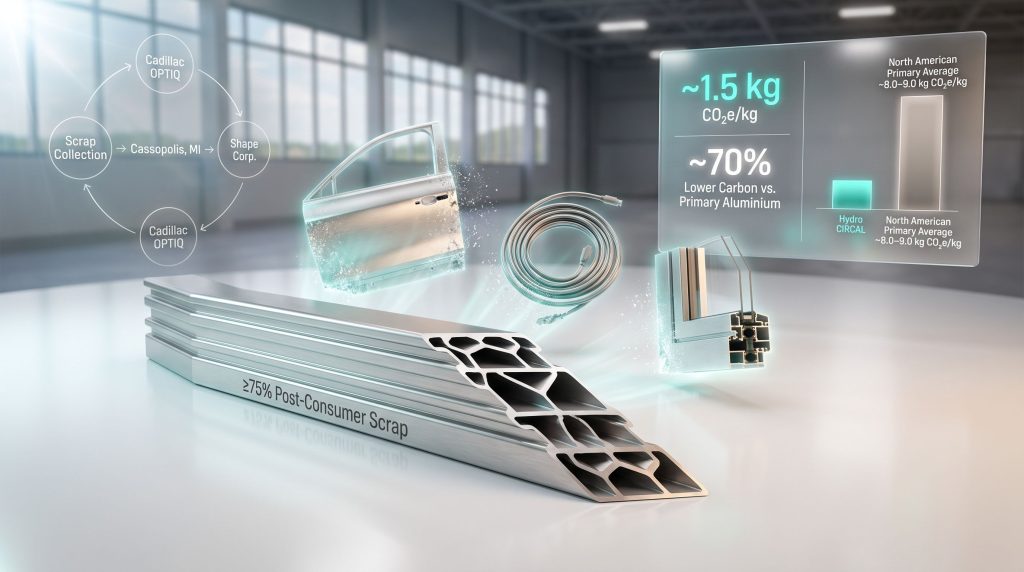
Hydro CIRCAL is an aluminium alloy product line engineered to contain a minimum of 75% post-consumer scrap content, with the qualifying scrap drawn from end-of-life product categories including:
- Scrapped vehicles and automotive components
- Architectural aluminium (window frames, door profiles)
- Electrical infrastructure cables and conductors
The critical distinction between Hydro CIRCAL and many other recycled aluminium products lies in how recycled content is validated. Hydro employs independent third-party verification of the post-consumer scrap percentage — a standard that differentiates the product from self-certified claims that are common elsewhere in the market. For automotive OEMs navigating Scope 3 emissions disclosure requirements, this third-party certification is not a marketing differentiator; it is a procurement necessity.
Carbon Footprint Performance Versus Primary Aluminium
The emissions advantage of CIRCAL relative to conventionally produced aluminium is substantial. The comparison below illustrates the scale of the gap:
| Metric | Hydro CIRCAL (this application) | North American Primary Aluminium Average |
|---|---|---|
| Carbon footprint (kg CO₂e per kg Al) | ~1.5 or lower | ~8.0 to 9.0 (estimated) |
| Estimated emissions reduction vs. primary | ~70% | Baseline |
| Post-consumer scrap content | 75% minimum | Near zero |
| Independent content verification | Yes | Not typically applicable |
The physics underlying this gap are straightforward. Primary aluminium smelting requires the electrolytic reduction of alumina, an energy-intensive electrochemical process that consumes roughly 13 to 15 kilowatt-hours of electricity per kilogram of aluminium produced. Remelting scrap bypasses this step entirely, requiring only a fraction of that energy input. When the energy used in remelting comes from lower-carbon sources, the lifecycle carbon figure drops further — explaining why specific applications can achieve figures at or below the 1.5 kg CO₂e per kilogram threshold cited for the OPTIQ bumper programme.
The Post-Consumer vs. Post-Industrial Distinction
A subtlety that matters significantly for lifecycle assessment (LCA) reporting is the difference between post-consumer and post-industrial scrap. Post-industrial scrap — the offcuts and trimmings generated during manufacturing processes — has historically dominated recycled content claims in aluminium products because it is cleaner, more homogeneous, and easier to reprocess. Post-consumer scrap, by contrast, comes from products that have completed their full useful life in the hands of end-users.
From an LCA methodology standpoint, post-consumer recycled content carries greater environmental credit than post-industrial scrap because it represents material diverted from waste streams rather than clean manufacturing offcuts that would have been recycled regardless.
The 75% minimum post-consumer threshold in Hydro CIRCAL is therefore a materially higher standard than simply claiming "recycled content" — it specifically refers to end-of-life materials that have re-entered the productive aluminium cycle. In addition, investments in aluminium recycling investment infrastructure are reinforcing this shift toward higher post-consumer standards across the sector.
The Cadillac OPTIQ Front Bumper: Engineering the Application
Three-Party Supply Chain Architecture
The delivery structure for this programme operates across three distinct tiers within a geographically compact regional footprint:
- Hydro produces CIRCAL alloy billets at its recycling facility in Cassopolis, Michigan, drawing on post-consumer scrap collected from regional end-of-life product streams
- Shape Corp., a Tier 1 automotive supplier, receives the CIRCAL feedstock and engineers, extrudes, and assembles the front bumper beam system to General Motors' crash performance specifications
- General Motors integrates the completed bumper system into the Cadillac OPTIQ EV platform at the assembly stage
This regional concentration matters beyond logistics convenience. Keeping scrap collection, remelting, component manufacturing, and vehicle assembly within a single geographic corridor reduces transport emissions, shortens supply chain lead times, and creates a more resilient material flow that is less exposed to import disruption.
Why EV Platforms Introduce Additional Complexity for Bumper Design
In a conventional internal combustion vehicle, the front crash zone primarily protects the engine block and occupant cell. In an EV like the Cadillac OPTIQ, the engineering brief expands considerably. Front-mounted motor assemblies, inverter housings, and thermal management components occupy the front compartment alongside charging infrastructure connections.
The bumper beam must be calibrated not just for occupant protection but also to manage crash energy in ways that prevent propagation into high-voltage systems — a fault mode with consequences that extend beyond structural damage to potential electrical and thermal hazards. This elevated complexity makes the qualification of Hydro CIRCAL in the Cadillac OPTIQ bumper system more significant than a comparable deployment in a simpler crash structure.
Contextualising the Industry Milestone
Where This Application Sits in the Landscape of Automotive Aluminium Use
The following table positions the OPTIQ bumper application within the broader hierarchy of aluminium use in automotive manufacturing, ranked by structural criticality and historical openness to recycled content:
| Application Type | Structural Criticality | Historical Use of High-Recycled Alloys |
|---|---|---|
| Interior trim and panels | Low | Common |
| Wheel arch liners | Low | Common |
| Body panels (non-structural) | Low to medium | Emerging |
| Chassis subframes | High | Limited |
| Front bumper beam (crash management) | High | Now demonstrated at scale |
| Battery enclosures | Very high | Experimental |
The progression visible in this table is not accidental. It reflects a deliberate qualification journey in which recycled aluminium proves its mechanical credentials in progressively more demanding applications, building an engineering evidence base that supports the next step up the criticality ladder.
What a Validated Precedent Means for the Industry
If the Hydro CIRCAL alloy performs to specification across the full OPTIQ production lifecycle — spanning years of service, diverse climate conditions, and real-world impact events — the implications extend far beyond a single model programme. Automotive engineers at competing OEMs will have access to publicly available evidence that post-consumer recycled aluminium can satisfy structural crash-management requirements.
For procurement teams managing Scope 3 emissions targets, the precedent also lowers the perceived risk of specifying recycled-content materials in structural roles, potentially accelerating adoption across programmes that are currently specifying primary aluminium by default. However, US aluminium market pressures remain a complicating factor for manufacturers seeking to scale these programmes quickly.
The Circular Economy Mechanics Behind the Model
How End-of-Life Aluminium Re-enters Structural Vehicle Production
The circular supply chain model demonstrated by this programme can be described in five sequential stages:
- Aluminium products — vehicles, window frames, electrical cables — reach the end of their operational life and enter collection streams
- Post-consumer scrap is sorted, cleaned, and segregated by alloy family using advanced processing technology
- Sorted scrap is remelted and alloyed at Hydro's Cassopolis facility into CIRCAL billets meeting automotive-grade property specifications
- CIRCAL billets are converted by Shape Corp. into finished bumper beam assemblies validated against GM's crash performance requirements
- Bumper systems are integrated into new Cadillac OPTIQ vehicles — which will themselves become a source of high-quality post-consumer aluminium scrap decades hence
This loop has a self-reinforcing quality that grows in value as EV production volumes increase. Aluminium-intensive electric vehicles entering end-of-life streams over the coming decade will generate progressively larger volumes of high-quality, relatively uncontaminated post-consumer scrap — precisely the feedstock that commands a premium in the CIRCAL production process.
The Investment Signal for Aluminium Recyclers
The commercial implications of this programme for the aluminium recycling sector are worth examining directly. When automotive OEMs begin specifying certified post-consumer recycled aluminium for structural applications, the demand signal transforms post-consumer scrap from a commodity input into a premium feedstock with a defined, high-value end market. This changes the investment calculus for recycling infrastructure in a fundamental way.
Recyclers who invest in sorting precision, alloy-control capabilities, and third-party certification programmes gain access to higher-margin supply contracts with automotive manufacturers. Those who continue operating commodity scrap processing risk being displaced from the most valuable segments of the market. The Hydro-Shape-GM collaboration is, in this sense, a market structure signal as much as an engineering milestone. Furthermore, the growth of EV recycling infrastructure more broadly is creating additional recovery pathways that will strengthen these feedstock supply chains over time.
The next major ASX story will hit our subscribers first
Implications for EV Sustainability Accounting
Why Manufacturing-Phase Emissions Are the Next Frontier for EV Carbon Claims
The dominant narrative around EV sustainability has centred on tailpipe emissions avoidance — the operational carbon saved by substituting electric propulsion for combustion. This framing is valid but increasingly incomplete as the regulatory and consumer focus shifts toward lifecycle carbon accounting that includes manufacturing-phase embedded emissions.
A study published in the International Journal of Life Cycle Assessment found that manufacturing an EV can generate significantly higher upfront emissions than producing an equivalent ICE vehicle, primarily due to battery production and the energy-intensive processing of structural materials including aluminium. Reducing the embedded carbon of these materials through recycled content substitution is therefore one of the most direct levers available to EV manufacturers seeking to improve their whole-of-life carbon position.
Using CIRCAL at ~1.5 kg CO₂e per kilogram versus primary aluminium at approximately 8 to 9 kg CO₂e per kilogram translates into meaningful lifecycle savings at the component level — savings that aggregate across an aluminium-intensive EV platform to produce a measurable improvement in total manufacturing-phase carbon. Initiatives focused on lower-carbon aluminium production are similarly targeting this manufacturing-phase gap from the primary production side.
Material Substitution vs. Carbon Offsets: A Critical Distinction
The approach taken in the OPTIQ programme illustrates an important philosophical divide in corporate sustainability strategy. Carbon offsets compensate for emissions that continue to occur by funding emissions reductions elsewhere in the economy. Material substitution, by contrast, prevents the embedded emissions from arising in the first place.
For automakers subject to regulatory lifecycle carbon accounting, material substitution delivers a verifiable reduction in the emissions attributed to vehicle production — an outcome that carbon offsets cannot replicate within the same accounting framework.
This distinction is becoming commercially significant as regulatory frameworks in major markets move toward mandatory lifecycle carbon disclosure for vehicles, creating a compliance environment in which the verified embedded carbon of structural materials carries direct financial and regulatory consequences. Hydro's own announcement of the CIRCAL supply agreement with General Motors underscores how seriously both parties regard this verified emissions reduction framework.
Key Facts: Hydro CIRCAL in the Cadillac OPTIQ Bumper System
- Hydro CIRCAL contains a minimum of 75% post-consumer scrap, independently verified by third parties
- The alloy achieves a carbon footprint of approximately 1.5 kg CO₂e per kilogram in this application, representing roughly a 70% reduction versus the North American primary aluminium average
- The Hydro CIRCAL in the Cadillac OPTIQ bumper system represents one of the first U.S. structural, safety-critical applications of high-recycled-content aluminium in automotive manufacturing
- The three-tier supply chain (Hydro Cassopolis, Michigan → Shape Corp. → General Motors) operates within a single regional geography, reducing logistics emissions and supply chain exposure
- Post-consumer scrap inputs include end-of-life vehicles, architectural window and door aluminium, and electrical cables — materials that have completed their full operational life
- If validated across the OPTIQ production lifecycle, this application creates an engineering precedent that lowers qualification risk for recycled aluminium in structural roles across the broader automotive industry
- Industry coverage from Aluminium Today confirms the significance of this supply agreement as a milestone for low-carbon automotive materials
Disclaimer: This article contains forward-looking statements regarding market trends, industry adoption trajectories, and potential emissions outcomes. These reflect current analysis and available information and should not be construed as guarantees of future outcomes. Readers with financial interests in companies mentioned should conduct independent research before making investment decisions.
Want to Track the Next Major Mineral Discovery Before the Market Moves?
Discovery Alert's proprietary Discovery IQ model delivers real-time alerts on significant ASX mineral discoveries — turning complex data across more than 30 commodities into clear, actionable insights for investors at every level. Start your 14-day free trial today, or explore historic discoveries and their returns to understand why getting in early can make all the difference.