August 5, 2026
The Productivity Paradox Driving Mining's Autonomous Revolution
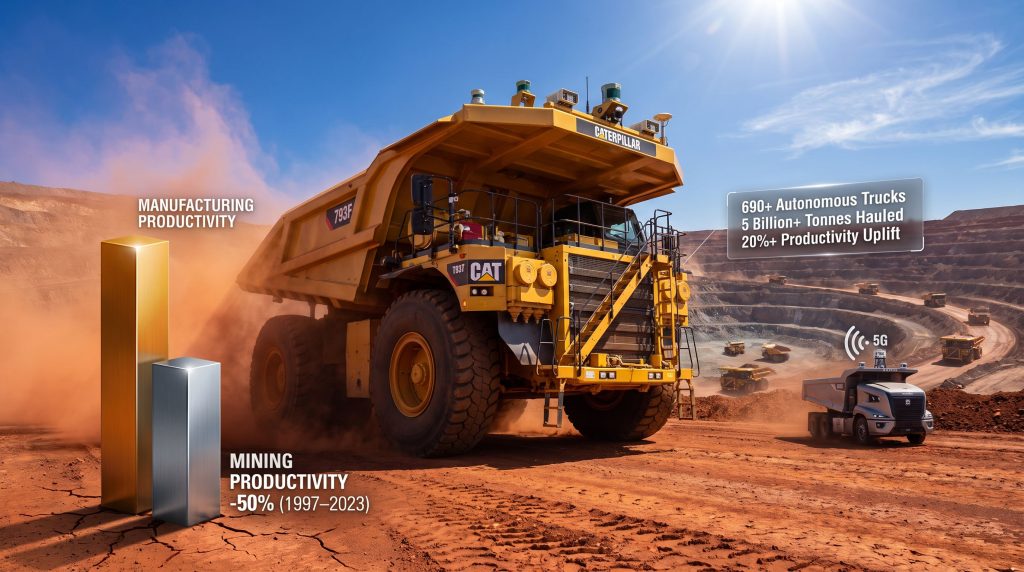
Few industries face a productivity contradiction as stark as modern mining. While global manufacturing output per worker roughly doubled between 1997 and 2023, mining productivity moved in the opposite direction, declining by approximately 50% over the same period according to OECD data. The reasons are structural: ore grades are falling, deposits are found deeper underground, workforces are aging in key mining regions, and the physical risks of putting humans inside active quarry and tunnel environments continue to mount. The industry's answer to this convergence of pressures is increasingly mechanical, and the machines leading that response are the top autonomous mining vehicles now operating across five continents.
Autonomous mining vehicles are no longer prototypes running on test tracks. They are commercially deployed, productivity-proven systems hauling hundreds of millions of tonnes annually across some of the world's largest resource operations. Understanding which platforms are setting the benchmark in 2026 requires more than reading payload specifications off a data sheet. It demands a closer look at system maturity, deployment scale, technology integration, and the emerging intersection of autonomy with decarbonisation.
When big ASX news breaks, our subscribers know first
Evaluating Autonomous Mining Vehicles: Beyond Raw Payload
One of the most persistent misconceptions in this sector is that a larger payload automatically equals a better autonomous vehicle. In practice, a truck carrying 300 tonnes with a partially automated system will frequently deliver lower operational value than a 230-tonne vehicle running a fully integrated, fleet-managed autonomous platform with real-time diagnostics and route optimisation.
A more useful evaluation framework considers four dimensions simultaneously:
| Evaluation Dimension | What It Measures |
|---|---|
| Deployment Scale | Number of units commercially operating globally |
| Technology Maturity | Years of autonomous operation and verified reliability |
| Payload Capacity | Tonnes of material moved per cycle |
| Autonomy Depth | Degree of human-free operation across the full haul cycle |
Furthermore, mining automation trends show that Caterpillar's CatMineStar system illustrates this well. The company reports that its autonomous trucks deliver productivity gains exceeding 20% above conventional operation, a figure that reflects system integration benefits rather than payload size alone.
"The most important number in autonomous haulage is not tonnes per truck. It is tonnes per hour across an entire coordinated fleet, sustained across months of uninterrupted operation."
Top 10 Autonomous Mining Vehicles in 2026
10. KAMAZ Jupiter 30: Russia's Purpose-Built Cabless Hauler
Manufacturer: KAMAZ | Headquarters: Tatarstan, Russia
| Specification | Detail |
|---|---|
| Payload Capacity | 30 tonnes |
| Cab Configuration | Cabless (fully unmanned design) |
| Sensor Suite | 2D and 3D LiDAR, ultrasonic sensors |
| Positioning System | Integrated GPS/GLONASS |
| Primary Application | Coal quarry haulage |
Pilot operations for the Jupiter 30 began in September 2023 across coal mining sites in Russia's Kemerovo region. Designed from the ground up without a cab, the vehicle represents a philosophically distinct approach from manufacturers that simply retrofit existing human-operated trucks with autonomous systems. The cabless architecture reflects a broader industry direction: purpose-built autonomous platforms engineered for unmanned environments from the design phase rather than adapted from crewed vehicle templates.
The Jupiter 30 is designed to transport loosened rock mass and ore while removing personnel from high-risk quarry zones. Its sensor package includes both 2D and 3D LiDAR alongside ultrasonic units, with GPS/GLONASS satellite positioning ensuring precision navigation across open-pit terrain.
9. Sandvik Toro LH514E: Underground Flexibility with an Upgrade Path
Manufacturer: Sandvik | Headquarters: Stockholm, Sweden
| Specification | Detail |
|---|---|
| Payload Capacity | 14 tonnes |
| Propulsion | Cable-electric |
| Autonomy Platform | AutoMine-ready |
| Operating Environment | Underground hard rock |
| Key Feature | Manual-to-autonomous upgrade path |
The Toro LH514E operates comfortably in both manual and fully autonomous configurations. Sandvik explicitly designed the platform so that operators can transition to full autonomy at any point during the equipment's working life without replacing the vehicle. This incremental upgrade model materially lowers the capital barrier for mines moving toward automation gradually.
Sandvik's broader AutoMine platform has accumulated more than 3 million autonomous operating hours across more than 600 underground loaders and trucks globally, giving the Toro LH514E a depth of verified operational history that is particularly significant in the complex and unforgiving geometry of underground hard rock environments.
The vehicle's onboard diagnostics, real-time positional tracking, and automated steering systems are engineered specifically to function within the constrained spatial dimensions of underground tunnels, where surface-derived autonomy solutions typically fail to translate effectively.
8. Scania Autonomous Heavy Tipper: European Precision for Open-Pit Operations
Manufacturer: Scania | Headquarters: Södertälje, Sweden
| Specification | Detail |
|---|---|
| Payload Capacity | 40 metric tonnes |
| Sensor Suite | Cameras, radar, LiDAR, GPS receivers |
| Control System | Intelligent autonomous control unit |
| Commercial Availability | Orders opened May 2024 |
| Key Deployment | Rio Tinto's Dampier salt operation, Western Australia |
Scania opened commercial orders for its 40-metric tonne autonomous heavy tipper in May 2024. The platform's intelligent control system fuses data from cameras, radar, LiDAR arrays, and GPS receivers to manage navigation, obstacle detection, and haul cycle execution without human input.
Rio Tinto's Dampier salt operation in Western Australia serves as a high-profile operational reference site for the platform. The system is also positioned to deliver measurable emissions reductions relative to conventional diesel haulers on equivalent routes, aligning the product with mining operators' growing decarbonisation obligations alongside productivity targets.
7. Epiroc Pit Viper 271: Autonomous Drilling at the Extraction Frontier
Manufacturer: Epiroc | Headquarters: Stockholm, Sweden
| Specification | Detail |
|---|---|
| Vehicle Type | Autonomous rotary blast-hole drill rig |
| Drilling Depth | Single-pass holes up to 18 metres |
| Compatible Ore Types | Gold, coal, copper, iron ore, silver, phosphate |
| Autonomy System | Rig Control System (RCS) |
| Distinguishing Feature | Patented cable feed system with automatic tensioning |
The Epiroc Pit Viper 271 occupies a distinct position in any ranking of top autonomous mining vehicles because it does not haul material at all. Instead, it automates the blast preparation phase of the mining value chain, a stage that is critical to downstream productivity but rarely receives the same profile as haulage automation.
Its Rig Control System enables autonomous drilling across six compatible ore types, producing single-pass holes to depths of 18 metres with minimal human oversight. The patented cable feed tensioning system contributes to lower component wear rates and reduced maintenance cost over the equipment's operational life. Automating the drilling phase also improves hole consistency across variable ground conditions, which has a direct downstream impact on blast fragmentation quality and subsequent haul efficiency.
"Autonomous drilling is an overlooked leverage point in mine productivity. Consistent blast-hole geometry reduces fragmentation variability, which compresses the entire downstream processing cycle."
6. Volvo TA15: Battery-Electric Autonomy for Contained Haulage Cycles
Manufacturer: Volvo Group | Headquarters: Gothenburg, Sweden
| Specification | Detail |
|---|---|
| Vehicle Type | Autonomous electric transport vehicle |
| Charging Capacity | 150 kW high-power autonomous charger |
| Operating Environment | Contained off-road haulage routes |
| System Platform | TARA autonomous transport solution |
| Primary Benefits | Energy efficiency, emissions reduction, process productivity |
The TA15 is purpose-built for high-repetition material transport in geofenced mining environments, where predictable routes allow the efficiency advantages of autonomous operation to compound over time. Its entire charging cycle is autonomous, meaning there is no point in the operational workflow where human intervention is required, from loading through to battery replenishment.
As part of Volvo's TARA solution, the TA15 integrates with loading equipment in coordinated multi-machine workflows. The combination of battery-electric propulsion and full operational autonomy positions it as one of the more complete responses to the dual challenge of productivity improvement and emissions reduction in contained haulage applications. In addition, electric mining transport solutions like this are increasingly shaping procurement decisions across the sector.
5. XCMG ZNK95: China's 5G-Connected Autonomous Hauler
Manufacturer: XCMG Construction Machinery | Headquarters: Jiangsu Province, China
| Specification | Detail |
|---|---|
| Payload Capacity | 85 tonnes |
| Cab Configuration | Cabless (fully unmanned) |
| Connectivity | Huawei 5G advanced network |
| Operating Temperature Range | Down to -40°C |
| Commercial Deployment | 100 units at Yimin open-pit coal mine (2025) |
| Autonomy Capabilities | Environmental perception, decision-making, fault diagnosis |
The XCMG ZNK95 represents the most commercially mature autonomous mining truck produced in China, deploying Huawei's 5G network infrastructure to enable continuous 24/7 operation without any human involvement. The integration of telecommunications infrastructure directly into vehicle management architecture is a model with significant implications for how large autonomous fleets are coordinated at scale.
The vehicle's ability to maintain full autonomous functionality at temperatures reaching -40°C addresses a critical operational requirement for coal mines in northern China and other extreme-climate mining regions. The deployment of 100 units at the Yimin open-pit coal mine in 2025 represents one of the largest single-site autonomous truck rollouts in the Asia-Pacific region to date.
The ZNK95's autonomous driving system incorporates environmental perception, decision-making logic, and self-diagnostic fault detection, making it a more complete autonomous platform than cabless designs focused purely on basic navigation.
4. Hitachi EH5000AC-3: Bullet Train Engineering in a Mining Dump Truck
Manufacturer: Hitachi | Headquarters: Tokyo, Japan
| Specification | Detail |
|---|---|
| Payload Capacity | 296 tonnes |
| Propulsion System | AC Drive System |
| Autonomy Method | Retrofit-compatible autonomous haulage system |
| Fleet Management | Wenco International Mining Systems integration |
| Operating Mode | Fully uncrewed loading, hauling, and dumping cycles |
The EH5000AC-3 is Hitachi's largest dump truck by payload, and its AC Drive System draws directly on the advanced propulsion engineering that powers Japan's high-speed rail network. That cross-sector technology transfer gives the vehicle's drivetrain a level of engineering validation that is uncommon in heavy mining equipment.
Autonomous capabilities are delivered through a retrofit-compatible system, allowing existing EH5000AC-3 fleets to be upgraded without full vehicle replacement. In autonomous mode, the truck executes complete uncrewed haul cycles including loading, hauling, and dumping in open-pit environments. Integration with Wenco's Fleet Management System enables real-time route optimisation across multi-truck deployments, targeting efficiency gains at the fleet level rather than the individual vehicle level.
3. Komatsu 930E-5AT: The Platform That Started Commercial Autonomous Haulage
Manufacturer: Komatsu | Headquarters: Tokyo, Japan
| Specification | Detail |
|---|---|
| Payload Capacity | 290 tonnes |
| Maximum Travel Speed | 64.5 km/h |
| Autonomy System | FrontRunner Autonomous Haulage System (AHS) |
| Navigation Technology | High-accuracy GPS, radar, laser sensors |
| Commercial Milestone | 1,000th autonomous truck commissioned, April 2026 |
| Global Footprint | 700+ deployments across 23 mine sites in five countries |
Komatsu's FrontRunner system holds a distinction that no other platform can claim: it is the world's first commercially deployed autonomous haulage system, entering active mine service in 2008. That 18-year operational track record provides a depth of real-world validation that newer entrants cannot replicate through technical specification alone.
In April 2026, Komatsu commissioned its 1,000th autonomous ultra-class haul truck, with the milestone vehicle being a 930E-5AT deployed at Barrick Gold's Nevada Gold Mines in the United States. The truck operates without a driver using a multi-sensor navigation suite combining high-accuracy GPS, radar, and laser sensors for precision positioning and collision avoidance across active open-pit environments.
Reaching 1,000 commercial autonomous truck deployments validates long-term operational reliability at industrial scale in a way that controlled trials or limited pilot programmes cannot. It also demonstrates that autonomous haulage has moved well beyond early adoption into full mainstream deployment across multiple commodity types and geographies.
2. Liebherr T 264: High Capacity Autonomy Meets Zero-Emission Integration
Manufacturer: Liebherr Group | Headquarters: Bulle, Switzerland
| Specification | Detail |
|---|---|
| Payload Capacity | 240 tonnes |
| Powertrain Options | Diesel, fuel cell, battery systems |
| Autonomy System | Integrated autonomous haulage software |
| Energy Partner | Fortescue Zero (fuel cells, batteries, AHS software) |
| Key Deployment | Fortescue's Eliwana mine site, Pilbara, Western Australia |
The Liebherr T 264 is one of the few top autonomous mining vehicles that simultaneously addresses both major structural challenges facing the industry: productivity and decarbonisation. Its autonomous haulage system combines real-time operational data with automation controls to deliver enhanced safety monitoring, efficiency optimisation, and remote management capability. Furthermore, its partnership with Fortescue Zero provides fuel cell and battery powertrain options alongside the autonomous haulage software.
Consequently, hydrogen autonomous trucks and fuel cell powertrains are increasingly viewed as the long-term solution for heavy haulage decarbonisation at scale. The T 264 operates in coordinated autonomous fleet configurations alongside large hydraulic excavators and wheel loaders rather than functioning as a standalone unit. It serves as one of the primary vehicles at Fortescue's Eliwana mine site in Western Australia's Pilbara region.
"The Liebherr T 264 may represent the clearest preview of where autonomous mining is heading: high-capacity, zero-emission, fully integrated fleet operation with no human in the operational loop."
1. Caterpillar Cat 793F: The World's Most Widely Deployed Autonomous Mining Truck
Manufacturer: Caterpillar Inc. | Headquarters: Texas, United States
| Specification | Detail |
|---|---|
| Payload Capacity | 231 tonnes |
| Autonomy System | CatMineStar Command |
| Autonomous Fleet Size | 690+ trucks operating globally (end of 2024) |
| Material Hauled (Cumulative) | 5 billion+ tonnes |
| Productivity Uplift | 20%+ increase vs. conventional operation |
| Primary Markets | Australia, North America, South America |
| Commodity Focus | Iron ore, gold, copper |
| Target Fleet Size | 2,000+ autonomous trucks by 2030 |
First introduced in 1991, the Cat 793F has undergone more than three decades of continuous engineering refinement. Its autonomous capabilities are delivered through the CatMineStar Command system, a fully integrated platform managing navigation, haul cycle execution, load dumping, and maintenance coordination without human assistance.
With more than 5 billion cumulative tonnes hauled by autonomous Cat trucks and 690+ units operating globally at the end of 2024, the 793F commands the largest commercially deployed autonomous mining vehicle fleet anywhere in the world. Caterpillar's roadmap targets more than 2,000 autonomous trucks in operation by 2030, reflecting sustained demand across iron ore, gold, and copper mining operations in Australia, North America, and South America.
The 793F's position at the top of this ranking is not defined by having the largest payload, since both the Komatsu 930E-5AT and Hitachi EH5000AC-3 carry more tonnes per cycle. Its dominance reflects the combination of CatMineStar's system integration depth, the proven scale of its global fleet, the maturity of Caterpillar's international service network, and a 20%-plus productivity advantage over conventional operation that has been validated across hundreds of active deployments.
Full Specification Comparison: Top 10 Autonomous Mining Vehicles (2026)
| Rank | Vehicle | Manufacturer | Payload (t) | Autonomy System | Environment | Propulsion |
|---|---|---|---|---|---|---|
| 1 | Cat 793F | Caterpillar | 231 | CatMineStar Command | Open-pit surface | Diesel |
| 2 | T 264 | Liebherr | 240 | Fortescue Zero AHS | Open-pit surface | Diesel / Fuel Cell / Battery |
| 3 | 930E-5AT | Komatsu | 290 | FrontRunner AHS | Open-pit surface | Electric (AC Drive) |
| 4 | EH5000AC-3 | Hitachi | 296 | Hitachi AHS + Wenco FMS | Open-pit surface | AC Drive |
| 5 | ZNK95 | XCMG | 85 | 5G Autonomous Platform | Open-pit surface | Electric (cabless) |
| 6 | TA15 | Volvo | N/A | TARA Solution | Contained off-road | Battery-electric |
| 7 | Pit Viper 271 | Epiroc | N/A (drill rig) | Rig Control System | Open-pit surface | Diesel / Electric |
| 8 | Heavy Tipper | Scania | 40 | Intelligent Control System | Open-pit surface | Diesel / Hybrid |
| 9 | Toro LH514E | Sandvik | 14 | AutoMine | Underground | Cable-electric |
| 10 | Jupiter 30 | KAMAZ | 30 | Integrated AV Platform | Open-pit surface | Diesel (cabless) |
The Technology Stack Powering Modern Autonomous Haulage
Sensors, Navigation, and the Intelligence Layer
Every top autonomous mining vehicle in this ranking relies on a layered technology stack that combines hardware sensing with software intelligence. The key components include:
- LiDAR (2D and 3D): Generates real-time spatial maps of the operating environment, enabling continuous obstacle detection and terrain navigation at vehicle speed
- Radar: Maintains reliable object detection in dust, low-light, and adverse weather conditions that are endemic to open-pit mining operations
- High-accuracy GPS and GLONASS: Provides centimetre-level positional precision for route adherence and fleet coordination across kilometre-scale haul routes
- Cameras: Supplement LiDAR and radar with visual confirmation, particularly useful for identifying smaller obstacles and reading ground surface conditions
- Ultrasonic sensors: Critical for short-range proximity detection, especially during loading and dumping cycles where spatial margins are tightest
- 5G connectivity (ZNK95): Enables continuous vehicle-to-infrastructure communication for real-time telemetry, remote diagnostics, and fleet coordination at scale
Fleet Management: Where Individual Vehicle Data Becomes Collective Intelligence
A point that is frequently underappreciated by observers outside the sector is that the value of autonomous mining vehicles scales non-linearly with fleet size. A single autonomous truck offers productivity and safety benefits. However, a fully coordinated fleet of 50 or 100 trucks, managed through an integrated platform, compounds those benefits through optimised loading sequences, dynamic route assignment, predictive maintenance scheduling, and fuel or energy consumption modelling across the entire fleet simultaneously.
Data-driven mining operations are consequently becoming the backbone of modern fleet management. This is why platforms like CatMineStar, FrontRunner, AutoMine, and Wenco FMS are not peripheral features of the vehicles they support. They are the primary value delivery mechanism, and the hardware is the carrier. Moreover, AI mining efficiency tools are increasingly being layered on top of these platforms to extract further performance gains from existing fleets.
The next major ASX story will hit our subscribers first
What the Next Phase of Autonomous Mining Looks Like
Several trends visible across these ten platforms point to where the sector is heading over the next five to ten years:
- Cabless architecture will become standard for new autonomous vehicle designs, as demonstrated by the KAMAZ Jupiter 30 and XCMG ZNK95. Removing the operator cab reduces vehicle weight, lowers manufacturing cost, and eliminates the need to maintain life-safety systems designed for human occupancy.
- Zero-emission autonomous integration will accelerate, with the Liebherr T 264 and Volvo TA15 providing early templates for fully battery-electric or hydrogen-powered autonomous fleets operating at commercial scale.
- Underground autonomy will deepen as sensor miniaturisation and improved tunnel-mapping technology extends the operational envelope of platforms like Sandvik's AutoMine ecosystem into narrower and more complex sub-surface geometries.
- 5G fleet connectivity will shift from a differentiating feature to a baseline expectation, enabling real-time coordination of larger fleets with lower latency and higher data throughput than current wireless systems permit.
- Autonomy will extend further along the value chain, with drill automation, as demonstrated by the Epiroc Pit Viper 271, eventually connecting to automated blast design, fragmentation analysis, and direct feed into processing plant scheduling. For a broader perspective on how autonomous trucks are deployed across global mining operations, industry analysts continue to document accelerating adoption rates across multiple commodity sectors.
Furthermore, broader industry data from Hexagon's autonomous mining research consistently highlights that mines embracing full-stack autonomy are outperforming peers on both safety and productivity metrics, reinforcing the commercial case for accelerated deployment across all vehicle categories.
Disclaimer: This article is intended for informational purposes only and does not constitute financial or investment advice. Market projections, deployment targets, and forward-looking statements referenced in this article are subject to change and should not be relied upon as guarantees of future performance. Readers should conduct independent research before making any investment or operational decisions.
Want to Invest in the Companies Behind Mining's Autonomous Revolution?
Discovery Alert's proprietary Discovery IQ model delivers real-time alerts the moment significant ASX mineral discoveries are announced, turning complex market data into actionable opportunities for both short-term traders and long-term investors — explore historic discoveries and their extraordinary returns, then begin your 14-day free trial to position yourself ahead of the market.