August 5, 2026
The Electrochemical Case for Aluminium: Rethinking Battery Chemistry From the Ground Up
Every dominant energy storage technology in history has eventually met a structural ceiling. Lithium-ion, the chemistry that powered the first generation of the clean energy transition, is approaching its own. Not because the technology has failed, but because the supply chains, safety profiles, and cost trajectories underpinning it are increasingly misaligned with the scale and geographic diversity of demand now being placed upon them. The question occupying serious researchers and industrial strategists alike is not whether an alternative will emerge, but which chemistry will credibly cross the threshold from laboratory curiosity to manufacturable product first.
EQONIC aluminium battery technology is one of the more technically grounded attempts to answer that question, and its mid-2026 confirmation of aluminium as its core electrochemical material marks a meaningful inflection point in a development story that has been quietly building momentum.
When big ASX news breaks, our subscribers know first
Why Lithium-Ion's Structural Weaknesses Are Driving the Search for Alternatives
The dominance of lithium-ion batteries over the past three decades has obscured some persistent vulnerabilities that become more visible as deployment scales. Lithium itself is geographically concentrated, with the majority of global reserves sitting in a handful of countries, most notably Chile, Australia, and China's processing infrastructure. Cobalt, used in many lithium-ion cathode formulations, carries an even more acute supply risk, and the global cobalt supply situation is further complicated by the Democratic Republic of Congo's near-monopoly on production.
Price volatility compounds the geopolitical risk. The lithium market downturn followed an extraordinary swing: lithium carbonate prices rose from under USD $7,000 per tonne in early 2021 to above USD $80,000 per tonne by late 2022, before collapsing back below USD $10,000 per tonne by mid-2024. For battery manufacturers attempting to lock in long-term contracts, this level of volatility makes financial planning extremely difficult.
Beyond supply chain concerns, lithium-ion's thermal runaway problem has never been fully resolved. The chemistry that enables its high energy density also makes it susceptible to catastrophic failure under specific conditions, including overcharging, physical damage, and elevated temperatures. This remains a genuine barrier in applications where safety certification is paramount.
Sodium-ion batteries have attracted considerable attention as a potential alternative, and Chinese manufacturers including CATL have moved toward early commercial production. However, sodium-ion faces its own trade-offs: lower energy density than lithium-ion, and performance characteristics that limit its appeal in high-demand applications. Neither sodium-ion nor solid-state lithium has fully resolved what battery researchers describe as the cost-safety-scalability trilemma. Furthermore, the broader battery raw materials market continues to face structural uncertainty across multiple chemistries.
The Electrochemical Fundamentals of Aluminium-Ion Energy Storage
Understanding why aluminium is a structurally interesting battery material requires a brief look at the underlying electrochemistry. Most battery chemistries rely on the movement of ions carrying a single positive charge between the anode and cathode during charge and discharge cycles. Lithium ions carry a single positive charge (Li⁺), as do sodium ions (Na⁺).
Aluminium is fundamentally different. It carries three positive charges per ion (Al³⁺), meaning each ion is capable of transferring three times the charge of a lithium or sodium ion per unit of material moved. In theoretical terms, this trivalent charge transfer opens the door to higher energy storage per unit of electrode material. For a deeper look at the underlying science, aluminium-ion battery research provides useful context on where this chemistry stands academically.
Technical Note: The trivalent nature of aluminium ions is both the technology's primary theoretical advantage and its most significant engineering challenge. Moving a triply charged ion through an electrolyte and into a cathode material is considerably more demanding than moving a singly charged ion. Electrolyte compatibility, cathode structural stability under repeated Al³⁺ insertion and extraction, and ionic conductivity at practical operating temperatures have historically been the key barriers to aluminium battery commercialisation.
Aluminium is also the most abundant metal in the Earth's crust and the third most abundant element overall. Its global production infrastructure is mature, with primary aluminium smelting operations distributed across more than 50 countries. This geographic distribution is a meaningful structural advantage over lithium, where processing capacity remains heavily concentrated in a small number of jurisdictions.
EQONIC's Development Stage and Technical Claims
EQONIC Group is a UK-based deep-tech company that has been developing a battery architecture explicitly designed to avoid lithium, sodium, and rare earth materials from first principles. Rather than modifying an existing chemistry, the company has approached the problem from a materials science perspective, building its architecture around aluminium's intrinsic properties.
As of August 2026, EQONIC aluminium battery technology is transitioning from laboratory-scale development into industrial validation. This is the phase where proof-of-concept results must survive translation into manufacturing-grade processes, and it is widely regarded as the single most technically demanding stage of battery commercialisation. Many battery startups have demonstrated compelling laboratory results only to encounter yield problems, consistency failures, or material degradation at production scale.
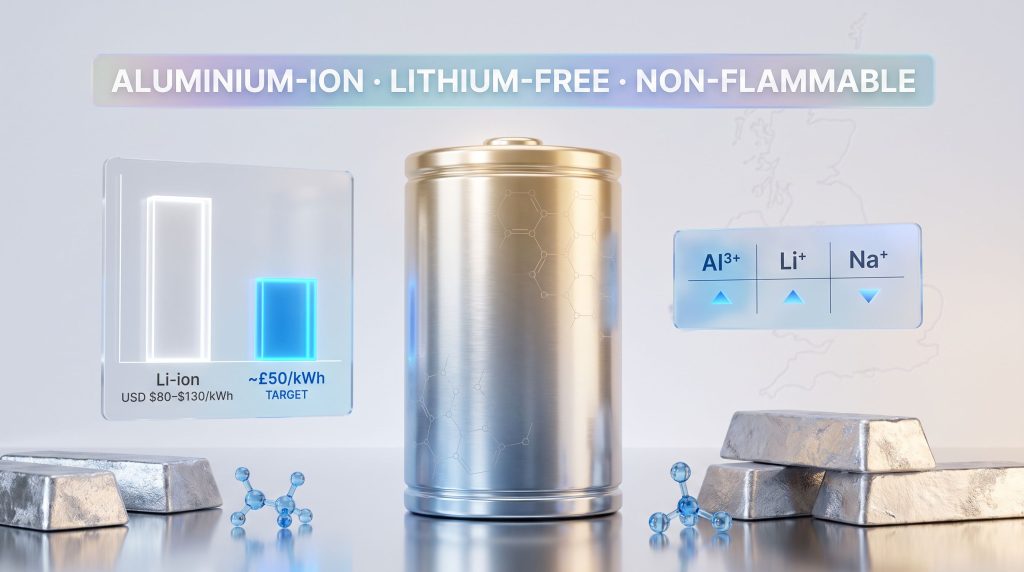
The company's stated cost target is a long-term production cost of approximately £50 per kWh (around USD $67/kWh), which it positions as roughly 30% of the manufacturing cost of conventional lithium metal batteries. The following table contextualises this claim against current market benchmarks:
| Cost Metric | EQONIC Target | Conventional Lithium-Ion (2025 Benchmark) |
|---|---|---|
| Long-term production cost | USD $80–$130/kWh | |
| Manufacturing cost vs. lithium metal | ~30% of lithium metal battery cost | Baseline (100%) |
| Material sourcing risk | Low (aluminium globally abundant) | High (lithium, cobalt, rare earths) |
It is important to note that these figures represent internal projections based on the company's modelling. They have not yet been independently verified through industrial-scale production runs. The distinction between cell-level cost and system-level cost of energy storage is also critical for commercial buyers: a cell target of £50/kWh does not automatically translate to a storage system at that cost once battery management systems, thermal management, enclosures, and integration are factored in.
Core Technical Claims: Safety, Supply Chain Independence, and Cost
EQONIC's technical positioning rests on three primary claims:
- Non-flammability: The aluminium-based chemistry is described as inherently non-flammable, eliminating thermal runaway risk. This is a significant claim for applications where safety certification is a procurement prerequisite.
- Supply chain independence: By removing lithium, sodium, and rare earth materials from the architecture entirely, EQONIC is targeting a genuinely different supply chain risk profile rather than simply substituting one constrained material for another.
- Cost structure: The 30% manufacturing cost target relative to lithium metal batteries is grounded in aluminium's commodity pricing and established processing infrastructure, though it remains contingent on achieving acceptable performance at scale.
The specific cathode formulation, electrolyte chemistry, and operating voltage remain undisclosed and are protected under patent. These are the three most consequential undisclosed variables for assessing the technology's real-world performance ceiling.
How EQONIC Aluminium Battery Technology Compares to Competing Chemistries
The competitive landscape for next-generation battery chemistries is crowded, and positioning EQONIC's technology requires an honest assessment of where it holds structural advantages and where it faces genuine competitive pressure.
| Attribute | Aluminium-Ion (EQONIC) | Lithium-Ion (Incumbent) | Sodium-Ion (Emerging) |
|---|---|---|---|
| Primary charge carrier | Al³⁺ | Li⁺ | Na⁺ |
| Flammability risk | Non-flammable (claimed) | High (thermal runaway) | Lower than Li-ion |
| Raw material availability | Abundant, globally distributed | Geopolitically concentrated | Abundant |
| Rare earth dependency | None (claimed) | Varies by chemistry | Minimal |
| Commercial maturity | Pre-commercial (validation stage) | Fully commercial | Early commercial |
| Long-term cost potential | ~£50/kWh (target) | USD $80–$130/kWh | Potentially competitive |
| Energy density | Lower practical density (historical challenge) | High | Moderate |
Critical Context: No aluminium-ion battery system has achieved commercial-scale deployment as of mid-2026. EQONIC's performance claims are derived from proprietary laboratory data that has not yet been independently validated at industrial scale. Commercial buyers and investors must distinguish clearly between claimed performance and independently verified performance.
Where Aluminium Holds Structural Advantages
- Aluminium is produced across more than 50 countries, creating a genuinely diversified supply chain that reduces single-point geopolitical risk.
- A non-flammable chemistry may materially accelerate safety certification processes for deployment in environments such as data centres, marine vessels, defence infrastructure, and buildings where fire risk is a governing design constraint.
- Aluminium's recycling ecosystem is among the most developed of any industrial metal. In addition, advances in critical minerals recycling more broadly suggest that end-of-life battery economics could become a genuine competitive advantage for materials with established reprocessing infrastructure.
Where the Technology Faces Its Toughest Pressure
- Energy density gap: Applications requiring high power-to-weight ratios, including electric vehicles and aviation, remain firmly in lithium-ion's domain. Aluminium-ion's historical challenge with practical energy density means near-term commercial opportunity is more plausibly found in stationary storage than in mobility.
- Cycle life verification: Stationary storage applications typically require between 3,000 and 6,000 charge-discharge cycles over the asset's operating life. Without publicly available, independently verified cycle life figures, procurement decisions cannot be made with confidence.
- Competitive timing: Lithium-ion costs have fallen from over USD $1,000/kWh in 2010 to below USD $100/kWh by 2025, compressing the window during which alternative chemistries must achieve cost parity. Sodium-ion is accelerating simultaneously, with multiple Chinese manufacturers approaching grid-scale commercial deployment.
Strategic Infrastructure Supporting EQONIC's Commercial Pathway
EQONIC's 2026 development activity has encompassed three distinct strategic pillars beyond the confirmation of its core chemistry.
UK Battery Innovation Programme: The company was selected to develop a digital twin of its manufacturing process under the UK Government's £452 million (approximately USD $609 million) Battery Innovation Programme. Consequently, this positions EQONIC within a wider push to advance UK battery production capabilities at a national level. A digital twin is a computational model of a physical manufacturing process that allows engineers to simulate cell behaviour, identify failure modes, and optimise parameters before committing capital to physical infrastructure.
Barton Knight Group Collaboration: In May 2026, EQONIC entered a strategic collaboration with the Barton Knight Group to jointly supply, install, and maintain battery storage and renewable energy systems across the UK. This channel partnership model allows EQONIC to access installed base and market presence without building its own deployment infrastructure, which is an important capital efficiency consideration for a pre-commercial company.
Leadership Expansion: The February 2026 appointments of John Saunders as Executive Director and Angela Knight CBE as Non-Executive Director signal a deliberate shift toward commercial and institutional readiness. Knight's background as former CEO of both the British Bankers' Association and Energy UK brings regulatory navigation expertise and industry credibility directly relevant to securing commercial partnerships.
The next major ASX story will hit our subscribers first
Key Risks and Unknowns Investors and Buyers Must Monitor
Battery development history is littered with companies that produced compelling laboratory results but failed to replicate them at manufacturing scale. The industrial validation phase that EQONIC is entering now is precisely where this failure most commonly occurs. Several specific risk dimensions warrant close attention.
Technical scale-up risks:
- Yield rates during cell production at manufacturing scale
- Electrolyte stability under production conditions rather than controlled laboratory environments
- Cell-to-cell consistency, which directly affects battery pack performance and safety
- Thermal management requirements at the system level, even if individual cells are non-flammable
Undisclosed parameters that determine commercial viability:
- Cathode chemistry: The single most important undisclosed variable affecting both energy density and cycle life
- Electrolyte formulation: Critical to understanding operating temperature range, ionic conductivity, and long-term degradation
- Operating voltage: Directly determines energy density and compatibility with existing power electronics and grid infrastructure
- Verified cycle life: Without this figure, suitability for stationary storage markets cannot be independently assessed
Due Diligence Framework for Commercial Buyers and Investors:
- Has cycle life been validated beyond controlled laboratory conditions by an independent testing body?
- What is the verified energy density at both cell level and system level?
- Has the £50/kWh cost target been stress-tested against real manufacturing inputs or derived from theoretical assumptions?
- What is the confirmed timeline from industrial validation completion to first commercial product delivery?
Competitive timing risk: The pace at which incumbent and emerging chemistries continue to improve creates a closing window. Each year that passes without commercial deployment narrows the addressable market that an alternative chemistry can realistically capture before buyers commit to competing solutions.
Target Markets and Application Fit
Given the energy density constraints historically associated with aluminium-ion chemistry, EQONIC's near-term commercial opportunity is most credibly concentrated in applications where safety, supply chain resilience, and cycle longevity outweigh the demand for maximum energy density.
- Stationary grid-scale storage: Where size and weight are not primary constraints and where safety certification for large-format installations is a significant consideration
- Telecoms and data centre backup: Environments where non-flammability directly addresses a critical risk management requirement
- Defence and marine: Sectors where supply chain independence from geopolitically sensitive materials is a strategic priority, and where procurement cycles reward demonstrated safety credentials
- Behind-the-meter commercial storage: Where total cost of ownership over a long operating life matters more than peak energy density
Mobility applications, including electric vehicles, represent the highest-volume potential market but also the domain where EQONIC faces the most formidable competitive challenge given the established performance advantage of lithium-ion in power-to-weight ratio.
What Aluminium Battery Progress Signals for the Broader Materials Landscape
EQONIC's advancement to industrial validation carries implications beyond the company itself. If aluminium-ion battery technology achieves credible, independently verified performance at manufacturing scale, it would represent the first serious evidence that a lithium-free, rare earth-free chemistry can progress beyond laboratory demonstration into manufacturable systems.
For the aluminium industry specifically, even partial market penetration of aluminium-ion batteries in stationary storage would represent a meaningful new demand category. Aluminium producers and downstream processors who have historically focused on packaging, transport, and construction applications would find themselves serving energy storage supply chains, a sector where demand growth projections are substantially more aggressive than in traditional end markets.
For capital markets, a credible cycle life and energy density dataset from industrial-scale testing would constitute the first major de-risking event in EQONIC's development trajectory. Commercial partnerships and licensing arrangements would logically follow as the primary monetisation pathway, rather than direct gigafactory-scale manufacturing investment.
The broader signal is this: the next phase of battery material competition is not simply about which chemistry achieves the lowest cost, but about which combination of cost, safety, supply chain resilience, and recyclability best fits the specific risk tolerances of each deployment environment. On that multi-dimensional basis, the case for EQONIC aluminium battery technology deserves serious and ongoing scrutiny.
This article contains forward-looking statements and projections based on information available as of August 2026. Performance targets, cost figures, and development timelines referenced reflect EQONIC's internal projections and have not been independently verified at industrial scale. This content does not constitute financial advice. Readers seeking further background on primary aluminium markets and downstream applications may find relevant industry coverage at alcircle.com.
Want to Stay Ahead of the Next Major Mineral Discovery on the ASX?
Discovery Alert's proprietary Discovery IQ model delivers real-time alerts on significant ASX mineral discoveries across more than 30 commodities, turning complex data into actionable insights for investors at every level — explore the historic returns major discoveries have generated and begin your 14-day free trial today to position yourself ahead of the broader market.