August 26, 2026
Why Mexico's Industrial Sorting Sector Is at an Inflection Point
The economics of secondary raw material recovery rarely move in a straight line. Across Latin America, the convergence of tightening resource margins, expanding urban mining activity, and growing cross-border industrial integration is pushing a new generation of processing operators to rethink how they extract value from materials previously considered marginal or uneconomical. Within this regional picture, Mexico occupies a particularly interesting position, one shaped by its dual identity as both a resource-rich extractive economy and a deeply integrated node within North American manufacturing and industrial supply chains.
It is against this backdrop that STEINERT expands its presence in Mexico, a move that reflects not just commercial ambition but a structural read on where demand for advanced sorting and separation technology is heading across the region's most strategically positioned market.
When big ASX news breaks, our subscribers know first
Mexico as a Sorting Technology Market: Understanding the Structural Pull
Mexico's industrial economy generates demand for advanced separation equipment from multiple directions simultaneously. The country's mining sector, which spans silver, copper, zinc, and gold production across states including Sonora, Zacatecas, and Chihuahua, is under increasing pressure to improve resource recovery rates as accessible high-grade ore bodies mature and operators are forced to process lower-grade material economically.
At the same time, Mexico's scrap metal processing industry has grown considerably in scale and sophistication, driven by both domestic steel production demand and cross-border trade flows with the United States. Furthermore, southeast Asian metal scrap trade patterns are reshaping global supply dynamics, making efficient ferrous and non-ferrous recovery operations increasingly reliant on sensor-based and magnetic separation systems capable of handling high-volume, mixed-composition input streams with precision.
The waste management sector adds a third layer of demand. As Mexican municipalities and industrial operators face mounting pressure to divert recoverable materials from landfill, investment in automated sorting infrastructure is accelerating. Taken together, these three converging demand streams create a market environment with few parallels in Latin America.
How Mexico Compares to Regional Peers
| Market Factor | Mexico | Brazil | Chile | Argentina |
|---|---|---|---|---|
| Mining sector scale | Large | Very Large | Large | Medium |
| Scrap metal processing growth | High | High | Medium | Low-Medium |
| North American supply chain integration | Very High | Low | Low | Low |
| Demand for localised technical support | High | High | Medium | Medium |
Mexico's proximity to North American industrial networks is a feature that no other Latin American market can replicate. This geographic and commercial connectivity means that equipment procurement cycles, technical support requirements, and operational standards in Mexico frequently align more closely with those of US and Canadian operators than with the norms common across South America.
From Transactional Sales to Lifecycle Partnerships: The Logic of In-Country Infrastructure
Serving an industrial market from an offshore hub or through distributor-led arrangements creates friction at every stage of the customer relationship. Equipment procurement timelines stretch when spare parts are not locally stocked. Troubleshooting slows when technical expertise must be sourced internationally. Trust in long-term technology partnerships erodes when operators cannot access responsive, Spanish-language support throughout the lifecycle of their systems.
STEINERT's decision to establish a dedicated warehouse and local spare-parts facility in Mexico directly addresses these structural limitations. By creating in-country infrastructure rather than relying on import-only fulfilment, the company repositions itself from equipment vendor to operational partner, a distinction that carries significant commercial weight in markets where downtime costs are material.
The expansion is coordinated through STEINERT USA, with Managing Directors Vinícius Souto and Robert Broughton overseeing the initiative. Both have described the Mexican market as dynamic and full of significant potential, characterising the expansion as central to the company's broader mission of solving complex sorting challenges across global industrial markets. This initiative also complements the existing operations of STEINERT Latinoamericana, headquartered in Belo Horizonte, Brazil, extending the company's direct-service footprint northward into Central America and Mexico's industrial corridors.
A dedicated Sales Manager role for Mexico and Central America has been established as part of the organisational framework, ensuring that commercial and technical coverage across the region is both targeted and locally informed. In addition, STEINERT's expansion in Mexico reinforces a broader pattern of strategic localisation that the company has pursued across multiple international markets.
The DIMECA Project: A Real-World Benchmark for Mexican Separation Technology Deployment
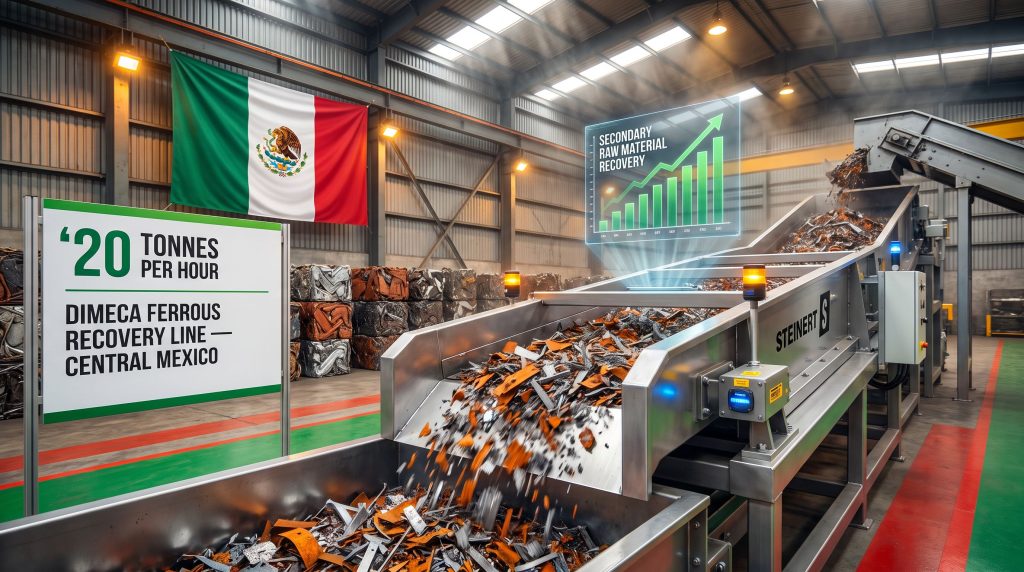
The most substantive recent demonstration of STEINERT's capabilities in the Mexican market is the DIMECA ferrous metal recovery project. STEINERT has been selected to design and supply the complete separation equipment package for DIMECA's new recovery line, located in central Mexico. DIMECA operates as one of Mexico's leading scrap metal processors, and the project carries significant weight as a commercial reference point for the company's regional ambitions.
Key Project Parameters
- Processing capacity: Up to 20 tonnes per hour (tph) of input scrap material
- Technology: Advanced STEINERT separation and recovery systems
- Objective: Maximise recovery rates for secondary raw materials while improving overall operational efficiency
- Location: Central Mexico
- Significance: Establishes a high-profile operational reference for STEINERT's Mexican market credentials
The design objectives for this installation reflect the broader economic logic driving ferrous recovery investment across Mexico. As global steel markets remain sensitive to input cost fluctuations, the ability to recover high-purity ferrous fractions from mixed scrap streams at competitive processing speeds becomes a genuine operational differentiator for processors competing in both domestic and export markets.
Processing up to 20 tph of scrap material, the DIMECA installation represents one of the most operationally substantive deployments of STEINERT separation technology in the Mexican market to date, establishing a concrete performance benchmark for future regional projects.
How Sensor-Based Ore Sorting Extends Mine Life in Mexican Mining Operations
Beyond the scrap metal sector, STEINERT's technology history in Mexico extends back to at least 2018, when the company installed its first ore sorter at a central Mexican mining operation. Subsequent fleet expansions have enabled those operations to process medium- to low-grade ore that would otherwise remain uneconomical to move through conventional concentrators. Notably, three STEINERT KSS sorting systems have previously been deployed to extend the operational life of a mine in Mexico, underscoring the company's proven track record in the region.
This application of sensor-based sorting technology to marginal ore grades is one of the less widely understood value propositions in the mining equipment sector. The core principle involves scanning run-of-mine material with sensor arrays capable of distinguishing valuable mineralised rock from waste based on physical or chemical properties, then mechanically or pneumatically ejecting the waste fraction before downstream processing begins.
Step-by-Step Process Flow for a Sensor-Based Ore Sorting Installation
- Material feeding and size classification to ensure particle dimensions fall within the sensor system's optimal detection range
- Sensor array scanning, which may use X-ray transmission, laser profiling, electromagnetic detection, or optical imaging depending on ore type and mineralisation characteristics
- Real-time data processing and particle classification using proprietary sorting algorithms
- Pneumatic or mechanical ejection of identified waste fractions from the product stream
- Separated high-value and waste streams directed to their respective downstream destinations
The economic impact of pre-concentration at this stage can be significant. For instance, x-ray transmissive sorting in mining applications demonstrates how removing barren or low-value rock before it enters the concentrator reduces energy consumption, lowers water usage, and improves the head grade delivered to downstream processing, consequently stretching the productive life of ore bodies that would otherwise be stockpiled or written off.
Comparing Ore Sorting Technologies for Mexican Mining Applications
| Sorting Technology | Best Application | Throughput Range | Key Benefit |
|---|---|---|---|
| X-ray Transmission (XRT) | Metallic ore pre-concentration | Medium-High | Density-based discrimination |
| Electromagnetic Sensors | Conductive metal detection | Medium | High selectivity for metals |
| Optical/Laser Sorting | Industrial minerals, coal | High | Surface characteristic analysis |
| Magnetic Separation | Ferrous metal recovery | Very High | Cost-effective, high-volume processing |
Production Capacity Expansion and the Global Growth Foundation
The Mexico initiative does not exist in isolation. STEINERT's most recent capacity investments in 2024 and 2025 focused on expanding production throughput at its STEINERT UniSort and STEINERT MSort manufacturing facilities in Germany. These expansions were a direct response to growing international demand for sensor-based sorting systems, and they provide the manufacturing backbone necessary to support new market entries without compromising delivery timelines for existing customers.
STEINERT Group CEO Peter Funke has described the Mexico expansion as another milestone within a multi-year internationalisation programme, situating the market entry as one step in a deliberate and sequenced global growth strategy rather than an opportunistic one-off move.
This framing matters for understanding the depth of commitment behind the expansion. Companies that invest in local warehouse infrastructure, dedicated sales coverage, and Spanish-language technical support alongside manufacturing capacity expansion at their production base are signalling a long-term market orientation, not a short-cycle commercial experiment. Furthermore, automation in mining technology continues to reshape how operators evaluate and commit to advanced separation equipment partners.
The next major ASX story will hit our subscribers first
Competitive Dynamics: Why Local Presence Changes the Game
For Mexican industrial operators evaluating sorting and separation technology providers, the presence of in-country infrastructure creates a meaningful point of differentiation that extends well beyond marketing positioning. The practical advantages include:
- Faster spare-parts fulfilment reducing equipment downtime during critical production periods
- Responsive technical support available in Spanish without international coordination delays
- Shorter project planning cycles enabled by direct application consulting from locally-based expertise
- Greater operator confidence in committing to long-term technology partnerships when local support is guaranteed throughout the equipment lifecycle
Competitors relying on distributor-led or import-only service models face a structurally more complex task in replicating these advantages without making equivalent infrastructure investments. This creates a window of competitive differentiation that STEINERT is actively exploiting.
The Circular Economy Shift Reshaping Mexican Industrial Procurement
Across Mexico's key industrial corridors, procurement decisions around sorting and separation equipment are increasingly being shaped by circular economy principles. Secondary raw material recovery is transitioning from a compliance-driven afterthought to a core operational objective for processors who recognise that recovered materials represent genuine value rather than processing residue.
This shift is particularly visible in the ferrous scrap processing sector, where the margin difference between a high-purity recovered fraction and a contaminated mixed stream can determine whether a processing operation is commercially viable at current commodity prices. Advanced separation technology converts what was once considered operational overhead into a recoverable revenue stream. The growing focus on urban mining and anthropogenic stock further reinforces why operators are investing in more precise recovery systems.
For STEINERT, this structural shift in industrial procurement philosophy aligns directly with the company's technology positioning and its lifecycle partnership model. As Mexican operators mature in their understanding of secondary raw material economics, demand for sophisticated, high-throughput separation systems is likely to deepen across the waste management, metal processing, and mining sectors simultaneously. However, realising this potential requires the kind of sustained local investment that STEINERT expands its presence in Mexico to deliver. Broader trends such as copper smelting expansion across the region are also intensifying the need for improved pre-processing and separation capabilities upstream.
Frequently Asked Questions: STEINERT in Mexico
What industries does STEINERT serve in Mexico?
STEINERT's Mexican operations target mining and mineral processing, scrap metal and ferrous recovery, and waste management and recycling, with technology solutions addressing separation challenges across all three sectors.
What is the DIMECA project?
The DIMECA project involves STEINERT designing and supplying separation equipment for a new ferrous metal recovery line in central Mexico, capable of processing up to 20 tph of scrap material. It is one of the most significant recent technology deployments in the Mexican sorting equipment market.
How long has STEINERT been active in Mexico?
STEINERT's documented presence in Mexico dates to at least 2018, when the company installed its first ore sorter at a central Mexican mining operation, with subsequent fleet expansions confirming a sustained long-term commitment to the market.
What customer support does STEINERT offer in Mexico?
Mexican customers can access Spanish-language technical service, application consulting, local spare-parts availability, and direct coordination support across planning and implementation phases of new sorting and separation projects.
Disclaimer: This article contains forward-looking statements and market assessments based on publicly available information. These should not be interpreted as financial advice or investment recommendations. Market conditions, technology adoption rates, and sector demand forecasts are subject to change.
Want to Identify the Next Major Mineral Discovery Before the Market Does?
Discovery Alert's proprietary Discovery IQ model delivers real-time alerts on significant ASX mineral discoveries, transforming complex geological data into actionable investment insights for both short-term traders and long-term investors — explore the historic returns major discoveries have generated and begin your 14-day free trial today to position yourself ahead of the broader market.