August 26, 2026
When Defence Procurement Meets the Circular Economy
The global hydrogen economy has long been shaped by two competing forces: the promise of clean, versatile energy and the persistent challenge of cost-effective production at scale. Most discussions centre on electrolysis, steam reforming, or thermochemical pathways. Yet one of the more technically intriguing approaches sits at the intersection of materials science and circular manufacturing — converting aluminium scrap to hydrogen for Canada submarines through a controlled chemical reaction. What makes this pathway newly relevant is not a laboratory breakthrough, but a procurement decision made in Ottawa.
Canada's commitment to acquiring up to 12 next-generation submarines has created a rare structural moment: a large-scale defence programme with a formal policy mandate to cultivate domestic industrial participation. For cleantech companies with technologies adjacent to naval hydrogen logistics, that policy architecture creates a pathway to relevance that would not otherwise exist. Understanding whether that pathway leads anywhere meaningful requires unpacking the technology itself, the submarine programme's actual requirements, and the considerable distance between a non-binding memorandum and a verified supply contract.
When big ASX news breaks, our subscribers know first
The Chemistry Behind Aluminium Scrap to Hydrogen for Canada Submarines
How the Aluminium-Water Reaction Actually Works
The core process is a chemically straightforward but practically nuanced reaction. When aluminium metal contacts water under controlled temperature and pressure conditions inside a modular reactor, an exothermic oxidation reaction occurs. The aluminium is oxidised, water molecules are split, and hydrogen gas is released. The aluminium itself is consumed in the process, which means feedstock supply and cost are central variables in the economic case.
Three outputs emerge simultaneously from this reaction:
| Output | Primary Application | Market Context |
|---|---|---|
| Hydrogen gas | Fuel cell feedstock, propulsion support | Growing industrial and defence demand |
| High-purity alumina (HPA) | Battery separators, ceramics, semiconductors | Premium pricing, tight supply |
| Thermal energy | Industrial process heat recovery | Offsetting facility operating costs |
A critical technical distinction worth noting is that the energy driving hydrogen release is stored chemically within the aluminium metal itself, not drawn from an external electricity source during the reaction phase. This differs fundamentally from PEM fuel cell technology, where a continuous power input is required throughout operation. In practical terms, this means the aluminium-water process can theoretically operate independently of grid infrastructure — a characteristic that has obvious relevance in remote or secured logistics environments.
The Feedstock Question: Why Scrap Aluminium Matters
Using post-industrial or post-consumer scrap aluminium rather than primary metal changes the economics considerably. Primary aluminium production is energy-intensive, requiring roughly 13 to 15 megawatt-hours per tonne via the Hall-Heroult electrolytic smelting process. Secondary aluminium, by contrast, requires approximately 5% of that energy input, making it a substantially lower-embodied-energy feedstock.
However, scrap aluminium is not a uniform commodity. Real-world performance of the aluminium-water reaction varies depending on:
- Alloy composition and the presence of alloying elements such as silicon, copper, or magnesium
- Surface oxide layer thickness, which can inhibit the reaction unless adequately prepared
- Contaminant levels from coatings, paints, or mixed-metal assemblies
- Particle size and surface area, which influence reaction kinetics and hydrogen yield rates
These variables mean that defence-grade hydrogen consistency — an absolute requirement for fuel cell systems operating in submarine environments — is not automatically guaranteed by the chemistry alone. It requires process engineering discipline around feedstock qualification and reactor control systems. Furthermore, advanced recycling technologies in this space remain an active area of technical development.
Canada's Submarine Programme and the ITB Policy Architecture
A Procurement Horizon Unlike Any Other
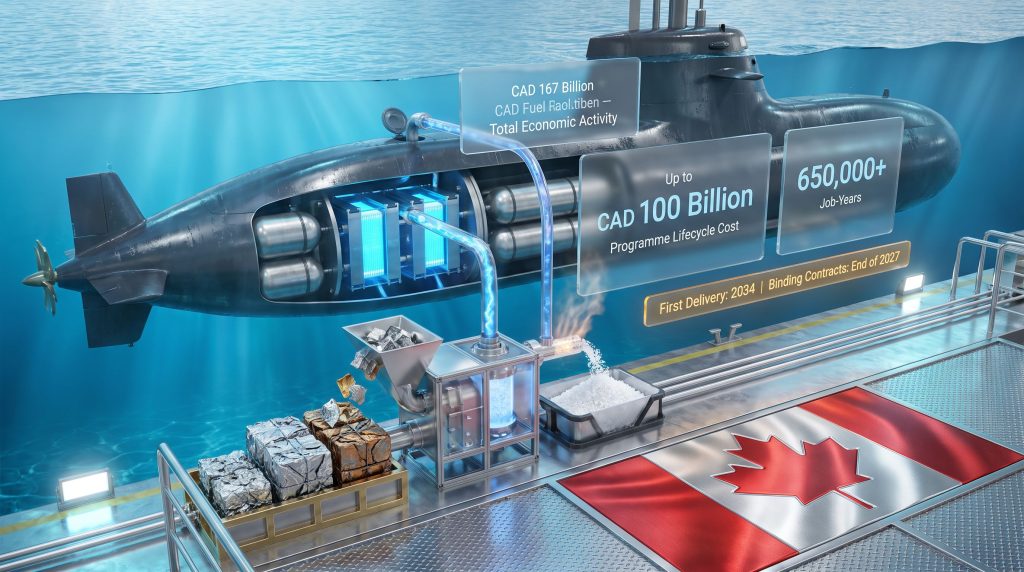
The Canadian Patrol Submarine Project represents a generational commitment. With a reported lifecycle cost reaching up to CAD 100 billion, anticipated binding contracts by the end of 2027, and first deliveries targeted from 2034, the programme creates a planning horizon that extends well into the second half of this century. The selection of the TKMS-led Team 212CD consortium on July 6 established the technical framework around which Canada's domestic industrial participation must now be designed.
The scale of economic projections attached to the programme is significant:
| Programme Metric | Reported Estimate |
|---|---|
| Total lifecycle cost | Up to CAD 100 billion |
| Total economic activity (TKMS projection) | CAD 167 billion |
| Direct economic impact | Over CAD 86 billion |
| Job-years generated | 650,000+ |
| Submarines planned | Up to 12 |
| First Canadian delivery target | 2034 |
| Binding contract expected | End of 2027 |
What Industrial and Technological Benefits Policy Actually Requires
Canada's Industrial and Technological Benefits (ITB) policy obligates foreign defence contractors to generate economic value within the Canadian industrial base equivalent to the contract value. This is not a voluntary commitment or aspirational target; it is a contractual condition of doing business with the Canadian government on major defence platforms.
For TKMS, this policy creates a structural incentive to identify, qualify, and integrate Canadian suppliers across the programme's industrial supply chain. The inclusion of Ontario-based Patriot Forge and Ottawa-based Kongsberg Geospatial in the Team 212CD consortium reflects this imperative. The ITB framework does not automatically confer programme membership on any Canadian company, but it does create a procurement-driven rationale for the prime contractor to actively cultivate domestic participation.
It is important to distinguish between a company operating within a policy environment that encourages domestic sourcing and a company that has secured a confirmed, contractual role within that programme. These represent materially different commercial positions.
For a company proposing aluminium scrap to hydrogen conversion as a supporting industrial capability, the ITB framework provides a logical commercial entry point. Whether hydrogen supply qualifies as an ITB-eligible activity, and at what scale, depends on programme structuring decisions not yet finalised.
The Type 212CD: What Makes This Submarine Different
Air-Independent Propulsion and Extended Submerged Endurance
The Type 212CD represents a genuine generational advance in non-nuclear submarine capability. Its propulsion architecture integrates three distinct systems working in complementary roles:
- Diesel-electric engines for surface transit and snorkel operations
- Lithium-iron-phosphate battery banks for submerged manoeuvring and burst speed
- Fourth-generation PEM hydrogen fuel cells for extended silent submerged endurance
The fuel cell system is where hydrogen supply becomes operationally critical. According to detailed technical reporting on the Type 212CD, PEM fuel cells combine hydrogen and oxygen electrochemically, generating electricity with water as the only by-product. There is no combustion, no exhaust, and critically for submarine operations, no acoustic or thermal signature detectable by adversary sensors.
Submerged Endurance: The Operational Leap
The endurance improvement from the Type 212A to the Type 212CD is substantial and has direct implications for operational planning:
| Submarine Class | Estimated Submerged Endurance (Low Speed) |
|---|---|
| Type 212A (previous generation) | Approximately 21 days |
| Type 212CD (current generation) | Up to 41 days |
The vessel measures approximately 73 metres in length, with a surface displacement of around 2,500 tonnes and submerged displacement of roughly 2,800 tonnes. Maximum submerged speed exceeds 20 knots, and the crew complement is approximately 30 personnel. Germany and Norway already have boats under construction, with the first Type 212CD delivery scheduled for 2033, one year ahead of the first Canadian boats.
Where Hydrogen Enters the Logistics Chain
The proposed application for aluminium-derived hydrogen is shore-based, not onboard. Hydrogen is pre-loaded into the submarine's storage systems before departure and consumed by the fuel cells during extended submerged operations. Replenishment occurs during port calls or at designated naval logistics facilities.
This supply-side positioning is architecturally important. A modular reactor would function as industrial port infrastructure, analogous to how a conventional gas production facility supplies industrial users. The submarine itself would be unchanged; the innovation lies in how its hydrogen is sourced and produced before it ever reaches the vessel.
Comparing Aluminium-Derived Hydrogen Against Competing Pathways
A Technology Framework Assessment
The aluminium-water reaction is not the only route to low-emission hydrogen. Understanding where it sits in the competitive landscape matters for evaluating its realistic prospects in a naval supply context. In addition, the broader shift towards renewable energy solutions in heavy industry continues to influence which production methods attract policy support and investment.
| Production Method | Feedstock | Key By-Products | Maturity Level | Defence Logistics Fit |
|---|---|---|---|---|
| Aluminium-water reaction | Scrap aluminium + water | HPA, heat | Early-stage commercial | High (distributed, grid-independent) |
| PEM electrolysis (green H2) | Water + renewable electricity | Oxygen | Commercial scale | Moderate (grid-dependent) |
| Steam methane reforming (grey/blue H2) | Natural gas | CO2 (captured or vented) | Fully mature | Low (emissions profile) |
| Biomass gasification | Organic waste | CO2, biochar | Demonstration stage | Low (feedstock consistency) |
The aluminium-water route has two characteristics that distinguish it from electrolysis in a defence context. First, it does not require a continuous external electricity input, making it theoretically deployable at forward operating bases or remote naval facilities with limited grid access. Second, the HPA co-product creates a secondary revenue stream that could structurally improve the economics of hydrogen production, particularly given HPA's premium pricing in battery separator and semiconductor markets where purities above 99.99% attract significant value.
The HPA Co-Product: An Underappreciated Economic Variable
High-purity alumina is a critical advanced material that often receives less attention than hydrogen in discussions of this technology. HPA above 4N purity (99.99%) commands pricing that can reach several thousand dollars per tonne in specialty markets, compared to standard aluminium oxide trading at commodity pricing levels.
Applications span LED phosphor coatings, lithium-ion battery separator coatings, sapphire glass substrates for semiconductors, and high-performance ceramics used in defence platforms. These same sectors are also driving the critical minerals demand now shaping national procurement strategies across allied nations.
If the aluminium-water reaction is producing HPA as a co-product at commercial quality thresholds, the hydrogen effectively arrives at a reduced net cost once HPA revenues are credited against operating expenses. This co-product economics model is a structural feature of the technology that pure electrolysis systems cannot replicate.
The Realistic Assessment: What Has and Has Not Been Established
What the Non-Binding MOU Actually Means
Investors, analysts, and industry observers monitoring GH Power's relationship with TKMS should approach the current status with precision. A non-binding memorandum of understanding represents a formalised intention to explore cooperation. It does not constitute:
- A confirmed supply agreement for hydrogen to the Canadian submarine fleet
- A technology qualification approval from TKMS or the Canadian government
- Formal membership in the Team 212CD programme consortium
- A committed ITB-eligible commercial arrangement
The collaboration exists at the preliminary commercial exploration stage, shaped by the ITB policy incentive rather than demonstrated technical integration. This is not unusual for early-stage industrial partnerships in complex defence procurement programmes, but the distinction matters enormously when assessing near-term commercial significance.
Three Conditions Required Before This Becomes Commercially Real
-
Reactor performance validation at scale: The modular reactor must demonstrate consistent hydrogen output meeting defence-grade purity and flow requirements under conditions representative of naval logistics operations. This standard has not yet been publicly confirmed.
-
ITB framework clarification: Canada's industrial participation programme must formally designate hydrogen supply as a qualifying ITB activity, with defined specifications for domestic content and supply chain structure.
-
Programme contract execution: The broader Canadian Patrol Submarine Project must progress from preferred supplier selection through to executed binding agreements — a milestone not expected before the end of 2027 at the earliest.
The Allied Programme Dimension
One aspect of the Type 212CD programme that receives less attention is its multi-nation character. Germany and Norway are already in construction. Canada's procurement adds a third customer nation. As analysis of the broader submarine hydrogen opportunity suggests, if aluminium-derived hydrogen were validated as a logistics-compatible production method within the Canadian programme, the technology concept could theoretically be evaluated for adoption across allied naval facilities operating the same platform. This potential replicability across partner programmes represents a longer-term dimension of the opportunity, though it remains entirely speculative at this stage.
The next major ASX story will hit our subscribers first
Frequently Asked Questions
What exactly is the aluminium scrap to hydrogen process being proposed for Canada's submarines?
The process involves reacting recycled or scrap aluminium with water inside a modular chemical reactor. The controlled exothermic oxidation reaction generates hydrogen gas, high-purity alumina, and recoverable heat. In the submarine context, the hydrogen output would be used to replenish fuel cell systems in the Type 212CD during port operations, not produced onboard the vessel. Furthermore, the battery recycling processes underpinning adjacent circular economy technologies share several feedstock management challenges with this aluminium conversion approach.
Why does it matter that hydrogen production would be shore-based rather than onboard?
Because it fundamentally changes the technology classification and regulatory environment. Onboard integration would require maritime certification, space and weight constraints, and potentially significant design modifications to the submarine. Shore-based industrial infrastructure, however, operates under a completely different qualification framework and can be developed, tested, and scaled independently of the submarine programme's own design timeline.
Has GH Power secured any role in Canada's submarine programme?
No confirmed contractual or programme role has been established as of the available reporting. The company is engaged in non-binding preliminary discussions with TKMS. Any future involvement depends on technology development outcomes, ITB programme structuring, and the execution of binding procurement agreements expected no earlier than the end of 2027.
What is high-purity alumina and why is it commercially significant?
High-purity alumina (HPA) is aluminium oxide refined to purity levels typically exceeding 99.99%. It serves as a critical input in LED lighting substrates, lithium-ion battery separator coatings, sapphire glass for semiconductor applications, and advanced ceramics used in aerospace and defence. As a co-product of the aluminium-water hydrogen reaction, HPA revenue can structurally reduce the effective cost of hydrogen production — an economic advantage not available to electrolysis-based competitors.
When will Canada's new submarines enter service?
The first four submarines for Canada are targeted for delivery beginning in 2034, with binding programme contracts anticipated by the end of 2027. The broader fleet encompasses up to 12 vessels across a programme with a reported lifecycle cost of up to CAD 100 billion.
The Structural Opportunity and Its Honest Limitations
The convergence of circular economy materials science with national defence infrastructure is genuinely novel. The case for aluminium scrap to hydrogen for Canada submarines rests on coherent technical logic: a hydrogen-consuming platform, a procurement policy mandating domestic industrial participation, and a production technology whose key differentiator is chemically stored energy rather than grid-dependent electrolysis.
Yet coherent logic and commercial reality are not the same thing. The technology must still prove consistent, defence-grade performance at meaningful scale. The programme must still define what qualifies as ITB-eligible hydrogen supply. And Canada must still progress from preferred supplier selection to binding contract — a milestone years away.
What the current situation genuinely represents is a well-positioned early-stage exploration operating within a structurally favourable policy environment. For observers tracking the aluminium value chain, the circular economy, or clean hydrogen production pathways, this intersection of scrap metal recycling and naval energy logistics offers a compelling case study in how industrial policy can create unexpected demand signals for emerging technologies.
Readers seeking broader context on the global secondary aluminium market and its intersections with advanced manufacturing applications can find ongoing industry coverage at alcircle.com, which tracks developments across the aluminium value chain from bauxite to downstream applications.
This article contains forward-looking assessments based on publicly available information. Nothing in this article constitutes financial advice or a recommendation to invest in any company or project. Readers should conduct their own due diligence before making investment decisions.
Want to Stay Ahead of the Next Major ASX Resource Discovery?
Discovery Alert's proprietary Discovery IQ model delivers real-time alerts the moment significant mineral discoveries — spanning critical minerals like aluminium and high-purity alumina feedstocks central to clean energy supply chains — are announced on the ASX, turning complex data into clear, actionable opportunities. Explore how historic discoveries have generated substantial returns and begin your 14-day free trial to position yourself ahead of the broader market.