August 26, 2026
The Hidden Emissions Problem Sitting in Plain Sight on Every Mine Site
There is a version of the mining decarbonisation story that almost everyone in the industry knows. It involves enormous autonomous haul trucks rolling silently across open-cut pits, their diesel engines replaced by battery packs or hydrogen fuel cells. It involves excavators the size of apartment buildings drawing power from overhead cables or on-board energy storage systems. It is a compelling vision, and it attracts the lion's share of capital, engineering talent, and media attention.
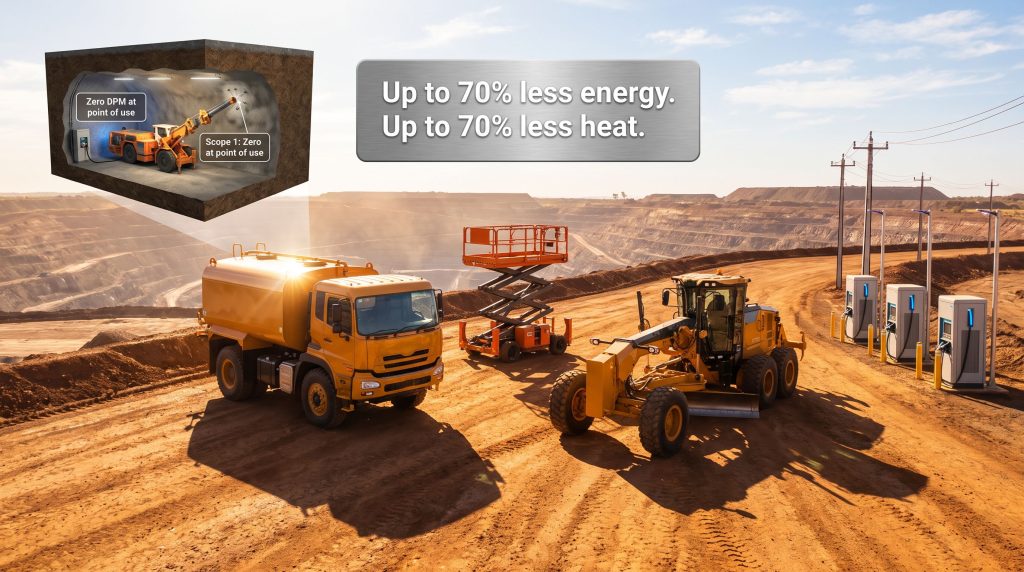
What that version consistently omits is the fleet of machines working in the background of every operational mine site, performing the unglamorous but operationally indispensable work that keeps production moving. Graders shaping haul roads. Water trucks suppressing dust across kilometres of unsealed surface. Bolters securing rock faces in underground drives. Scalers clearing loose material from tunnel walls. Scissor lifts positioning crews at height. None of these machines move ore. All of them are essential. And almost all of them still run on diesel.
This is not a minor oversight. On a large-scale operation, support equipment can account for a substantial share of total on-site diesel consumption precisely because these machines operate continuously across every shift, every day, for the life of the mine. The cumulative emissions footprint is significant, and it has been systematically underweighted in decarbonisation planning.
That calculus is beginning to shift. The emergence of commercially validated battery-electric support equipment in mining is creating a pathway to near-term, achievable emissions reduction that does not require operators to wait for full haul fleet electrification. Understanding why this category of equipment matters, how it performs, and what it demands from operators is increasingly central to credible sustainability strategy across the sector.
When big ASX news breaks, our subscribers know first
What Battery-Electric Support Equipment Actually Is
Before examining the case for adoption, it is worth establishing precise definitions. Battery-electric support equipment in mining refers to auxiliary machines powered by battery-electric drivetrains rather than diesel engines, deployed specifically for site support functions rather than primary ore movement.
The category spans two distinct operating environments:
-
Surface support applications: Water trucks for dust suppression, motor graders for haul road maintenance, wheel loaders and wheel dozers for bulk material handling and site preparation tasks.
-
Underground support applications: Rock bolters for ground support installation, scalers for loose material removal, shotcrete sprayers for tunnel lining, scissor lifts and elevated work platforms for overhead access, and utility vehicles for crew and materials transport.
These machines share a defining characteristic: they do not generate revenue directly, but their absence immediately reduces the productivity and safety of every machine that does. A haul road that has not been graded deteriorates rapidly under heavy traffic, reducing truck speeds and increasing tyre wear. Dust that has not been suppressed creates visibility hazards, regulatory compliance failures, and community relations risks. The dependency is absolute, even if the machines themselves remain largely invisible in fleet electrification narratives.
The Structural Case for Electrifying Support Fleets First
The conventional wisdom in the mining electrification transition has been to pursue the largest diesel consumers first. By raw volume, haul trucks consume more fuel than any other equipment category on most large operations, which makes them an intuitive target for emissions reduction programmes. However, full haul fleet electrification is extraordinarily capital-intensive, requires purpose-built charging infrastructure at scale, and demands wholesale changes to operational logistics that many sites are not ready to implement.
Support equipment offers a structurally different proposition, and the differences are meaningful:
-
Predictable duty cycles: Unlike haul trucks, which operate across variable routes and gradients, many support machines follow consistent, repeatable patterns. A water truck refills at a fixed point and follows a defined dust suppression route. A grader works a designated section of haul road before returning. These patterns simplify charging logistics considerably.
-
Fixed return points: Machines that regularly return to established locations can be charged during natural operational breaks without requiring extensive roaming charging infrastructure.
-
Lower capital intensity: Electrifying a single water truck or grader requires a fraction of the investment associated with replacing a 300-tonne haul truck with an electric equivalent. The entry cost is accessible for a far broader range of operations.
-
Faster deployment timelines: Because the infrastructure requirements are more manageable, battery-electric support equipment can be commissioned and operational in timeframes that are realistic within current capital cycles.
The implication is significant: electrifying support fleets represents the most accessible near-term decarbonisation lever available to most mining operations, enabling measurable scope 1 emissions reductions without waiting for the full-scale infrastructure overhaul that primary fleet electrification demands.
Underground Operations: Where the Benefits Compound
Why Does the Underground Environment Amplify the Advantages?
For underground mining specifically, the case for battery-electric support equipment extends well beyond carbon accounting. The underground environment creates a set of interdependent operational challenges for which battery-electric machines offer compounding benefits that diesel equivalents cannot match.
The most significant of these relates to heat and ventilation. Every diesel engine operating underground generates thermal energy that must be removed from the working environment. Ventilation systems consume enormous amounts of electrical power to maintain safe temperature and air quality conditions, and the cost of that ventilation scales with both the depth of the operation and the number of diesel machines running simultaneously.
Research and field data from battery-electric underground equipment deployments have demonstrated that these machines can generate up to 70 per cent less heat than equivalent diesel platforms, with a corresponding reduction in energy consumption underground. That figure has compounding infrastructure implications: lower heat generation means lower ventilation requirements, which means lower operating costs and potentially greater access to deeper ore bodies where ventilation costs currently make diesel-based operations economically prohibitive.
| Performance Category | Diesel Underground Equipment | Battery-Electric Underground Equipment |
|---|---|---|
| Heat generation | High, requires intensive ventilation | Up to 70% lower |
| Energy consumption | Baseline diesel consumption | Up to 70% lower |
| Diesel particulate matter | Present in all exhaust | Eliminated at point of use |
| Ventilation infrastructure demand | High, scales with depth | Significantly reduced |
| Scope 1 carbon emissions | Full diesel footprint | Zero at point of use |
| Worker health exposure | Ongoing DPM carcinogen risk | Eliminated |
The elimination of diesel particulate matter (DPM) from underground workings deserves particular emphasis. DPM is classified as a Group 1 human carcinogen by the International Agency for Research on Cancer, meaning there is sufficient evidence that it causes cancer in humans. Underground miners working in diesel-powered environments carry an elevated occupational exposure risk that battery-electric equipment removes entirely. This is not an abstract ESG benefit; it is a direct and material improvement to worker health conditions.
Real-world validation of these benefits is available from multiple operational deployments. Sandvik's DS412iE battery-electric bolter has accumulated field performance data from deployment at the Tanco mine in Canada. The Oyu Tolgoi underground operation in Mongolia has demonstrated that mixed battery-electric fleets — incorporating bolters, scissor trucks, loaders, and haul trucks — can function as a coherent operational whole. Furthermore, MacLean Engineering has reported its battery-electric underground support vehicles reaching commission across 16 mine sites globally, with the installed base accumulating more than 500,000 operating hours, a figure that provides meaningful statistical confidence in reliability and duty-cycle performance.
Surface Operations: The Emerging Frontier for Electrification
Underground adoption has advanced further than surface electrification of support equipment, for reasons that are structurally logical. The underground environment creates urgent economic incentives in ventilation cost savings and regulatory DPM compliance that have no direct equivalent on the surface. Surface support equipment operates in open air, consequently removing the most acute drivers of adoption.
That dynamic is changing as OEM validation programmes extend explicitly into surface support categories. XCMG's current battery-electric testing programme in Xuzhou, China is instructive in this respect. Of the four machines currently undergoing comprehensive validation, exactly half address surface support functions: the XDE150E battery-electric water truck and the GR350EP battery-electric grader. The other two platforms target production support applications. The deliberate allocation of half of a major OEM's validation portfolio to support equipment signals that the industry is beginning to treat surface support electrification as a first-order priority.
For Australian operators, the surface environment presents its own specific challenges. The Pilbara region of Western Australia represents one of the most demanding operating conditions on the planet: extreme ambient temperatures, long continuous shift requirements, vast site footprints, and productivity expectations that leave little margin for equipment unreliability. In addition, the mining decarbonisation benefits of electrifying surface fleets are becoming harder to ignore as regulatory and investor pressure intensifies.
Dust suppression adds a compliance dimension that reinforces the commercial case. Every Australian mine site is subject to dust management requirements under state environmental legislation, and failure to maintain adequate suppression has direct consequences for air quality monitoring results, regulatory reporting, and community licence to operate.
The Engineering Reality: Why Validation Programmes Matter
It would be technically misleading to characterise battery-electric support equipment as a straightforward substitution of power source. Replacing a diesel drivetrain with a battery-electric system in a working mining machine is a systems-level engineering challenge that touches every aspect of machine design and operational integration.
The key integration requirements include:
-
Battery architecture selection suited to the specific load profile and duty cycle of the application.
-
Thermal management systems capable of maintaining battery performance within safe operating temperature ranges in high-ambient environments.
-
Intelligent machine control software that optimises power delivery, manages regenerative braking energy recovery, and monitors battery state of health in real time.
-
Charging infrastructure compatibility ensuring that machine charging requirements align with site power supply capacity and charging network design.
-
Structural and mechanical integration of battery packs into machine frames designed for the dynamic loads, vibration, and rough terrain typical of mining applications.
Validation programmes replicate the conditions that expose failures in any of these integration areas: sustained high-load operation, steep gradients, variable duty cycles, and extended shift durations. The engineering discipline involved in taking a battery-electric machine from prototype specification to field-ready reliability is substantial. The battery safety risks associated with lithium-ion systems in demanding environments make rigorous validation not merely best practice, but operationally essential.
The Global Mining Guidelines Group (GMG) has published guidelines recommending standardised field testing protocols and transparent performance reporting to enable genuine machine-to-machine comparison across OEM platforms. The GMG framework represents an effort to establish a common language for evaluating battery-electric equipment capability that operators can apply with greater confidence.
Procurement teams evaluating battery-electric support equipment should request independently verified field test data referenced against standardised duty cycles, rather than relying solely on manufacturer specification sheets. The difference between peak performance figures and sustained operational performance in the field can be material to total cost of ownership calculations.
The next major ASX story will hit our subscribers first
OEM Landscape: Who Is Delivering Commercial Battery-Electric Support Equipment
| OEM | Battery-Electric Support Equipment | Key Milestones |
|---|---|---|
| Sandvik | Underground bolters, rock support drill rigs, loaders, trucks | More than 600 electric units in global installed base |
| Epiroc | Underground loaders, electrification platforms for support applications | Active deployments across multiple continents |
| MacLean Engineering | Underground support vehicles across multiple categories | 16 mine site commissions; 500,000+ operating hours logged |
| XCMG | Battery-electric water trucks, graders, wheel loaders, wheel dozers | Comprehensive four-machine validation programme underway in Xuzhou |
Total Cost of Ownership: Looking Beyond the Sticker Price
The upfront capital cost of battery-electric support equipment is currently higher than equivalent diesel platforms, and this differential is the most frequently cited barrier to adoption. Evaluating the comparison on purchase price alone, however, produces a systematically distorted picture of long-term economics.
A structured total cost of ownership assessment across the full asset life changes the comparison materially:
| Cost Category | Diesel Support Equipment | Battery-Electric Support Equipment |
|---|---|---|
| Upfront purchase cost | Lower | Higher |
| Energy costs | Ongoing diesel expenditure | Lower electricity costs per operating hour |
| Maintenance complexity | Engine, transmission, exhaust, cooling systems | Fewer moving parts; battery degradation management |
| Underground ventilation infrastructure | High ongoing operational cost | Significantly reduced requirement |
| Regulatory compliance trajectory | Increasing DPM and carbon pricing exposure | Lower long-term exposure |
| Asset residual value | Declining as emissions regulations tighten | Improving as technology matures |
The ventilation cost reduction in underground applications deserves specific quantification. Ventilation systems in deep underground mines can account for 30 to 50 per cent of total site electricity consumption, according to industry engineering estimates. A meaningful reduction in the underground heat load generated by support equipment translates to a reduction in ventilation fan energy demand that compounds across the full operational life of the mine. Furthermore, the role of renewable energy in mining is growing alongside electrification, potentially amplifying these cost savings when clean power sources displace grid electricity.
Matching Equipment to Application: Suitability Assessment
Not all support equipment applications are equally suited to battery-electric conversion under current technology parameters. Operators benefit from a structured suitability assessment before committing capital:
Highest current suitability:
-
Underground bolters and scalers operating on fixed, repetitive duty cycles in confined workings where DPM elimination and heat reduction carry the greatest value.
-
Water trucks following defined dust suppression routes with regular return to fixed refill and recharge points.
-
Scissor lifts, elevated work platforms, and underground utility vehicles characterised by short-range, high-frequency stop-start operation.
Moderate suitability:
-
Motor graders performing continuous haul road maintenance across large surface footprints, where charging window planning is required to maintain operational continuity.
-
Shotcrete sprayers operating on batch-process cycles that create natural equipment downtime suitable for opportunity charging.
Lower suitability under current technology:
- High-cycle surface support equipment operating across very large site footprints without established fixed return points, where range limitations and charging logistics remain unresolved.
Infrastructure Planning: The Often-Underestimated Requirement
The single most common implementation failure in early battery-electric equipment deployments has not been machine performance. It has been inadequate planning for the infrastructure that makes machine performance possible. Charging networks, grid connection capacity, thermal management systems, and safety protocols must all be designed into the mine plan from the outset, not retrofitted after equipment has been ordered.
Successful battery-electric support equipment deployment requires coordinated advance planning across five domains:
-
Charging infrastructure including location, power capacity, network topology, and grid connection requirements.
-
Ventilation system recalibration for underground operations, incorporating the reduced heat load generated by battery-electric fleets.
-
Battery thermal management in high-ambient-temperature surface environments, where lithium-ion chemistry is sensitive to sustained exposure above optimal operating ranges.
-
Fire safety protocols specific to lithium-ion battery hazards, including detection systems, suppression equipment, and emergency response procedures trained to battery-specific scenarios.
-
Workforce capability development covering operator competency for battery-electric machine handling and maintenance technician upskilling for battery system servicing.
The manufacturer-operator relationship is central to navigating these requirements effectively. Site conditions, productivity targets, and duty cycle profiles are highly specific to individual operations, and the feedback loop between operational experience and equipment refinement is what closes the gap between a technically capable machine and a fit-for-purpose field deployment. Research published in ScienceDirect further reinforces that systematic infrastructure planning is a decisive factor in the successful commercialisation of battery-electric mining equipment.
The Incremental Path Forward
Full mine electrification will not arrive in a single capital cycle. The trajectory will be incremental: machine by machine, application by application, site by site. Within that incremental framework, battery-electric support equipment in mining occupies a uniquely accessible position. The capital requirements are lower, the deployment timelines are faster, the operational disruption is more manageable, and the emissions outcomes are measurable and real.
Each support machine commissioned on battery-electric power contributes more than the direct emissions reduction it achieves. It builds operator competency with the technology, develops site infrastructure that future deployments can leverage, and generates operational data that refines total cost of ownership modelling for subsequent procurement decisions. The electric mining vehicles sector as a whole benefits from this accumulation of real-world performance intelligence across both production and support equipment categories.
Corporate net-zero commitments across major mining companies are translating into concrete fleet electrification timelines. Scope 1 emissions from support fleets are reportable, auditable, and increasingly scrutinised by investors, lenders, and insurers applying ESG frameworks to capital allocation decisions. The support fleet, long invisible in sustainability planning, is becoming a tangible and near-term opportunity for operators prepared to engage with the technology seriously.
The machines that keep mines running — the graders, water trucks, bolters, and scalers — are no longer a footnote to the electrification story. They are increasingly the chapter that gets written first.
This article draws on industry reporting published in the July 2026 edition of Australian Mining magazine. Readers seeking ongoing coverage of mining electrification, ESG developments, and equipment innovation across the Australian resources sector can explore related reporting at australianmining.com.au. Forward-looking statements regarding technology performance, adoption timelines, and cost trajectories involve inherent uncertainty and should not be treated as financial or investment advice.
Want to Identify ASX Mining Companies Leading the Electrification Transition?
Discovery Alert's proprietary Discovery IQ model delivers real-time alerts the moment significant mineral discoveries hit the ASX, transforming complex data into actionable insights for investors tracking the companies reshaping how mines are built and operated — start your 14-day free trial today, or explore the historic returns major discoveries have delivered to understand the scale of opportunity that early positioning can unlock.