August 25, 2026
When Records Disappear: What the Rennell Bauxite Case Reveals About Pacific Island Mineral Governance
Across the global extractive industry, the integrity of a mineral export regime rests on a deceptively simple premise: that every tonne leaving a country's shores can be independently verified, valued, and accounted for. When that chain of verification breaks down, the consequences ripple far beyond administrative inconvenience. They touch resource sovereignty, community rights, and the fundamental question of who benefits when a nation's finite natural assets are exported abroad.
The Solomon Islands Rennell bauxite shipments investigation has brought precisely these questions into sharp focus. What began as an inquiry into royalty discrepancies has widened into a multi-layered accountability examination involving missing permits, absent payment records, and a complete lack of independent export valuation across 33 disputed bauxite consignments. Understanding what went wrong, and why it matters, requires looking closely at both the mechanics of mineral export governance and the structural vulnerabilities that allowed this situation to develop over multiple years.
When big ASX news breaks, our subscribers know first
The Mechanics of Mineral Export Accountability
How a Functioning Consignment Permit System Should Work
In resource-exporting nations, consignment permits serve as the foundational control mechanism for each individual shipment leaving the country. Before a cargo vessel departs with mineral ore, a permit must be issued by the relevant ministry, typically cross-referenced against approved export volumes, destination refinery details, and agreed commercial terms.
Alongside consignment permits, refinery assay reports and certificates of quality play a critical role. These documents, produced by the receiving facility upon receipt and processing of the ore, independently confirm the grade and volume of the material shipped. Without them, a government has no third-party verification of what was actually exported or at what commercial value. This is not a bureaucratic formality; it is the mechanism through which royalty obligations are calculated and enforced.
The Solomon Islands Rennell bauxite shipments investigation has revealed that this system failed comprehensively across a multi-year period. The evidentiary picture that has emerged looks like this:
| Document Type | Standard Purpose | Status in the Rennell Investigation |
|---|---|---|
| Consignment Permits | Authorise individual export shipments | Missing or incomplete for 2019, 2020, and 2021 |
| Customs Documentation | Record cargo volume and destination | Incomplete across multiple shipments |
| Refinery Assay Reports | Third-party verification of grade and volume | Not located by investigators |
| Certificates of Quality | Independent export valuation support | Not located |
| Central Bank Payment Records | Confirm royalty and tax remittances | No corresponding records found |
| Attorney General Correspondence | Legal authorisation for export activity | Absent for the relevant period |
| MOU or Government Agreements | Formalise benefit-sharing terms | Not located |
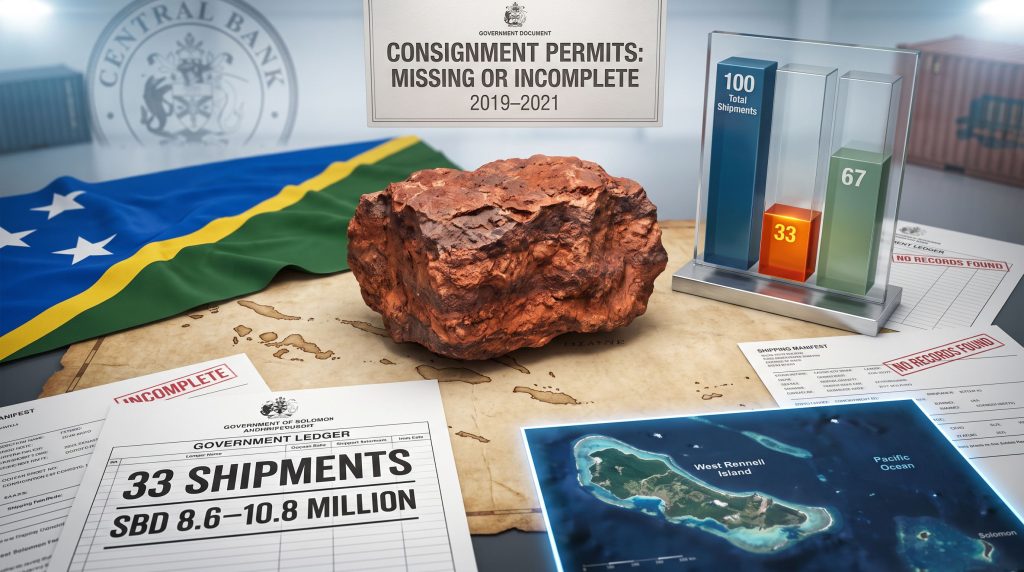
Of approximately 33 disputed shipments, investigators were able to locate only around 11 consignment permits. The authorisation basis for the remaining consignments is entirely unaccounted for in the documentary record.
Why Bauxite Grade Verification Is Commercially Critical
Bauxite is not a uniform commodity. Its commercial value varies substantially depending on several grade parameters that refineries use to determine alumina extraction efficiency. Furthermore, understanding these parameters is essential context for assessing the bauxite production leaders across the globe and the standards they apply:
- Available alumina content (Al₂O₃): The primary measure of recoverable aluminium oxide, typically expressed as a percentage of total ore weight
- Reactive silica (SiO₂): High silica content increases refining costs and reduces the value of the ore to alumina producers
- Total moisture content: Affects the net weight calculations used in royalty and pricing assessments
- Diaspore vs. gibbsite mineralogy: Different bauxite mineral types require different refining temperatures and pressures, affecting suitability for different refineries
Without independent assay certification, the grade, and therefore the commercial value, of bauxite exports cannot be objectively determined. For West Rennell Island ore, this means the Solomon Islands government has no independent record of whether the exported material met commercial specifications, what price benchmarks applied, or how royalty obligations should have been calculated across these 33 shipments.
The absence of refinery assay reports in the Rennell investigation is not merely a paperwork gap. It eliminates the only objective mechanism through which the government could independently verify the commercial value of what left the country.
What the Evidence Trail Reveals
The Payment Discrepancy at the Heart of the Investigation
The two companies under scrutiny, Asia Pacific Investment Development Ltd (APID) and Bintan Mining SI Ltd (BMSI), had communicated to the Ministry of Mines that royalty payments were made in relation to the disputed shipments. However, the Central Bank of Solomon Islands holds no payment records corresponding to either company for the 2019 to 2020 shipment period.
This divergence between company-stated positions and central bank records is the central factual tension of the investigation. It has, consequently, driven the inquiry toward financial intelligence review and, potentially, criminal accountability assessment.
Royalty estimates now place the unaccounted obligation in a range of approximately SBD 8.6 million to SBD 10.8 million, distributed across beneficiary groups that include:
- Indigenous landowners on Rennell Island
- The national government of the Solomon Islands
- Renbel Province
- A community development agreement fund
The Timeline Correction and Its Legal Significance
Initial reporting on the investigation placed the disputed shipment period between 2017 and early 2019. The Attorney General's Chambers has since formally corrected this, confirming the unpaid royalty issue relates specifically to the 2019 to 2020 shipment window, while consignment permit gaps extend further into 2021.
This timeline correction is not a minor administrative detail. In legal proceedings involving potential proceeds of crime, the precise shipment period determines which officials held responsibility, which legal frameworks apply, and which statute of limitations considerations are relevant. Correcting the record from a 2017 starting point to a 2019 starting point reshapes the entire accountability landscape.
Officials Unable to Explain the Record Gaps
When the investigation turned to officials who held ministerial and departmental responsibility during the relevant period, not one was able to produce documentary evidence explaining how consignment permits continued to be issued, and shipments continued to proceed, against a backdrop of missing records, absent central bank approvals, and no locatable Attorney General correspondence.
This finding is significant beyond the immediate investigation. It suggests that the accountability failure was not simply a case of misfiled documents; it points to a system in which the checks designed to catch exactly this kind of discrepancy were either not functioning or were not being applied.
The Escalation to Financial Intelligence Review
Why the Financial Intelligence Unit's Involvement Changes the Nature of the Inquiry
The involvement of the Solomon Islands Financial Intelligence Unit (FIU) represents a meaningful escalation of the Rennell bauxite inquiry. FIU mandates in Pacific Island jurisdictions typically extend to assessing whether financial flows constitute proceeds of crime under anti-money laundering statutes.
If the FIU determines that royalty payments were received by the companies but not remitted to the state, or that export proceeds were moved in ways inconsistent with declared transaction values, the investigation could transition from an administrative audit into a criminal accountability process. This would, furthermore, open the possibility of state asset recovery proceedings.
It is important to note that, as of the current investigative stage, no finding of wrongdoing has been made against APID or BMSI. The inquiry has identified documentary failures and the absence of verifiable records, but the legal threshold for criminal liability has not been crossed in the official findings to date.
Rennell Island: A History That Complicates the Picture
UNESCO World Heritage Status and Environmental Controversy
West Rennell Island carries UNESCO World Heritage designation, a status that has made bauxite mining operations there internationally contentious. The island hosts one of the Pacific's most significant raised coral limestone ecosystems, and environmental advocates have raised concerns about habitat degradation linked to mining activity over an extended period.
The governance failures now under investigation did not emerge in isolation. They developed against a backdrop of community benefit disputes, reported shipping incidents, and longstanding concerns about the adequacy of regulatory oversight applied to extraction activities on the island. In addition, ongoing bauxite project development elsewhere in the region highlights the contrast between robust modern oversight frameworks and the deficiencies revealed here.
Across the broader export record, royalties were reportedly paid on approximately 67 of roughly 100 total bauxite shipments from Rennell Island, leaving the 33 disputed consignments without any verified payment trail. This ratio suggests the accountability failure, while serious, was not universal across the entire export history; but it raises the question of why the verification regime was inconsistently applied.
A Governance Benchmark Comparison
How the Rennell Case Measures Against Best-Practice Standards
Pacific Island nations face structural challenges in administering mineral export governance. Limited institutional capacity, geographic remoteness, and constrained regulatory budgets can create conditions where documentation failures accumulate over time. However, best-practice frameworks for comparable small-nation extractive industries establish clear minimum standards:
| Governance Element | Best Practice Standard | Rennell Investigation Status |
|---|---|---|
| Independent export valuation | Mandatory third-party assay certification | Not located |
| Royalty payment verification | Central bank confirmation required | No records found |
| Consignment permit completeness | Fully auditable for each shipment | Incomplete across three calendar years |
| Legal authorisation trail | AG correspondence mandatory | Absent for the relevant period |
| Community benefit distribution | Structured, documented, and auditable | Disputed and unverified |
| Customs documentation | Complete cargo records required | Incomplete across multiple shipments |
Nations such as Papua New Guinea have implemented centralised mineral revenue management frameworks that route royalty flows through dedicated accounts with independent oversight. The Rennell case illustrates what can occur when equivalent mechanisms are absent or inconsistently applied. By contrast, a review of major bauxite mines globally demonstrates how more mature jurisdictions maintain auditable export trails as standard practice.
The next major ASX story will hit our subscribers first
The Human Cost of Unverified Export Proceeds
Who Bears the Loss When Royalties Cannot Be Verified
Resource royalty frameworks in Pacific Island nations are typically structured to distribute proceeds across multiple stakeholder tiers. In the Solomon Islands context, this means that when payments cannot be independently verified, the downstream impact is not felt equally across all parties.
When royalty flows are interrupted or unverifiable, the communities with the least institutional recourse, often indigenous landowners in geographically remote areas, absorb the greatest proportional impact. National governments and provincial authorities retain bureaucratic mechanisms to pursue recovery; landowner groups typically do not.
For Rennell Island communities, the unresolved royalty question represents a potential loss of income that should have flowed from the extraction of resources from their ancestral land. Regardless of the investigation's ultimate findings on corporate liability, the community impact of the documentation failure is real and immediate.
What Systemic Reform Would Look Like
Priority Changes for Pacific Island Mineral Export Governance
The Solomon Islands Rennell bauxite shipments investigation provides a clear template for the regulatory reforms that would reduce the likelihood of comparable failures elsewhere in the Pacific. Encouragingly, frameworks around natural capital in mining and evolving mine reclamation standards demonstrate that the broader industry is moving toward greater accountability. The priority reforms needed here include:
-
Mandatory independent assay certification: Requiring that refinery-issued assay reports be transmitted directly to the government ministry and central bank for every shipment, eliminating reliance on company-submitted documentation alone
-
Real-time central bank royalty monitoring: Establishing dedicated resource revenue accounts with automated payment confirmation systems that flag non-receipt within defined windows
-
Digital permit management: Replacing paper-based consignment permit systems with auditable digital records that cannot be selectively lost or misfiled
-
Attorney General pre-export legal clearance: Requiring documented AG sign-off before any consignment permit is issued, creating an additional accountability checkpoint
-
Third-party community benefit verification: Independent audit of community development fund distributions to ensure landowner entitlements are being met
These are not novel concepts. They reflect frameworks already operating in more mature extractive governance environments and are achievable within the institutional capacity of Solomon Islands with appropriate technical assistance from bodies such as the Extractive Industries Transparency Initiative, which supports exactly this kind of reform in developing resource economies.
Key Facts: Solomon Islands Rennell Bauxite Shipments Investigation
- 33 shipments of bauxite departed the Solomon Islands without a complete, independently verifiable government record of grade, volume, value, or payment
- Consignment permit records for 2019, 2020, and 2021 are either missing or incomplete
- Only approximately 11 consignment permits have been located in connection with the 33 disputed shipments
- The Central Bank of Solomon Islands holds no payment records for either APID or BMSI across the disputed period
- Unaccounted royalties are estimated at SBD 8.6 million to SBD 10.8 million
- Royalties were reportedly paid on approximately 67 of roughly 100 total shipments from the site
- The Financial Intelligence Unit is assessing whether proceeds of crime statutes apply
- The corrected disputed period covers 2019 to 2020 for unpaid royalties, with permit gaps extending to 2021
- No formal finding of wrongdoing has been made against either company
- West Rennell Island holds UNESCO World Heritage designation, adding an international dimension to governance concerns
- For further context on regional governance challenges, the Pacific Community's mineral policy resources provide useful comparative frameworks for small island developing states
Disclaimer: This article is based on publicly available investigative reporting and does not constitute legal, financial, or investment advice. The investigation into the Rennell bauxite shipments is ongoing. No finding of wrongdoing has been formally established against any company or individual named in connection with this matter. Readers should not treat the contents of this article as a definitive account of legal liability or corporate misconduct.
Want to Stay Ahead of Significant ASX Mineral Discoveries Before the Broader Market Does?
Discovery Alert's proprietary Discovery IQ model delivers real-time alerts on major ASX mineral discoveries, instantly translating complex geological and commodity data into clear, actionable investment insights for traders and long-term investors alike — explore historic examples of what significant discoveries can return and begin your 14-day free trial at Discovery Alert to position yourself ahead of the market.