August 25, 2026
When a Fraction of a Licence Tells the Whole Story
The global heavy mineral sands industry has quietly become one of the most strategically consequential sectors in modern mining. Titanium feedstocks, zircon, and high-grade garnet underpin everything from aerospace alloys and semiconductor manufacturing to pigment production and waterjet cutting systems. Yet unlike lithium or rare earths, HMS deposits rarely capture mainstream attention until a resource estimate arrives that reframes the scale of what lies beneath a stretch of coastline.
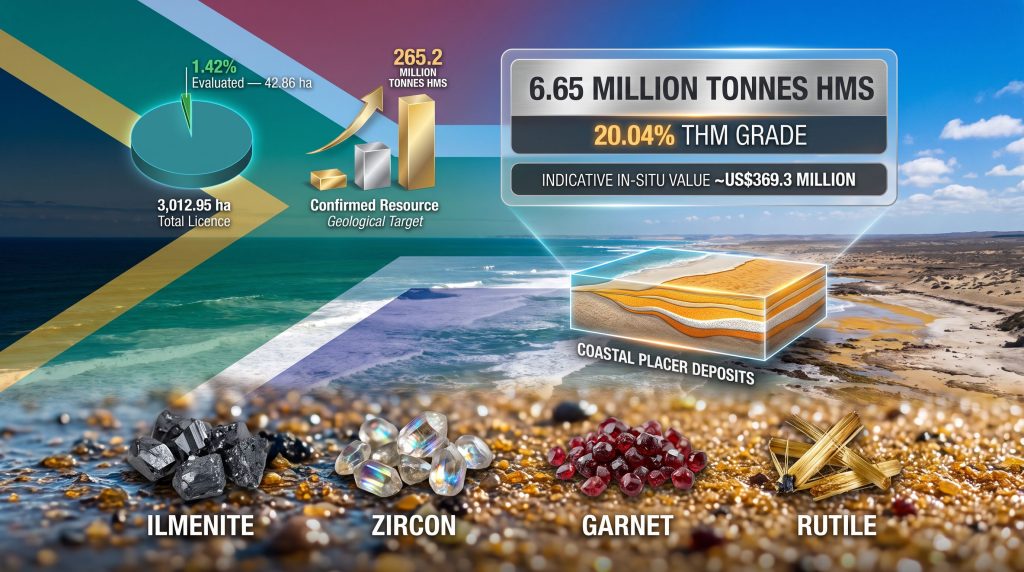
That is precisely the dynamic now unfolding along South Africa's Northern Cape coast, where an independent technical report has formally validated the resource potential of the Kazera Sea Concession 2A heavy mineral sands project within an evaluated zone that represents just 1.42% of the total licence area.
When big ASX news breaks, our subscribers know first
Why Heavy Mineral Sands Matter More Than Most Investors Realise
Heavy mineral sands are sedimentary placer deposits enriched in economically valuable minerals through long-term coastal and aeolian sorting processes. The four principal economic heavy minerals found within the Sea Concession 2A licence are:
- Ilmenite – the dominant titanium feedstock globally, critical to pigment manufacturing (TiO2) and aerospace-grade titanium metal production
- Rutile – a higher-purity titanium feedstock commanding premium pricing, used in pigment production, welding electrode coatings, and advanced titanium sponge manufacturing
- Zircon – essential to ceramic tile manufacturing, refractory applications, nuclear fuel rod cladding, and specialty chemical synthesis
- Garnet – the industrial workhorse of the HMS assemblage, widely used in waterjet cutting, abrasive blasting, and filtration media
What makes HMS particularly relevant in the current global resource environment is the classification of all four minerals as critical raw materials by major economies including the United States, the European Union, and Australia. Demand pressure is intensifying across aerospace, clean energy, and advanced manufacturing supply chains, while new large-scale HMS supply has been slow to emerge.
The 2A Licence: Geography, Geology, and Why Location Matters
A Coastal Corridor With Deep Historical Precedent
The Sea Concession 2A licence covers approximately 3,012.95 hectares along a roughly 30-kilometre coastal corridor running between Port Nolloth and Alexander Bay in South Africa's Northern Cape Province. This stretch of South Africa's west coast is not an untested geological frontier. The Alexander Bay region has been associated with mineral extraction since the early twentieth century and sits within a broader heavy mineral province shaped by millions of years of Atlantic Ocean wave sorting and aeolian reworking of ancient beach terraces.
Coastal placer deposits in this region benefit from a geological mechanism well understood within the HMS industry: the repeated concentration of dense heavy minerals through wave action creates surf-zone accumulations that can achieve grades far exceeding typical inland deposit benchmarks. The surf-zone setting of the 2A evaluation area directly reflects this mechanism.
The proximity of the 2A concession to the Walviskop heavy mineral sands operation provides an important operational reference point. Walviskop's existence demonstrates that the regional geology is capable of hosting economically viable HMS mineralisation, and its infrastructure represents a practical template for what development at 2A could eventually look like.
Licence Scale at a Glance
| Metric | Figure |
|---|---|
| Total 2A Licence Area | ~3,012.95 hectares |
| Coastal Corridor Length | ~30 kilometres |
| Initial Evaluation Area | 42.86 hectares |
| Evaluation Area as Percentage of Total Licence | 1.42% |
| Remaining Unexplored Licence Area | ~98.58% |
Understanding the Independent Technical Report: What Creo Geo Consulting Confirmed
The Role of an Independent Technical Report in Resource Validation
Within the mining industry, an independent technical report serves a function that extends well beyond internal project confidence. It converts provisional geological observations into a formally structured, third-party verified resource statement that can be used as a foundation for regulatory applications, commercial negotiations, and investor communications.
The completion, approval, and sign-off of the technical report by Creo Geo Consulting marks the transition of the 2A project from a stage of provisional findings to a stage of independently validated resource data. Furthermore, the report confirmed and refined findings initially announced in early August 2026, providing a firmer technical foundation for future development decisions.
The Inferred Mineral Resource: Core Statistics
| Resource Parameter | Confirmed Figure |
|---|---|
| Evaluation Area | 42.86 hectares |
| Inferred Mineral Resource | 6.65 million tonnes HMS |
| Grade (THM) | 20.04% total heavy minerals |
| Contained THM | ~1.33 million tonnes |
| Economic Heavy Minerals | ~1.31 million tonnes |
| Indicative In-Situ Value (Q2 2026 FoB) | ~US$369.3 million |
Critical Clarification on Resource Classification: An inferred mineral resource represents the lowest confidence tier within internationally recognised resource reporting frameworks. It is established through sufficient geological sampling to imply continuity of mineralisation, but does not carry the level of certainty required for mine planning or feasibility studies. Inferred resources are a necessary first step toward a more definitive resource estimate, not a measure of extractable value.
How Does a 20.04% THM Grade Rank Globally?
Grade is arguably the single most important determinant of an HMS project's economic viability at the prefeasibility stage. Understanding cut-off grade economics is therefore essential context when evaluating this result. Within the global HMS industry, grades above approximately 5% THM are generally considered commercially interesting, and grades in the 15-20% THM range are regarded as high-quality by operating mine standards. A THM grade of 20.04% positions the 2A evaluation area favourably against established producing HMS operations worldwide.
Critically, the technical report highlights that the heavy mineral assemblage at 2A contains a high proportion of economic heavy minerals, with approximately 1.31 million tonnes of the 1.33 million tonnes of contained THM classified as economically significant minerals. This near-total economic mineral proportion within the assemblage is a meaningful quality indicator, as HMS deposits with high proportions of non-economic minerals (such as leucoxene or waste fines) require more intensive and costly beneficiation processing.
What the In-Situ Valuation Actually Represents
The indicative in-situ value of approximately US$369.3 million is calculated on a Free-on-Board (FoB) pricing basis using Q2 2026 commodity prices for ilmenite, garnet, zircon, and rutile. FoB pricing represents the value of the contained minerals at the point of loading onto a vessel for export, prior to freight and insurance costs. According to Kazera Global's official resource announcement, this valuation reflects the confirmed evaluation zone only.
It is essential to understand what this figure does not represent:
- It does not account for mining costs, processing recoveries, or capital expenditure requirements
- It does not reflect net present value or any discounted cash flow analysis
- It applies exclusively to the 1.42% of the licence area represented by the initial evaluation zone
- No indicative in-situ value has been attributed to the remaining 98.58% of the 2A concession at this stage
The Geological Target: Quantifying the Unknown 98.58%
Resource vs. Geological Target: A Distinction That Matters
Important Investor Distinction: A geological target is a conceptual extrapolation based on geological interpretation across areas that have not yet been systematically sampled. It is not a mineral resource under any internationally recognised reporting standard. The uncertainty associated with a geological target is substantially higher than that of even an inferred resource. Investors should treat geological target figures as indicative of exploration potential only, not as a measure of defined or extractable mineralisation.
The independent technical report identifies the remaining 98.58% of the 2A licence area as representing a substantial geological target. On a conservative basis, this remaining area is estimated to contain an additional 265.2 million tonnes of HMS, refining an earlier preliminary estimate of at least 234 million tonnes. Grades across this area remain to be determined through future drilling and sampling programs.
Geological Target Overview
| Target Parameter | Estimate |
|---|---|
| Geological Target (Remaining 98.58%) | 265.2 million tonnes HMS |
| Previous Preliminary Estimate | At least 234 million tonnes HMS |
| Grades | Yet to be determined |
| Indicative In-Situ Value Attribution | None assigned at this stage |
To convert any portion of this geological target into a defined mineral resource, the following exploration work would typically be required:
- Systematic drilling and sampling across representative sections of the remaining licence area
- Bulk sampling programs to establish grade continuity and mineral assemblage characteristics
- Mineralogical analysis to determine the economic heavy mineral proportion within the broader assemblage
- Geostatistical modelling to establish resource classification confidence levels under international reporting standards
- Environmental baseline studies for any areas targeted for future resource definition drilling
A Hypothetical Scale Illustration
This is a hypothetical illustration only, not a mineral resource estimate or investment projection. If the geological target were eventually converted to an inferred resource at a grade comparable to the evaluation area's confirmed 20.04% THM, the potential scale of contained mineralisation across the full concession would be orders of magnitude larger than the currently defined resource. The evaluation area's 6.65 million tonnes of HMS at 20.04% THM already carries an indicative in-situ value of US$369.3 million.
The geological target is estimated at approximately 40 times that tonnage. This illustrative comparison underscores why the concession's overall footprint is considered strategically significant, while also highlighting how much technical work remains before any broader resource can be formally defined. Consequently, the importance of understanding mineral deposit tiers becomes readily apparent when contextualising the exploration upside here.
Regulatory Pathway: The Mining Right as the Critical Catalyst
South African Mining Rights Under the MPRDA
Commercial mining in South Africa cannot proceed without a granted mining right under the Mineral and Petroleum Resources Development Act (MPRDA). The MPRDA framework requires applicants to demonstrate technical competence, financial capacity, and environmental compliance before a mining right is granted. The process involves:
- Submission of a mining work program outlining planned extraction methods and production targets
- Environmental authorisation under the National Environmental Management Act (NEMA), including an Environmental Management Program
- Community and stakeholder consultation through a formal public participation process
- Review and approval by the Department of Mineral and Petroleum Resources
The granting of the 2A Mining Right is explicitly identified as the key next regulatory milestone for the project's commercial advancement. Until this right is granted, no commercial extraction can occur at the 2A concession. Factors such as grade and permitting remain central to how the project will ultimately be assessed by regulatory authorities.
The Withdrawn Objection: What It Means and What It Does Not Guarantee
A previously lodged objection to the 2A mining right application has since been withdrawn. The withdrawal of a formal objection removes one procedural obstacle from the review process. However, it does not guarantee approval, nor does it accelerate the timeline of the Department of Mineral and Petroleum Resources' review. The public participation process remains open to further objections, and the full regulatory review must still run its course.
Key Regulatory Risks to Monitor
| Risk Category | Description |
|---|---|
| Review Timeline | Delays in the departmental review process are common in South African mining |
| Environmental Authorisation | Coastal and surf-zone operations face specific NEMA requirements |
| Further Objections | Third-party objections during public participation remain possible |
| Community Consultation | Stakeholder engagement obligations must be fully satisfied |
The next major ASX story will hit our subscribers first
Commercial Structure and the South Africa AT Investments Agreement
The strategic partnership agreement signed with South Africa AT Investments on 9 July 2026 creates a defined commercial framework for the monetisation of the 2A asset once regulatory milestones are achieved. The agreement establishes a revenue pathway that is explicitly linked to the progression of the mining right approval process.
The broader commercial strategy fits within a pattern already demonstrated by Kazera Global's monetisation of other South African assets. The receipt of a US$750,000 strategic partner payment for the Whale Head Minerals project illustrates the company's approach of structuring commercial agreements around its HMS asset portfolio in the Northern Cape region.
The development pathway from current status to first commercial production involves a sequential series of milestones:
- Granting of the 2A Mining Right
- Detailed definitive feasibility study and resource upgrade drilling program
- Environmental management plan approval and operational permitting
- Mining and processing infrastructure establishment
- First commercial production and FoB sales commencement
Balanced Risk and Reward Assessment
| Risk Category | Description | Current Status |
|---|---|---|
| Regulatory Risk | Mining right not yet granted | Objection withdrawn; application under review |
| Resource Risk | 98.58% of concession is geological target only | Independent technical report confirms evaluation area |
| Commodity Price Risk | HMS prices subject to global demand cycles | Q2 2026 FoB pricing used as indicative benchmark |
| Operational Risk | Surf-zone coastal mining involves technical complexity | Walviskop operation provides regional precedent |
| Financing Risk | Capital requirements for full concession development | Strategic partnership partially structures this pathway |
The upside drivers for the Kazera Sea Concession 2A heavy mineral sands project are equally clear-cut:
- A confirmed high-grade inferred resource of 20.04% THM across the evaluation area, independently validated by Creo Geo Consulting
- A geological target conservatively estimated at 265.2 million tonnes across the remaining concession area
- Sustained and growing global demand for zircon, ilmenite, and rutile as critical industrial minerals
- A coastal location with regional HMS operational infrastructure already in place
- Withdrawal of the mining right objection potentially improving the regulatory outlook
Frequently Asked Questions: Sea Concession 2A HMS Project
What exactly is Sea Concession 2A?
Sea Concession 2A is a heavy mineral sands licence covering approximately 3,012.95 hectares along a roughly 30-kilometre coastal corridor between Port Nolloth and Alexander Bay in South Africa's Northern Cape Province. It is held by Kazera Global, an AIM-listed mining company with a portfolio of HMS assets in southern Africa.
What minerals has the evaluation confirmed?
The four principal economic heavy minerals identified within the 2A evaluation area are ilmenite, garnet, zircon, and rutile, all of which are classified as critical minerals by major global economies.
What is the confirmed inferred resource at 2A?
An inferred mineral resource of 6.65 million tonnes of HMS at a grade of 20.04% THM has been confirmed within the initial 42.86-hectare evaluation area, with an indicative in-situ value of approximately US$369.3 million based on Q2 2026 FoB commodity prices.
What is the difference between the inferred resource and the geological target?
The inferred resource is a regulated classification based on geological sampling and statistical analysis conducted within the 42.86-hectare evaluation area. The geological target of 265.2 million tonnes is a conceptual extrapolation covering the remaining 98.58% of the concession and is not a defined mineral resource under any reporting standard.
Who conducted the independent technical report?
The independent technical report was completed, approved, and signed off by Creo Geo Consulting.
What is the most important next step for the project?
The granting of the 2A Mining Right by South African authorities is the single most critical regulatory milestone before any commercial development can proceed.
This article is intended for informational purposes only and does not constitute financial or investment advice. Mineral resource estimates, geological targets, and indicative in-situ valuations are subject to material uncertainty. Readers should conduct their own due diligence and seek qualified professional advice before making any investment decisions. Forward-looking statements involve inherent risks and actual outcomes may differ materially from those projected or implied.
Want to Be First When the Next Major Mineral Discovery Hits the ASX?
Discovery Alert's proprietary Discovery IQ model delivers real-time alerts the moment significant mineral discoveries are announced on the ASX, transforming complex resource data into clear, actionable insights across more than 30 commodities — so subscribers can act before the broader market catches on. Explore historic examples of major discovery returns and start your 14-day free trial today to position yourself at the front of the market.