August 25, 2026
The Hidden Operational Logic Behind Underground Mining's Biggest Fleet Decisions
Underground mining contracting operates on a fundamentally different risk calculus to most capital-intensive industries. Unlike surface mining, where equipment can be redeployed with relative ease, underground fleets are committed to specific geological environments with limited flexibility once a project is underway. The decision to standardise around a single original equipment manufacturer (OEM) across multiple continents is therefore rarely driven by procurement convenience alone.
It reflects something far more consequential: a contractor's conviction about its own pipeline visibility, its project sequencing confidence, and its ability to absorb and operate complex equipment in environments where supply chain failures carry outsized consequences.
Against this backdrop, the Byrnecut Sandvik equipment investment announced in August 2026 offers a compelling window into how global underground contracting leaders are positioning themselves for the next phase of sector growth. The procurement, encompassing 25 major units across seven distinct equipment categories, is structured in a way that rewards careful reading.
When big ASX news breaks, our subscribers know first
What 25 Units of Underground Equipment Actually Signals
Most equipment procurement stories in mining are reported as operational updates. The more analytically interesting question is what the composition and scale of an order reveals about the contractor's forward commitments. In this case, the Byrnecut Sandvik equipment investment is not a fleet refresh. It is a deliberate, multi-category scaling event that spans the entire underground mining production cycle simultaneously.
The complete procurement package, as confirmed in the Australian Mining case study published August 25, 2026, includes the following:
| Equipment Category | Model | Quantity | Primary Operational Function |
|---|---|---|---|
| Development Drills | Sandvik DD422i | 4 | Underground heading and drive development |
| Underground Loaders (Automated) | Toro LH621i with AutoMine | 4 | Automated load-haul-dump operations |
| Underground Trucks | Toro TH663i | 4 | Underground haulage cycles |
| Longhole Drills | Sandvik DL432i | 2 | Stope production drilling |
| Longhole Drills | Sandvik DL422i | 1 | Stope production drilling |
| Raise Boring Machines | Rhino 100 Mobile | 4 | Shaft and raise infrastructure |
| Raise Boring Modules | Rhino Uphole Module | 1 | Uphole raise boring |
| Total | 25 units | Full-cycle underground operations |
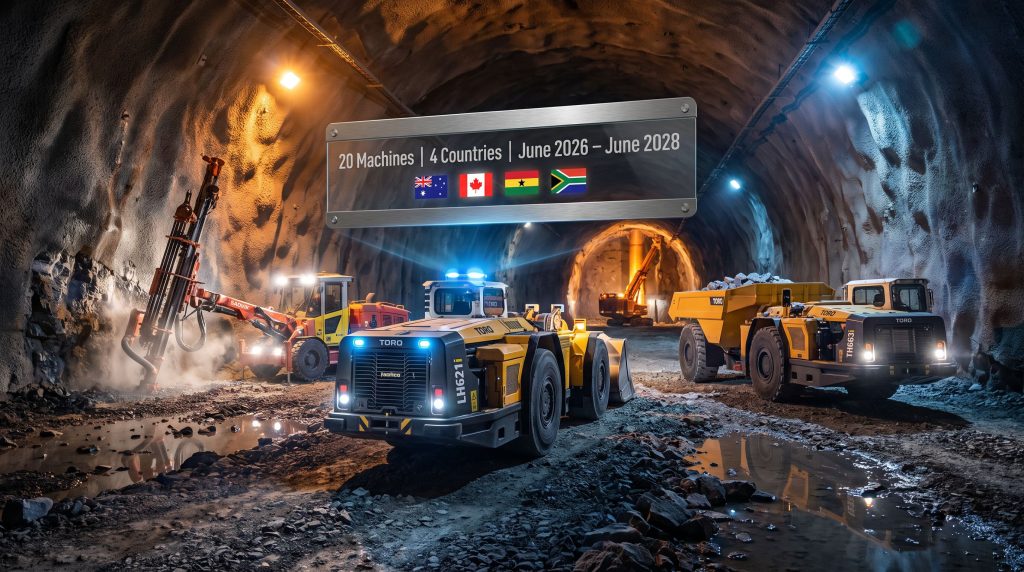
Orders were placed in June 2026, with deliveries expected to progress through to June 2028, a 24-month deployment horizon that reflects the sheer logistical complexity of absorbing this volume of capital equipment across four geographically dispersed regions: Australia, Canada, West Africa, and Southern Africa.
When a contractor simultaneously procures across development drilling, production loading, haulage, and raise boring categories, it is not refreshing capacity, it is building it. That distinction matters enormously for understanding where underground mining activity is heading over the next two to three years.
Why Fleet Homogeneity Is a Financial and Operational Strategy
One of the less-discussed realities of underground contracting is that fleet standardisation around a single OEM platform is one of the most effective tools for managing total cost of ownership (TCO) across remote sites. When every drill in a contractor's fleet shares the same control architecture, parts inventory, and maintenance procedures, the cost of sustaining availability across multiple geographies drops materially.
For a contractor like Byrnecut, operating across jurisdictions as operationally distinct as Western Australia, northern Canada, and West Africa, the alternative — maintaining a mixed-OEM fleet with fragmented service and parts requirements — introduces compounding risk at every project site. Underground equipment downtime is not merely a productivity problem.
In the context of tight underground development cycles, a single drill sitting idle for parts availability can delay an entire stoping sequence by weeks, with direct consequences for contractor margins and client relationships. Furthermore, predictive maintenance in mining has become increasingly critical in managing these risks before they escalate into costly delays.
Fleet standardisation also simplifies operator training and certification. Across an organisation of Byrnecut's scale, deploying technicians and operators familiar with a common platform reduces onboarding timelines and improves workforce flexibility between projects — a meaningful operational advantage in an industry where skilled underground labour is chronically scarce.
Breaking Down the Equipment: What Each Category Delivers Underground
Development Drilling and the Production Readiness Chain
The four Sandvik DD422i development drills represent the upstream anchor of any underground production system. Development drilling creates the physical headings, drives, and access infrastructure that downstream production equipment depends upon. Without sufficient development footage ahead of the mining face, production stopes cannot be established and the entire production schedule contracts.
What is less commonly understood outside the industry is that development drilling rates directly constrain the rate at which longhole production drilling and subsequent blasting can occur. The ratio of development to production drilling capacity is one of the most closely managed parameters in underground mine planning. Ordering four development drills in a single procurement round suggests Byrnecut has confirmed project pipelines at a scale where parallel commencement across multiple sites is both necessary and commercially justified.
AutoMine-Equipped Loaders: From Productivity Tool to Operational Standard
The four Toro LH621i loaders, each equipped with Sandvik's AutoMine system, represent the most strategically significant element of the Byrnecut Sandvik equipment investment from a technology perspective. AutoMine enables underground loaders to operate in automated or semi-automated modes, performing tramming cycles between the muck pile and the ore pass without continuous operator input.
The operational implications of this technology at scale are worth unpacking carefully. Indeed, automation transformed mining productivity well before this procurement, but its deployment at this scale across four continents simultaneously marks a clear inflection point:
- Shift utilisation: Automated loaders can continue operating through shift changes, crib breaks, and blast clearance periods when manually operated machines would be idle, directly improving tonnes moved per shift
- Operator safety: Removing operators from the immediate vicinity of active underground loading faces reduces exposure to ground fall risk, blast fumes, and other hazards associated with proximity to the muck pile
- Cycle time consistency: Automated systems maintain consistent tramming paths and speeds, reducing cycle time variability compared to manual operation
- Labour flexibility: AutoMine-enabled fleets can be supervised by a single operator managing multiple machines simultaneously from a remote monitoring station, addressing one of underground mining's most persistent workforce challenges
The deployment of four AutoMine-equipped loaders across multiple continents simultaneously signals that automation has moved well beyond the pilot or trial phase for leading underground contractors. It is now being embedded as a standard operational configuration.
Matched Loader-Truck Systems: Why Specifications Synchronisation Matters
The four Toro TH663i underground trucks ordered alongside the LH621i loader fleet are not incidental. In underground haulage design, the payload capacity and cycle characteristics of loaders and trucks must be closely matched to prevent either machine from becoming a bottleneck in the material movement chain.
A mismatched system — where loaders fill faster than trucks can evacuate — creates queuing delays that erode the productivity gains of both machines. Conversely, oversized trucks waiting on underpowered loaders waste capital. The fact that Byrnecut ordered equivalent quantities of loaders and trucks within the same procurement round suggests a deliberate fleet architecture decision, not simply an equipment catalogue selection.
Longhole Drilling: The Production Engine of Underground Stoping
The combination of two Sandvik DL432i and one DL422i longhole drills addresses the production drilling phase of underground mining — the point at which ore is actually fragmented for extraction. Longhole drills create the uphole or downhole blast patterns within stopes that are subsequently charged and fired to release ore for loading.
The DL432i and DL422i represent different performance specifications within Sandvik's longhole platform range, giving Byrnecut operational flexibility to match drill performance to the specific stope geometries and rock conditions at different project sites. The selection of three longhole drills across what is confirmed to be a multi-site, multi-country deployment suggests stope production is either commencing or scaling across several ore bodies concurrently.
Raise Boring: The Infrastructure Commitment Few People Notice
Perhaps the most analytically revealing element of the procurement is the five raise boring systems, comprising four Rhino 100 mobile raise boring machines and one Rhino uphole module. This element of the order tends to attract less commentary than flashier automated loaders, but it carries significant strategic information.
Raise boring is used to create vertical or sub-vertical cylindrical openings in underground mines for purposes including ventilation shafts, ore passes, escapeway raises, and infrastructure connection points. Unlike development drilling, which advances horizontal or sub-horizontal drives, raise boring creates the vertical connectivity that determines how efficiently air, people, and materials move through an underground mine.
The commissioning of five raise boring systems within a single procurement round is an unusually large commitment. It indicates that Byrnecut's project portfolio contains a significant number of underground operations either at early infrastructure development stages — where ventilation and shaft systems must be established before production can begin — or at transition points where existing infrastructure is being expanded to support deeper or expanded mining.
The volume of raise boring capacity ordered in a single procurement cycle is one of the most reliable indirect indicators of underground mine depth and infrastructure intensity. Five systems in one order suggests a pipeline heavy with complex, deep, or expanding underground operations rather than shallow, simple mining scenarios.
The 24-Month Delivery Window as a Project Intelligence Signal
The June 2026 to June 2028 delivery timeline is not simply a logistics schedule. It is a structured map of Byrnecut's project sequencing intentions. Underground mining projects do not absorb 25 pieces of heavy capital equipment all at once. Equipment must be delivered to match the development stage of each project, with development drills typically required earliest, followed by raise boring infrastructure, then loaders and trucks as production zones become accessible.
A staggered 24-month delivery programme requires significant advance planning discipline. It implies that Byrnecut has confirmed project commitments with sufficient lead time to co-ordinate OEM production scheduling, port and transport logistics across at least four countries, and underground infrastructure readiness at each deployment site. This kind of planning horizon is inconsistent with speculative capacity building. It points toward contracted projects.
Four Geographies, One Fleet Strategy: Regional Context
Australia: Labour Scarcity Driving Automation Adoption
Western Australia's underground gold and nickel sectors have experienced sustained labour market pressure, with skilled underground operators consistently among the most difficult positions to fill across the Australian resources industry. This dynamic has made automation adoption not merely a productivity enhancement but a structural necessity for contractors seeking to maintain project commitments without dependence on an unreliable labour supply.
The deployment of AutoMine-equipped loaders into Australian operations directly addresses this challenge. By enabling single operators to supervise multiple machines remotely, automation reduces the headcount required to sustain a given production rate — a strategically valuable capability in markets where underground operator availability constrains project throughput. Consequently, electric mining vehicles are also increasingly being evaluated alongside automated systems as part of this broader operational transformation.
Canada: Depth and Ground Conditions Shaping Equipment Choice
Canada's underground mining sector encompasses some of the world's deepest base metal operations, particularly in Ontario and Quebec. At depth, ground conditions, rock stress, and seismicity all intensify, placing premium demands on equipment reliability and drill performance. The selection of Sandvik's proven DD422i and DL432i platforms for Canadian deployment reflects a preference for equipment with demonstrated performance in demanding underground environments.
West Africa and Southern Africa: Reliability Over Unit Cost
In African mining jurisdictions, the OEM support infrastructure argument becomes particularly compelling. In remote West African locations, where logistics chains for spare parts can involve multiple transshipment points and weeks of transit time, equipment reliability and OEM service density are weighted far more heavily in procurement decisions than unit purchase price.
Byrnecut's decision to leverage Sandvik's global support network across its African operations, as confirmed in the Australian Mining case study, reflects an understanding that equipment availability in frontier mining environments depends less on the machine itself and more on the support architecture surrounding it. For further detail on this specific procurement, Sandvik's official announcement provides comprehensive OEM context.
Automation and Electrification: The Converging Technology Trajectory
AutoMine as the Foundation Layer for Battery-Electric Integration
A dimension of the Byrnecut Sandvik equipment investment that extends beyond immediate operational deployment is the strategic positioning it creates for future technology integration. AutoMine-ready fleets are, by their control architecture, significantly better positioned to integrate battery-electric vehicle (BEV) technology than conventional diesel-operated fleets.
Underground BEV adoption is accelerating across the industry, driven by the substantial ventilation cost savings achievable when diesel particulate loads are eliminated from enclosed underground environments. Ventilation is one of the largest operational cost drivers in deep underground mining, often representing 40 to 50 per cent of total underground operating energy consumption. Removing diesel combustion from the equation fundamentally changes the ventilation requirement.
Contractors that build automation capability into their fleets today are establishing the control infrastructure and organisational competency required to integrate BEV technology as it achieves broader commercial maturity. In addition, data-driven mining operations are increasingly integral to managing these automated and electrified fleets at scale, creating a compounding advantage in both productivity and ESG positioning over the medium term.
The next major ASX story will hit our subscribers first
OEM Partnership Architecture: The Strategic Value Beyond the Purchase Order
Why Concentrated OEM Relationships Create Competitive Moats
There is a broader industry trend — often underappreciated by observers outside the sector — toward concentrating equipment investment with fewer OEM partners rather than diversifying across multiple suppliers. The rationale is counterintuitive relative to conventional procurement logic, which often favours supplier competition to achieve cost reductions.
In underground mining contracting, however, deep OEM relationships create preferential access to delivery sequencing during periods of high industry demand, technical support prioritisation, and co-development opportunities for next-generation equipment configurations. These benefits compound over time and are not accessible to transactional buyers.
Sandvik's management of the Byrnecut relationship over many years, as described in the Australian Mining case study, reflects this dynamic. For Sandvik, Byrnecut represents a globally diversified, high-volume customer that provides stable OEM production planning data. For Byrnecut, the relationship delivers the equipment availability, technical support, and global service coverage required to operate competitively across four continents. Furthermore, mining efficiency technology continues to evolve rapidly, meaning these OEM partnerships increasingly extend into co-development of digital and AI-assisted operational tools.
For independent analysis of the procurement's industry significance, Mining Technology's coverage offers useful third-party context on what this order signals for the broader underground equipment market.
Frequently Asked Questions
What did the Byrnecut Sandvik equipment investment include?
The investment comprised 20 underground mobile machines and five raise boring systems, totalling 25 major units. Models included the DD422i development drill, Toro LH621i automated loader, Toro TH663i underground truck, DL432i and DL422i longhole drills, Rhino 100 mobile raise boring machines, and a Rhino uphole module.
When were orders placed and when will deliveries be completed?
Orders were booked in June 2026, with equipment deliveries scheduled progressively through to June 2028.
Where will the equipment be deployed?
Across underground mining operations in Australia, Canada, West Africa, and Southern Africa, supporting both existing projects and newly commencing operations.
What is AutoMine and why is it significant?
AutoMine is Sandvik's underground automation platform that allows loaders and other equipment to perform tramming and loading cycles with reduced or no direct operator input. Its significance lies in improving shift utilisation, reducing operator exposure to underground hazards, and enabling a single operator to supervise multiple machines simultaneously.
What does the raise boring component of the order indicate?
Five raise boring systems in a single procurement round indicates substantial underground infrastructure commitments, likely including ventilation shaft development, ore pass construction, and escapeway raise boring across multiple projects at relatively early or expanding development stages.
Key Takeaways
- Scale reflects commitment, not speculation: A 25-unit, multi-category procurement across four continents is inconsistent with speculative capacity building and points toward contracted project pipelines
- Automation is now operational standard: Four AutoMine-equipped loaders deployed simultaneously across multiple regions indicates automation has moved from pilot programmes to standard fleet configuration for leading underground contractors
- Raise boring volume is an infrastructure intensity indicator: Five raise boring systems in one order signals a project portfolio with significant shaft, ventilation, and vertical infrastructure requirements
- OEM concentration is a strategic advantage: Deep, long-term supplier relationships deliver preferential access, support prioritisation, and co-development opportunities that transactional buyers cannot replicate
- BEV readiness is embedded in the investment: AutoMine-compatible fleets are architecturally positioned for battery-electric integration as that technology matures, creating medium-term productivity and ESG advantages
- Delivery sequencing maps project timelines: The 2026 to 2028 delivery window provides a direct window into Byrnecut's underground project development schedule across its global portfolio
Readers seeking further context on underground mining equipment trends and OEM partnership dynamics can find additional industry reporting at Australian Mining.
Want to Identify the Next Major Mining Discovery Before the Market Does?
The scale of fleet investments like Byrnecut's signals where underground mining activity is heading — and Discovery Alert's proprietary Discovery IQ model ensures subscribers receive real-time alerts the moment significant ASX mineral discoveries are announced, turning complex data into actionable opportunities. Explore historic discoveries and their remarkable returns, then start your 14-day free trial to position yourself ahead of the market.