August 25, 2026
Iron Ore, Infrastructure, and Six Decades of Industrial Transformation
Few industries demonstrate the compounding power of long-term capital commitment quite like large-scale iron ore mining. When a single bulk carrier departs a remote port under a 15-year supply agreement, it is not merely moving material. It is triggering an irreversible chain of infrastructure investment, community formation, and bilateral trade architecture that reshapes entire economies for generations. The Pilbara's emergence as one of the world's preeminent iron ore provinces is precisely this kind of story, playing out across six decades of sustained industrial development.
Understanding Rio Tinto's 60 years of operations in Western Australia requires more than a retrospective count of shipped tonnes. It demands an appreciation of the geological, geopolitical, and economic forces that converged at a specific moment in history to make such an operation both possible and necessary.
When big ASX news breaks, our subscribers know first
Why the Pilbara Became the Engine Room of Australia's Export Economy
The Structural Conditions That Made Large-Scale Iron Ore Development Possible
The mid-twentieth century presented a uniquely narrow development window for large-scale iron ore extraction in Australia. Post-war reconstruction across Asia, particularly in Japan, generated voracious demand for steel-making inputs that existing supply chains struggled to satisfy. Australia's iron ore export ban, which had been in place since the 1930s based on erroneous domestic reserve estimates, was lifted in 1960. That single policy shift unlocked access to the Pilbara's extraordinary geological endowment at precisely the moment Asian demand was accelerating.
What followed was not simply resource extraction. It was infrastructure-led nation building. Ports had to be constructed from scratch, railway corridors carved through remote terrain, and residential townships established to support permanent workforces in areas that had previously seen almost no industrial activity. The commercial viability of Pilbara iron ore was entirely contingent on this upfront capital commitment, which in turn depended on long-term supply contracts providing the revenue certainty to justify it.
The Pilbara's Place in Global Iron Ore Geography
The Pilbara's geological characteristics deserve closer examination than they typically receive in mainstream coverage. The region's iron ore deposits are hosted within Precambrian banded iron formations, ancient geological sequences formed approximately 2.5 billion years ago when the Earth's oceans underwent significant chemical changes. These formations underwent supergene enrichment processes over millions of years, concentrating iron content to grades that are commercially exceptional by global standards. Furthermore, understanding the various iron ore deposit types helps contextualise why the Pilbara's hematite formations are so commercially significant.
Unlike lower-grade magnetite deposits that require energy-intensive beneficiation before they can be used in steelmaking, the Pilbara's hematite ores can typically be shipped with minimal processing. This direct-shipping ore characteristic fundamentally lowers the cost structure of Pilbara operations compared to many global competitors, particularly those in jurisdictions where beneficiation plants represent a major capital and operating cost burden.
Geological Note: The distinction between direct-shipping hematite ore and magnetite ore requiring beneficiation is critical for understanding why the Pilbara maintains a cost advantage that has proven durable across multiple commodity price cycles. Hematite ore grades in the Pilbara typically range between 56% and 62% iron content, reducing downstream processing requirements for steelmakers.
Australia's iron ore advantages extend beyond geology. Western Australia consistently ranks among the top two iron ore exporting jurisdictions globally by tonnage, and the Pilbara's geographic positioning along major Asian shipping routes compounds the raw geological advantage with a meaningful freight cost benefit over competitors in Brazil and West Africa.
What Did the First Iron Ore Shipment from Dampier Actually Represent?
The August 1966 Departure: More Than a Logistical Event
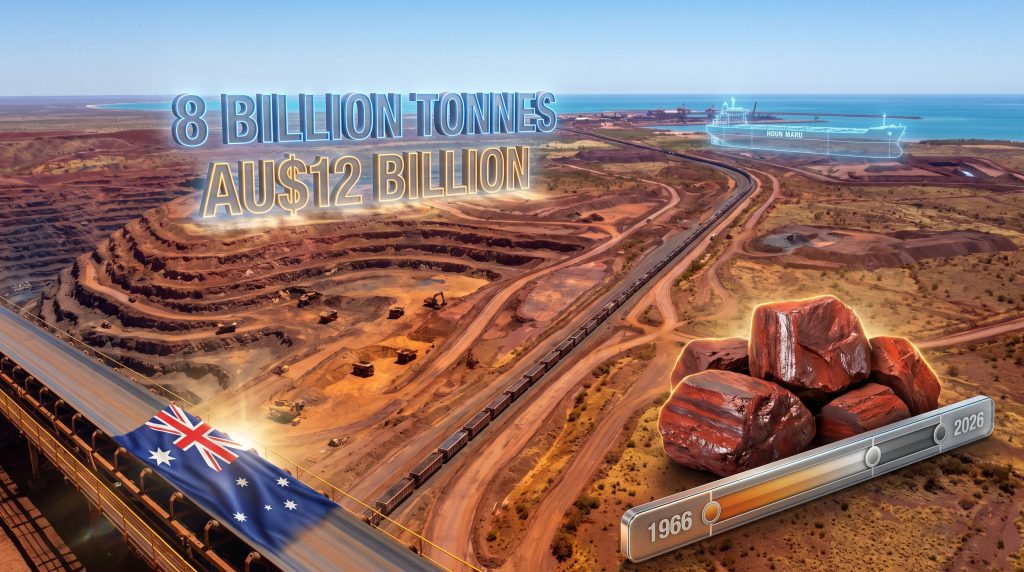
On 22 August 1966, the vessel Houn Maru departed Dampier carrying the first commercial iron ore cargo from what would evolve into Rio Tinto's Pilbara operations. The shipment was the physical realisation of a supply agreement with Japanese steelmakers covering 65.5 million tonnes of iron ore over a 15-year period, which stood as the largest export contract in Australian history at that time.
This contract structure is worth examining carefully because it illustrates a commercial logic that remains relevant today. The Japanese steelmakers needed volume certainty to justify blast furnace investment. Rio Tinto's predecessor operations needed revenue certainty to justify the enormous Pilbara infrastructure spend. The long-term offtake agreement was not a peripheral financing mechanism. It was the foundational instrument that made the entire development equation work.
| Milestone | Detail |
|---|---|
| First shipment date | 22 August 1966 |
| Vessel name | Houn Maru |
| Port of departure | Dampier, Western Australia |
| Destination | Japan |
| Initial contract volume | 65.5 million tonnes |
| Contract duration | 15 years |
| Historical significance | Largest export contract in Australian history at the time |
Why the Japan Relationship Shaped Pilbara Development Logic
Japan's post-war industrial expansion created a steel demand trajectory that was unlike anything the global economy had previously experienced. Between the 1950s and 1970s, Japanese crude steel production grew from a modest post-war base to making the country one of the world's dominant steelmakers. Australian iron ore was geographically positioned to serve this demand more efficiently than alternatives in South America or Africa.
Beyond logistics, the bilateral relationship established institutional frameworks for long-term resource agreements that became the template for Australia's entire export commodity sector. Annual benchmark pricing negotiations between Australian iron ore producers and Japanese steelmakers set global price references for decades. The Pilbara-Japan iron ore corridor essentially defined how bulk commodity trade relationships were structured across the industry.
How Large Have Rio Tinto's Pilbara Operations Grown Over Six Decades?
Eight Billion Tonnes: Contextualising an Almost Incomprehensible Volume
Since that inaugural 1966 shipment, Rio Tinto has exported more than 8 billion tonnes of iron ore from the Pilbara. Contextualising this figure requires some translation. Global crude steel production currently runs at approximately 1.8 to 1.9 billion tonnes annually, requiring roughly 2.8 to 3 tonnes of iron ore input per tonne of steel produced. Eight billion tonnes of iron ore represents an input volume sufficient to produce in the order of 2.5 to 3 billion tonnes of steel, enough to construct millions of major infrastructure projects and hundreds of millions of vehicles.
This cumulative output represents one of the largest sustained resource extraction programmes in modern industrial history, built on a foundation laid by a single export contract in 1966.
The Operational Footprint in 2025 and 2026
The current scale of Rio Tinto's 60 years of operations in Western Australia is reflected in its Pilbara infrastructure, which has been shaped by six decades of continuous investment and expansion:
- 18 mines operating across the Pilbara region
- 4 independent port terminals managing bulk export logistics at Dampier and Cape Lambert
- A rail network spanning approximately 2,000 kilometres, one of the largest privately operated heavy-haul rail systems anywhere in the world
- 6 residential towns in the Pilbara supported by Rio Tinto's presence
- 5 regional fly-in fly-out (FIFO) hubs extending workforce reach across remote areas
- Global iron ore headquarters based in Perth, Western Australia
Scale Perspective: The roughly 2,000-kilometre Pilbara rail network is longer than the rail distance from Sydney to Melbourne, and it operates exclusively to move iron ore. The logistics infrastructure that underpins Rio Tinto's operations represents a capital investment that would be extraordinarily difficult and time-consuming to replicate, creating a structural barrier to entry that competitors cannot easily overcome.
The heavy-haul rail technology deployed across this network is specialised and worth understanding. Trains operating on these corridors regularly exceed 2.5 kilometres in length and carry payloads of 25,000 to 30,000 tonnes per journey. Rio Tinto has also been progressively deploying autonomous train technology across this network through its AutoHaul programme, which represents one of the largest autonomous rail deployments in global mining.
What Is Rio Tinto's Economic Contribution to Western Australia Today?
AU$12 Billion in Local Procurement: The Supply Chain Multiplier Effect
In 2025, Rio Tinto recorded AU$12 billion in procurement expenditure with Western Australian businesses. This figure carries significant analytical weight beyond its headline size. It represents a doubling of local supply chain spending over four years, which signals a deliberate and sustained strategic reorientation toward domestic sourcing rather than offshore procurement.
For context, AU$12 billion in annual supplier spending distributed through the Western Australian economy generates employment, tax revenue, and further downstream spending across a wide range of sectors, including engineering, logistics, professional services, manufacturing, and retail. The economic multiplier effect of this procurement base extends well beyond Rio Tinto's direct workforce.
Community Investment: AU$500 Million Over Five Years
Over the five years leading to 2026, Rio Tinto invested approximately AU$500 million in community programmes across Western Australia. This investment spans a broad range of categories:
- Workforce development and training programmes
- Regional infrastructure and public amenities
- Traditional Owner partnership programmes and cultural heritage initiatives
- Social welfare and health programmes in Pilbara communities
- Educational initiatives targeting regional and remote communities
| Economic Metric | Value | Period |
|---|---|---|
| Local supplier procurement | AU$12 billion | 2025 |
| Growth in local supplier spend | Doubled | Over 4 years |
| Community programme investment | AU$500 million | Over 5 years |
| Cumulative iron ore exports | 8+ billion tonnes | 1966 to 2026 |
How Rio Tinto Has Shaped the Social and Cultural Fabric of the Pilbara
Building Permanent Communities, Not Transient Camps
One dimension of Rio Tinto's Pilbara presence that receives insufficient attention is the residential community model. Unlike purely FIFO-dependent operations that create minimal lasting demographic impact, Rio Tinto's six residential Pilbara towns represent permanent community infrastructure in areas that would otherwise remain essentially uninhabited.
These communities encompass schools, healthcare facilities, retail services, and civic infrastructure. The long-term demographic anchoring of populations in remote Pilbara locations has implications for regional Western Australia that extend well beyond the operational lifecycle of any individual mine. The residential model reflects an older development philosophy, shaped partly by regulatory requirements and partly by the practical reality that the Pilbara's early workforce needed permanent housing given the distances involved and the absence of any FIFO infrastructure.
Traditional Owner Relationships: From Compliance to Partnership
Rio Tinto's relationship with Traditional Owner groups across the Pilbara has evolved substantially over six decades, though not without controversy. The 2020 destruction of the Juukan Gorge rock shelters represented a severe low point in the company's cultural heritage stewardship and prompted significant organisational and regulatory reform across the Australian mining industry more broadly.
The 2026 anniversary has been accompanied by forward-looking commitments on partnership frameworks with Traditional Owner groups, including formal agreements governing land access, cultural heritage protection, and economic participation. The gifting of historical photographs by the late photographer Richard Woldendorp, documenting the construction of the Mount Tom Price mine, to the State Library of Western Australia represents a cultural preservation initiative tied directly to the anniversary milestone.
Rio Tinto Iron Ore CEO Matthew Holcz has publicly emphasised the collaborative nature of the company's six-decade journey, noting that the business could not have been built in isolation and acknowledging the foundational contributions of Traditional Owners, workers, communities, and partner organisations across generations.
The next major ASX story will hit our subscribers first
What Does Rio Tinto's Strategic Outlook Mean for Western Australia's Next Decade?
Capacity Expansion: The Kangwinan Project
Rio Tinto is advancing the Kangwinan project as a near-term capacity expansion initiative, with the objective of nearly doubling throughput capacity at a key Pilbara operation. Sustained investment in port, rail, and mine infrastructure signals the company's confidence in continuing iron ore demand despite evolving global steel market conditions.
The strategic framing around the 60-year anniversary has been deliberately forward-looking rather than purely retrospective. Rio Tinto has publicly stated its intention to remain in Western Australia for decades to come, which carries implicit signals about capital allocation priorities and infrastructure investment commitments. In addition, the China steel demand outlook remains a critical variable in shaping those long-term capital decisions across the Pilbara.
The Green Steel Transition: Risk and Opportunity
Perhaps the most consequential strategic question facing Rio Tinto's Pilbara operations over the next decade is compatibility with decarbonising steel supply chains. Global steelmakers are under increasing pressure to reduce the carbon intensity of their production processes, and this is driving meaningful investment in alternative ironmaking technologies. The broader green iron transition is reshaping procurement strategies across Asia's steelmaking sector.
Two principal pathways are emerging:
- Direct Reduced Iron (DRI) using natural gas or green hydrogen, which bypasses the blast furnace and produces a higher-purity iron input suitable for electric arc furnaces
- Electric arc furnace steelmaking using recycled scrap, which reduces but does not eliminate demand for primary iron ore inputs
The DRI pathway is particularly relevant for Pilbara producers because DRI-grade ore requires higher iron content and lower impurity levels than blast furnace feed. Advances in hydrogen iron ore reduction technology are accelerating this shift, and Pilbara hematite ores vary in their suitability for these applications. This is an area of active research and commercial development within Rio Tinto's product strategy, and the company's ability to supply ore grades compatible with green steel production pathways will influence its long-term market positioning as Asian steelmakers navigate the energy transition.
Water Security as an Operational Constraint
An underappreciated dimension of long-term Pilbara operational sustainability is water security. The region's arid climate makes freshwater availability a genuine operational constraint, and Rio Tinto's agreement with Yindjibarndi Waterco for the development of a desalination plant at Dampier represents a meaningful step toward operational water self-sufficiency. Desalination infrastructure of this nature also carries broader community and regional economic implications, potentially supplying water to communities beyond the immediate operational footprint.
Benchmarking Six Decades of Pilbara Development Against Global Mining Legacies
| Dimension | Rio Tinto Pilbara | Industry Context |
|---|---|---|
| Operational duration | 60 years (1966 to 2026) | Among the longest continuous large-scale iron ore operations globally |
| Cumulative export volume | 8+ billion tonnes | Equivalent to a significant share of cumulative global steel production inputs |
| Rail network length | ~2,000 km | Comparable to major national heavy-freight rail corridors |
| Annual local procurement | AU$12 billion | Substantial regional economic multiplier |
| Residential community presence | 6 towns | Distinguishes from purely FIFO-dependent operational models |
| Community programme investment | AU$500 million | Over five years to 2026 |
No alternative iron ore province currently combines the ore grade consistency, infrastructure maturity, sovereign stability, and Asian market proximity that characterises the Pilbara. Brazil's Carajas system offers comparable grade and scale, but freight distances to Asian buyers are substantially longer. West African iron ore provinces hold significant geological promise but face infrastructure and sovereign risk challenges that increase capital costs and operational complexity.
The Pilbara's decades of sunk infrastructure investment create a competitive moat that is genuinely difficult to replicate. Any new entrant seeking to establish comparable integrated mining and logistics systems would face capital requirements, permitting timelines, and community engagement obligations that make the Pilbara's existing infrastructure extraordinarily valuable by comparison.
Frequently Asked Questions: Rio Tinto's 60 Years in Western Australia
When did Rio Tinto begin iron ore operations in Western Australia?
Rio Tinto's Western Australian iron ore operations commenced commercially on 22 August 1966, when the first shipment departed Dampier aboard the Houn Maru bound for Japan under the largest export contract in Australian history at that time.
How much iron ore has Rio Tinto exported from the Pilbara?
Since 1966, Rio Tinto has shipped more than 8 billion tonnes of iron ore from its Pilbara operations, supplying raw materials for global steel production across six decades of continuous activity.
What is the scale of Rio Tinto's current Pilbara infrastructure?
The operational network includes 18 mines, 4 port terminals, and approximately 2,000 kilometres of dedicated heavy-haul rail, making it one of the largest integrated mining logistics systems anywhere in the world.
How much does Rio Tinto spend with Western Australian businesses?
In 2025, Rio Tinto's procurement spend with Western Australian suppliers reached AU$12 billion, a figure that has doubled over the preceding four years.
What is the significance of the original Japan iron ore contract?
The initial supply agreement covering 65.5 million tonnes over 15 years was the largest export contract in Australian history at the time and provided the commercial certainty necessary to justify the enormous upfront capital investment in Pilbara infrastructure.
What is the Kangwinan project?
Kangwinan is a near-term Pilbara capacity expansion project aimed at nearly doubling throughput capacity at a key Rio Tinto operation, reflecting the company's ongoing confidence in sustained iron ore demand.
Disclaimer: This article contains forward-looking observations regarding commodity markets, decarbonisation trends, and strategic investment directions. These represent analysis of publicly available information and industry trends rather than financial advice. Readers should conduct independent research before making any investment decisions.
Want to Track the Next Major ASX Mineral Discovery Before the Market Moves?
Discovery Alert's proprietary Discovery IQ model scans ASX announcements in real time, delivering instant alerts on significant mineral discoveries — including iron ore and beyond — so subscribers can identify actionable opportunities ahead of the broader market. Explore historic discoveries and the returns they generated, then begin a 14-day free trial at Discovery Alert to position yourself at the forefront of the next major find.