August 25, 2026
The Transboundary Puzzle That Has Kept 10 Trillion Cubic Feet Locked Beneath the Caribbean
Transboundary offshore gas fields represent one of the most technically and diplomatically complex categories of hydrocarbon development on earth. When a single geological structure straddles an international maritime boundary, neither nation can act unilaterally without risking the integrity of the shared reservoir. Pressure depletion on one side affects recoverable volumes on the other. This interdependency transforms what would otherwise be a conventional offshore development into a multi-decade negotiation involving reservoir engineers, maritime lawyers, heads of state, and international energy companies simultaneously.
Few fields anywhere in the world illustrate this challenge more sharply than the Loran-Manatee gas field, a massive natural gas accumulation sitting beneath the Atlantic continental shelf on the southern edge of the Caribbean basin. Discovered in 1983, the system has spent more than four decades as one of the region's most discussed but least developed energy assets. That is now beginning to change.
When big ASX news breaks, our subscribers know first
What the Loran-Manatee Gas Field Actually Is
The Loran-Manatee system is not two separate gas fields that happen to be located near each other. It is a single geological accumulation that crosses the maritime boundary dividing Venezuela from Trinidad and Tobago. This physical reality is the defining characteristic of the entire project and the root cause of its complexity.
The field sits on the Atlantic continental shelf, in relatively moderate water depths compared to deepwater frontier developments in the Atlantic or Pacific. However, the technical demands of developing a shared reservoir across two sovereign jurisdictions introduce layers of complexity that depth alone cannot capture.
Why Shared Reservoirs Are Technically Distinct
When hydrocarbons are produced from one side of a shared reservoir, pressure dynamics across the entire accumulation are affected. This means that production decisions made by Venezuelan operators on the Loran side will influence the recoverable resource available to Trinidad and Tobago's Manatee operators, and vice versa. Managing this requires a unitization agreement, a legally binding framework that allocates production entitlements between parties based on agreed estimates of how much of the reservoir lies within each jurisdiction.
Unitization negotiations are notoriously complex. They require independent reservoir characterisation studies, agreement on the allocation formula, and ongoing mechanisms for redetermination as new production data becomes available. The absence of a fully formalised unitization arrangement between Venezuela and Trinidad has historically been one of the structural barriers slowing the project's progress.
Resource Scale: Breaking Down the ~10 Tcf Estimate
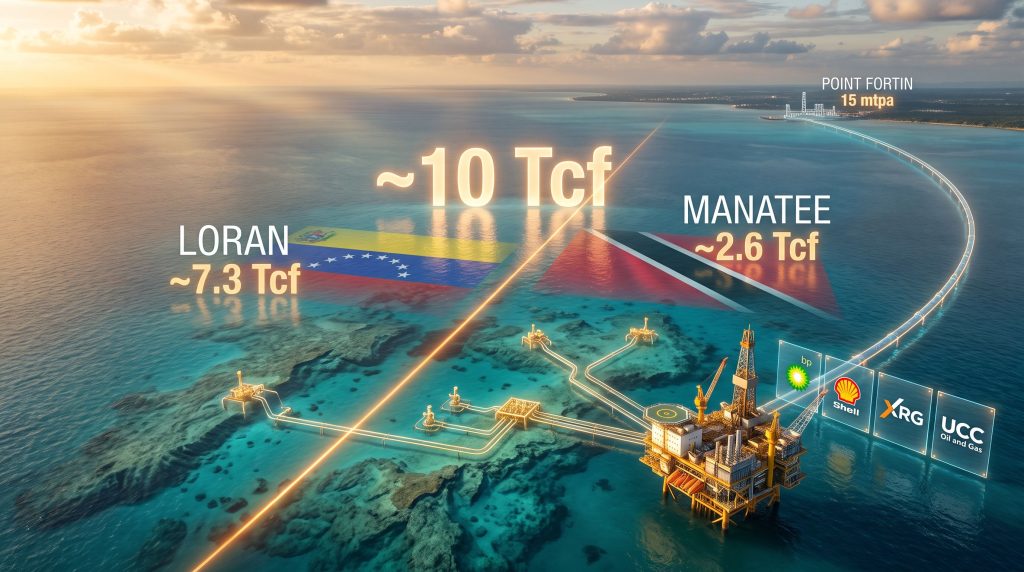
The combined resource estimate for the Loran-Manatee system positions it among the most significant undeveloped offshore gas accumulations in Latin America. Total system resources are estimated at approximately 10 to 10.5 trillion cubic feet (Tcf), distributed unevenly across the two national jurisdictions.
| Segment | Jurisdiction | Estimated Resource |
|---|---|---|
| Loran | Venezuela | ~7.3 Tcf |
| Manatee | Trinidad and Tobago | ~2.6–2.7 Tcf |
| Total System | Cross-border | ~10–10.5 Tcf |
To contextualise these figures: 1 Tcf of natural gas is roughly sufficient to heat approximately 15 million homes for a year under average consumption conditions. At that scale, the Loran-Manatee system represents a generational energy asset for both countries and a material supply source for Atlantic basin LNG markets. For further context on the LNG supply outlook across global markets, the broader dynamics are worth examining alongside this project's significance.
Resource estimates at this stage carry inherent uncertainty. The figures above are based on available geological and seismic data, but additional appraisal drilling could revise them upward or downward. What the estimates confirm is that the system is large enough to justify the sustained diplomatic and commercial effort required to develop it.
Loran Phase 2: The 4 Tcf Development Tranche
According to reporting by Reuters, the second phase of Loran's development encompasses up to 4 Tcf of producible gas and will be operated by bp in partnership with XRG, Venezuela's international energy vehicle, and UCC Oil and Gas. Venezuela awarded this license in August 2026.
A 4 Tcf development mandate alone would rank among the largest single offshore gas project commitments in the Caribbean region's history. For bp, the license represents a strategic re-entry into Venezuelan upstream gas, a market the company has approached cautiously given the country's complex political and sanctions environment. The decision signals a calculated assessment that the resource scale and proximity to existing infrastructure justify the elevated risk profile.
The Operator Landscape: Who Controls Each Side
Understanding the Loran-Manatee gas field requires mapping the stakeholder structure across both jurisdictions, as the operator configurations are meaningfully different.
Venezuelan Side: Loran's Consortium Architecture
On the Venezuelan side, bp holds the lead operator role under the August 2026 license, partnering with XRG and UCC Oil and Gas. XRG functions as Venezuela's internationally oriented energy arm, designed to facilitate partnerships with foreign majors in a regulatory environment that has historically deterred capital. The involvement of a recognised international operator like bp alongside XRG provides a degree of institutional credibility that the project previously lacked.
Venezuela's hydrocarbons licensing framework gives the national government significant influence over project terms, including royalty rates, cost recovery mechanisms, and fiscal conditions. Furthermore, Venezuela policy changes in recent years have added additional layers of complexity to how international companies structure their risk exposure. These parameters will be central to determining whether Loran Phase 2 can generate the returns needed to sustain long-term capital commitment from bp and its partners.
Trinidad and Tobago Side: Shell's Manatee Mandate
The contrast with the Trinidad side is stark. Shell is the operator of the Manatee block under Trinidad and Tobago's regulatory framework, and critically, the company has already taken its Final Investment Decision (FID) on the project. Shell has projected peak production exceeding 600 million cubic feet per day (MMcf/d), with first gas targeted for 2027.
Shell's FID on Manatee is one of the most consequential upstream gas investment decisions taken in the Caribbean in over a decade. It transforms Manatee from a development concept into an execution-stage project with committed capital, contracted timelines, and engineering activities already underway. According to offshore project reporting, the Manatee field development scope reflects significant technical ambition given the cross-border constraints involved.
Technical Challenges That Must Be Solved
The engineering demands of the Loran-Manatee gas field extend well beyond standard offshore project complexity. Three distinct technical domains present material challenges.
Subsurface and Reservoir Engineering
- Reservoir pressure management across a shared geological structure requires constant coordination between operators on both sides of the maritime boundary.
- Well architecture must be designed to maximise recovery without inadvertently draining volumes that are formally allocated to the other jurisdiction.
- Any future redetermination of the unitization allocation ratio will require new well data, which makes early drilling decisions consequential for long-term entitlement calculations.
Subsea Infrastructure and Collection Systems
- Subsea manifold design must accommodate high-volume gas flows from a geographically distributed reservoir.
- Flowline routing from Venezuelan wells to processing infrastructure requires decisions about whether the gas travels to Venezuelan onshore facilities or is tied back through Trinidad's existing network.
- Cross-border tie-back scenarios introduce significant additional engineering complexity compared to single-jurisdiction developments.
Surface Processing and Liquefaction Pathways
A critical and often underappreciated question is whether Venezuelan Loran gas can be physically integrated with Trinidad's onshore processing infrastructure, or whether it will require standalone Venezuelan facilities. The answer has major implications for project economics and timeline.
Connecting Loran gas to Trinidad's grid would allow developers to leverage existing pipeline and processing capacity, potentially reducing capital requirements significantly. However, it would also introduce new regulatory dimensions around cross-border gas transit, tariff structures, and sovereign revenue sharing.
Atlantic LNG: The Infrastructure Prize at the End of the Pipeline
The strategic logic underpinning the entire Loran-Manatee system becomes clearest when viewed through the lens of Atlantic LNG, the liquefaction complex located at Point Fortin, Trinidad. The facility has a nameplate capacity of approximately 15 million tonnes per annum (mtpa), making it one of the largest LNG export terminals in the Western Hemisphere.
However, Atlantic LNG's operational reality has diverged substantially from its nameplate capacity. Trinidad has faced a structural decline in domestic gas feedstock as legacy producing fields have matured and production volumes have fallen. Reuters has reported that the facility has experienced supply shortfalls, with some processing units taken offline for maintenance or operating below capacity. The gap between installed liquefaction capacity and available gas supply represents a significant stranded asset problem.
If Loran-Manatee gas can be routed to Point Fortin at the volumes projected, it could serve as a transformative backfill supply source, potentially restoring Atlantic LNG to near-full operational utilisation and unlocking billions of dollars in latent capacity value.
This backfill dynamic is what elevates the Loran-Manatee gas field from a country-level resource story to a regional LNG market story with direct implications for Atlantic basin buyers, long-term contract pricing, and Caribbean energy security. In addition, the natural gas price trends observed in recent months highlight just how sensitive global markets are to supply developments of this scale.
The next major ASX story will hit our subscribers first
Why Four Decades Passed Without Development
Understanding why a 10 Tcf gas field discovered in 1983 remained largely undeveloped for more than 40 years requires examining layered structural barriers rather than any single cause.
The Geopolitical Friction Layer
Venezuela's broader economic and political trajectory has periodically made it difficult for international energy companies to commit the capital and institutional resources required for a long-cycle offshore gas project. Sanctions exposure has been a particularly significant structural barrier, limiting the pool of operators willing and able to work within Venezuela's upstream licensing system.
Bilateral negotiations over unitization arrangements and maritime boundary coordination between Venezuela and Trinidad have historically moved slowly. The diplomatic relationship between the two countries, while generally functional, has not always provided the consistent political framework that large-scale cross-border energy projects require.
What Shifted in the 2024 to 2026 Period
Several converging forces appear to have created the conditions for forward movement during this period:
- Global LNG demand growth, particularly from European buyers seeking supply diversification following the post-2022 global energy security crisis, elevated the strategic value of undeveloped Caribbean gas resources.
- Trinidad and Tobago's domestic gas supply deficit created an urgent policy imperative to advance new upstream projects, accelerating Manatee's development timeline.
- Shell's FID on Manatee provided a concrete anchor of institutional commitment, signalling to other potential participants that the broader system was commercially viable.
- bp's willingness to accept Venezuelan upstream risk for the Loran Phase 2 license suggests an internal assessment that the resource scale and proximity to Atlantic LNG infrastructure justified re-engagement.
Risk Matrix: What Could Still Go Wrong
Despite meaningful progress, the Loran-Manatee gas field carries a substantial risk profile that investors and industry observers should weigh carefully.
| Risk Category | Venezuelan Side (Loran) | Trinidad Side (Manatee) |
|---|---|---|
| Geopolitical / Sanctions | High | Low |
| Regulatory Stability | Moderate to High | Low |
| Operator Commitment | Confirmed (bp/XRG/UCC) | Confirmed (Shell FID) |
| Unitization Agreement | Pending full formalisation | Aligned with Venezuela |
| Infrastructure Readiness | Requires development | Partially available |
Beyond the geopolitical dimension, execution risks deserve specific attention:
- Offshore project cost inflation has been a persistent challenge across the global subsea engineering and marine construction sector, with vessel day rates and equipment costs remaining elevated.
- Supply chain bottlenecks for subsea hardware, including trees, manifolds, and flexible flowlines, continue to create scheduling pressure for projects targeting 2027 to 2030 first production windows.
- Currency and fiscal regime conditions on the Venezuelan side could affect bp's cost recovery mechanisms under the license terms, particularly if macroeconomic conditions deteriorate.
- Any delay to Manatee's 2027 first gas target would extend Atlantic LNG's period of underutilisation, compounding the economic pressure already being felt by the facility.
Three Scenarios for the Field's Future
Scenario 1: Accelerated Integration
Manatee achieves first gas in 2027 as planned. Loran Phase 2 advances to FID within 24 to 36 months. Combined throughput progressively restores Atlantic LNG toward near-full capacity utilisation through the early 2030s, repositioning the southern Caribbean as a globally competitive LNG export corridor.
Scenario 2: Phased and Fragmented Development
Manatee produces on schedule but Loran Phase 2 encounters delays driven by Venezuelan fiscal constraints, sanctions complications, or unitization disputes. Atlantic LNG benefits partially from Manatee volumes but full system integration is deferred to the mid-2030s.
Scenario 3: Structural Stall
Geopolitical deterioration, operator withdrawal, or unresolved unitization conflicts prevent Loran Phase 2 from reaching FID. Manatee operates as a standalone project. The broader 10 Tcf system remains only partially monetised, and Atlantic LNG continues operating below its installed capacity ceiling. For a broader energy market overview, understanding how commodity price shifts might affect project viability under each scenario is equally important.
Frequently Asked Questions: Loran-Manatee Gas Field
What is the Loran-Manatee gas field?
A transboundary offshore natural gas accumulation discovered in 1983, straddling the maritime boundary between Venezuela and Trinidad and Tobago. Total estimated resources across both national sectors are approximately 10 to 10.5 Tcf.
Who is developing the Manatee field?
Shell is the operator. The company has taken its Final Investment Decision, with peak production projected at more than 600 MMcf/d and first gas targeted for 2027.
Who holds the Loran Phase 2 license?
bp, in partnership with XRG and UCC Oil and Gas, received a Venezuelan development license in August 2026 covering up to 4 Tcf of producible gas.
What is Atlantic LNG's connection to this project?
Atlantic LNG is a liquefaction complex at Point Fortin, Trinidad, with approximately 15 mtpa of nameplate capacity. Loran-Manatee gas is a primary candidate to backfill supply for the facility's underutilised processing trains.
Why did development take so long?
A combination of cross-border unitization complexity, Venezuela's political and economic environment, international sanctions exposure, and recurring misalignment between project economics and operator risk appetite collectively delayed progress for over four decades. Consequently, understanding the global energy security crisis context that has since reframed the urgency of projects like this one is essential for appreciating why momentum has finally shifted.
Disclaimer: This article contains forward-looking assessments, scenario projections, and resource estimates that are subject to material uncertainty. Resource figures are based on publicly available data and may be revised as additional appraisal and production data becomes available. Nothing in this article constitutes financial or investment advice. Readers should conduct independent due diligence before making any investment or commercial decisions related to the projects or entities discussed.
For ongoing coverage of Caribbean and Latin American energy developments, visit World Energy Wire.
Want to Stay Ahead of the Next Major Resource Discovery?
Discovery Alert's proprietary Discovery IQ model delivers real-time alerts on significant ASX mineral discoveries, transforming complex geological data into actionable investment insights for traders and investors at every experience level — explore the historic returns major discoveries have generated and begin your 14-day free trial to secure your market-leading edge.