August 26, 2026
When Europe's Biggest Gas Asset Ages in Plain Sight
Every major energy transition leaves behind a structural vulnerability that only becomes visible when supply margins tighten. For Europe, that vulnerability is increasingly concentrated in a handful of ageing Norwegian gas fields that now shoulder a burden once shared with Russian pipeline infrastructure. The assumptions underpinning European energy security rest heavily on the continued performance of a small number of platforms in the North Sea, and one field above all others carries disproportionate weight: Troll.
Understanding the Norway Troll gas expansion requires looking past the headline production figures and asking a more uncomfortable question: is Europe building long-term resilience, or buying time with reserves that already exist?
When big ASX news breaks, our subscribers know first
The Supply Architecture Europe Inherited After 2022
From Russian Dependency to Norwegian Concentration
The collapse of Russian pipeline gas flows following the 2022 invasion of Ukraine did not diversify Europe's supply base so much as reroute its concentration. Norway stepped into the vacancy and became the continent's single largest pipeline gas supplier almost overnight. That transition carried immediate benefits in terms of political reliability and rule-of-law governance, but it also embedded a new structural risk: an outsized share of European gas now flows through a small number of Norwegian mega-fields and processing facilities.
The Kollsnes processing plant on Norway's west coast functions as the critical hub through which Troll's gas passes before entering the European network. Its throughput capacity effectively sets the ceiling on what Troll can deliver to European buyers regardless of what happens at the reservoir level. This single-point dependency is rarely discussed in mainstream energy security analysis, but it represents one of the more consequential infrastructure vulnerabilities in the European gas system.
Why Headline Export Volumes Can Be Misleading
Norwegian gas export totals have remained impressively stable in recent years, but stability at the aggregate level can obscure reservoir-level depletion dynamics at individual fields. Accelerating production from a mature reservoir does not constitute genuine reserve growth. It repositions the timing of delivery while leaving the total recoverable volume unchanged, or in some cases slightly reduced due to reservoir pressure effects.
This distinction sits at the heart of what the Norway Troll gas expansion actually achieves. Bringing gas forward protects today's export capacity. It does not expand tomorrow's reserve base. Consequently, natural gas price trends may reflect short-term confidence in supply without capturing the longer-term depletion dynamics beneath the surface.
Inside the Troll Field: Scale, Age, and Structural Importance
A Platform in Its Fourth Decade Still Setting the Pace
The Troll A platform commenced production in 1996, making it one of the longest-operating offshore gas installations in the world. Its concrete gravity base structure remains one of the largest objects ever moved by human beings. Three decades after commissioning, it continues to anchor Norwegian gas exports to Europe at a scale that no other single asset can match.
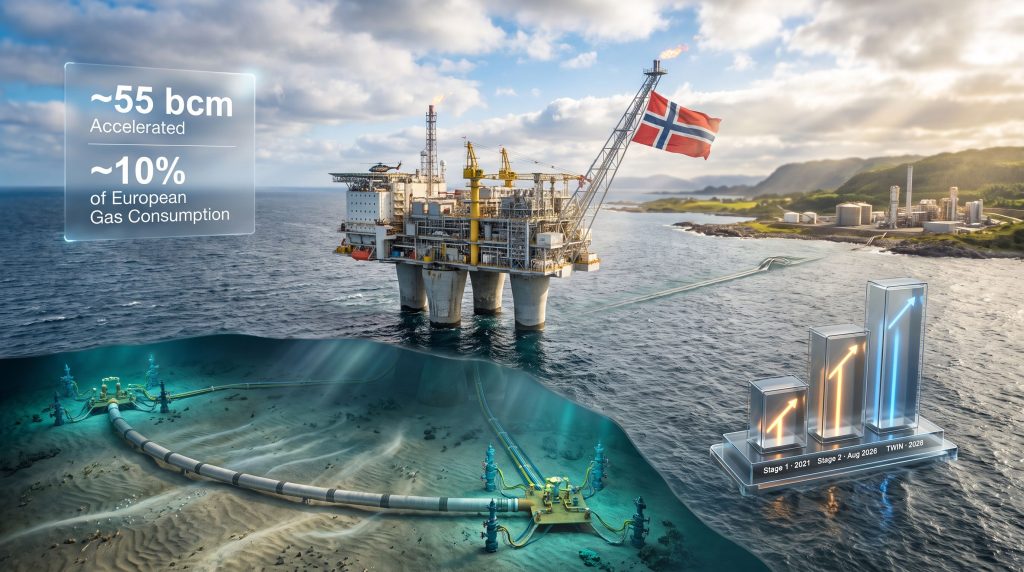
The Troll field contains approximately 40% of remaining gas reserves on the Norwegian Continental Shelf, and the field alone supplies gas equivalent to roughly 10% of total European gas consumption. These figures underscore why any development decision at Troll carries continent-wide implications rather than simply company-level significance.
Both the Troll A platform and the Kollsnes processing facility are powered from shore rather than by onsite gas turbines, a design choice that substantially reduces the operational carbon intensity of every unit of gas produced. This shore-power model gives Troll a meaningful emissions advantage over competing supply sources, including most liquefied natural gas cargoes arriving from distant markets.
Troll Phase 3 Stage 2: What Was Actually Built
Project Architecture and Execution Performance
The second stage of the Troll Phase 3 development consists of two subsea templates, eight new production wells drilled into the Troll West reservoir, and a 28-kilometre pipeline connecting the subsea infrastructure back to the Troll A platform. The project deliberately replicated the standardised designs and template configurations used in the first stage of Troll Phase 3, which delivered first gas in 2021.
That reuse strategy generated tangible results. The eight-well drilling campaign was completed in approximately 5.5 months, roughly 25% faster than the original plan. First gas arrived on 22 August 2026, several months ahead of schedule, and the project came in under its original capital estimate of approximately USD $1.2 billion by tens of millions of dollars. Furthermore, Equinor's official announcement confirmed that the standardised approach was central to achieving both the cost and timeline outperformance.
What the Numbers Actually Represent
| Metric | Detail |
|---|---|
| Gas volumes accelerated | ~55 billion cubic metres (bcm) |
| Maximum annual acceleration | Up to 7 bcm in a single year |
| Equivalent demand comparison | ~2 years of French gas consumption |
| Capital cost | ~USD $1.2 billion (delivered under budget) |
| Drilling campaign duration | 5.5 months (25% faster than planned) |
| Share of Norway's annual exports | ~6% at peak annual acceleration |
The critical interpretive point is what these figures describe. The 55 bcm does not represent newly discovered gas. It represents existing reserves within Troll's already-classified resource base that will now reach market sooner than they would have under the previous production profile. The total recoverable volume of the Troll field has not increased. The delivery schedule has been restructured.
Key Distinction: Accelerated production and expanded reserves are fundamentally different outcomes. Troll Phase 3 Stage 2 achieves the former. European energy security planning that conflates the two risks drawing incorrect conclusions about the durability of Norwegian supply.
The TWIN Project: What Comes Next in Troll's Expansion Roadmap
Troll West Increased Gas Recovery North
Earlier in 2026, the Troll field partners approved the third step in the Phase 3 development sequence, known as TWIN (Troll West Increased Gas Recovery North). The project carries a capital commitment of approximately NOK 4 billion and involves two new production wells, a seabed template, and tie-in connections to existing subsea infrastructure.
TWIN is expected to produce between 2 and 2.5 million cubic metres per day during its first eight years, with total incremental gas recovery estimated at approximately 11 bcm. First production is targeted for 2028.
How the Three Phases Compare
| Investment Round | Year Approved | Capital Committed | Wells | Production Target |
|---|---|---|---|---|
| Troll Phase 3 Stage 1 | Pre-2021 | Not disclosed | Undisclosed | First gas 2021 |
| Troll Phase 3 Stage 2 | ~2024 | ~NOK 12 billion | 8 new wells | First gas Aug 2026 (ahead of schedule) |
| TWIN (Phase 3 Step 3) | 2026 | ~NOK 4 billion | 2 new wells | First gas 2028 |
The progression across these three stages illustrates a deliberate brownfield intensification strategy: each successive development uses smaller capital commitments and fewer wells to extract incremental volumes from a reservoir whose boundaries are already well understood. This approach compresses timelines and improves per-unit economics, but it also approaches the practical limit of what the existing platform and infrastructure architecture can economically absorb.
The Long-Duration Contract Dimension
Equinor's 15-Year Agreement With Uniper
One day before Troll Phase 3 Stage 2 delivered first gas, Equinor signed a 15-year gas supply agreement with Germany's Uniper, committing to deliver more than 30 terawatt-hours annually (approximately 2.8 bcm per year) beginning in 2027. The timing was not coincidental. Upstream investment decisions and long-duration downstream contracts are directly linked in the Norwegian gas system.
Contracts extending into the 2040s do not simply require proven reserves. They require:
- Sufficient well stock to sustain agreed delivery rates as individual wells decline
- Compression capacity that can maintain pipeline pressure as reservoir pressure falls over time
- Processing plant throughput headroom at Kollsnes for additional volumes
- Pipeline integrity and capacity across the export infrastructure network
This infrastructure dependency means that future capital investment obligations are baked into today's contract structures, creating a forward commitment cycle that links upstream development timelines to downstream supply agreements in ways that are not always visible from the outside.
The next major ASX story will hit our subscribers first
Norway's Production Lifecycle: The Structural Challenge Ahead
What Troll Phase 3 Is Compensating For
A less frequently examined aspect of the Norway Troll gas expansion is what it is actually offsetting. Production from several other mature Norwegian Continental Shelf fields has been declining, and Troll's accelerated output is partially compensating for that lost volume rather than adding incrementally to total Norwegian export capacity.
This dynamic makes the headline export stability figure somewhat misleading. The aggregate remains stable, but the underlying composition is shifting: more of the total is coming from Troll, while contributions from other fields diminish. Concentration risk within the Norwegian system is increasing even as total output holds relatively steady. In turn, European gas prices have reflected this shifting supply architecture in ways that warrant closer examination.
The Reserve Replacement Gap
The Norwegian Continental Shelf faces a reserve replacement challenge that the Troll expansion does not resolve. Most recent exploration discoveries in Norwegian waters have been too small to justify standalone field development. The economics of a new standalone development typically require a minimum commercially viable resource size that recent discoveries have not consistently reached.
The standard lead time from discovery to first production on the Norwegian Continental Shelf spans approximately 7 to 10 years. This means that any discovery made today would not contribute meaningful production volumes until the mid-2030s at the earliest. For Norway to sustain its current export plateau into that period, exploration success and project sanctioning decisions need to materialise within the current decade.
Speculative but Analytically Grounded: If exploration underperforms and brownfield intensification at existing fields like Troll reaches its practical ceiling during the late 2020s, Norwegian export volumes could begin a structural decline well before European demand for pipeline gas meaningfully contracts. The timing mismatch between upstream depletion and the energy transition creates a window of genuine supply risk that is not fully reflected in current market sentiment.
The Infrastructure Reuse Model: Efficiency With a Ceiling
The brownfield-first development model that characterises Norwegian Continental Shelf activity today delivers real advantages. Investment-to-production timelines of roughly two years, as demonstrated by Troll Phase 3 Stage 2, are only achievable because existing platforms, pipelines, and processing capacity absorb the bulk of the development cost and complexity.
However, this model has physical limits. Existing platforms were engineered for specific throughput ranges. Processing plants have rated capacities. Pipeline systems have design pressure limits. Each successive brownfield increment brings the overall system closer to those engineering boundaries, beyond which incremental expansion becomes substantially more expensive or technically constrained.
Norway's Dual Mandate: Production and Decarbonisation
Managing the Tension
Norway occupies an unusual position in global energy policy. It is simultaneously one of the world's most climate-progressive nations and one of its most active offshore hydrocarbon producers. That tension has surfaced in Norwegian Supreme Court climate litigation that challenges the legal basis for continued Arctic drilling approvals, even as the Norwegian government has publicly committed to ongoing licensing activity in both the North Sea and Arctic regions.
Equinor's shore-powered operational model at Troll and Kollsnes provides partial insulation from this tension by reducing the per-unit carbon footprint of Norwegian gas to levels that compare favourably with LNG alternatives. When European buyers weigh Norwegian pipeline gas against spot LNG cargoes, the emissions differential is meaningful and growing in regulatory importance as carbon accounting frameworks tighten. These considerations are amplified by green transition pressures that continue to reshape how buyers and policymakers evaluate long-term supply commitments.
Two Scenarios for Norwegian Gas Exports Through the 2030s
| Scenario | Conditions Required | Likely Export Trajectory |
|---|---|---|
| Managed Plateau | New discoveries sanctioned by 2027-2028; continued brownfield expansions; infrastructure maintenance investment sustained | Exports hold near current levels through approximately 2033-2035 before gradual decline |
| Structural Decline | Exploration underperforms; replacement projects delayed beyond 2028-2029; infrastructure ageing constrains throughput | Accelerated post-2030 decline as Troll and peer fields deplete simultaneously |
The leading indicators worth monitoring are Norwegian Continental Shelf licensing round outcomes, discovery sizes relative to standalone development thresholds, and the sanctioning timelines of any potential replacement projects. These upstream variables will determine whether Europe's most reliable pipeline gas supplier can sustain its current contribution through the decade ahead. In addition, shifts in global LNG supply dynamics will influence how urgently European buyers seek to lock in pipeline alternatives.
Frequently Asked Questions: Norway Troll Gas Expansion
What is the Norway Troll gas expansion?
The Norway Troll gas expansion refers to a series of phased subsea development projects collectively known as Troll Phase 3. The second stage, completed in August 2026, accelerated approximately 55 bcm of gas from the Troll West reservoir through eight new production wells and a 28-kilometre subsea pipeline. A third stage known as TWIN was approved in 2026 and targets first production in 2028.
Does the Troll expansion add new gas reserves?
No. All three stages of Troll Phase 3 accelerate production of gas that is already classified within Troll's existing recoverable resource base. They improve the rate and timing of delivery without increasing the total volume the field will ultimately produce over its lifetime.
How much of Europe's gas does the Troll field supply?
The Troll field is estimated to supply gas volumes equivalent to approximately 10% of total European gas consumption, making it the single most consequential upstream asset in the European pipeline gas supply system.
What is the TWIN project?
TWIN stands for Troll West Increased Gas Recovery North. Approved by the Troll field partners in 2026, it involves two new production wells, a seabed template, and connections to existing subsea infrastructure. The capital commitment is approximately NOK 4 billion, incremental gas recovery is estimated at roughly 11 bcm, and first production is targeted for 2028.
Why does Norwegian gas matter so much to Europe now?
Following the effective exit of Russian pipeline gas from European markets after 2022, Norway became the continent's largest single source of pipeline gas. Norwegian supply is valued for its political stability, established pipeline connectivity, long-duration contract reliability, and in the case of shore-powered fields like Troll, a relatively low production emissions intensity compared with LNG alternatives. European supply security has consequently become far more dependent on the continued performance of a small number of Norwegian assets.
Can Norway sustain current gas export levels into the 2030s?
Current export volumes depend on a combination of large mature fields and incremental brownfield expansion. Without sufficient new discoveries and sanctioned replacement developments, the Norwegian Continental Shelf faces a structural production decline risk during the 2030s. Troll's expansion projects extend the current plateau but do not resolve the longer-term reserve replacement deficit.
The Strategic Verdict: A Bridge With a Known Endpoint
The Norway Troll gas expansion delivers genuine and meaningful value to European energy security. It preserves pipeline supply from a politically stable, low-emissions producer at a critical moment when the continent remains exposed to global LNG price volatility and geopolitical supply disruptions. The project's ahead-of-schedule delivery and below-budget execution reflect a mature, efficient development model that other producing regions would struggle to replicate.
But the strategic picture has limits that clarity requires acknowledging:
- The expansion accelerates existing reserves rather than creating new ones
- Increasing reliance on Troll concentrates Norwegian Continental Shelf supply risk in a single asset
- The brownfield intensification model approaches engineering and economic ceilings
- Reserve replacement through new discoveries is not occurring at a pace sufficient to offset depletion
- Long-duration supply contracts into the 2040s will require upstream investment decisions that have not yet been sanctioned
The Norway Troll gas expansion is best understood as a high-quality bridge: well-engineered, efficiently delivered, and genuinely important for near-term supply stability. What Europe and Norway's upstream sector still need to define is what lies on the other side of that bridge, and whether sufficient investment and exploration success will be in place to reach it.
Want to Stay Ahead of Major Mineral Discoveries Before the Broader Market?
Whilst Norwegian gas fields dominate today's energy security headlines, the real generational wealth opportunities often emerge from significant mineral discoveries closer to home — and Discovery Alert's proprietary Discovery IQ model delivers real-time ASX alerts the moment those discoveries are announced, turning complex resource data into actionable insights for both short-term traders and long-term investors. Explore how historic discoveries have generated extraordinary returns on Discovery Alert's dedicated discoveries page, and begin your 14-day free trial today to position yourself ahead of the market.